Getting a Large Sofa Through a Narrow Hallway in South Riding
What if the doorway isn’t the part that stops your sofa? If you’re getting a large sofa through a narrow hallway South Riding, the tightest turn, low ceiling, or protruding trim may be the real obstacle. A quick glance at the entry isn’t enough. Forcing a sofa around a corner can damage the furniture, walls, or floors.
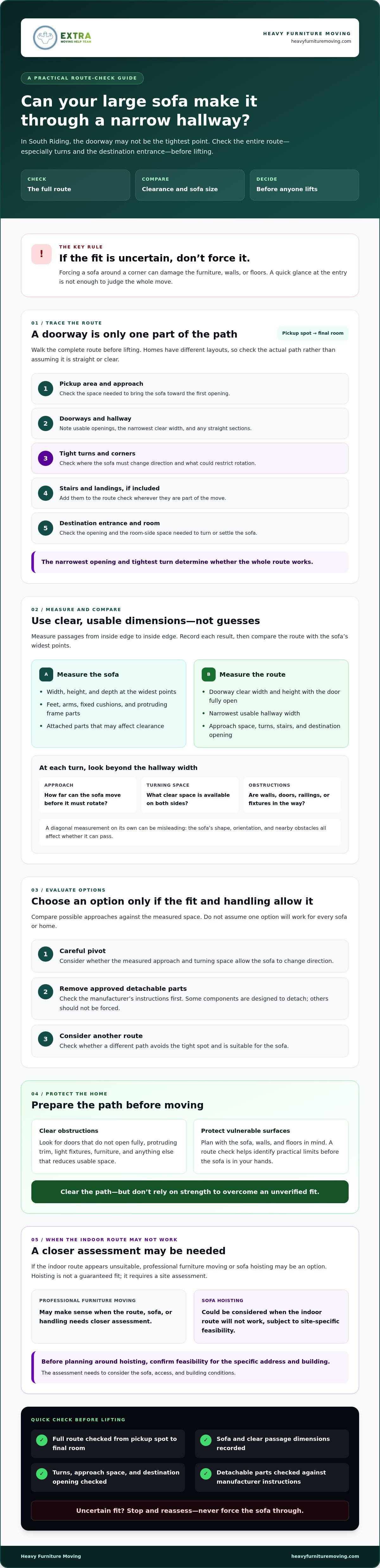
Before you lift, measure the sofa and the entire route, including hallways, corners, stairs, and the final room entrance. Then compare the space with the sofa’s dimensions to see whether a careful pivot, an approved detachable part, or another route might work. If the fit is uncertain, don’t force it.
This guide explains which dimensions to check, how to assess turning space, and how to protect your home as you plan. You’ll also learn when professional furniture moving may make sense and when sofa hoisting could be considered because the indoor route won’t work. Hoisting requires a site assessment, so confirm feasibility for your specific address and building before planning around it.
Key Takeaways
- For getting a large sofa through a narrow hallway South Riding, check the full route, including tight turns and the destination opening, before lifting.
- Measure the sofa and each passage from inside edge to inside edge so you can compare clearances instead of relying on listed dimensions.
- Compare a careful pivot, removing approved detachable parts, and trying another route against the space and handling each option requires.
- Clear the path and protect vulnerable surfaces, but don’t rely on strength to overcome an unverified fit.
- If the indoor route appears unsuitable, professional furniture moving or sofa hoisting may be an option after an assessment of the sofa, access, and building conditions.
Getting a Large Sofa Through a Narrow Hallway in South Riding: Start with the Route
A sofa can fit through the front doorway and still get stuck at a hallway corner or the entrance to its destination room. For getting a large sofa through a narrow hallway South Riding, don’t judge the move by one opening. Before lifting, walk the complete route from the sofa’s pickup spot to its final position. Homes have different layouts, so check the actual path rather than assuming it is straight or clear.
Look for anything that reduces usable space or gets in the way, such as doors that don’t open fully, projecting trim, light fixtures, furniture, stairs, and tight corners. Pay particular attention to where the sofa needs to change direction. The geometry of a difficult turn is sometimes described as the moving sofa problem, but a real home also has obstacles and surfaces to protect. Checking the route first helps you identify practical limits before the sofa is in your hands.
Which hallway measurements matter before moving a sofa?
Measure the narrowest clear hallway width, including the space taken up by protruding trim or fixtures. Record each doorway’s usable width and height with the door fully open. Then check the straight approach to each turn and the open space needed to angle the sofa into its destination room.
Write down the measurements as you go. A doorway measurement alone won’t tell you whether the sofa can turn after passing through it. Include stairs and landings if they’re part of the route, and note every place where the path narrows or changes direction.
What sofa dimensions should you compare with the route?
Measure the sofa’s width, height, and depth at their widest points. Include feet, arms, fixed cushions, and any frame parts that protrude. Compare these dimensions with the measured route, checking both straight passages and the space available to pivot. Don’t assume a listed sofa size accounts for every part that sticks out.
Check the manufacturer’s instructions before removing legs or other attached parts. Some components are designed to detach, while others shouldn’t be forced. Record the sofa’s measurements beside the route measurements so you can evaluate each tight spot before moving day.
- Route: Pickup spot, doorways, hallway, turns, stairs, and destination entrance.
- Obstacles: Trim, fixtures, doors, furniture, and anything else that reduces clearance.
- Sofa: Widest dimensions, including attached or protruding parts.
If a measurement is uncertain, recheck it before lifting. These checks can help you decide whether the route needs a closer assessment before anyone tries to maneuver the sofa through it.
Measure a South Riding Hallway and Check Every Turn Before Lifting
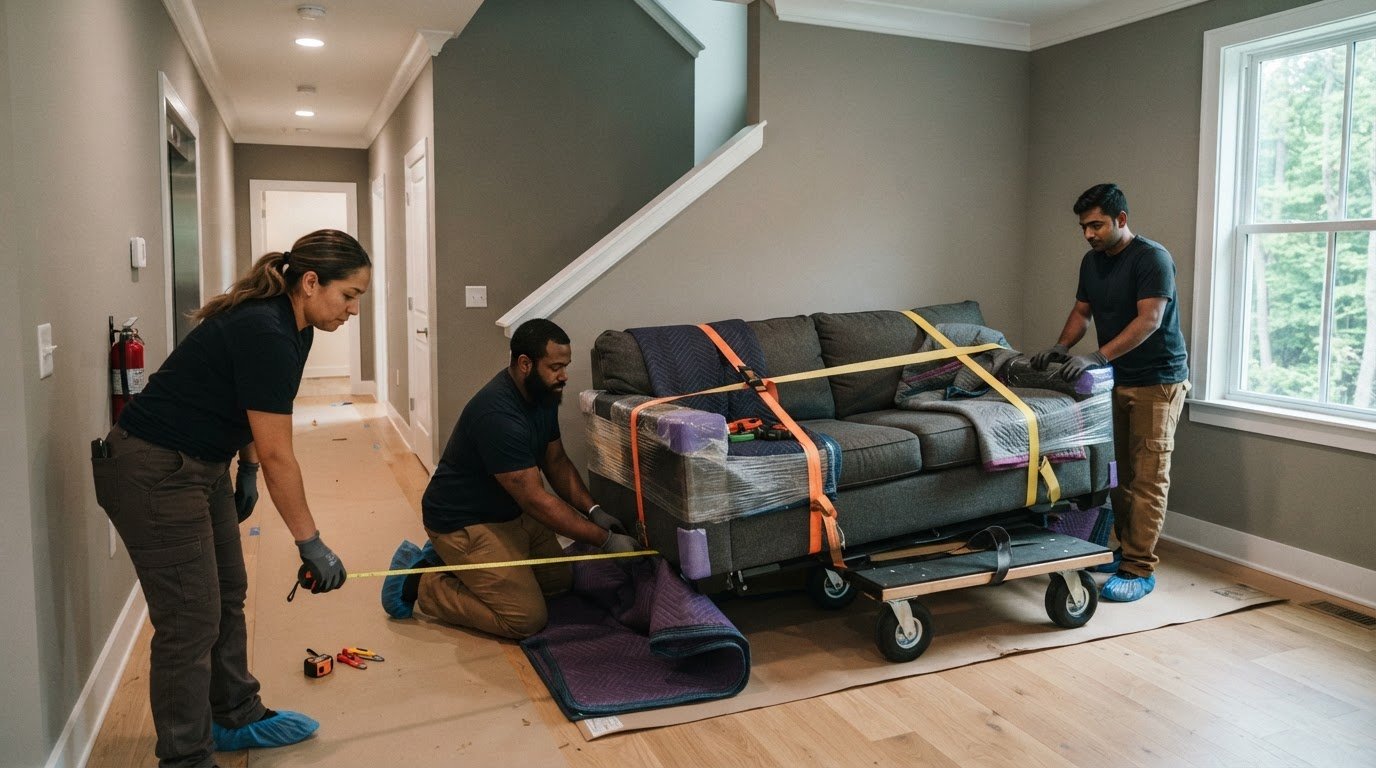
Turn your route check into a simple fit test. Measure clear, usable space from inside edge to inside edge, not from the outside of the trim or from approximate sofa dimensions. Write down each result, then sketch the route from the entry point to the room. Mark where the sofa must rotate, tilt, or change direction. A sketch can make it easier to spot a problem before anyone starts lifting.
The narrowest opening and tightest turn determine whether the whole route works. A sofa can clear a wide doorway and still be blocked by a short approach, a nearby wall, or limited room to turn.
- 1. Measure the sofa. Record its full width, height, and depth at the widest points, including fixed parts that affect clearance.
- 2. Check each doorway. Measure clear width and height with the door fully open. Include the approach space on both sides.
- 3. Measure the hallway. Note the narrowest usable width and the length of each straight section before a turn.
- 4. Map every corner. Measure the clear space on both sides of the turn and the approach to it. Mark doors, walls, railings, and fixtures that could restrict rotation.
- 5. Check the destination opening. Measure its clear width and height, plus the room-side space where the sofa needs to turn or settle.
How do you measure a hallway corner for a large sofa?
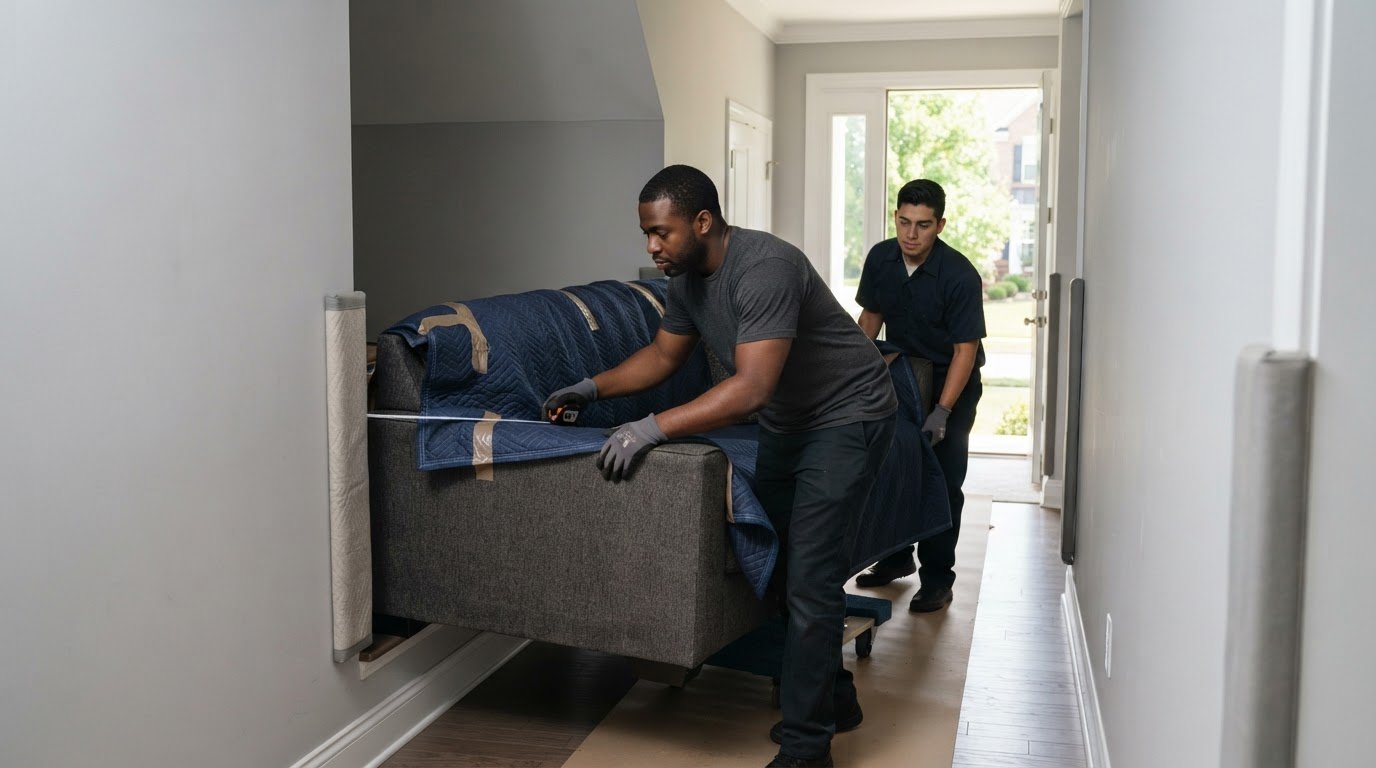
Measure the corner as a working space, not just as two hallway widths. Note how far the sofa can move toward the corner before it must rotate, and what sits directly opposite the turn. A diagonal measurement on its own can be misleading because the sofa’s shape, orientation, and nearby obstacles all affect whether it can pass.
How can you check whether the sofa can rotate into the room?
Compare the sofa’s dimensions with the doorway opening and the space available on the room side. Use your sketch to trace how its longest and widest parts might move through the turn. Consider tilting it only if you can control the movement without scraping walls or ceilings. Review safe lifting guidelines before attempting a heavy lift.
If the measurements leave little clearance or you can’t tell whether the sofa can rotate safely, stop. Don’t test the fit by forcing the furniture into the corner. A professional assessment can help clarify the route and handling options. South Riding residents can ask about professional sofa moving help and confirm whether the specific address and access conditions can be assessed.
Compare Sofa-Moving Options for a Tight South Riding Hallway
Once you’ve checked the measurements, choose the least risky option the route can support. A sofa that looks too wide may pass when turned, but pivoting won’t create space where a corner or room entrance is too tight. For getting a large sofa through a narrow hallway South Riding, treat each plan as conditional, not guaranteed.
- Pivot or angle the sofa: Consider this only if the approach and corner leave enough room to change its orientation without pressing the frame against walls or floors.
- Remove approved detachable parts: Taking off removable legs or sectional connectors may reduce the sofa’s dimensions. Don’t remove structural parts or force components loose.
- Use another route: A different doorway or access point may work if it’s clear and safe to use. Check the full path, including outdoor surfaces and the entrance back inside.
- Get professional help: If the measurements suggest a difficult lift or uncertain turn, professional furniture movers can assess the sofa, route, and handling needs before you attempt it.
When can angling or pivoting help a sofa clear a hallway?
Angling can help when the sofa’s dimensions and the turning space allow it to rotate without binding. Move slowly, with people watching the frame, walls, and floor and communicating before each adjustment. Stop if the sofa catches, shifts unpredictably, or needs force to move. Don’t keep changing angles while people are carrying the full weight.
When should you remove sofa parts or choose another route?
Check the manufacturer’s instructions before detaching legs or sectional connectors. Removable accessories aren’t the same as structural pieces, and removing a door may not solve a tight hallway turn or blocked destination entrance. Consider another exit only after checking its clearance, access, and outdoor conditions. If the alternative also requires force or awkward handling, rule it out.
If no option looks safe after you compare the measurements, pause instead of risking damage or injury. Heavy Furniture Moving serves South Riding and offers professional sofa moving. Sofa hoisting may also be considered when indoor access won’t work, subject to a site assessment. Ask about local moving help and confirm whether the service is feasible for your specific address and building.
Avoid Sofa, Wall, and Injury Damage During a South Riding Move
A strong lift can’t make an unverified route safe. More muscle won’t create clearance at a tight corner, and pushing harder can scrape the sofa, mark a wall, or leave someone carrying an unstable load. Use your measurements to decide whether a move is manageable. If the sofa doesn’t have a clear path, pause before lifting.
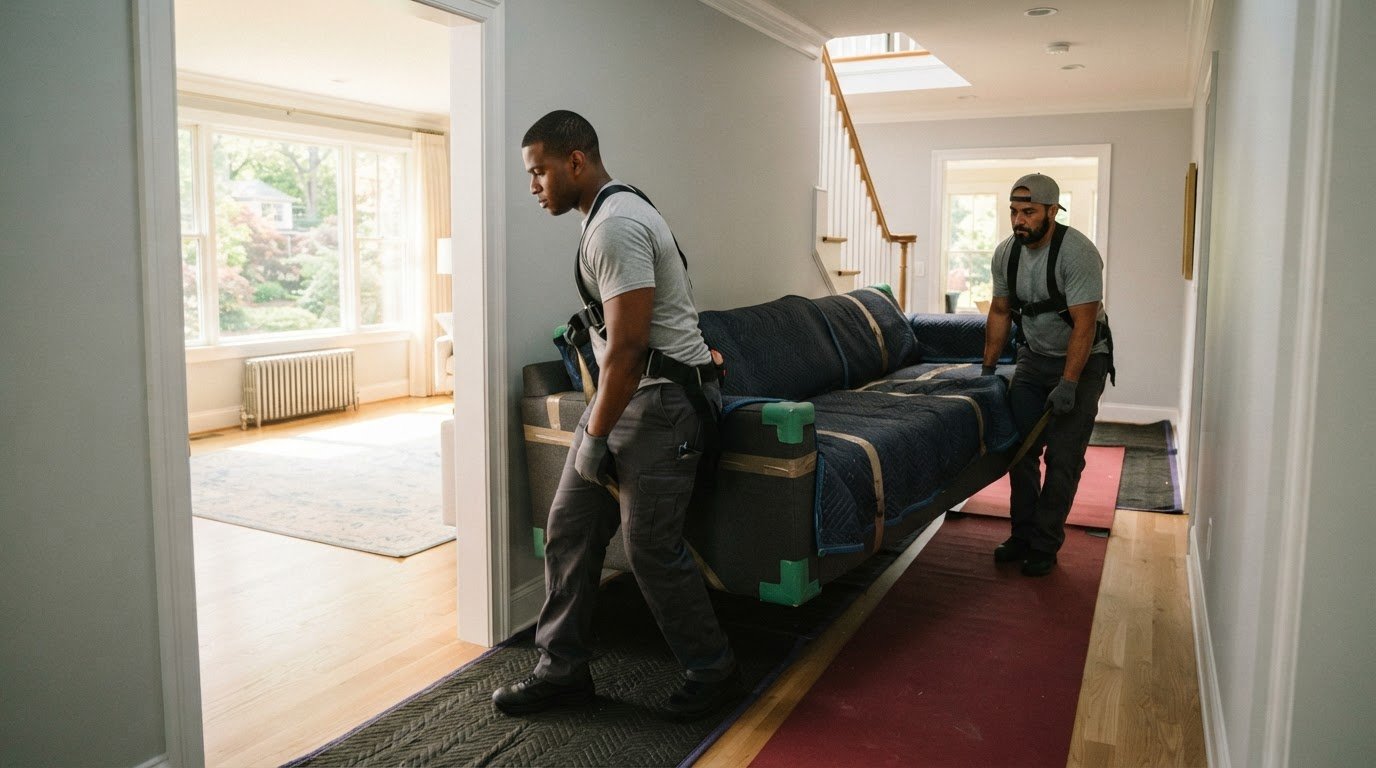
Before moving anything, clear the route from end to end. Move small furniture and loose items out of the way, open doors fully, and secure loose rugs so they can’t bunch underfoot. Protect vulnerable surfaces with suitable furniture blankets and floor coverings. Make sure the protection lies flat and won’t create a trip hazard or slide under the sofa.
What should you protect before moving a sofa through a tight space?
Pay special attention to corners, door trim, stair rails, and finished floors where the sofa may come close during a turn. Assign someone to watch the clearance and give directions while the lifters focus on controlling the sofa. Agree on simple instructions before starting. Don’t pull or push blindly from the other side of a wall or doorway.
When should you stop trying to move the sofa yourself?
Stop if the sofa catches, the load shifts unexpectedly, or the route offers too little room to adjust. Don’t twist your body while carrying a heavy item, and don’t attempt a lift that exceeds your ability. Stairs, sharp turns, delicate finishes, and overhead fixtures can make even a short move harder to control.
Another DIY attempt may seem quicker, but forcing the sofa can increase the chance of damage or injury. Stopping gives you time to reassess the route and consider qualified help. One measurement or one successful pivot doesn’t prove the rest of the path is clear. For getting a large sofa through a narrow hallway South Riding, base your decision on the full route and how safely the sofa can be handled at each obstacle.
If a difficult turn, stairs, or fragile finishes make the move uncertain, ask about professional furniture moving before lifting again. Explore professional sofa moving help and confirm whether your address and access conditions can be assessed.
When South Riding Sofa Hoisting or Professional Moving Help Makes Sense
If your measurements show a tight turn, limited clearance, or a route that may be unsafe to handle, a professional assessment can help you compare options before moving the sofa. Furniture movers can review the sofa’s size and construction, the path through the home, access points, and handling challenges. That gives you a more informed next step than testing a questionable fit with the sofa already in motion.
For getting a large sofa through a narrow hallway South Riding, share clear details upfront. Helpful information includes:
- Sofa width, height, and depth, plus whether it’s a sectional or has detachable parts.
- Photos of the sofa, hallway, turns, stairs, doorways, and destination room.
- Clear hallway and doorway measurements, including the tightest points.
- The floor level and relevant access details, such as a narrow landing or limited approach space.
Ask whether service is available for your specific South Riding address and whether the sofa and property access can be assessed. Share uncertainties too, especially if you’re unsure about a turn or opening. A useful review depends on the actual layout, not a general description of a “narrow hallway.”
Could sofa hoisting work if the hallway route is too tight?
Possibly. Sofa hoisting may offer another way to move furniture when an indoor route won’t work, but it isn’t suitable for every home or building. A professional needs to assess the sofa, a possible window or balcony opening, exterior space, access, and site-specific safety concerns. Don’t assume an opening that looks large enough from inside will make hoisting feasible.
Heavy Furniture Moving offers professional sofa hoisting for furniture that can’t pass through standard entryways or elevators. Feasibility depends on the property and requires a site assessment. Confirm whether the service can be considered for your specific address and building before planning around it.
If the indoor route seems unsuitable, request an assessment from Heavy Furniture Moving before attempting another difficult lift. Share your measurements and photos, and ask about professional sofa moving or hoisting options for your South Riding property. That can help you understand the available choices without forcing the sofa through a route that hasn’t checked out.
Make a Safe Plan for Your Sofa Move
A successful sofa move starts with the whole route, not just the front doorway. Measure the sofa and each passage, check the tightest turn, and compare realistic options before lifting. If the furniture catches, shifts, or needs force, stop rather than risking damage or injury. Pivoting or removing approved parts may help in some layouts, but neither guarantees a fit.
For getting a large sofa through a narrow hallway South Riding, professional help is worth considering when measurements leave you unsure. Heavy Furniture Moving serves South Riding, and sofa hoisting is a listed specialized service that may be considered when indoor access isn’t workable. Feasibility depends on the property and requires an assessment.
Ask Heavy Furniture Moving about sofa-moving help in South Riding, and confirm whether service is available and feasible for your address and building. With a careful plan and the right support, you can choose your next step with confidence.
Frequently Asked Questions
Can you get a large sofa through a narrow hallway?
Getting a large sofa through a narrow hallway South Riding is possible only when the sofa and route have enough clearance at every doorway, corner, and destination opening. Check width, height, and depth against the tightest points, including the space needed to turn. A doorway that clears the sofa straight on may not leave room to rotate it. Don’t lift or force the sofa based on one measurement.
How do you measure a hallway before moving a sofa?
Measure the clear width of the hallway and each doorway from inside edge to inside edge. Check doorway height with the door fully open, and include protruding trim or fixtures that reduce clearance. Measure the sofa at its widest points, then record the approach and turning space at each corner and the destination entrance. Sketch the route and mark stairs or obstacles so you can compare each section before lifting.
Can you turn a sofa sideways to get it around a hallway corner?
Sometimes, if the corner and approach provide enough room for the sofa to change orientation. Compare the sofa’s dimensions with the clear space on both sides of the turn and consider what may block its frame, such as a wall, railing, or open door. Move slowly with people watching for contact. Stop if the sofa binds, shifts unpredictably, or needs force to keep moving.
Should you remove sofa legs to fit it through a narrow hallway?
Remove sofa legs only if the manufacturer’s instructions identify them as detachable and explain how to take them off safely. Check whether removing them changes the sofa’s height enough to matter at the tight point. Don’t force legs, arms, or other structural parts loose, and keep removed hardware together. If the sofa still won’t clear the turn or doorway, reassess the route instead of trying to squeeze it through.
What should you do if a sofa will not fit through the hallway?
Stop and avoid pushing or lifting harder. Recheck the route and sofa measurements, then consider whether an approved detachable part or a genuinely safe alternate entrance changes the fit. Removing a door may help at its opening, but won’t solve a tight corner farther down the hall. If no route appears workable, ask professional furniture movers to assess the sofa and access before attempting another lift.
Can movers hoist a sofa into a South Riding home?
Yes, sofa hoisting may be an option when a sofa cannot pass through standard entryways or elevators, but a site assessment must determine feasibility. The property, opening, exterior access, and safe handling all matter. Heavy Furniture Moving offers sofa hoisting and serves South Riding. Its local coverage also includes Fairfax, Woodbridge, Manassas, Manassas Park, Aldie, Ashburn, McLean, Vienna, Reston, Centreville, Chantilly, Clifton, Dumfries, South Riding, Fairfax Station, Haymarket, and Gainesville.
How many people should move a large sofa through a hallway?
There isn’t one safe number for every sofa or hallway. The people needed depend on the sofa’s size and weight, how it can be gripped, the route, and whether the load can be controlled at turns or stairs. Don’t lift beyond your ability or assume extra hands make a poor fit safe. If the sofa feels unstable or the route is complicated, stop and ask a professional to assess the move.
Frequently Asked Questions
Measure the narrowest clear hallway width, including the space taken up by protruding trim or fixtures. Record each doorway’s usable width and height with the door fully open. Then check the straight approach to each turn and the open space needed to angle the sofa into its destination room. Write down the measurements as you go. A doorway measurement alone won’t tell you whether the sofa can turn after passing through it. Include stairs and landings if they’re part of the route, and note every place where the path narrows or changes direction.
Measure the sofa’s width, height, and depth at their widest points. Include feet, arms, fixed cushions, and any frame parts that protrude. Compare these dimensions with the measured route, checking both straight passages and the space available to pivot. Don’t assume a listed sofa size accounts for every part that sticks out. Check the manufacturer’s instructions before removing legs or other attached parts. Some components are designed to detach, while others shouldn’t be forced. Record the sofa’s measurements beside the route measurements so you can evaluate each tight spot before moving day. If a measurement is uncertain, recheck it before lifting. These checks can help you decide whether the route needs a closer assessment before anyone tries to maneuver the sofa through it. Turn your route check into a simple fit test. Measure clear, usable space from inside edge to inside edge, not from the outside of the trim or from approximate sofa dimensions. Write down each result, then sketch the route from the entry point to the room. Mark where the sofa must rotate, tilt, or change direction. A sketch can make it easier to spot a problem before anyone starts lifting. The narrowest opening and tightest turn determine whether the whole route works. A sofa can clear a wide doorway and still be blocked by a short approach, a nearby wall, or limited room to turn.
Measure the corner as a working space, not just as two hallway widths. Note how far the sofa can move toward the corner before it must rotate, and what sits directly opposite the turn. A diagonal measurement on its own can be misleading because the sofa’s shape, orientation, and nearby obstacles all affect whether it can pass.
Compare the sofa’s dimensions with the doorway opening and the space available on the room side. Use your sketch to trace how its longest and widest parts might move through the turn. Consider tilting it only if you can control the movement without scraping walls or ceilings. Review safe lifting guidelines before attempting a heavy lift. If the measurements leave little clearance or you can’t tell whether the sofa can rotate safely, stop. Don’t test the fit by forcing the furniture into the corner. A professional assessment can help clarify the route and handling options. South Riding residents can ask about professional sofa moving help and confirm whether the specific address and access conditions can be assessed. Once you’ve checked the measurements, choose the least risky option the route can support. A sofa that looks too wide may pass when turned, but pivoting won’t create space where a corner or room entrance is too tight. For getting a large sofa through a narrow hallway South Riding, treat each plan as conditional, not guaranteed.
Angling can help when the sofa’s dimensions and the turning space allow it to rotate without binding. Move slowly, with people watching the frame, walls, and floor and communicating before each adjustment. Stop if the sofa catches, shifts unpredictably, or needs force to move. Don’t keep changing angles while people are carrying the full weight.
Check the manufacturer’s instructions before detaching legs or sectional connectors. Removable accessories aren’t the same as structural pieces, and removing a door may not solve a tight hallway turn or blocked destination entrance. Consider another exit only after checking its clearance, access, and outdoor conditions. If the alternative also requires force or awkward handling, rule it out. If no option looks safe after you compare the measurements, pause instead of risking damage or injury. Heavy Furniture Moving serves South Riding and offers professional sofa moving. Sofa hoisting may also be considered when indoor access won’t work, subject to a site assessment. Ask about local moving help and confirm whether the service is feasible for your specific address and building. A strong lift can’t make an unverified route safe. More muscle won’t create clearance at a tight corner, and pushing harder can scrape the sofa, mark a wall, or leave someone carrying an unstable load. Use your measurements to decide whether a move is manageable. If the sofa doesn’t have a clear path, pause before lifting. Before moving anything, clear the route from end to end. Move small furniture and loose items out of the way, open doors fully, and secure loose rugs so they can’t bunch underfoot. Protect vulnerable surfaces with suitable furniture blankets and floor coverings. Make sure the protection lies flat and won’t create a trip hazard or slide under the sofa.
Pay special attention to corners, door trim, stair rails, and finished floors where the sofa may come close during a turn. Assign someone to watch the clearance and give directions while the lifters focus on controlling the sofa. Agree on simple instructions before starting. Don’t pull or push blindly from the other side of a wall or doorway.
Stop if the sofa catches, the load shifts unexpectedly, or the route offers too little room to adjust. Don’t twist your body while carrying a heavy item, and don’t attempt a lift that exceeds your ability. Stairs, sharp turns, delicate finishes, and overhead fixtures can make even a short move harder to control. Another DIY attempt may seem quicker, but forcing the sofa can increase the chance of damage or injury. Stopping gives you time to reassess the route and consider qualified help. One measurement or one successful pivot doesn’t prove the rest of the path is clear. For getting a large sofa through a narrow hallway South Riding, base your decision on the full route and how safely the sofa can be handled at each obstacle. If a difficult turn, stairs, or fragile finishes make the move uncertain, ask about professional furniture moving before lifting again. Explore professional sofa moving help and confirm whether your address and access conditions can be assessed. If your measurements show a tight turn, limited clearance, or a route that may be unsafe to handle, a professional assessment can help you compare options before moving the sofa. Furniture movers can review the sofa’s size and construction, the path through the home, access points, and handling challenges. That gives you a more informed next step than testing a questionable fit with the sofa already in motion. For getting a large sofa through a narrow hallway South Riding, share clear details upfront. Helpful information includes: Ask whether service is available for your specific South Riding address and whether the sofa and property access can be assessed. Share uncertainties too, especially if you’re unsure about a turn or opening. A useful review depends on the actual layout, not a general description of a “narrow hallway.”
Possibly. Sofa hoisting may offer another way to move furniture when an indoor route won’t work, but it isn’t suitable for every home or building. A professional needs to assess the sofa, a possible window or balcony opening, exterior space, access, and site-specific safety concerns. Don’t assume an opening that looks large enough from inside will make hoisting feasible. Heavy Furniture Moving offers professional sofa hoisting for furniture that can’t pass through standard entryways or elevators. Feasibility depends on the property and requires a site assessment. Confirm whether the service can be considered for your specific address and building before planning around it. If the indoor route seems unsuitable, request an assessment from Heavy Furniture Moving before attempting another difficult lift. Share your measurements and photos, and ask about professional sofa moving or hoisting options for your South Riding property. That can help you understand the available choices without forcing the sofa through a route that hasn’t checked out. A successful sofa move starts with the whole route, not just the front doorway. Measure the sofa and each passage, check the tightest turn, and compare realistic options before lifting. If the furniture catches, shifts, or needs force, stop rather than risking damage or injury. Pivoting or removing approved parts may help in some layouts, but neither guarantees a fit. For getting a large sofa through a narrow hallway South Riding, professional help is worth considering when measurements leave you unsure. Heavy Furniture Moving serves South Riding, and sofa hoisting is a listed specialized service that may be considered when indoor access isn’t workable. Feasibility depends on the property and requires an assessment. Ask Heavy Furniture Moving about sofa-moving help in South Riding, and confirm whether service is available and feasible for your address and building. With a careful plan and the right support, you can choose your next step with confidence.
Getting a large sofa through a narrow hallway South Riding is possible only when the sofa and route have enough clearance at every doorway, corner, and destination opening. Check width, height, and depth against the tightest points, including the space needed to turn. A doorway that clears the sofa straight on may not leave room to rotate it. Don’t lift or force the sofa based on one measurement.
Measure the clear width of the hallway and each doorway from inside edge to inside edge. Check doorway height with the door fully open, and include protruding trim or fixtures that reduce clearance. Measure the sofa at its widest points, then record the approach and turning space at each corner and the destination entrance. Sketch the route and mark stairs or obstacles so you can compare each section before lifting.
Sometimes, if the corner and approach provide enough room for the sofa to change orientation. Compare the sofa’s dimensions with the clear space on both sides of the turn and consider what may block its frame, such as a wall, railing, or open door. Move slowly with people watching for contact. Stop if the sofa binds, shifts unpredictably, or needs force to keep moving.
Remove sofa legs only if the manufacturer’s instructions identify them as detachable and explain how to take them off safely. Check whether removing them changes the sofa’s height enough to matter at the tight point. Don’t force legs, arms, or other structural parts loose, and keep removed hardware together. If the sofa still won’t clear the turn or doorway, reassess the route instead of trying to squeeze it through.
Stop and avoid pushing or lifting harder. Recheck the route and sofa measurements, then consider whether an approved detachable part or a genuinely safe alternate entrance changes the fit. Removing a door may help at its opening, but won’t solve a tight corner farther down the hall. If no route appears workable, ask professional furniture movers to assess the sofa and access before attempting another lift.
Yes, sofa hoisting may be an option when a sofa cannot pass through standard entryways or elevators, but a site assessment must determine feasibility. The property, opening, exterior access, and safe handling all matter. Heavy Furniture Moving offers sofa hoisting and serves South Riding. Its local coverage also includes Fairfax, Woodbridge, Manassas, Manassas Park, Aldie, Ashburn, McLean, Vienna, Reston, Centreville, Chantilly, Clifton, Dumfries, South Riding, Fairfax Station, Haymarket, and Gainesville.
There isn’t one safe number for every sofa or hallway. The people needed depend on the sofa’s size and weight, how it can be gripped, the route, and whether the load can be controlled at turns or stairs. Don’t lift beyond your ability or assume extra hands make a poor fit safe. If the sofa feels unstable or the route is complicated, stop and ask a professional to assess the move.