
Dismantling a Home Gym for Moving in Aldie: A Guide

Taking apart more of your home gym does not always make moving it safer. A treadmill may need only a few parts removed, while a cable machine or rack may require careful disassembly. This guide to dismantling a home gym for moving Aldie residents can use starts with one rule: remove only what the equipment’s instructions call for or what is needed for safe access and handling. Guessing can leave you with unidentified parts or a harder reassembly.
You’ll learn which equipment may move intact, what to check before carrying or loading it, and how to keep bolts, cables, adjustment pieces, and instructions together. Labeling parts and measuring the route out of your home can help you plan the move and protect both the equipment and your space.
For heavy, awkward, or complex machines, professional exercise-equipment moving in Aldie is another option. When asking about help, describe the equipment and access route, then confirm which tasks are available for your specific move. A clear plan helps you keep parts organized and avoid taking on a lift you cannot control.
Key Takeaways
- Not every machine needs full disassembly. Use the manufacturer’s guidance to decide which parts to remove for handling and access.
- For dismantling a home gym for moving Aldie residents should label removed parts and store hardware and instructions with the equipment.
- Disconnect power according to the manual and protect cables, electronics, and nearby surfaces. Don’t force or cut components unless the instructions direct you to.
- Compare DIY, general moving labor, and specialized exercise-equipment moving based on the machine’s complexity, route, and lifting demands.
- Measure the equipment and moving route, then confirm the service scope and access details before arranging help in Aldie.
Identify What to Dismantle for Your Aldie Move
Large gym equipment can be awkward to maneuver through a doorway or hallway, but that does not mean every machine needs to come apart. Dismantling means removing selected components to make access, handling, or transport more manageable. The right preparation depends on the equipment’s design, your route, and the manufacturer’s instructions.
Model-specific instructions matter because parts that look removable may support the machine, carry wiring, or connect to its resistance system. Before dismantling a home gym for moving Aldie residents should check the manual for the exact make and model. Do not assume that a procedure for a different machine applies to yours.
Which home gym equipment may need partial disassembly?
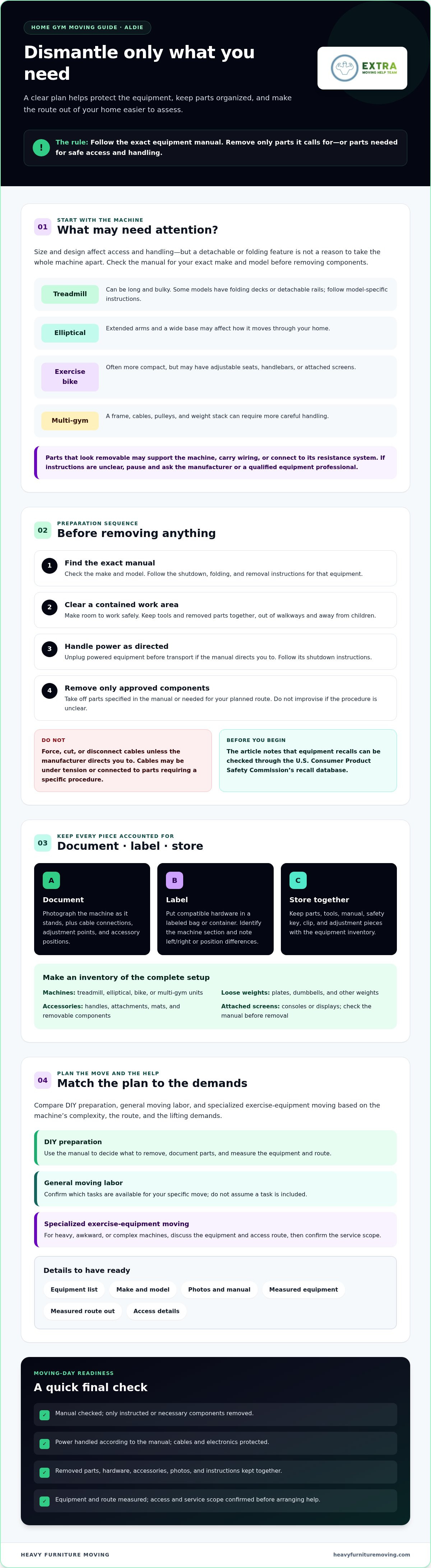
Treadmills can be long and bulky, while some models have folding decks or detachable rails. Ellipticals often have extended arms and a wide base. Exercise bikes are usually more compact, but may have adjustable seats, handlebars, or attached screens. Multi-gym systems can include a frame, cables, pulleys, and a weight stack, so their parts may need more careful handling. For a broader overview of types of exercise equipment, consider each piece in your setup before planning the move.
A folding or detachable feature is not an instruction to take the whole machine apart. Check the manual before removing consoles, rails, arms, or weight-stack components. If it does not give clear guidance, pause and ask the manufacturer or a qualified equipment professional before disconnecting parts.
What to record before taking anything apart
Photograph the machine as it stands, then take close-ups of cable connections, adjustment points, and accessory positions. These visual notes can help you identify where parts belong during setup. Write down the manufacturer and model, and keep the manual or relevant support instructions with your moving paperwork.
Use a simple inventory to account for the complete setup:
- Machines: List each treadmill, elliptical, bike, or multi-gym unit.
- Loose weights: Record plates, dumbbells, and other weights separately from the frame.
- Accessories: Note handles, attachments, mats, and removable components.
- Attached screens: Record consoles or displays and check the manual before removing them.
Keep the inventory with your photos and instructions. If you’re asking for exercise-equipment moving help in Aldie, share the equipment list and describe the route out of your home. Those details help the moving team discuss handling needs and confirm what preparation is within scope.
How to Dismantle Home Gym Equipment Safely: Manuals, Parts, and Protection
Use a consistent sequence before removing anything: consult the manufacturer’s manual, clear the work area, disconnect power as instructed, and label each approved removal. When dismantling a home gym for moving Aldie, rushing or guessing can leave you with loose parts you cannot identify or a machine that is harder to reassemble.
A careful order for preparing gym machines
Start with the manual for your exact model. Follow its shutdown and folding instructions, and unplug powered equipment before preparing it for transport if the manual directs you to. Clear space around the machine so you can work without tripping over tools or parts. Remove only components the manual specifies or that must come off for your planned route. If instructions are unclear, stop and seek guidance instead of improvising.
Do not cut, force, or disconnect cables unless the manufacturer directs you to. Cables may be under tension or connected to parts that require a specific procedure. Before starting, you can also check for equipment recalls through the U.S. Consumer Product Safety Commission’s recall database.
How to keep cables, bolts, and accessories organized
Take photos of cable routing and connections before any manufacturer-approved disconnection. As you remove parts, place compatible hardware in a labeled bag or container for that component. Keep small pieces out of walkways and away from children, and store tools and removed parts together in a clear, contained work area.
Keep every removed piece of hardware identified with the component it came from. Label bags with the machine section, such as “console” or “left rail,” and note if parts differ by side or position. Keep the manual, safety key, clip, and adjustment pieces with the equipment inventory so they do not get separated during the move.
Protect screens and exposed parts
Use soft padding around screens and consoles, and secure it so it will not shift during handling. Protect exposed edges and moving parts with suitable padding, taking care not to press on delicate controls or trap cables in a fold. Keep accessories together, but do not attach loose items to the frame in a way that could scratch surfaces or stress connections. Padding can help reduce handling risks, but it cannot guarantee against damage.
If a machine is heavy, awkward, or difficult to prepare safely, consider professional exercise-equipment moving help. Heavy Furniture Moving offers exercise-equipment moving in Aldie. Describe your equipment and access route, then confirm whether disassembly or reassembly is available for your specific machine. You can learn more about exercise-equipment moving help.
DIY Dismantling or Professional Gym Movers in Aldie: Compare the Risks and Scope
Having the right tools does not make a heavy or complex machine safe to move alone. Choose an approach based on the equipment, the route out of your home, and who will handle lifting and transport. Treat dismantling and moving as separate tasks, then confirm exactly what any hired help will cover.
| Option | Preparation control | Lifting demands | Equipment complexity and scope |
|---|---|---|---|
| DIY | You control the pace and preparation. | You’re responsible for lifting and maneuvering each piece. | Consider this for equipment with clear instructions and manageable components. Plan for both preparation and transport. |
| General moving labor | You may prepare the equipment and explain what is ready to move. | Describe the machine and access route, then confirm what lifting help is included. | Check whether the agreed work covers moving only or includes any preparation tasks. |
| Specialized exercise-equipment moving | Discuss the machine and preparation needs before arranging service. | Ask how the specific lifting and route requirements will be handled. | Consider it for complex or awkward machines. Confirm whether disassembly, transport, and reassembly are available for your equipment. |
When DIY preparation may be reasonable
DIY may suit a machine with clear manufacturer instructions, manageable components, and a straightforward route out of the home. Check doorways, stairs, and tight turns before moving day. Think through how you will control the equipment along the entire route, not just whether it fits. Follow the manual’s handling guidance, and do not rely on tools alone to make a difficult lift safe.
Stop if a part is stuck, unusually heavy, or not clearly covered in the instructions. Do not force a connection or continue with a load you cannot control.
When to ask a moving team about the equipment
Ask about moving help for heavy frames, weight stacks, narrow routes, or several machines. Heavy Furniture Moving offers exercise-equipment moving in Aldie. Share the equipment details and access route, then confirm whether lifting, transport, disassembly, or reassembly is available for your specific job.
Moving equipment for continued use is different from disposing of it. If you want to keep the machine, say so when discussing the job and confirm that the planned service is for transport rather than disposal.
Prepare Your Aldie Home Gym for Moving Day With a Practical Checklist
A smooth move starts with clear records and a route checked in advance. For dismantling a home gym for moving Aldie, prepare details that help you plan the lift, protect loose parts, and identify tight access points before moving day.
Check the route from the gym to the moving vehicle
Measure each machine in its intended moving configuration, including any parts that will remain attached. Then check doorways, hallways, stairs, landings, and turns along the route. Note any spots where a bulky frame may need extra room to turn, as well as the distance from the gym to the pickup location. Clear walkways and consider how to protect nearby floors and walls. No covering method can guarantee against marks or damage, so move carefully.
Moving-day preparation checklist
- Equipment inventory: List each machine, loose weights, and accessories.
- Manual and model details: Keep the manufacturer’s instructions handy and record make and model information when available.
- Photos: Save pictures of each machine and any parts or connections that may help with later setup.
- Parts bags: Keep removed hardware and accessories labeled and connected to the relevant equipment in your inventory.
- Power: Disconnect powered equipment according to its manual before handling it.
- Access notes: Record stairs, narrow turns, door clearances, and the path to the moving vehicle.
Share useful details when arranging help in Aldie
If you’re contacting a moving team, share your address, equipment list, make and model details, access conditions, and useful photos. Explain which parts are already removed and which remain attached. This gives the team a clearer picture of the job, but confirm service availability for your address and whether lifting, transport, disassembly, or reassembly is included. Do not assume a preparation task is part of the service without checking.
Think of moving day in three stages: prepare by checking the inventory, route, and agreed scope; load the equipment and its labeled parts according to a clear plan; then reassemble at the destination by following the manufacturer’s instructions. If the equipment is heavy or the route is difficult, ask about exercise-equipment moving help and share your access details when you inquire.
Get Home Gym Moving Help in Aldie and Confirm the Next Steps
Choose help based on the machine and the route, not just the number of parts you have removed. Follow the manufacturer’s instructions, keep hardware traceable, and be clear about what you need a moving team to do. Heavy Furniture Moving offers exercise-equipment moving in Aldie, but the tasks available for your equipment need to be confirmed directly.
Questions to ask before booking gym equipment movers
Share enough detail for the moving company to discuss your specific equipment and site. Ask whether the team handles that type of machine and whether its size, component weight, and access route can be accommodated. Clarify each part of the job separately:
- Does the requested service include lifting and transport?
- Can the team handle disassembly, reassembly, both, or neither for this model?
- Are there site-specific access requirements for your Aldie address?
- What availability and scheduling options can be confirmed?
Share practical details such as stairs, narrow doorways, turns, and parking near the pickup location. These can affect how equipment is moved, so do not leave them until moving day. Confirm any questions about scope or access with the company before making plans.
Make the move easier with the right information
Have equipment photos, make and model details, and the manufacturer’s manual ready. Explain which components are still attached, what you have already removed, and where labeled hardware and accessories are stored. Clear information helps the company understand the job and tell you what it can handle. For broader relocation planning, consult a guide to reliable movers in Northern Virginia.
Request help for heavy or awkward equipment
If a machine feels too heavy to control, includes a complex frame or weight stack, or must pass through a difficult route, professional help is an option. You do not have to dismantle everything yourself before asking about transport. For dismantling a home gym for moving Aldie, describe the equipment and access conditions, then verify whether the requested preparation and moving tasks are available for your particular job.
Have a heavy or awkward machine to move? Contact Heavy Furniture Moving to discuss exercise-equipment moving in Aldie and confirm the next steps for your equipment and address.
Move Your Home Gym With a Clear Plan
The safest approach to dismantling a home gym for moving Aldie is to follow the instructions for your specific model, keep removed parts identifiable, and choose help that fits the equipment and access route. Not every machine needs to come apart, and complex or heavy pieces may be better handled with professional support.
Heavy Furniture Moving offers exercise-equipment moving in Aldie and focuses on heavy and bulky household items. Before arranging help, describe your equipment and route, then confirm availability and whether disassembly, transport, or reassembly is included for your specific move.
Have a machine that feels too awkward or heavy to manage comfortably? Ask Heavy Furniture Moving about exercise-equipment moving in Aldie and discuss the next steps.
Frequently Asked Questions
Does every home gym machine need to be dismantled before moving?
No. Many machines can move with only selected parts removed, and some may not need dismantling at all. Check the manual for your exact model and compare its moving instructions with the route out of your home. A folding feature does not automatically mean the machine should be taken apart. Remove only what the manufacturer directs or what is needed for access and handling.
How do I keep home gym bolts and cables from getting lost during a move?
Keep each removed part traceable to its original location. Put compatible bolts and small hardware in a bag labeled with the machine section, then store it with the equipment rather than loose in a general moving box. Photograph cable connections before any manual-approved disconnection. Keep accessories, keys, safety clips, and adjustment pieces together with the manual and equipment inventory.
Can I move a treadmill without taking it apart?
Possibly, but it depends on the treadmill’s design, the manufacturer’s instructions, and the access route. Some models have folding decks or removable components, while others may need different preparation. Check the manual before removing rails or a console. Measure the treadmill in its intended moving configuration and check doorways, halls, stairs, and turns before deciding whether it can pass safely.
Should I dismantle a weight machine before moving it?
Do not dismantle a weight machine by guesswork. Multi-gym systems can have frames, cables, pulleys, and weight stacks, so removing the wrong part may complicate handling or reassembly. Follow the instructions for the specific make and model. If the manual is unclear, or a part feels stuck or unusually heavy, stop and get guidance before proceeding. Keep any approved removed hardware labeled by component.
What information should I give gym equipment movers in Aldie?
Share your Aldie address, equipment list, make and model details if available, and photos of the machines. Describe stairs, narrow doorways, turns, parking, and the distance to the pickup point. Tell the moving company which parts remain attached and where labeled hardware is stored. Heavy Furniture Moving’s stated service area also includes Fairfax, Woodbridge, Manassas, Manassas Park, Aldie, Ashburn, McLean, Vienna, Reston, Centreville, Chantilly, Clifton, Dumfries, South Riding, Fairfax Station, Haymarket, and Gainesville.
Is gym equipment moving the same as junk removal?
No. Moving gym equipment means transporting it for continued use, while junk removal concerns getting rid of unwanted items. Be clear about your goal when asking for help so the service matches your needs. Heavy Furniture Moving offers exercise-equipment moving. If you want to keep your machine, ask specifically about moving it and confirm what the service covers for your equipment and address.
When should I hire professional movers for a home gym?
Consider professional help if a machine is heavy, awkward, complex, or difficult to maneuver through stairs, tight turns, or narrow access. Tools alone do not make an uncomfortable lift safe. Before arranging help, describe the machine and route, then confirm availability and whether lifting, transport, disassembly, or reassembly is included for your specific move.
Frequently Asked Questions
Treadmills can be long and bulky, while some models have folding decks or detachable rails. Ellipticals often have extended arms and a wide base. Exercise bikes are usually more compact, but may have adjustable seats, handlebars, or attached screens. Multi-gym systems can include a frame, cables, pulleys, and a weight stack, so their parts may need more careful handling. For a broader overview of types of exercise equipment, consider each piece in your setup before planning the move. A folding or detachable feature is not an instruction to take the whole machine apart. Check the manual before removing consoles, rails, arms, or weight-stack components. If it does not give clear guidance, pause and ask the manufacturer or a qualified equipment professional before disconnecting parts.
No. Many machines can move with only selected parts removed, and some may not need dismantling at all. Check the manual for your exact model and compare its moving instructions with the route out of your home. A folding feature does not automatically mean the machine should be taken apart. Remove only what the manufacturer directs or what is needed for access and handling.
Keep each removed part traceable to its original location. Put compatible bolts and small hardware in a bag labeled with the machine section, then store it with the equipment rather than loose in a general moving box. Photograph cable connections before any manual-approved disconnection. Keep accessories, keys, safety clips, and adjustment pieces together with the manual and equipment inventory.
Possibly, but it depends on the treadmill’s design, the manufacturer’s instructions, and the access route. Some models have folding decks or removable components, while others may need different preparation. Check the manual before removing rails or a console. Measure the treadmill in its intended moving configuration and check doorways, halls, stairs, and turns before deciding whether it can pass safely.
Do not dismantle a weight machine by guesswork. Multi-gym systems can have frames, cables, pulleys, and weight stacks, so removing the wrong part may complicate handling or reassembly. Follow the instructions for the specific make and model. If the manual is unclear, or a part feels stuck or unusually heavy, stop and get guidance before proceeding. Keep any approved removed hardware labeled by component.
Share your Aldie address, equipment list, make and model details if available, and photos of the machines. Describe stairs, narrow doorways, turns, parking, and the distance to the pickup point. Tell the moving company which parts remain attached and where labeled hardware is stored. Heavy Furniture Moving’s stated service area also includes Fairfax, Woodbridge, Manassas, Manassas Park, Aldie, Ashburn, McLean, Vienna, Reston, Centreville, Chantilly, Clifton, Dumfries, South Riding, Fairfax Station, Haymarket, and Gainesville.
No. Moving gym equipment means transporting it for continued use, while junk removal concerns getting rid of unwanted items. Be clear about your goal when asking for help so the service matches your needs. Heavy Furniture Moving offers exercise-equipment moving. If you want to keep your machine, ask specifically about moving it and confirm what the service covers for your equipment and address.
Consider professional help if a machine is heavy, awkward, complex, or difficult to maneuver through stairs, tight turns, or narrow access. Tools alone do not make an uncomfortable lift safe. Heavy Furniture Moving offers exercise-equipment moving in Aldie. Before arranging help, describe the machine and route, then confirm availability and whether lifting, transport, disassembly, or reassembly is included for your specific move.


