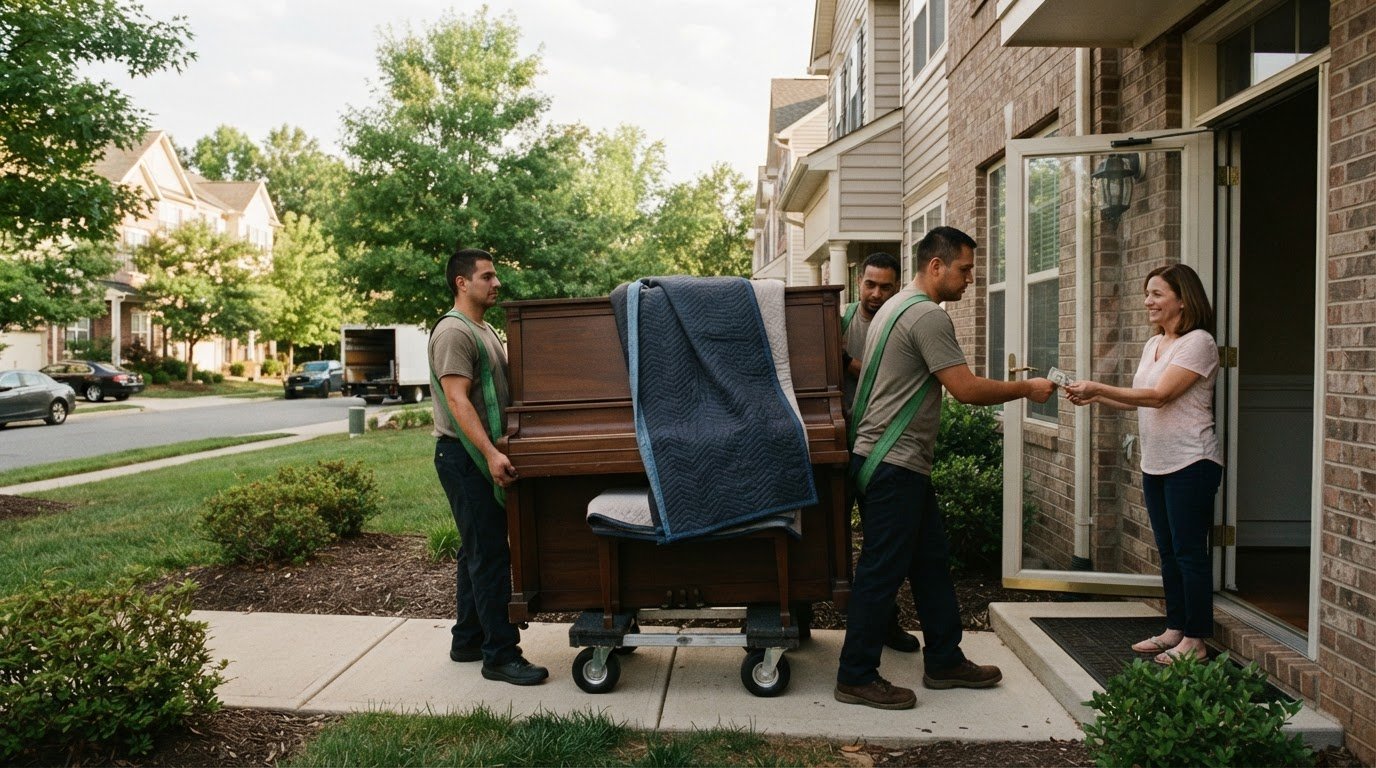
Best Way to Move a Piano on Carpet in Woodbridge, VA
Moving a piano across carpet isn’t a test of strength. It’s a route-and-equipment problem, and the wrong setup can make the piano tip or the carpet bunch beneath it. If you’re looking for the best way to move a piano on carpet Woodbridge, treat the carpet as an obstacle to plan for, not just another floor.
Furniture sliders or a dolly may seem like an easy fix, but carpet adds resistance. A heavy, awkward piano can shift suddenly if equipment catches or the people guiding it lose control. A safer plan depends on the piano type, the full route, and equipment suited to both the instrument and the floor.
This guide explains how carpet affects a piano move, when sliders or a dolly may be appropriate, and what to prepare beforehand. You’ll also learn when the piano’s weight, stairs, or route make a DIY move too risky. For Woodbridge residents, specialized piano handling can make sense when careful planning and suitable equipment matter more than muscle alone.
Key Takeaways
- The best way to move a piano on carpet Woodbridge depends on a clear route, suitable equipment, and controlled movement, not strength alone.
- Learn why piano-specific dollies and ordinary furniture sliders aren’t interchangeable on carpet.
- Compare DIY moves on simple, level routes with moves involving stairs, tight turns, thresholds, or narrow halls.
- Use a pre-move checklist to plan the destination, inspect the route, clear obstacles, and measure doorways and turns.
- See when carpet, access challenges, or uncertainty about control make specialized piano handling from Heavy Furniture Moving a sensible option in Woodbridge.
Why moving a piano across carpet in Woodbridge takes more than muscle
The best way to move a piano on carpet Woodbridge homeowners can rely on starts with a plan, not a push. Map the route from the piano’s current position to its destination. Note tight turns, changes in floor level, and the space needed to maneuver through each doorway. Choose equipment suited to both the instrument and the carpet, and make sure helpers can communicate and stop if the load shifts or equipment catches.
Carpet changes how equipment travels. Its pile adds drag, while a seam, rug edge, or compressed area can snag a wheel or slider. Sudden resistance can throw off balance or make a piano harder to steer. Pulling harder isn’t a solution: equipment may lurch, the piano may shift, or a helper may lose footing. Pause and reassess if the piano doesn’t move smoothly.
Piano weight and carpet resistance both affect control. The heavier the load, the more important a clear route and suitable equipment become.
A piano also differs from a couch or cabinet. Its weight is concentrated in a large, awkward shape, and its legs or other supporting parts can be vulnerable to uneven force. A sudden bump may mark the case or affect internal components. Piano styles have different shapes and construction, as outlined in this guide to types of pianos and their construction. The handling plan should account for the specific instrument rather than assume one approach fits every move.
What makes a piano harder to move on carpet?
Carpet can hide small transitions that are easy to spot on a hard floor. A doorway threshold, seam, or uneven join may catch equipment or change how it rolls. The piano type, room layout, and direction of each turn all affect the route. A short move across an open room is different from steering around furniture and through a narrow doorway. Inspect the entire path, including the space where the piano will end up.
Which damage risks should Woodbridge homeowners consider?
Dragging or poorly supported equipment may pull carpet fibers, crush the pile, or leave scuffs and pressure marks. Contact with a wall or doorway can scratch the piano’s case. If the piano tips or takes a hard impact, internal components may be affected even when visible damage seems minor. These are risks to prevent, not outcomes to assume.
Look for obstacles that could force a sudden adjustment, especially:
- Narrow halls and doorways that limit turning space.
- Steps or changes in floor height along the route.
- Carpet seams, delicate areas, and transitions that equipment could catch.
- Helpers’ positions, so nobody is trapped between the piano and a wall.
If the route leaves little room to steer, or the piano feels difficult to control, stop rather than forcing it forward. A careful assessment helps protect the instrument, the carpet, and the people helping.
How piano-moving equipment handles carpet and protects the route
The right equipment does more than help a piano roll. It supports the instrument in a stable position and helps the people guiding it maintain control across carpet, around corners, and over floor transitions. A piano-specific dolly is made for moving a piano. Household sliders are pads placed under furniture to help it slide. These tools aren’t interchangeable, and neither should be chosen by guesswork.
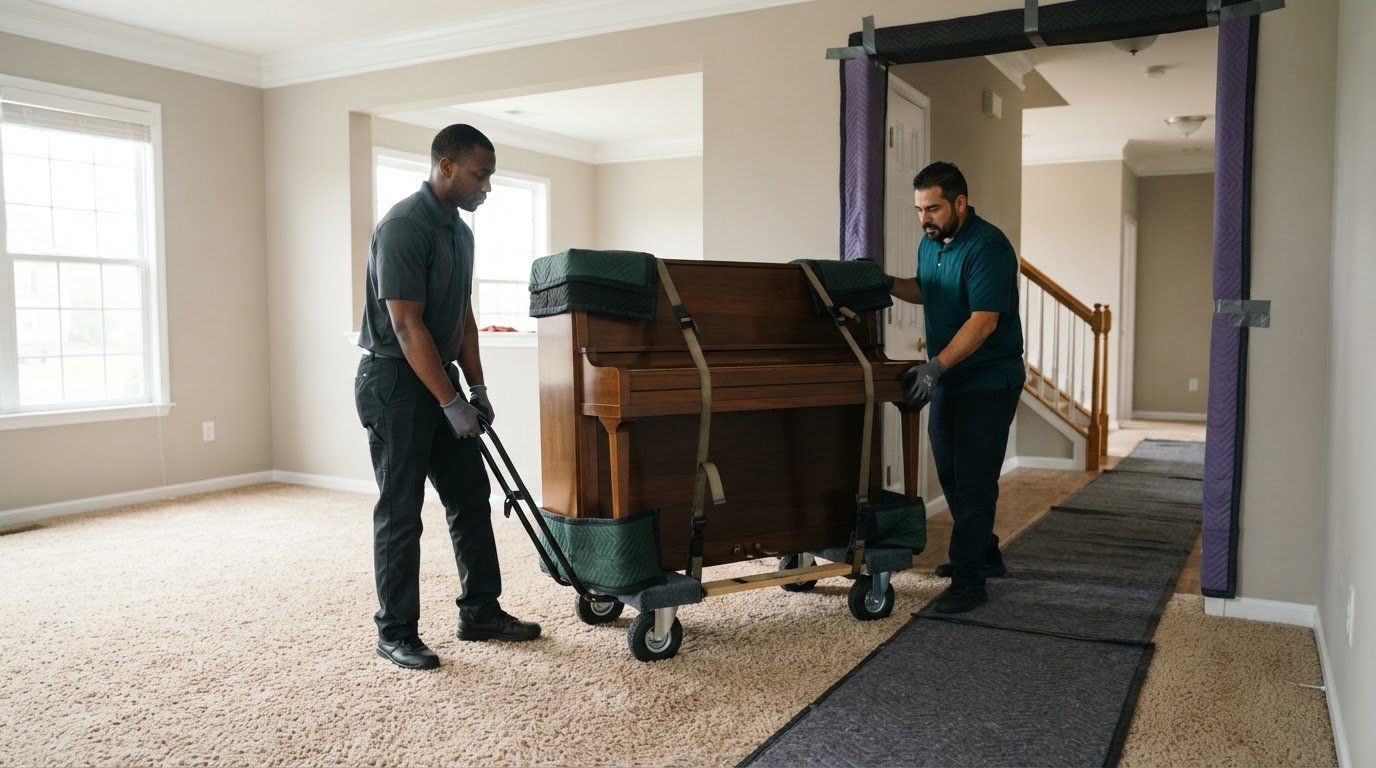
Piano-specific equipment matters on carpet because it helps support and control a heavy, awkward load where ordinary sliders may catch, shift, or fail to stabilize it. A suitable piano dolly can distribute the load across its wheels, while a piano board can support the instrument during a specialized move. The equipment must match the piano and route, and it must be positioned securely before movement begins. Adding force to an unstable setup only increases the chance of a sudden shift.
Dragging a piano or trying to roll it on improvised household items can pull carpet fibers, leave pressure marks, or send the load off course. A protective board or firm route covering may help reduce snags, but only if it lies flat, stays in place, and creates a continuous path. Loose sheets or overlapping material can slide or buckle under weight. OSHA’s guidelines for safe material handling address clear aisles in workplaces. The same practical principle applies at home: remove obstacles before handling a heavy load.
When are sliders or a temporary path appropriate?
Sliders may suit some furniture moves, but common household versions may not support or stabilize every piano. Their suitability depends on the instrument, the surface, and the route. A firm, continuous path can reduce contact with carpet seams if it’s stable and carefully laid. Don’t pull a piano across carpet or rely on loose coverings. If a slider catches or a path shifts, stop and reassess instead of forcing the move.
Why does piano type change the moving method?
An upright has a tall, compact shape, while a grand has a broad body and a different balance. Grand piano legs and other components need specialist handling. Attempting to remove them without the right knowledge can put the instrument and helpers at risk. Don’t assume a dolly setup for an upright will suit a grand. Component removal and specialized equipment for complex moves call for specialist handling.
Before choosing equipment, consider the full route: carpet thickness, seams, turns, thresholds, and the space available to guide the piano. The best way to move a piano on carpet Woodbridge residents can plan for is one that matches the equipment to the instrument and keeps the path clear from start to finish. Heavy Furniture Moving provides piano moving help in Woodbridge.
DIY methods versus professional piano movers on carpet
A short, straight path across level carpet is not the same job as steering a piano around a tight corner or over a threshold. The right choice depends on the piano type, the route, and whether you have suitable equipment and can keep the instrument under control. Adding extra helpers doesn’t automatically make an improvised move safe. Without clear roles and a stable setup, more people can mean conflicting force and less control.
Use this comparison to judge the route before deciding how to move:
| Factor | Carefully planned DIY move | Professional piano movers |
|---|---|---|
| Control | Depends on clear communication, capable helpers, and a load that stays steady. | Specialized handling experience helps guide and manage the piano through the route. |
| Equipment needs | Requires equipment suited to the piano and carpet, not just household sliders or improvised supports. | Uses equipment selected for piano handling and the conditions of the move. |
| Route difficulty | Most suitable for a simple, level path with room to maneuver. | More sensible for stairs, tight turns, thresholds, and narrow halls. |
| Risk considerations | Stop if the piano snags, shifts, or becomes hard to control. | Specialized handling can help reduce avoidable risks to people, the piano, and the home. |
When might a carefully planned DIY move be reasonable?
Consider DIY only if the route is straightforward, level, and clear, and the piano and suitable equipment can remain under control throughout. Before moving, assign helpers clear roles and agree on a simple stop signal. Don’t start if anyone is unsure of their position or task. If the piano shifts, catches on carpet, or can’t be guided steadily, stop. Don’t try to muscle through the problem.
When should you bring in piano-moving professionals?
Stairs, tight turns, delicate carpet, and grand pianos add handling challenges that can make a DIY plan risky. A grand’s shape and components call for specialized care, while a narrow hall may leave little room to correct a shift. Piano movers bring experience with heavy-item handling and suitable equipment. That can help reduce avoidable risks, though no method can promise that damage is impossible.
When choosing the best way to move a piano on carpet Woodbridge homeowners should weigh more than the number of available helpers. Ask whether the full route is simple, the piano type suits the planned method, and the equipment is appropriate. If any answer is no or uncertain, specialized help is the more sensible choice. If the move is straightforward, prepare the path carefully and keep control the priority from the first movement to the final placement.
A step-by-step checklist before moving a piano over carpet
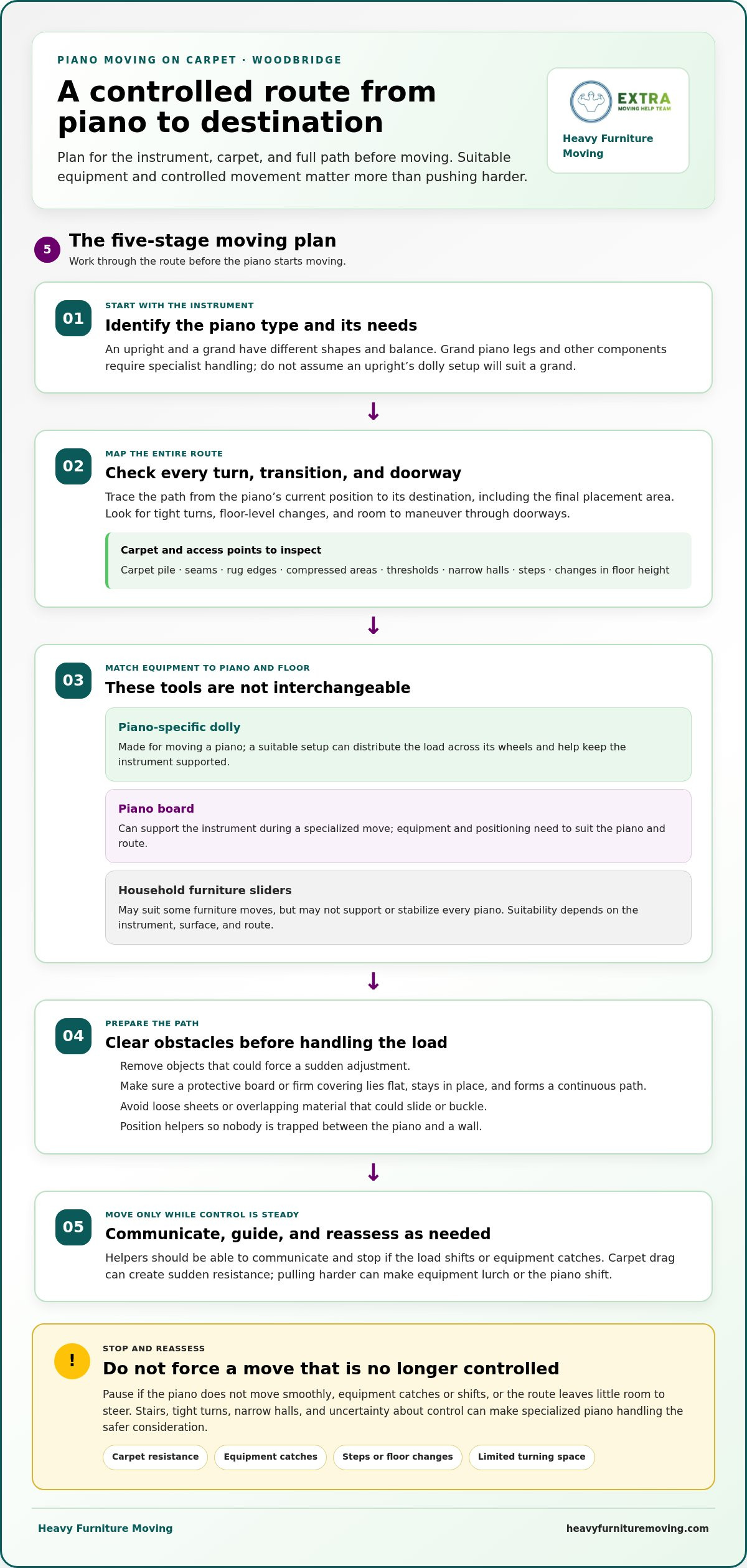
A calm move starts before anyone touches the piano. Walk the route as if you’re guiding the instrument through it, from its current spot to its exact destination. The best way to move a piano on carpet Woodbridge residents can plan for is to find obstacles early, prepare the path, and agree on how helpers will communicate. Use this checklist before moving day, not while the piano is already in motion.
- Choose the destination. Decide where the piano will sit and make sure there’s room to maneuver into place, not just through the doorway.
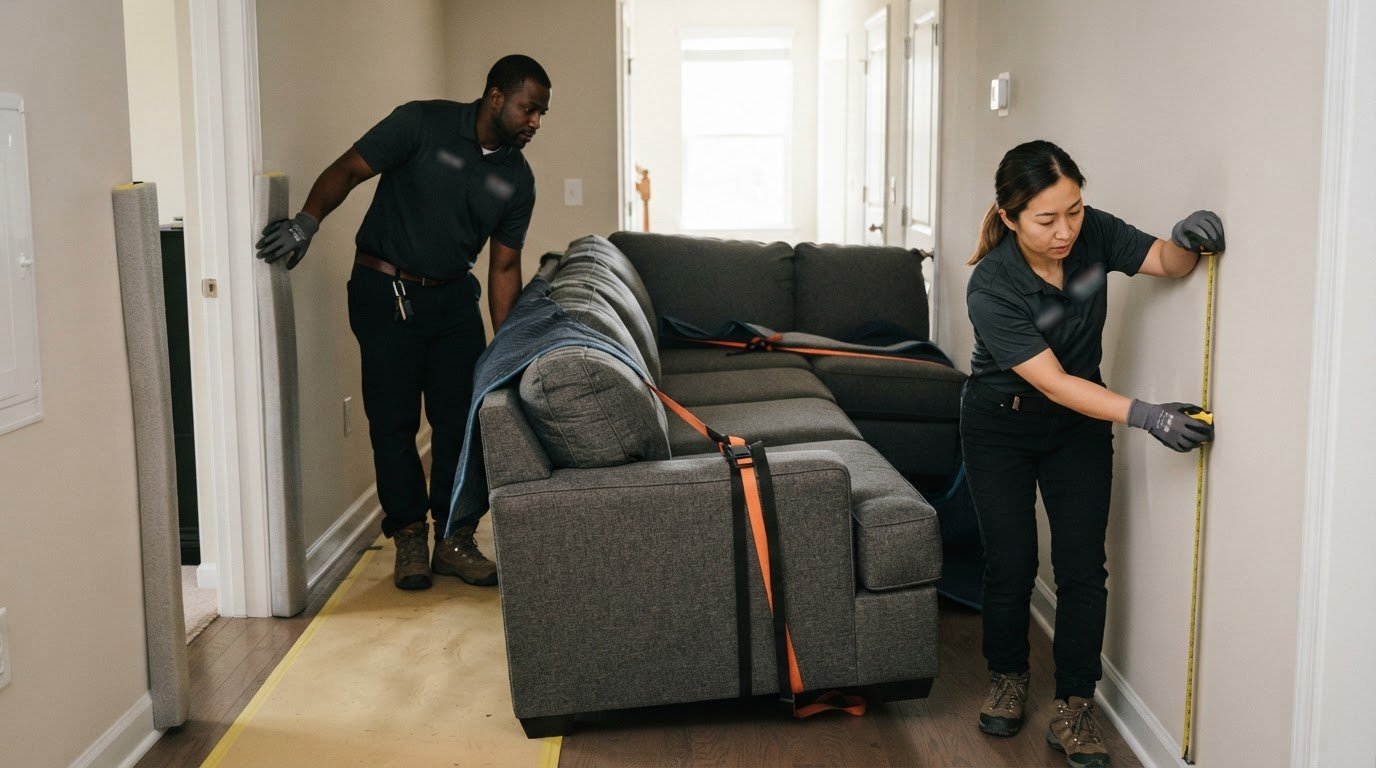
- Measure the route. Measure door openings and tight turns in advance. Account for the piano’s shape and the space needed to guide it, then check thresholds and floor transitions.
- Inspect from end to end. Walk the full route and look for carpet seams, uneven areas, corners, and steps that could interrupt movement.
- Clear the path. Remove rugs, small furniture, cords, and loose objects. Keep children, pets, and unrelated foot traffic away from the work area.
- Protect the surfaces. Choose suitable coverings that sit flat and stay in place under the moving equipment. Don’t rely on loose sheets or materials that can bunch or slide.
- Review the plan. Confirm the equipment and route suit the piano, and agree on who is guiding the move before it begins.
How do you prepare the room and route?
Start at the piano, then follow the planned path all the way to its new position. Check door openings, thresholds, corners, and changes between carpet and other flooring. A doorway may be wide enough for the piano but leave little space for a turn, so measure both the opening and the maneuvering area. Clear the destination too, including anything that could block the final placement.
Lay protective material only if it forms a firm, continuous surface and can’t shift beneath equipment. If it wrinkles, overlaps unevenly, or slides when tested, reset it before moving. Keep the route free of people who aren’t helping. Less foot traffic means fewer distractions and fewer chances for someone to step into the path.
What should helpers agree on before lifting or rolling?
Choose one person to coordinate the move and give clear commands, including a shared word for stopping. Each helper should know their position and responsibility. Confirm everyone can hear the coordinator and will pause immediately when asked. Don’t begin if a helper is unsure, the equipment feels unstable, or the piano can’t be controlled. Stop if it snags, shifts, or raises any doubt about safe movement.
If stairs, narrow turns, delicate carpet, or uncertainty make the plan difficult to control, get experienced help rather than forcing the move. Get help with a difficult piano move in Woodbridge from Heavy Furniture Moving, which provides specialized handling for pianos and other heavy items.
Get professional piano-moving help in Woodbridge when carpet complicates the move
Some piano moves are hard to manage safely without specialized help. Stairs, tight turns, narrow openings, delicate carpet, and uncertainty about controlling the piano all add complications. A route that looks manageable at first may leave too little room to steer or require navigating a threshold with a heavy load. If you’re unsure the piano can stay stable throughout the move, pause and get experienced support rather than forcing it.
Heavy Furniture Moving provides specialized handling for pianos and other heavy items in Woodbridge and nearby Northern Virginia communities. The move should be planned around the instrument and its route, not handled through extra muscle alone. Sharing clear details about the piano and both locations gives the planning process a practical starting point.
What details help plan a piano move?
Describe the piano type, where it’s currently located, and where it needs to go. Explain which parts of the route are carpeted and note access details such as stairs, tight turns, thresholds, and narrow doorways. Measurements of openings and turning space can help show whether the piano has room to pass and maneuver.
Include conditions at both ends of the move, not only the hallway between rooms. For example, mention if the piano sits in a cramped corner, if the destination has limited clearance, or if the route passes over a carpet-to-hard-floor transition. This context helps the team consider access challenges and plan the handling appropriately.
Finding the best way to move a piano on carpet Woodbridge residents can feel comfortable with starts by sharing the details that shape the job. You don’t need to solve the route yourself before asking for help. A clear description is enough to begin a useful conversation about the move.
How can Woodbridge residents take the next step?
It’s reasonable to get help with one heavy item. A piano can be awkward to move even over a short distance, and carpet or access challenges can make careful handling more demanding. Don’t wait until the piano is halfway through a doorway to decide the plan needs to change.
Describe the piano, its starting room and destination, and the route between them. Share any stairs, turns, thresholds, or tight openings, along with concerns about carpet or control. Heavy Furniture Moving provides specialized piano handling in Woodbridge and nearby Northern Virginia communities. Arrange professional piano-moving help and discuss the route before moving day.
Make your piano move easier to plan
Before moving day, picture the piano in its new place. Will it fit without blocking a doorway or crowding the room? Is there enough space to approach it safely for future use? Thinking through these details now can help you avoid last-minute changes once the piano is on the move.
The best way to move a piano on carpet Woodbridge homeowners can choose is the one that fits their instrument, route, and comfort with the work. If any part of the move feels uncertain, you don’t have to manage it alone. Share the piano type, its starting point, destination, and access challenges, then let experienced help guide the next step.
Heavy Furniture Moving is ready to discuss your piano move and help you plan for the route ahead. The company serves Fairfax, Woodbridge, Manassas, Manassas Park, Aldie, Ashburn, Mclean, Vienna, Reston, Centreville, Chantilly, Clifton, Dumfries, South Riding, Fairfax Station, Haymarket, and Gainesville. Arrange professional piano-moving help and move forward with a clear plan.
Frequently Asked Questions
Can you move a piano across carpet without damaging it?
It may be possible, but the risk depends on the piano, carpet, and route. Avoid dragging it or assuming household sliders are suitable. Before moving, check whether carpet edges or transitions could catch the equipment, and make sure the route allows steady movement. Stop if anything snags or shifts. If the path includes stairs or tight turns, professional piano movers can plan the handling to reduce avoidable risks.
What is the best way to move an upright piano on carpet?
Start by checking the upright’s route, doorway clearances, thresholds, and destination. Use equipment suited to the piano’s size and structure, and don’t pull it across the carpet or lift it by vulnerable parts. Any floor covering should remain stable as equipment passes over it. The best way to move a piano on carpet Woodbridge households can plan depends on these details. For stairs or tight turns, get professional help.
Can furniture sliders move a piano on carpet?
Not necessarily. A slider that works under a dresser may not support or stabilize a piano, and carpet can make movement less predictable. Don’t choose equipment based only on past experience moving lighter furniture. Consider the piano’s type, the route, and whether the setup keeps it steady. If it shifts, catches, or feels difficult to control, stop and arrange specialist assistance rather than trying another improvised method.
How do you protect carpet when moving a piano?
Clear the route and use floor protection that lies flat and stays in place under the moving equipment. Loose coverings can wrinkle, slide, or catch, creating a new hazard instead of protecting the carpet. Check areas where carpet meets another floor surface, since equipment can snag at transitions. Avoid dragging the piano. For a heavy move with complicated access, professional movers can plan suitable protection alongside the handling approach.
Is it safe to move a piano with two people?
Two people aren’t automatically enough to move a piano safely. The instrument’s type, route, equipment, and helpers’ ability to maintain control all matter. For example, stairs or a tight turn can make a short move demanding even with another person present. Agree on clear commands before starting, and don’t continue if the piano shifts or anyone loses control. A difficult route calls for professional piano-moving help.
Should you empty or take apart a piano before moving it?
Don’t dismantle piano components unless a qualified specialist directs the work. Generic furniture-disassembly advice may not suit a musical instrument, especially a grand piano with components that need specialized handling. Before the move, clear loose items from around the piano and make the path accessible. Tell the moving team the piano type and route so they can plan for the instrument and any access challenges.
When should I hire piano movers in Woodbridge?
Consider hiring piano movers if your route includes stairs, narrow halls, tight turns, delicate carpet, or a grand piano, or if you’re unsure you can keep the instrument controlled. Heavy Furniture Moving provides specialized handling for pianos and other heavy items in Woodbridge. Share the piano type, starting point, destination, and access details when arranging help. That gives the team useful information to plan the move around your home.
Frequently Asked Questions
Carpet can hide small transitions that are easy to spot on a hard floor. A doorway threshold, seam, or uneven join may catch equipment or change how it rolls. The piano type, room layout, and direction of each turn all affect the route. A short move across an open room is different from steering around furniture and through a narrow doorway. Inspect the entire path, including the space where the piano will end up.
Dragging or poorly supported equipment may pull carpet fibers, crush the pile, or leave scuffs and pressure marks. Contact with a wall or doorway can scratch the piano’s case. If the piano tips or takes a hard impact, internal components may be affected even when visible damage seems minor. These are risks to prevent, not outcomes to assume. Look for obstacles that could force a sudden adjustment, especially: If the route leaves little room to steer, or the piano feels difficult to control, stop rather than forcing it forward. A careful assessment helps protect the instrument, the carpet, and the people helping. The right equipment does more than help a piano roll. It supports the instrument in a stable position and helps the people guiding it maintain control across carpet, around corners, and over floor transitions. A piano-specific dolly is made for moving a piano. Household sliders are pads placed under furniture to help it slide. These tools aren’t interchangeable, and neither should be chosen by guesswork. Piano-specific equipment matters on carpet because it helps support and control a heavy, awkward load where ordinary sliders may catch, shift, or fail to stabilize it. A suitable piano dolly can distribute the load across its wheels, while a piano board can support the instrument during a specialized move. The equipment must match the piano and route, and it must be positioned securely before movement begins. Adding force to an unstable setup only increases the chance of a sudden shift. Dragging a piano or trying to roll it on improvised household items can pull carpet fibers, leave pressure marks, or send the load off course. A protective board or firm route covering may help reduce snags, but only if it lies flat, stays in place, and creates a continuous path. Loose sheets or overlapping material can slide or buckle under weight. OSHA’s guidelines for safe material handling address clear aisles in workplaces. The same practical principle applies at home: remove obstacles before handling a heavy load.
Sliders may suit some furniture moves, but common household versions may not support or stabilize every piano. Their suitability depends on the instrument, the surface, and the route. A firm, continuous path can reduce contact with carpet seams if it’s stable and carefully laid. Don’t pull a piano across carpet or rely on loose coverings. If a slider catches or a path shifts, stop and reassess instead of forcing the move.
An upright has a tall, compact shape, while a grand has a broad body and a different balance. Grand piano legs and other components need specialist handling. Attempting to remove them without the right knowledge can put the instrument and helpers at risk. Don’t assume a dolly setup for an upright will suit a grand. Component removal and specialized equipment for complex moves call for specialist handling. Before choosing equipment, consider the full route: carpet thickness, seams, turns, thresholds, and the space available to guide the piano. The best way to move a piano on carpet Woodbridge residents can plan for is one that matches the equipment to the instrument and keeps the path clear from start to finish. Heavy Furniture Moving provides piano moving help in Woodbridge. A short, straight path across level carpet is not the same job as steering a piano around a tight corner or over a threshold. The right choice depends on the piano type, the route, and whether you have suitable equipment and can keep the instrument under control. Adding extra helpers doesn’t automatically make an improvised move safe. Without clear roles and a stable setup, more people can mean conflicting force and less control. Use this comparison to judge the route before deciding how to move:
Consider DIY only if the route is straightforward, level, and clear, and the piano and suitable equipment can remain under control throughout. Before moving, assign helpers clear roles and agree on a simple stop signal. Don’t start if anyone is unsure of their position or task. If the piano shifts, catches on carpet, or can’t be guided steadily, stop. Don’t try to muscle through the problem.
Stairs, tight turns, delicate carpet, and grand pianos add handling challenges that can make a DIY plan risky. A grand’s shape and components call for specialized care, while a narrow hall may leave little room to correct a shift. Piano movers bring experience with heavy-item handling and suitable equipment. That can help reduce avoidable risks, though no method can promise that damage is impossible. When choosing the best way to move a piano on carpet Woodbridge homeowners should weigh more than the number of available helpers. Ask whether the full route is simple, the piano type suits the planned method, and the equipment is appropriate. If any answer is no or uncertain, specialized help is the more sensible choice. If the move is straightforward, prepare the path carefully and keep control the priority from the first movement to the final placement. A calm move starts before anyone touches the piano. Walk the route as if you’re guiding the instrument through it, from its current spot to its exact destination. The best way to move a piano on carpet Woodbridge residents can plan for is to find obstacles early, prepare the path, and agree on how helpers will communicate. Use this checklist before moving day, not while the piano is already in motion.
Start at the piano, then follow the planned path all the way to its new position. Check door openings, thresholds, corners, and changes between carpet and other flooring. A doorway may be wide enough for the piano but leave little space for a turn, so measure both the opening and the maneuvering area. Clear the destination too, including anything that could block the final placement. Lay protective material only if it forms a firm, continuous surface and can’t shift beneath equipment. If it wrinkles, overlaps unevenly, or slides when tested, reset it before moving. Keep the route free of people who aren’t helping. Less foot traffic means fewer distractions and fewer chances for someone to step into the path.
Choose one person to coordinate the move and give clear commands, including a shared word for stopping. Each helper should know their position and responsibility. Confirm everyone can hear the coordinator and will pause immediately when asked. Don’t begin if a helper is unsure, the equipment feels unstable, or the piano can’t be controlled. Stop if it snags, shifts, or raises any doubt about safe movement. If stairs, narrow turns, delicate carpet, or uncertainty make the plan difficult to control, get experienced help rather than forcing the move. Get help with a difficult piano move in Woodbridge from Heavy Furniture Moving, which provides specialized handling for pianos and other heavy items. Some piano moves are hard to manage safely without specialized help. Stairs, tight turns, narrow openings, delicate carpet, and uncertainty about controlling the piano all add complications. A route that looks manageable at first may leave too little room to steer or require navigating a threshold with a heavy load. If you’re unsure the piano can stay stable throughout the move, pause and get experienced support rather than forcing it. Heavy Furniture Moving provides specialized handling for pianos and other heavy items in Woodbridge and nearby Northern Virginia communities. The move should be planned around the instrument and its route, not handled through extra muscle alone. Sharing clear details about the piano and both locations gives the planning process a practical starting point.
Describe the piano type, where it’s currently located, and where it needs to go. Explain which parts of the route are carpeted and note access details such as stairs, tight turns, thresholds, and narrow doorways. Measurements of openings and turning space can help show whether the piano has room to pass and maneuver. Include conditions at both ends of the move, not only the hallway between rooms. For example, mention if the piano sits in a cramped corner, if the destination has limited clearance, or if the route passes over a carpet-to-hard-floor transition. This context helps the team consider access challenges and plan the handling appropriately. Finding the best way to move a piano on carpet Woodbridge residents can feel comfortable with starts by sharing the details that shape the job. You don’t need to solve the route yourself before asking for help. A clear description is enough to begin a useful conversation about the move.
It’s reasonable to get help with one heavy item. A piano can be awkward to move even over a short distance, and carpet or access challenges can make careful handling more demanding. Don’t wait until the piano is halfway through a doorway to decide the plan needs to change. Describe the piano, its starting room and destination, and the route between them. Share any stairs, turns, thresholds, or tight openings, along with concerns about carpet or control. Heavy Furniture Moving provides specialized piano handling in Woodbridge and nearby Northern Virginia communities. Arrange professional piano-moving help and discuss the route before moving day. Before moving day, picture the piano in its new place. Will it fit without blocking a doorway or crowding the room? Is there enough space to approach it safely for future use? Thinking through these details now can help you avoid last-minute changes once the piano is on the move. The best way to move a piano on carpet Woodbridge homeowners can choose is the one that fits their instrument, route, and comfort with the work. If any part of the move feels uncertain, you don’t have to manage it alone. Share the piano type, its starting point, destination, and access challenges, then let experienced help guide the next step. Heavy Furniture Moving is ready to discuss your piano move and help you plan for the route ahead. The company serves Fairfax, Woodbridge, Manassas, Manassas Park, Aldie, Ashburn, Mclean, Vienna, Reston, Centreville, Chantilly, Clifton, Dumfries, South Riding, Fairfax Station, Haymarket, and Gainesville. Arrange professional piano-moving help and move forward with a clear plan.
It may be possible, but the risk depends on the piano, carpet, and route. Avoid dragging it or assuming household sliders are suitable. Before moving, check whether carpet edges or transitions could catch the equipment, and make sure the route allows steady movement. Stop if anything snags or shifts. If the path includes stairs or tight turns, professional piano movers can plan the handling to reduce avoidable risks.
Start by checking the upright’s route, doorway clearances, thresholds, and destination. Use equipment suited to the piano’s size and structure, and don’t pull it across the carpet or lift it by vulnerable parts. Any floor covering should remain stable as equipment passes over it. The best way to move a piano on carpet Woodbridge households can plan depends on these details. For stairs or tight turns, get professional help.
Not necessarily. A slider that works under a dresser may not support or stabilize a piano, and carpet can make movement less predictable. Don’t choose equipment based only on past experience moving lighter furniture. Consider the piano’s type, the route, and whether the setup keeps it steady. If it shifts, catches, or feels difficult to control, stop and arrange specialist assistance rather than trying another improvised method.
Clear the route and use floor protection that lies flat and stays in place under the moving equipment. Loose coverings can wrinkle, slide, or catch, creating a new hazard instead of protecting the carpet. Check areas where carpet meets another floor surface, since equipment can snag at transitions. Avoid dragging the piano. For a heavy move with complicated access, professional movers can plan suitable protection alongside the handling approach.
Two people aren’t automatically enough to move a piano safely. The instrument’s type, route, equipment, and helpers’ ability to maintain control all matter. For example, stairs or a tight turn can make a short move demanding even with another person present. Agree on clear commands before starting, and don’t continue if the piano shifts or anyone loses control. A difficult route calls for professional piano-moving help.
Don’t dismantle piano components unless a qualified specialist directs the work. Generic furniture-disassembly advice may not suit a musical instrument, especially a grand piano with components that need specialized handling. Before the move, clear loose items from around the piano and make the path accessible. Tell the moving team the piano type and route so they can plan for the instrument and any access challenges.
Consider hiring piano movers if your route includes stairs, narrow halls, tight turns, delicate carpet, or a grand piano, or if you’re unsure you can keep the instrument controlled. Heavy Furniture Moving provides specialized handling for pianos and other heavy items in Woodbridge. Share the piano type, starting point, destination, and access details when arranging help. That gives the team useful information to plan the move around your home.