
You finally unlock the door to your new home, ready to relax, but then you see it. A deep gouge marks your hardwood floor, or your heirloom piano has a fresh crack in the finish. It’s a gut-wrenching moment that turns a fresh start into a logistical nightmare. You might feel powerless against a big moving company, especially when you’re staring down complex contracts and looming deadlines. We understand that frustration because we know how much your belongings matter. Knowing exactly what to do if movers damage your property is the only way to reclaim control and protect your home.
It’s true that the moving industry is one of the most complained-about sectors in the country. You’re right to feel protective of your things and your rights. This guide provides the clear, actionable steps you need to document the damage immediately and file a successful claim. We will break down the federal nine-month deadline, explain why Released Value protection often leaves people empty-handed, and show you how to get the compensation you deserve. From immediate checklists to understanding valuation levels, you’ll gain the tools to handle a moving mishap with the same discipline and grit we bring to every heavy lift.
Key Takeaways
- Stop the moving process immediately if you spot damage to document the scene with high-resolution photos and video before the crew departs.
- Learn exactly what to do if movers damage your property, including how to navigate the federal nine-month claim window and state-specific deadlines.
- Understand the critical difference between “Released Value” and “Full Value” protection so you aren’t left with minimal compensation for expensive items.
- Follow a clear, step-by-step roadmap for filing a formal claim using your Bill of Lading and professional repair estimates from local experts.
- Prevent future damage by hiring specialized movers for heavy items like pianos and safes who use protective gear like floor runners and sofa hoisting.
Immediate Actions: What to Do Before the Movers Leave
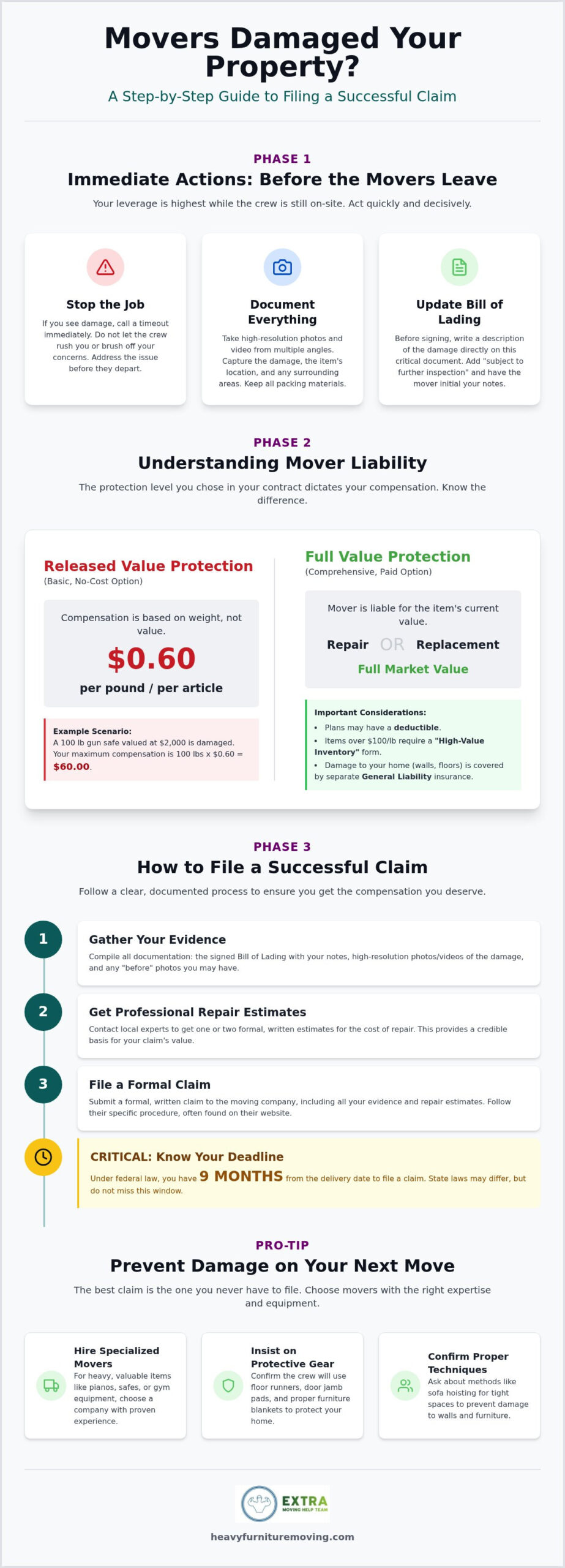
Stop the job immediately. If you see a fresh gouge in your hardwood floors or a splintered doorframe, call a timeout. Your leverage is highest while the crew is still on-site. Once the truck pulls away, proving the movers caused the damage becomes a steep uphill battle. Knowing what to do if movers damage your property starts with a proactive stance the moment you spot a problem. Be the protector of your new space; don’t let a fast-moving crew brush off your concerns or rush your inspection.
Documenting Property and Item Damage
Grab your phone and start recording. Take high-resolution photos and video of the damage from multiple angles to capture the depth of scratches or the extent of cracks. Photograph the item exactly where it sits before moving it any further. If a heavy safe or gym equipment was mishandled, document the floor and walls nearby. We often use specialized techniques like sofa hoisting to prevent wall damage, but if your movers took shortcuts, you must record every scratch. Capture “before” photos if you have them on your phone for a clear comparison. Don’t let the boxes go to the curb yet. Keep the damaged item and all original packing materials in a safe corner. Insurance adjusters frequently deny claims if they cannot inspect the specific padding, tape, and boxes used during transport.
The Bill of Lading: Your Most Important Document
The Bill of Lading is your primary legal defense and the most critical piece of paper you will handle. Never sign this document if it includes pre-printed language stating all items were “received in good condition” when they weren’t. If you are confused about what to do if movers damage your property, follow these steps before the crew departs:
- Write a single, factual sentence describing the damage directly on the mover’s paperwork in ink.
- Add a “subject to further inspection” note if you cannot check every box immediately. This is a vital safety net for large Fairfax estates where checking every piece of furniture takes hours.
- Ensure the lead mover initials your handwritten notes on the document before they pull out of the driveway.
While a general moving industry overview might describe standard business practices, this specific document governs your recovery. Stand your ground and ensure the paperwork matches the reality of your move. A few minutes of careful documentation now prevents weeks of headache later.
Understanding Liability: How Much Are Movers Actually Responsible For?
Don’t assume your mover will automatically pay the full replacement cost for a broken item. The level of liability you agreed to in your contract dictates your recovery options. In the moving industry, “protection” isn’t the same as traditional insurance. It’s a level of valuation that limits how much a company must pay out. Understanding these tiers is a vital part of knowing what to do if movers damage your property so you aren’t surprised by a tiny settlement check later.
Released Value vs. Full Value Protection
Released Value Protection is the basic, no-cost option required by federal law. It pays out a flat rate of $0.60 per pound per article. Let’s look at the math for a common Northern Virginia scenario. If a mover drops a 100-pound gun safe, they only owe you $60. It doesn’t matter if the safe cost $2,000; the weight is the only factor. For expensive but lightweight items like a flat-screen TV, this coverage is almost useless. Full Value Protection is much more comprehensive. Under this plan, the mover is responsible for the replacement value or the cost of a professional repair. Be sure to check your contract for a deductible, as many Full Value plans require you to pay the first $250 or $500 of a claim. If you have items worth more than $100 per pound, like fine jewelry or high-end electronics, you must declare them on a “High-Value Inventory” form. If you skip this step, the mover can limit their liability for those specific items to the basic $0.60 rate.
Damage to the Home: Floors, Walls, and Doorways
Household goods coverage protects your boxes, but structural damage to your house is a different category. Scratched hardwoods in a Fairfax foyer or dented drywall in a narrow Ashburn hallway are common moving mishaps. Liability for these issues usually falls under the company’s General Liability insurance. Before the move starts, confirm the team is prepared with floor runners and door jamb pads. If the company denies structural damage that their crew clearly caused, you can file a complaint with the FMCSA to initiate a formal dispute. Virginia state law generally follows federal Department of Transportation standards, ensuring local residents have the same protections as interstate travelers. To minimize these risks, consider hiring a specialist service like Heavy Furniture Moving, known for navigating tight spaces with heavy loads.
Filing a Formal Claim: A Step-by-Step Process
Once the dust settles, you must pivot from documenting the scene to demanding results. Don’t rely on phone calls or casual conversations with the driver. A verbal complaint carries no legal weight in the moving industry. Federal law gives you a nine-month window from the delivery date to file a written claim for interstate moves. While some Virginia intrastate moves might have tighter windows, nine months is the federal minimum. Start the process early. The sooner you file, the faster you can reach a resolution. Understanding what to do if movers damage your property means following a disciplined, paper-heavy trail that the company cannot ignore.
Gathering Your Evidence Folder
Organization is your best weapon. Create a dedicated digital folder for your move and keep physical copies in a secure file. You need your signed contract, the Bill of Lading, and every photo you took during the delivery. If you are claiming damage to high-value items, include original receipts or professional appraisals to prove their worth. For structural damage to your home, contact local Northern Virginia contractors to get written repair estimates. Having a professional quote for floor refinishing or drywall repair adds immediate credibility to your claim. Write a self-contained sentence for each damaged item that defines the specific dollar amount you are requesting for repair or replacement. This clarity simplifies the job for the claims adjuster and speeds up the process.
Writing the Demand Letter
Your formal claim should be a clear, fact-based demand letter sent via certified mail with a return receipt requested. This provides proof that the company received your package. Clearly state that you are holding the company liable for specific damages and reference your Bill of Lading number and the move date. Set a reasonable deadline, such as 30 days, for a formal response. Under federal regulations, the mover must acknowledge your claim within 30 days of receiving it. They then have 120 days to pay, deny, or make a settlement offer. Keep a detailed log of every email, letter, and phone call with the claims department. Note the date, the name of the person you spoke with, and exactly what was said. If you are still wondering what to do if movers damage your property after the initial filing, this log will be your primary evidence if you need to escalate the dispute later.
Resolving Disputes: What to Do if Your Claim Is Denied
A denied claim feels like a slap in the face after the stress of a move. Don’t let a “no” from a claims adjuster be the final word. If you’re stuck wondering what to do if movers damage your property and the company refuses to take responsibility, it’s time to escalate. Stay disciplined and keep your emotions in check. You have legal and regulatory avenues designed to protect consumers from bad-faith actors in the moving industry.
Arbitration vs. Small Claims Court
First, demand a formal letter of denial. This document must state the specific reason your claim was rejected. If your move crossed state lines, federal law requires movers to offer a binding arbitration program for disputes involving loss or damage up to $10,000. Arbitration is often less formal than a trial and can be handled through written submissions. For local moves within Northern Virginia, Small Claims Court is your best bet. In Virginia, you can pursue damages up to $5,000 without a lawyer. It’s a cost-effective way to hold a company accountable, provided you have the photographic evidence and Bill of Lading notes we discussed earlier. You should also contact the Virginia Department of Agriculture and Consumer Services (VDACS); they regulate intrastate movers and can often mediate disputes.
Third-Party Insurance and Homeowners Policies
Check your own safety nets if the mover remains stubborn. Many homeowners insurance policies cover specific “perils” during a move, though they may have high deductibles. Call your agent to see if your coverage extends to transit damage. If you paid for your move or a deposit with a premium credit card, check their benefits guide. Some high-end cards offer protection for damaged household goods. Just be aware of “double recovery” rules. You cannot collect the full value of a repair from both the mover and your insurance company. If you want to avoid these legal headaches entirely, start with a team that respects your home. Our piano moving and heavy item specialists use the right gear to ensure a claim is never necessary in the first place.
Prevention: How to Avoid Damage on Your Next Move
Prevention is the only way to guarantee your peace of mind during a relocation. While knowing what to do if movers damage your property is essential for recovery, choosing the right crew from the start keeps your home intact. Many people try to save money by packing their own boxes. However, if you use “Packed by Owner” (PBO) designations for fragile items, most movers will deny damage claims automatically. They will argue that your packing, not their handling, caused the break. For your most valuable or delicate pieces, invest in professional packing. It shifts the liability entirely to the company and ensures your items have the best protection available. Don’t let a small savings on packing tape lead to a total loss of your favorite heirloom.
The Risks of Generalist Movers for Heavy Items
Specialized items like gun safes and upright pianos require more than just raw strength. Generalist movers often lack the training and heavy duty equipment needed for these high risk tasks. They might try to manhandle a 600 pound safe up a flight of stairs, leading to cracked treads or dented drywall. These crews often struggle with the weight distribution of bulky furniture, which is how most floor gouges happen. We use specialized techniques like sofa hoisting to move large furniture through windows or over balconies. This method bypasses narrow, winding staircases entirely and prevents structural damage to your house. Hiring a team that understands the specific layouts of Northern Virginia homes is a smart investment in safety. It ensures your safe moving or piano relocation happens without a single scratch on your walls.
How Heavy Furniture Moving Protects Your Property
Choose a veteran family owned company with a proven track record in Fairfax and Ashburn. We treat your property with the same discipline we bring to every heavy lift. Our teams use floor runners, corner protectors, and door jamb pads on every job to create a barrier between your furniture and your home. We don’t just move boxes; we protect your hardwoods and tight hallways from the moment we walk in. Our specialized labor is trained specifically for high risk, bulky furniture that standard movers often avoid or mishandle. By focusing on safety and physical strength, we remove the difficulty from the moving process. If you want to skip the stress of a damage claim and ensure your property arrives in perfect condition, start with the experts. Get a quote for safe, professional moving services and let our family take care of yours.
Take Control of Your Move
You don’t have to feel helpless when a move goes wrong. By following the steps in this guide, you now know exactly what to do if movers damage your property. Your leverage is strongest before the truck leaves your driveway. Always document every scratch with high-resolution photos and make precise, initialed notes on the Bill of Lading. Whether you are dealing with a gouged hardwood floor in Fairfax or a damaged safe in Ashburn, a solid paper trail is your only path to a successful recovery.
The best way to handle a damage claim is to ensure you never have to file one. Rely on a team that treats your home with the discipline and care it deserves. As a veteran-family owned business, we bring specialized hoisting and heavy item equipment to every complex job in Northern Virginia. We take visible pride in the physical strength and expert techniques required to move your heaviest items safely through tight spaces. Avoid the stress-hire the heavy item experts at Heavy Furniture Moving today. You’ve worked hard for your home and your belongings; let our family help you protect them.
Frequently Asked Questions
How long do I have to file a claim with a moving company?
You have nine months from the date of delivery to file a written claim for interstate moves. This is a federal requirement set by the FMCSA. For moves within Virginia, the deadline can be much shorter, sometimes ranging from 30 to 90 days. Check your specific contract immediately to avoid missing these critical windows. Filing your claim early ensures you don’t lose your right to compensation while the details are still fresh.
Can I still file a claim if I already signed the delivery receipt?
Yes, you can still file a claim even if you signed the delivery receipt. While a signature often implies items arrived in good condition, it doesn’t waive your right to report hidden damage found later. This is why we recommend writing “subject to further inspection” on the Bill of Lading. If you discover damage after the crew leaves, document it with photos immediately and contact the claims department to start the formal process.
What is the 60 cents per pound rule?
The 60 cents per pound rule, known as Released Value Protection, is the minimum liability movers must provide at no extra cost. This means if a 100 pound dresser is destroyed, the company only owes you $60. It’s a weight-based calculation that ignores the item’s actual market value or replacement cost. This is the industry standard for basic moves, which is why Full Value Protection is often a better choice for expensive furniture.
Are movers responsible for damage to my house, like scratched floors?
Movers are responsible for damage to your home’s structure, including scratched hardwoods or dented drywall. This type of damage usually falls under the company’s General Liability insurance rather than their cargo valuation. Document these issues on the Bill of Lading before the crew departs. Knowing what to do if movers damage your property like your floors or walls is vital for protecting the resale value of your Northern Virginia home.
What happens if the movers break something I packed myself?
Movers are generally not liable for damage to items inside boxes you packed yourself. Unless the exterior of the box shows clear signs of mishandling, like a crush mark or a hole, the company will likely claim the damage resulted from improper packing. To protect fragile items, have the professionals handle the packing and unpacking. This shifts the liability to the company and ensures your most delicate belongings are covered if a mishap occurs.
What should I do if the moving company denies my damage claim?
Request a formal letter explaining the specific reasoning for the rejection if your claim is denied. You can then escalate the dispute through the company’s required arbitration program for interstate moves or contact the Virginia Department of Agriculture and Consumer Services for local moves. Don’t give up after the first rejection. Persistence often leads to a settlement offer when you have clear photographic evidence and a well-documented timeline of all communications.
Is it worth suing a moving company for property damage?
Suing is often worth it for significant property damage through Virginia’s Small Claims Court system. You can pursue claims up to $5,000 without the high cost of hiring a lawyer. This is a practical way to hold a company accountable for expensive repairs to your home or furniture. For smaller amounts, the time and filing fees might outweigh the recovery, so weigh the costs against the potential payout before filing your paperwork.
Does homeowners insurance cover damage caused by movers?
Your homeowners insurance might cover damage during a move, but it depends on the specific perils listed in your policy. Most standard policies have high deductibles that may exceed the value of the damaged item. Call your agent to see if your coverage applies before you decide what to do if movers damage your property. Some premium credit cards also offer secondary transit insurance if you used the card to pay for the moving services.