
The success of your move to London or Tokyo isn’t decided at the destination; it’s won or lost in the first hour on your Fairfax driveway. Most people assume international shipping is just about finding a big boat, but the real challenge is ensuring your heavy piano or heirloom safe survives a forty day ocean voyage without a scratch. Searching for international movers near me shouldn’t add to your stress. It should provide you with a capable partner who knows exactly how to protect your valuables for the long haul.
We know the weight on your shoulders is about more than just physical boxes. You’re likely worried about complex customs paperwork like the CBP Form 3299 or the UK’s Transfer of Residence relief. This article will help you master the complexities of overseas moving with expert logistics, specialized heavy item handling, and local Northern Virginia insights. We’ll preview the differences between air and ocean freight, explain how to navigate international regulations, and show you how professional packing prevents damage. We are breaking down the entire process into clear, manageable steps so you can focus on your new adventure instead of the logistics.
Key Takeaways
- Learn how to decide if the speed of air freight is worth the cost compared to traditional ocean containers.
- Discover why standard moving pads aren’t enough and how specialized “Export Wrapping” keeps your heirlooms safe.
- Identify the five mandatory documents you’ll need to prevent your shipment from getting stuck at the border.
- Partner with international movers near me who have the muscle and gear to safely ship pianos, safes, and treadmills.
- Work with a veteran-family owned team that takes pride in managing the complex logistics of a global move from Fairfax.
Understanding International Relocation from Northern Virginia
Moving across an ocean is far more than a long-distance haul; it’s a complex, multi-modal logistics puzzle. Your belongings don’t just sit in one truck. They transition from your home to a warehouse, then into a shipping container, and finally onto a massive vessel or cargo plane. For residents in Northern Virginia, this journey starts in one of the busiest logistical hubs in the country. If you’re looking for international movers near me, you need a team that understands how to bridge the gap between your Fairfax driveway and a port halfway around the world.
The “First Mile” is the most critical stage of the entire journey. This is the physical act of moving items from your home and securing them for the rough conditions of international transit. While the process of relocating presents many emotional hurdles, the physical safety of your belongings depends on how they are handled before they ever leave Virginia. A standard local mover might know how to drive a truck, but an international shipment coordinator knows how to prep a 900-pound safe for a 3,000-mile sea voyage.
The Role of an International Shipment Coordinator
Don’t settle for a distant corporate call center that treats your move like a line on a spreadsheet. A local international shipment coordinator acts as your single point of contact, managing the hand-off between local labor and global carriers. We coordinate the specialized packing, the heavy hauling, and the freight forwarding. This ensures your piano or gym equipment is handled by the same disciplined team from start to finish. This approach provides a level of accountability and rugged reliability that massive van lines simply can’t match.
Why Proximity to Dulles (IAD) Matters for Your Move
Living in McLean, Reston, or Ashburn gives you a massive logistical advantage. Proximity to Dulles International Airport (IAD) means faster access to air freight options for high-priority household goods. However, local Northern Virginia traffic patterns on I-66 and the Beltway can ruin a pickup schedule if your mover isn’t prepared. We use our local insights to time your move perfectly. We ensure your international movers near me arrive on time and get your items to the port or airport without unnecessary delays. This local expertise is what keeps a global move on track during that high-stakes first day.
Air Freight vs. Ocean Freight: Which is Right for You?
Choosing how to ship your belongings is the most significant factor in your moving budget. When you look for international movers near me, you need a team that explains the logistics clearly. Most global relocations rely on two methods: the slow, steady sea or the fast, expensive sky. For Fairfax residents, the decision often comes down to how much furniture you have and how quickly you need it at your new front door. Each method has specific requirements for how we pack and secure your gear.
Ocean Freight: The Standard for Full Home Moves
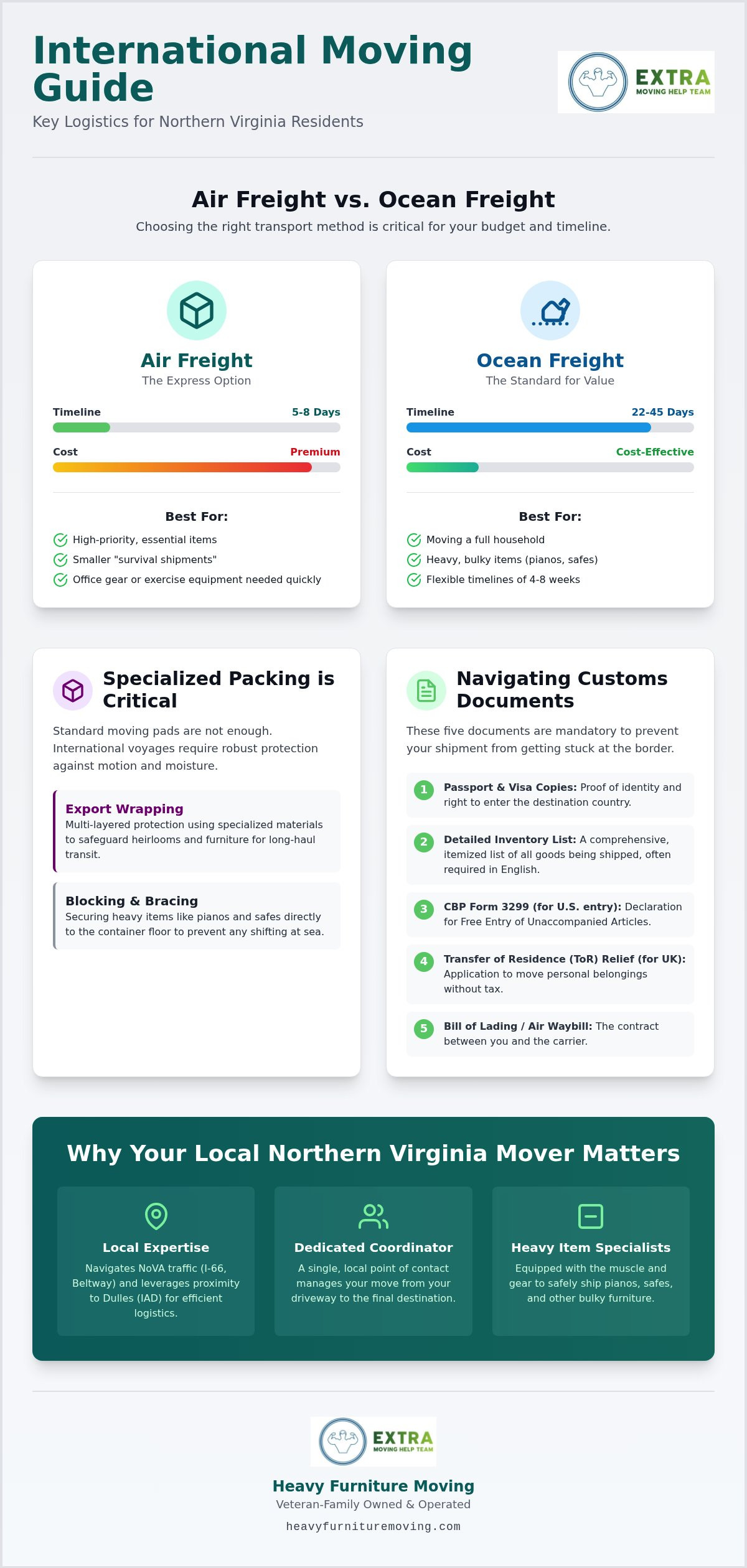
Ocean freight is the workhorse of the industry. If you’re moving an entire household, you’ll likely use a Full Container Load (FCL). This gives you exclusive use of a 20-foot or 40-foot steel container. If you have a smaller shipment, we use “Lift Vans.” These are specialized wooden crates that travel as a Less than Container Load (LCL). This method is cost-effective but takes time. Expect a transit window of 22 to 45 days for most major global ports. Because your items face the constant motion of the sea, we prioritize blocking and bracing. We secure heavy items like pianos or safes directly to the container floor to prevent any shifting during the voyage.
Air Freight: Speed for Essential Household Goods
Air freight is built for speed. It’s the best choice for high-priority items like office gear or essential exercise equipment. Most air shipments arrive within 5 to 8 days. However, this speed comes at a premium. Airlines use “chargeable weight,” which calculates cost based on either the actual weight or the volume of the box. For heavy furniture, this gets expensive fast. A single heavy safe could cost more to fly than an entire room of standard furniture. We typically recommend air freight for a small “survival shipment” while your main container travels by sea. If you aren’t sure which path fits your timeline, our team can help you plan your international shipment logistics to find the right balance.
Use this simple framework to decide what works for your move:
- Choose Ocean Freight if: You’re moving a full house, shipping heavy items like safes, or have a flexible timeline of 4 to 8 weeks.
- Choose Air Freight if: You’re moving a small shipment under 300 kg, you need your items in under two weeks, or you’re shipping high-value electronics.
Remember that sea voyages involve high humidity and temperature shifts. We use specialized moisture-wicking materials for ocean containers that aren’t always necessary for air travel. Whether you choose the sea or the sky, our focus remains on the physical safety of every piece of furniture we handle.
Specialized Packing for Heavy Furniture and Bulky Items
Standard moving pads work fine for a trip across Fairfax. They fail miserably on a trip across the Atlantic. International shipments require “Export Wrapping.” This is a rigorous, multi-layer process using heavy-duty corrugated cardboard, foam, and specialized tape. It creates a rigid shell around your furniture that resists crushing and vibration. Don’t rely on DIY packing for these moves. If a box isn’t packed to strict international standards, insurance providers often deny damage claims. Searching for international movers near me should lead you to a team that prioritizes this rugged, labor-intensive protection over quick shortcuts.
Protecting Pianos and Safes for the Long Haul
Moving a 900-pound safe or a grand piano requires physical power and technical precision. We don’t just wrap these items; we secure them. We use heavy-duty skids to distribute weight and build custom wooden crates for maximum security. For sea voyages, salt air and moisture are constant threats. We use industrial-grade desiccant packs inside the wrapping to control humidity and prevent wood warping or metal corrosion. Our piano moving services handle the grueling task of navigating narrow stairs and tight Virginia hallways before the crating even begins. Most corporate van lines reject these high-weight items because they lack the specialized labor. We take visible pride in the sweat and tangible results required to move what others won’t.
Sofa Hoisting: When the Elevator Isn’t an Option
Many modern townhomes in Reston or high-rises in Vienna have stairwells and elevators that were never built for oversized furniture. If your sectional or sofa won’t fit through the door, we don’t leave it behind. We use specialized sofa hoisting to move your furniture through windows or over balconies. This method is often safer for the piece and the building than trying to force a tight corner. We integrate this process into your overall packing timeline so the container loading stays on schedule. It’s a high-energy, precise task that demands the right gear and a steady hand. By handling the difficult exits now, we ensure your furniture is ready for its 3,000-mile journey without unnecessary stress or delay.
When you choose a local expert, you get more than just a truck. You get a neighborly guide who understands the specific architecture of Northern Virginia homes. We know which buildings in Ashburn have tight freight elevators and which Fairfax neighborhoods require street permits. This local expertise, combined with specialized packing, ensures your heaviest belongings arrive in your new country in the same condition they left your old one.
Navigating Customs and International Documentation
Packing your home is only half the battle. The other half happens behind a desk, where a single missing signature can stall your shipment for weeks. When you hire international movers near me, you aren’t just paying for muscle. You’re paying for the expertise to clear your belongings through foreign ports. Every country has its own set of rules, but the paperwork remains the foundation of a successful move. We take the confusion out of the process by ensuring every form is filled out before your container leaves Northern Virginia.
You’ll need five essential documents for almost any destination:
- A valid passport and work visa for your destination country.
- A comprehensive Packing List detailing every box and item.
- The Bill of Lading, which acts as your official title to the goods.
- A Customs Declaration form (like the UK’s ToR1 or U.S. Form 3299).
- An Insurance Certificate or Valuation form.
The Bill of Lading is the most important document in your hand. It’s a legal contract between the owner of the goods and the carrier. It confirms that the carrier has received your items and outlines where they are going. Never lose this document; it’s your primary proof of ownership during the transit process. Be aware that regional restrictions vary wildly. Australia is fierce about soil on outdoor gear, while the EU has strict rules on certain wood types used in furniture. We help you identify these “red flag” items before they cause a headache at the border.
Creating a Customs-Ready Inventory List
A Valued Inventory List is a detailed document where you assign a replacement value to every item in your shipment for customs and insurance purposes. When documenting heavy items like exercise equipment or safes, be specific about the make and model to ensure accurate valuation. Avoid “Packed by Owner” (PBO) boxes. Customs officials view PBO items with high scrutiny because they cannot verify the contents. This often leads to intrusive physical inspections and extra fees. We recommend our professional packing and unpacking services to ensure your inventory is “Carrier Packed,” which significantly speeds up the clearance process.
Insurance and Liability for Overseas Transit
Don’t assume your standard homeowner’s policy covers an ocean voyage. You need specialized transit insurance. Total Loss coverage only pays out if the entire shipment is lost, such as a ship sinking. All-Risk coverage is better for most residents because it covers individual damage to heavy furniture. Before we secure your items in their crates, take clear photos of their condition. This creates a baseline for any potential claims. If you need to file a claim from a different time zone, having this digital trail makes the process much faster. We handle the heavy lifting, but we also ensure you have the protection you need for total peace of mind.
Choosing the Right International Mover Near You
Choosing a partner for a global relocation is a high-stakes decision. When you search for international movers near me, you’ll see plenty of massive corporate logos. These companies often rely on a network of subcontractors who have never seen your home. A local, veteran-family owned business offers a different level of accountability. We take visible pride in our manual labor because we are part of the Northern Virginia community. We don’t just send a quote; we understand the tangible results of a job well done. Finding the right international movers near me means looking for a team that handles the packing, hauling, and logistics under one roof.
Before you sign a contract, use this final checklist to ensure a stress-free transition:
- Verify Equipment: Ensure the mover has specialized gear like heavy-duty skids and hoisting straps for pianos or safes.
- Confirm Site Visits: A reliable mover should perform a physical walk-through to identify narrow stairs or tight corners.
- Check Accountability: Ask if the same company manages the “First Mile” labor and the final container sealing.
- Review Customs Knowledge: Make sure they provide clear guidance on mandatory forms like the Bill of Lading.
The Local Advantage in Northern Virginia
A physical site visit in Woodbridge or Manassas is worth more than ten phone calls. It allows us to spot logistical traps like steep driveways or narrow townhome entries before move day. We also understand the specific HOA rules in Ashburn or Aldie. We know which neighborhoods require street permits for shipping containers and which ones have strict window hours for large trucks. This local knowledge prevents fines and delays that a distant call center would never anticipate. Being a neighborly service means we are available when you need us, providing a steady pulse of help throughout the process.
Taking the Next Step with Heavy Furniture Moving
We specialize in the items that big van lines often reject. Whether it’s a 1,000-pound safe or a delicate grand piano, we have the physical power and the technical gear to move the “unmovable.” We have been serving Northern Virginia since at least 2021, bringing a disciplined and hardworking attitude to every international shipment. Don’t let the stress of global logistics overshadow your excitement for a new country. Schedule a specialized consult for your heaviest items today. Let our dedicated team handle the heavy lifting so you can focus on your new adventure. We are ready to provide the rugged reliability and expert care your belongings deserve.
Ready to Start Your Global Adventure?
Moving across the world is a massive undertaking, but it doesn’t have to be a source of constant anxiety. You’ve learned that success depends on the first mile of specialized export wrapping and choosing the right freight method for your timeline. Whether you’re coordinating ocean containers for a full household or air freight for essential gear, the physical safety of your belongings is the top priority. Don’t let confusing customs paperwork or the fear of damaged furniture hold you back from your new life abroad.
When you search for international movers near me, look for a team that has the muscle and the heart to do the job right. We are a veteran-family owned and operated business serving Fairfax and all of Northern Virginia. We specialize in the heavy items other companies often reject, including pianos, safes, and treadmills. We take pride in our local roots and our dedication to every family we serve. Take the first step toward a seamless move today. Get a Specialized International Moving Quote and let us handle the heavy lifting while you focus on the journey ahead.
Frequently Asked Questions
How much does an international move from Northern Virginia typically cost?
Typical industry costs in 2026 range from $4,000 to over $15,000 depending on your destination. Moves to Europe usually fall between $6,000 and $12,000; while Asia and Australia often exceed $15,000. These figures depend on the volume of goods and the shipping method. Searching for international movers near me helps you find local experts who can provide a precise estimate based on your specific inventory and the current shipping rates at Northern Virginia ports.
Can I ship my gun safe or heavy exercise equipment overseas?
Yes; you can ship heavy items like gun safes or treadmills; but they require specialized crating. We specialize in exercise equipment moving and safe transport for global relocations. These items add significant weight; so we secure them with heavy duty skids to prevent shifting inside the container. Don’t leave your high value gear behind just because it’s heavy. We have the physical power to ensure it reaches your new home safely.
What is the difference between a freight forwarder and an international mover?
An international mover handles the physical labor; including packing; loading; and hauling your items from your Fairfax home. A freight forwarder manages the logistical booking with carriers. When looking for international movers near me; you want a partner who manages both. We handle the high energy first mile of the move and coordinate with global carriers to ensure your belongings transition smoothly from land to sea. This keeps the process simple and accountable.
How long does it take for my furniture to arrive at an international destination?
Shipping times vary based on the method you choose. Ocean freight typically takes between 22 and 45 days for door to door delivery to most major global ports. If you choose air freight; your items usually arrive within 5 to 8 days. Factors like customs inspections or port congestion can add a few days to these windows. We help you plan your schedule to account for these variables and keep your relocation on track.
Do I need to be present for the customs clearance of my household goods?
You typically do not need to be physically present at the port for customs clearance. However; you must provide all mandatory documentation; such as CBP Form 3299 for the U.S. or form ToR1 for the UK. Your shipment coordinator manages the interaction with customs officials on your behalf. Ensuring your inventory is detailed and your paperwork is signed before the container leaves Virginia is the best way to avoid delays or physical inspections.
What items are strictly prohibited in international household shipments?
Most countries prohibit hazardous materials; including aerosols; flammables; and ammunition. Perishable food items; especially meat products; are strictly regulated by authorities like U.S. Customs. You should also avoid shipping liquids or plants that could leak or carry pests. Every destination has unique restrictions; so we provide a specific list of banned items for your new country. Removing these “red flag” items early prevents your entire container from being flagged for an intrusive inspection.
Is it better to sell my heavy furniture or ship it internationally?
This decision depends on the replacement value and sentimental importance of your pieces. International shipping is often calculated by volume or weight; so heavy furniture can be expensive to move. If your items are heirlooms or high end pieces; shipping is usually the right choice. If the furniture is easily replaceable; selling it in Fairfax and buying new at your destination might save money. We provide honest advice based on the physical condition and weight of your goods.
How do I protect my piano during a sea voyage?
Protecting a piano for a 3,000 mile sea voyage requires more than a simple blanket. We use a multi layer “Export Wrapping” process and build a custom wooden crate to prevent any physical impact. Inside the wrap; we place industrial desiccant packs to control humidity and protect the wood from salt air. Our specialized piano moving services ensure your instrument is handled with the rugged reliability needed to survive the shifting environment of an ocean container.