Moving Heavy Reclaimed Barnwood Dining Tables Down Narrow Steps
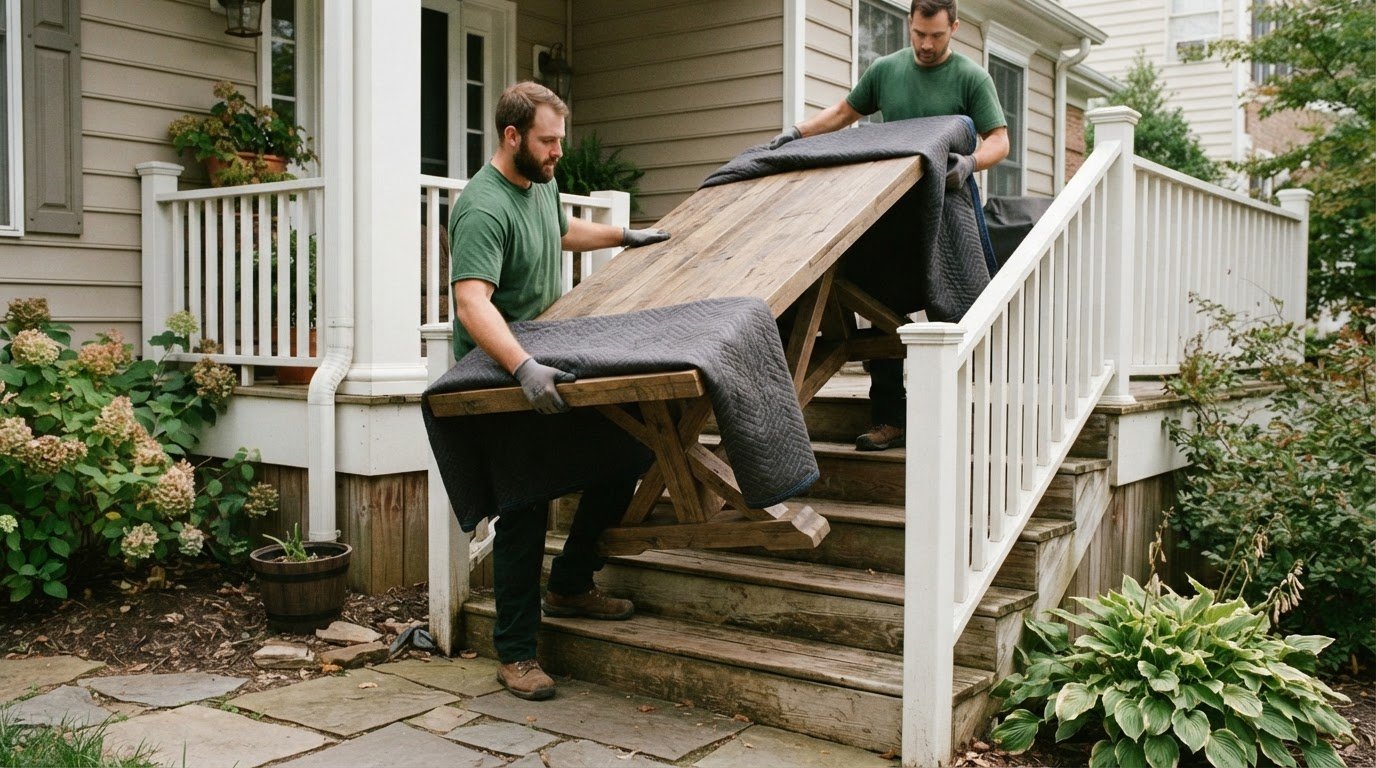
A narrow porch stairway changes the move: assess the table’s base and joints before tilting or carrying it down. When moving a heavy reclaimed barnwood dining table down narrow porch steps in Ashburn, start by measuring the route, protecting the wood, and planning a controlled angle that keeps the table stable.
It’s easy to focus on the tabletop, but a trestle base can affect where movers grip and how the table clears each step. The joints matter too, especially if the table flexes when tilted. This guide explains what to look for in both, how to prepare the porch route, and when a heavy-lifting team can take the strain out of the move.
Key Takeaways
- Assess the table’s base, joints, and balance before choosing how to carry it down the steps.
- Measure the porch route and clear obstacles so the team can plan a controlled path.
- Use suitable moving equipment to improve grip, protect the wood, and manage the load.
- Remove the legs only when the table’s construction allows it, and keep all hardware organized.
- Know how an awkward grip or unstable descent can put the table, your home, and the movers at risk.
3. How do professional movers safely move heavy furniture down narrow porch steps?
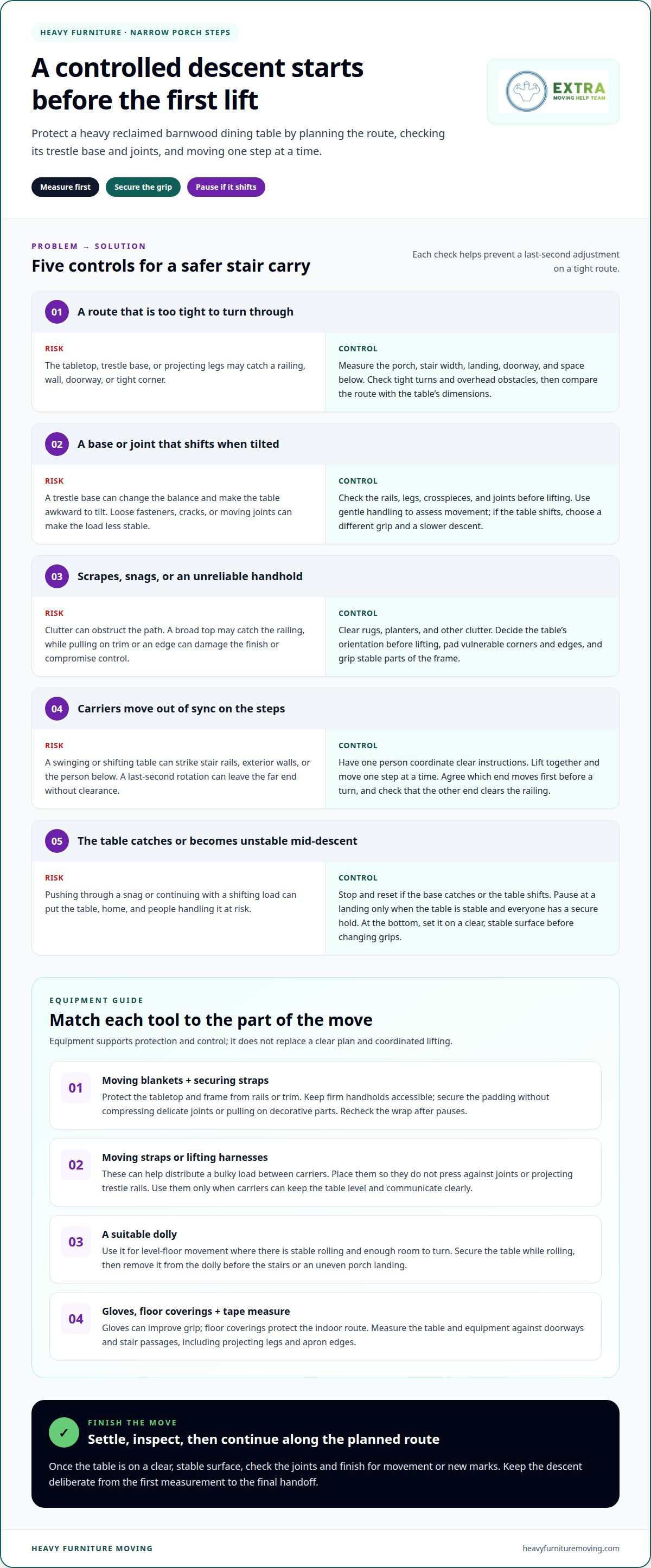
Moving a heavy reclaimed barnwood dining table down narrow porch steps in Ashburn starts with assessing the route, not lifting. Measure the porch, stair width, landing, doorway, and space below. Identify tight turns and overhead obstacles before carrying anything. This gives the team a chance to plan where to pause, pivot, and reposition the table without scraping walls or railings.
Next, assess the table. A trestle base changes its balance and can make it awkward to tilt. Check whether the rails, legs, and crosspieces are firmly joined. Look for loose fasteners, visible cracks, or movement at the joints. If the table shifts with gentle handling, it needs a different grip and a slower descent than a rigid piece.
Check the tabletop’s shape and overhang, too. A long top may extend beyond the carriers’ hands, while a broad top can catch the porch railing during a turn. Compare the table’s dimensions with the narrowest part of the route. Decide its orientation before lifting instead of attempting a last-second rotation on the steps.
Before the carry, clear rugs, planters, and other clutter from the porch route. Pad vulnerable corners and edges, securing the protection so it won’t slide. Choose stable handholds on the frame rather than pulling on decorative trim or the table edge. Careful handling also helps prevent fresh dents and scrapes on reclaimed barnwood.
Have one person coordinate the movement and give clear instructions at each transition. Lift together, keep the table controlled, and move one step at a time. At a landing, pause only when the table is stable and everyone has a secure hold. Before turning, agree which end moves first and check that the other end clears the railing.
Keep the descent deliberate. Prevent the table from swinging into stair rails, exterior walls, or the person below. If the base catches or the table shifts, stop and reset instead of pushing through. This is especially important with a trestle design, whose base may project beyond the tabletop and snag a narrow corner.
At the bottom, set the table on a clear, stable surface before changing grips or removing protection. Check the joints and finish for movement or new marks, then carry it onward along the planned route. Breaking a difficult porch exit into controlled steps helps protect the table, the home, and the people handling it.
Careful handling is only part of looking after reclaimed wood furniture. Reclaimed wood used for furniture may come from older structures and is often described as dense, well-seasoned, and tightly grained. Reclaimed wood countertops can also be used beyond kitchens, including on end tables or in built-in furniture nooks. Once the furniture is in place, choose a finish or sealant suited to indoor or outdoor use. Match the protection to the setting to continue caring for the piece after the move.
For routine upkeep, dust reclaimed wood furniture regularly and avoid harsh chemical cleaners. For outdoor furniture, protect it from the elements, such as by placing it under cover or using an exterior-grade sealer. Choose a finish or sealant suited to indoor use for an indoor piece, and one suited to outdoor use for an outdoor piece. These simple care steps help a reclaimed wood dining table, end table, or built-in furniture nook stay suited to its intended role.
4. What equipment is needed to move a heavy dining table down steps?
The right equipment supports the table, protects its finish, and gives carriers a controlled grip. For a reclaimed barnwood dining table, choose tools suited to its weight, shape, and base. A long trestle frame calls for different hand placement than a compact pedestal. No tool replaces a clear plan and coordinated lifting.
Moving blankets and securing straps help protect the tabletop and frame from porch rails or door trim. Wrap the table while leaving firm handholds accessible. Straps can hold padding in place, but should not compress delicate joints or pull against decorative parts. Check the wrap before the first step and after each pause.
Moving straps or lifting harnesses can help distribute a bulky load between carriers. Placement matters: a strap against an apron or projecting trestle rail may shift the table’s balance. Use straps only if carriers can keep the table level and communicate clearly. If the base prevents a secure setup, carrying it by stable frame grips may offer better control.
A suitable dolly can help move the table across a level floor before the stairs. A standard furniture dolly is not a substitute for controlled carrying down narrow steps. It needs a level, stable surface and enough clearance to turn. Secure the table while rolling, and remove it from the dolly before reaching the stairs or an uneven porch landing.
Basic protective and preparation supplies include gloves, floor coverings, and measuring tools. Gloves can improve your grip on the frame, while floor coverings protect the indoor route. Use a tape measure to compare the table and equipment with the doorway and stair passage. Measure projecting legs and apron edges as well as the tabletop.
- For protection: use blankets and padding that stay secured around corners.
- For carrying: choose straps that fit the frame without pressing on joints.
- For level movement: use a dolly only where the floor allows stable rolling.
- For preparation: keep gloves, floor coverings, and a tape measure close.
Keep disassembly tools nearby only if the table’s construction allows its legs to be removed. Use a screwdriver or socket tool that matches the fasteners. Keep removed hardware together, and don’t force a resistant joint. A glued or fixed connection needs a different plan from a bolted leg. Protect loose parts so they don’t scratch the barnwood during transport.
Before lifting, place each tool where it can be reached without crossing the carrying path. Keep straps untangled, padding ready, and the dolly parked away from the stairs. For an awkward table that needs coordinated handling, a heavy lifting moving service can help manage the physical carry.
5. Can a dining table be disassembled before moving it, and how?
Some dining tables can be partially disassembled by removing their legs or a detachable trestle base. Whether that helps depends on the joints and fasteners, not just the table’s size. Inspect the underside for bolts, brackets, or screws connecting the base to the top. Leave glued joints and solid wood connections intact rather than forcing them apart.
Start by clearing the tabletop and placing a soft, stable covering beneath it. Photograph the underside before touching any fasteners. These pictures can help you see how brackets, washers, and legs fit together during reassembly. Use a tool that matches the fastener head and loosen each connection steadily. If a screw turns without releasing, or a joint creaks or shifts, stop rather than applying more force.
If the table has removable legs, loosen each fastener while supporting the leg. Keep the table steady so its weight doesn’t twist the remaining connections. Remove one leg at a time and set it on padding away from the walking path. A trestle table may have a crosspiece linking its supports. Leave it attached unless the design clearly allows its removal through accessible fasteners.
Sort the hardware by location. Place each leg’s fasteners in a labeled bag and note which side they came from. Keep washers and brackets with their matching bolts. This helps prevent mixed hardware from complicating reassembly. Don’t leave loose screws on the floor or tucked into a blanket, where they could disappear or scratch the reclaimed wood.
Protect exposed connection points after disassembly. Wrap each leg or base section so its edges can’t rub against the tabletop. Cover the underside and corners, but don’t apply adhesive directly to the finish. If the tabletop is separate, support it evenly during handling. A long top can flex when carried from one end, so use balanced support rather than lifting from a corner.
Disassembly may make a tight doorway easier to manage, but it also leaves more pieces to carry and reassemble. Compare the intact table’s width with the route, including porch turns and railings. If removing the legs won’t improve clearance at the tightest point, leave the frame together. Taking apart a stable base without gaining useful space adds handling and strain to its joints.
Before reassembly, match each part to the underside photos and labeled hardware. Set the table on a level surface, align the legs or base, and start the fasteners by hand. Tighten connections evenly, checking that the frame sits square and doesn’t rock. Don’t overtighten hardware into reclaimed wood: damaged threads or crushed fibers can weaken the connection. If the table has fixed or complex joinery, leave it intact and plan the move around its assembled shape.
Tighten the fasteners gradually, alternating between connections so the base aligns without pulling one side out of position. Check that the tabletop sits level before fully securing anything. If it rocks or a gap remains, loosen the fasteners and realign the parts instead of forcing them together. Once stable, check that each connection is snug and no tools or loose hardware remain underneath. When moving the table again, lift from the base, not a leg or the tabletop edge, to reduce stress on the reassembled joints.
For reclaimed wood, don’t assume that a surface should be stripped simply because the table has been taken apart. Old-growth trees that grew before the 20th century were exposed to less air pollution. That fact provides context about old-growth material, but it does not establish how a particular table was joined or finished. Keep the existing finish protected during handling, and avoid treating age alone as a reason to alter the surface. If a connection remains unstable after careful alignment, leave the table supported and seek help from someone familiar with furniture repair rather than repeatedly tightening it.
4. What are the risks of moving heavy furniture down narrow steps without professional help
A heavy dining table can become difficult to control when its weight shifts during a stair turn. For example, if one person lifts the tabletop while another grips a trestle rail, the table may tilt unevenly. On narrow porch steps, that mismatch can lead to a dropped end, a strained grip, or a collision with the railing.
Personal injury is one risk. A carrier may lose footing while stepping backward, twist to avoid a wall, or overreach for the table edge. The load can shift suddenly if someone changes grip or pauses. Even a short descent becomes harder when carriers cannot see their next step or communicate clearly around the furniture.
Property damage can happen quickly. A table corner may strike a porch post, scrape siding, or chip a stair edge during a tight turn. The same awkward angle can damage a doorway or wall indoors. Reclaimed barnwood may already have character marks, but a fresh gouge or split edge is still avoidable damage.
The table’s construction can suffer, too. Lifting a trestle base from the wrong point puts pressure on its rails and joints. Pulling on a crosspiece instead of supporting the frame may loosen or shift a joint. A long tabletop can also twist if one end is raised higher, straining the connections between the top and base.
Unplanned turns create another problem. The person at the lower end may try to rotate the table while the upper end remains wedged near a porch railing. Hands can get trapped between the wood and rail, or the table can end up in a position nobody can hold comfortably. Measure the tightest passage and identify every turn before moving the piece.
Clutter and unsteady equipment make the route less predictable. A rug bunched near the doorway, a planter beside a landing, or a dolly left in the path can interrupt a carrier’s footing. Clear the entire route, including the porch and ground-level exit. Keep pets and bystanders away while the table is moving.
Fatigue can build over repeated attempts. Carriers may begin with a firm grip, then shift their hands to regain balance or rest. Each change briefly makes the table less controlled. If it stops moving smoothly, set it down only on a stable landing and reassess the route instead of forcing it past an obstruction.
Before lifting, consider whether everyone can communicate, maintain secure footing, and manage the table’s shape through the narrowest point. If the answer is no, don’t attempt the descent alone. A trained moving team can plan the handling around the table and the porch layout. Arrange help moving a heavy table before the first lift.
Heavy Furniture Moving: Movers Near Me
Heavy Furniture Moving helps with bulky furniture moves when a narrow stairway makes carrying difficult to manage alone. Its Movers Near Me and in-home furniture moving services can help move a dining table through your home and out along a tight porch route. Consider professional help if the table’s weight, trestle base, or fixed joints make repositioning risky.
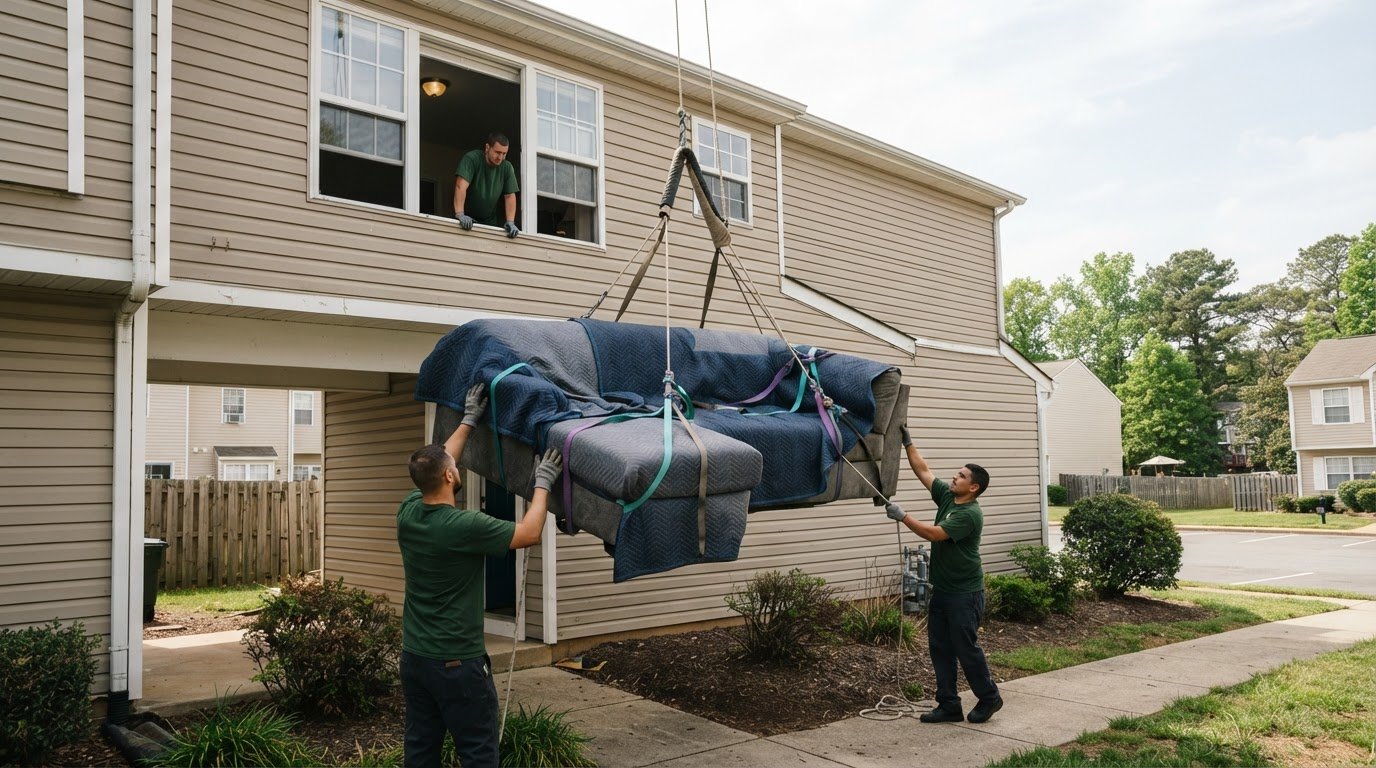
For other challenging lifts, Heavy Furniture Moving also offers Exercise Equipment Moving and Sofa Hoisting. Choose support suited to the item and route instead of attempting a difficult carry without a clear plan.
Contact Heavy Furniture Moving or visit heavyfurnituremoving.com to discuss your move.
Make the Next Move a Planned One
Before moving day, decide where the table will go once it clears the porch. Leave the destination open and ready so the carrying team can finish without another awkward turn through the house. If the table has sentimental value or a distinctive finish, point out what needs extra care before it is handled.
Planning to move a heavy reclaimed barnwood dining table down narrow porch steps in Ashburn starts with a clear picture of the full route and the table’s final placement. That preparation helps everyone work toward the same result without rushing decisions at the doorway or landing.
If the porch layout or table shape makes the lift feel like too much to manage, bring in help before attempting it. Contact Heavy Furniture Moving about your table move and take the next step with a plan that fits your home. A careful start can make the transition to its new place feel much easier.
Frequently Asked Questions
How much does it cost to hire movers in Ashburn, Virginia for a heavy dining table?
The cost depends on the table and the work involved, so request a quote for your Ashburn move. Factors include the table’s size, access through the home, and the porch stairs and landings. Heavy Furniture Moving prices stairs and landings before the crew arrives. Hourly labor has a 2-hour minimum, while most single heavy-item moves use a flat-rate quote. A photo of the table and stairs helps describe the job.
What Ashburn VA moving companies handle oversized furniture and narrow staircases?
Heavy Furniture Moving handles residential furniture moves in Ashburn, including heavy and bulky items. Its in-home furniture moving and Movers Near Me services can help with a dining table that needs careful handling through a narrow staircase. The team measures doorways, stairs, and item dimensions before lifting. Wrap, blankets, and straps are included on every job. Share the home’s access details when arranging help so the move can be planned around the route.
Frequently Asked Questions
The cost depends on the table and the work involved, so request a quote for your Ashburn move. Factors include the table’s size, access through the home, and the porch stairs and landings. Heavy Furniture Moving prices stairs and landings before the crew arrives. Hourly labor has a 2-hour minimum, while most single heavy-item moves use a flat-rate quote. A photo of the table and stairs helps describe the job.
Heavy Furniture Moving handles residential furniture moves in Ashburn, including heavy and bulky items. Its in-home furniture moving and Movers Near Me services can help with a dining table that needs careful handling through a narrow staircase. The team measures doorways, stairs, and item dimensions before lifting. Wrap, blankets, and straps are included on every job. Share the home’s access details when arranging help so the move can be planned around the route.