How to Move a Heavy Upright Freezer Down McLean Basement Steps Safely
The safest way to move an upright freezer down McLean basement steps is to keep it upright, not lay it on its side. Knowing how to safely move a heavy upright freezer down basement steps in McLean means planning for the tight stairway and protecting the freezer’s finish and the floors along the route. If it must travel on its side, follow the owner’s manual and let it stand upright for 24 hours before plugging it in.
It’s natural to worry about scraped floors, a damaged appliance, or losing control on the stairs. A safe move starts by preparing the freezer and assessing the stairway, landings, and turns before lifting.
This guide explains why keeping a freezer upright is safer for its cooling system, what to do if side transport is necessary, and how to prepare the appliance and route. You’ll also learn what details help movers plan a basement move in McLean and when experienced heavy-lifting help can make it more manageable.
Key Takeaways
- Prepare the freezer for transport by emptying and defrosting it, removing loose shelves, and securing the doors.
- Protect floors and the freezer’s exterior with suitable coverings, and plan for tight turns and landings along the route.
- Use the freezer’s model details and measurements to assess whether it can clear the basement stairs and doorway.
- Stair moves call for appropriate moving equipment and controlled handling, not an improvised lift.
- Heavy Furniture Moving offers moving help for heavy, bulky items when the basement route feels difficult to manage.
Can you lay a freezer on its side?
Keep an upright freezer upright whenever the route allows. Laying it on its side can affect the cooling system, so professionals plan the basement route before moving day.
Relocation and Transport Preparation
Prepare the freezer for relocation by emptying, defrosting, and securing it. This protects removable parts and helps prevent mess on the stairs and floors.
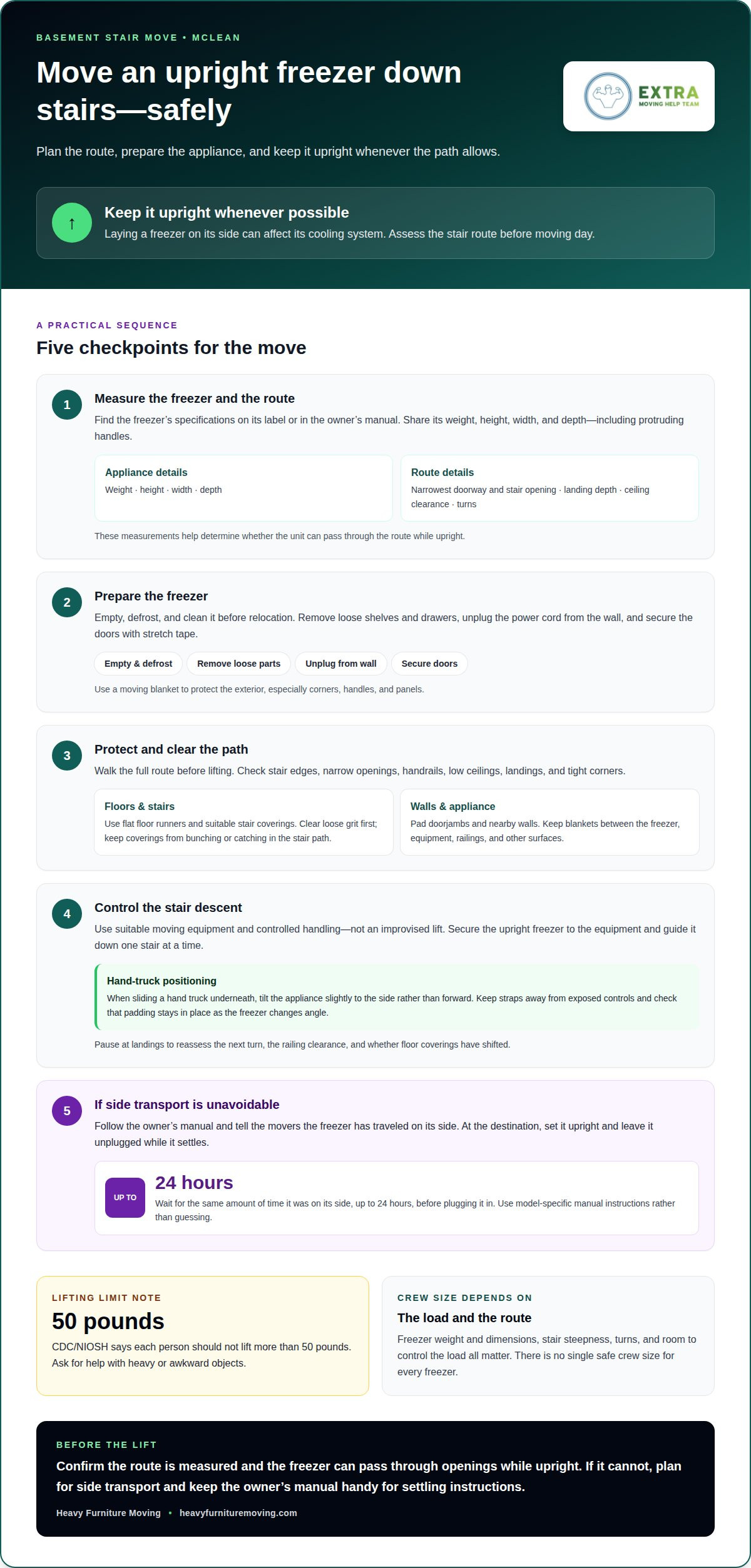
Before the crew arrives, remove the food, defrost and clean the freezer, and take out removable shelves and drawers. Unplug the power cord from the wall. Secure the doors with stretch tape, then protect the exterior with a moving blanket. Tell the movers if the unit has already been laid on its side, because that affects when it can be plugged in.
Freezer Weight and Dimensions
The freezer’s weight and dimensions help movers assess the lift and route. Find its specifications on the appliance label or in the owner’s manual.
Share the freezer’s weight, height, width, and depth, including protruding handles. Also measure the narrowest doorway and stair opening, landing depth, ceiling clearance, and any turn. These details help movers determine whether the freezer can pass while upright. CDC/NIOSH says each person should not lift more than 50 pounds; ask for help with heavy or awkward objects.
There’s no single safe crew size for every freezer. The number of movers depends on the appliance’s weight and dimensions, stair steepness, turns, and room to control the load. The crew needs enough people to guide the unit safely without asking anyone to exceed their lifting capacity.
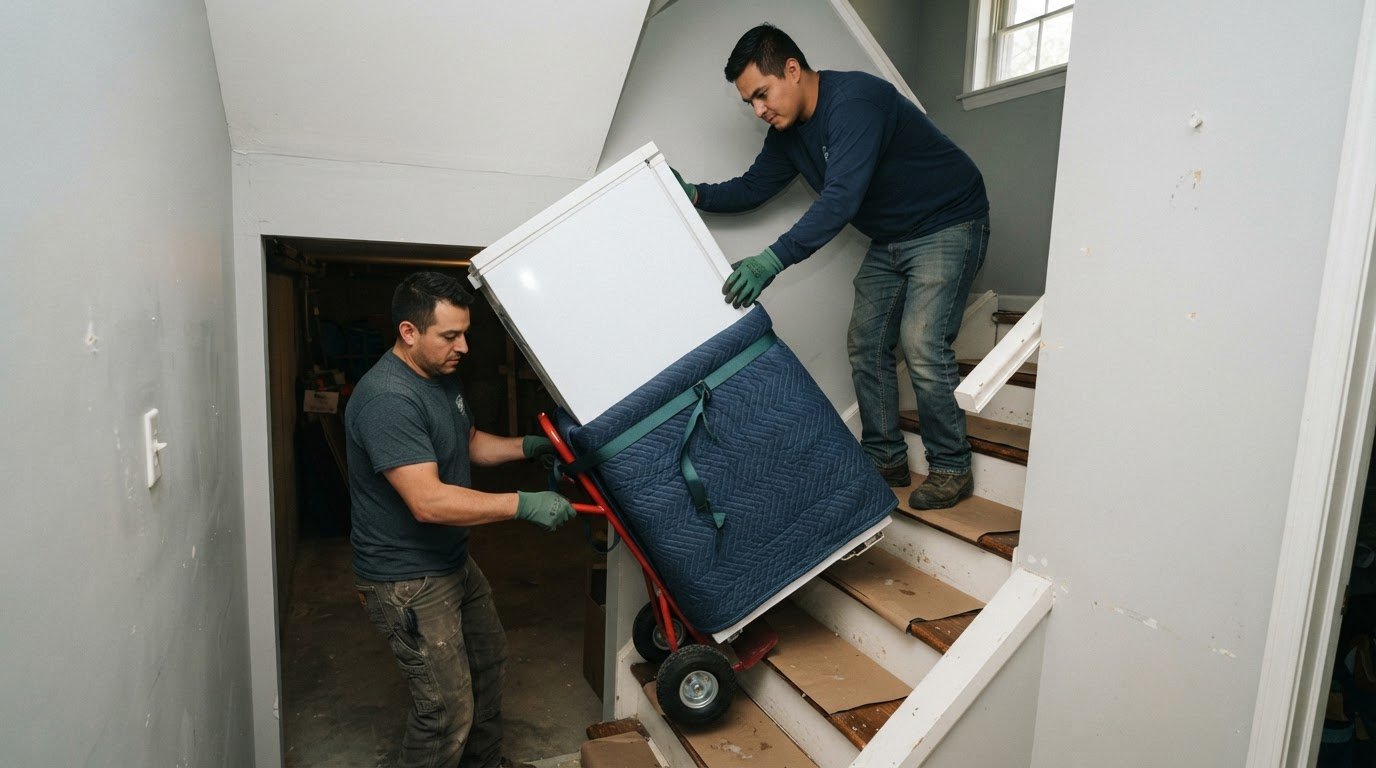
The safest professional approach is to keep the freezer upright, secure it to suitable moving equipment, and control its descent one stair at a time. When sliding a hand truck under it, tilt the appliance slightly to the side rather than forward. A moving blanket helps protect the exterior during handling.
If the freezer travels on its side, set it upright in its final location and wait for the same amount of time it was on its side, up to 24 hours, before plugging it in. Follow the owner’s manual for model-specific instructions.
If the freezer cannot be moved and must be discarded, treat disposal separately from relocation. The applicable McLean or Fairfax County process depends on the disposal method, so don’t assume moving arrangements include appliance disposal.
Treat disconnection and settling as separate checkpoints in the move. Disconnect an existing freezer's power cord from the wall receptacle before relocating it. Once the unit reaches its destination, keep it unplugged if it traveled on its side until it has settled for the appropriate period. Plugging in a freezer before it has settled after being transported on its side can damage the appliance.
Before lifting, confirm that the route has been measured and the freezer can pass through openings while upright. If it cannot, plan for side transport and tell the crew how the unit will be positioned at its destination. Keep the owner’s manual handy for model-specific settling instructions, and follow them rather than guessing.
How professional movers protect floors and the freezer exterior
Basement moves can put hardwood, tile, carpet, doorframes, and appliance panels at risk of scuffs or dents. A careful crew prepares the route and the freezer before lifting. Planning how to safely move a heavy upright freezer down basement steps in McLean means looking beyond the stairs to the entry path, floor transitions, landings, and tight turns.
Before the lift, movers walk the route and note vulnerable surfaces. They check for exposed stair edges, narrow doorways, handrails, low ceilings, and corners where the freezer might make contact. This review helps them place floor runners and padding where needed and identify spots to pause and reposition the load.
- Floor runners: Protective runners cover exposed flooring along the path and stay flat to avoid bunching.
- Stair coverings: Padding protects vulnerable treads and landings during controlled pauses and turns.
- Doorway protection: Covers shield doorjambs and nearby walls when the freezer passes through a tight opening.
- Appliance padding: Moving blankets cushion corners and panels that could touch equipment, railings, or walls.
Surface preparation matters. Grit beneath a runner can still scratch a floor, so clear loose debris first. On tile, lay coverings flat. On carpet, keep the edges clear of the stair path, where a fold could catch a foot or interfere with handling.
The freezer also needs protection around its corners, handles, and controls. Movers keep blankets between the appliance and the hand truck or nearby surfaces. They position straps securely without pressing them across exposed controls. As the freezer changes angle, the crew checks that the padding stays in place.
A landing is a chance to pause and reassess. Movers can check whether a runner has shifted, confirm the freezer is clear of the railing, and coordinate the next turn. Knowing how to safely move a heavy upright freezer down basement steps in McLean means accounting for these transitions, not just covering the longest stretch of floor.
Before the move, describe any delicate flooring, freshly finished surfaces, or tight corners. This helps movers prepare suitable coverings and plan how to guide the unit. After the freezer reaches its destination, the crew can remove protective materials carefully and check the route for shifted coverings or visible contact marks.
If the stairway or flooring needs careful handling, professional moving help can manage the heavy lift while protecting the home along the route.
Risks of laying a freezer on its side
An upright freezer is designed to stand upright, and keeping it vertical during transport helps protect its cooling system. Laying it on either side can allow compressor oil to move into the sealed refrigerant tubing. Starting the freezer before the oil settles can accelerate compressor wear. A tight McLean basement turn may make tilting seem convenient, but it changes the appliance’s orientation and handling risks.
The internal components aren’t the only concern. A freezer resting on its side can shift as movers turn or lower it, changing where its weight presses against the blanket or moving equipment. Contact with a stair edge, doorframe, railing, or basement wall can mark the exterior. On a tight landing, a sudden shift can also make the next movement harder to control.
The main injury risks include back strain, pinched fingers, and falls if someone loses grip on the stairs. Property risks include damage to the freezer’s finish, stair edges, walls, flooring, or nearby railings. The National Institute for Occupational Safety and Health (NIOSH) identifies improper lifting as a cause of back injuries.
Moving downstairs requires particular control because gravity pulls the freezer toward the lower steps. If the unit tips unexpectedly, the person supporting the lower end may have little room to step aside. A narrow stairwell can also trap hands between the freezer and a wall or railing. Movers plan their positions and communication before the appliance starts moving.
Side transport also changes what happens after arrival. Set the freezer upright in its final location and wait for the same amount of time it was on its side, up to 24 hours, before plugging it in. For example, if it traveled sideways for a shorter period, the waiting period matches that time. The owner’s manual provides model-specific recommendations.
Keep the freezer upright whenever the basement route permits. If a doorway or turn appears to require laying it down, professionals assess the opening and stair geometry before choosing that approach. The safer decision depends on the freezer’s shape, available clearance, and ability to maintain control. A difficult turn is not, by itself, a reason to rush or force the appliance onto its side.
Before the move, share the freezer’s model and the route’s tightest points with the movers. Mention steep stairs, a sharp landing turn, or a low ceiling. These details help the crew plan whether the unit can stay upright and where extra control is needed. Don’t start down the stairs until the plan accounts for every step and landing.
Side transport has a specific mechanical risk: lubricating oil can move from the compressor into the sealed refrigerant tubing, and starting the freezer before the oil settles can accelerate compressor wear. The concern links the appliance’s orientation to what happens at startup; it is not limited to the moment the freezer is carried or turned.
How much does a heavy upright freezer weigh and what are its dimensions?
Upright freezers vary in weight and size. The model number, manufacturer’s label, and owner’s manual provide useful specifications. Share those details with the movers so they can assess the appliance and the McLean basement route before moving day.
Find the freezer’s model information on its label or in its manual. Use the listed weight for planning rather than guessing from its appearance. Two freezers with similar exterior dimensions can weigh different amounts. If the label lists both shipping weight and appliance weight, specify which figure you’re sharing. That distinction helps movers plan for the unit itself.
Record the freezer’s full height, width, and depth. Include handles and other parts that extend beyond the cabinet, since the widest point affects clearance. If the model has a curved door, include how far it projects. Give the movers the model number along with the measurements so they can match the figures to the correct freezer.
- Freezer: Share the model number, listed weight, height, width, and depth.
- Doorways: Measure the clear opening, including any narrow point caused by trim or a door standing open.
- Stairs: Describe the narrowest width, headroom, stair direction, and number of steps.
- Landings: Note the landing depth and any turn between the stairway and basement room.
Measure clear space, not just the wall-to-wall opening. A railing, handrail, doorframe, or low ceiling can reduce the usable path. For example, a stairway may look wide at the entrance but narrow beside a projecting handrail. Tell the movers where that pinch point is and note any turn immediately above or below it.
The freezer’s dimensions help determine whether it can pass upright. Compare its height with overhead clearance and its width with the narrowest stair or doorway opening. Depth matters at a landing too: a tall cabinet may clear a straight stair but be difficult to turn in a shallow space. The crew needs measurements for the entire route, not just the basement doorway.
Measurements help with planning, but they don’t replace an in-person assessment of a complex route. A tape measure can record a doorway; it can’t show how much room movers have to guide the freezer through a turn. Share photos of the stairs, landings, and doorways alongside the model details. Include a clear view of the handrail and ceiling above the steps.
Accurate details help movers plan the equipment, handling, and crew needed. Send the manufacturer’s listed weight and route measurements together. This gives the crew a practical basis for assessing the heavy lift instead of relying on the freezer’s appearance.
Equipment for moving a freezer down basement stairs safely
For basement stairs, professionals choose equipment that supports the freezer, controls its angle, and protects the route. An appliance hand truck can help steady the load, while straps and padding help secure and protect the unit. Stair width, landings, and turns determine what equipment can be used safely.
A hand truck needs to fit both the freezer and the route. Movers position it carefully beneath the appliance and secure the load before starting down. When sliding the hand truck under a freezer, tilt the appliance slightly to the side rather than forward. This helps avoid unnecessary pressure on the front of the unit.
- Appliance hand truck: Supports the freezer as movers guide it across landings and down stairs.
- Securing straps: Hold the appliance against the hand truck so it doesn’t shift during a controlled descent.
- Moving blankets: Cushion the exterior against contact with the equipment, walls, and stair railings.
- Floor and stair coverings: Protect exposed surfaces along the route where equipment or the freezer may pass.
Straps must secure the freezer without pressing against vulnerable controls or sharp edges. Movers also check that the blanket stays between the appliance and hand truck. A loose strap or bunched blanket can make the load harder to control, especially when the crew pauses at a landing or changes direction.
Stairs require steady handling, not simply a stronger push. The crew coordinates each movement to keep the hand truck and freezer controlled as they descend. At a tight landing, movers may pause, check the load, and adjust its position before continuing. The space around the hand truck matters as much as the stair width.
Equipment choice depends on the freezer’s dimensions and the basement layout. A hand truck suited to a straight stairway may not work for a sharp turn or narrow landing. Movers assess the approach, clearance, and stair shape before choosing how to support and guide the appliance. They also account for nearby walls and railings.
Tell the moving crew about an unusually narrow stairwell, a sharp turn, or a landing with limited space. Those details help them plan equipment and handling before the freezer reaches the stairs. If the load or route feels difficult to manage, arrange professional heavy-item moving help for a controlled basement move.
Heavy Furniture Moving
Heavy Furniture Moving helps with heavy, bulky household moves when a freezer’s weight, basement stairs, or tight landings make the job difficult to manage alone. Its moving help can take the strain of coordinating the lift and navigating the route, with attention to the appliance and the home. Share the freezer’s model details and describe the stairs, turns, and doorways so the move can be planned around the actual layout. This support is useful when keeping the freezer upright or protecting floors requires careful handling. For help with your freezer move, contact Heavy Furniture Moving.
Make the Next Move Easier
Planning how to safely move a heavy upright freezer down basement steps in McLean starts with deciding who should handle the lift. If the route feels too tight or the appliance too awkward to control, experienced moving help can reduce the strain and help prevent avoidable damage to your home.
Heavy Furniture Moving provides local moving help, exercise equipment moving, and sofa hoisting for demanding household moves. Its teams handle bulky items and challenging routes. Share what makes your freezer move difficult so the crew can plan for the specific job.
You don’t need to turn a heavy basement move into a solo project. Contact Heavy Furniture Moving for help, and take the next step toward getting your freezer downstairs with less stress.
Frequently Asked Questions
Can an upright freezer be transported on its side or must it stay upright?
Keep an upright freezer upright whenever the route allows. Side transport may be necessary for a tight opening, but follow the owner’s manual for guidance on the specific model. For example, if the freezer clears a doorway upright, that avoids the extra handling and settling time associated with side transport. Make sure the destination is accessible so movers can place the unit upright before reconnecting it.
When should you hire professional appliance movers for basement stairs?
Hire professional movers when the freezer is too heavy or awkward to control, or when the stairs have a sharp turn, narrow landing, or limited clearance. A freezer can be difficult to steady while descending, even if it fits through the doorway. Heavy Furniture Moving provides help with challenging household lifts. Share the freezer’s model and route details so the crew can plan around the obstacles.
What do appliance movers charge for moving a freezer down stairs in McLean, Virginia?
The price depends on the case and is provided after a quote request. Factors include the freezer’s size, the stairs, the distance through the home, and the handling needed to protect the route. Heavy Furniture Moving offers upfront quotes before work begins. Its pricing structure varies by job, so the details of a basement move determine the quote rather than a general stair-moving estimate.
Frequently Asked Questions
Keep an upright freezer upright whenever the route allows. Side transport may be necessary for a tight opening, but follow the owner’s manual for guidance on the specific model. For example, if the freezer clears a doorway upright, that avoids the extra handling and settling time associated with side transport. Make sure the destination is accessible so movers can place the unit upright before reconnecting it.
Hire professional movers when the freezer is too heavy or awkward to control, or when the stairs have a sharp turn, narrow landing, or limited clearance. A freezer can be difficult to steady while descending, even if it fits through the doorway. Heavy Furniture Moving provides help with challenging household lifts. Share the freezer’s model and route details so the crew can plan around the obstacles.
The price depends on the case and is provided after a quote request. Factors include the freezer’s size, the stairs, the distance through the home, and the handling needed to protect the route. Heavy Furniture Moving offers upfront quotes before work begins. Its pricing structure varies by job, so the details of a basement move determine the quote rather than a general stair-moving estimate.