How to Hoist a Sectional Through McLean Sliding Glass Doors
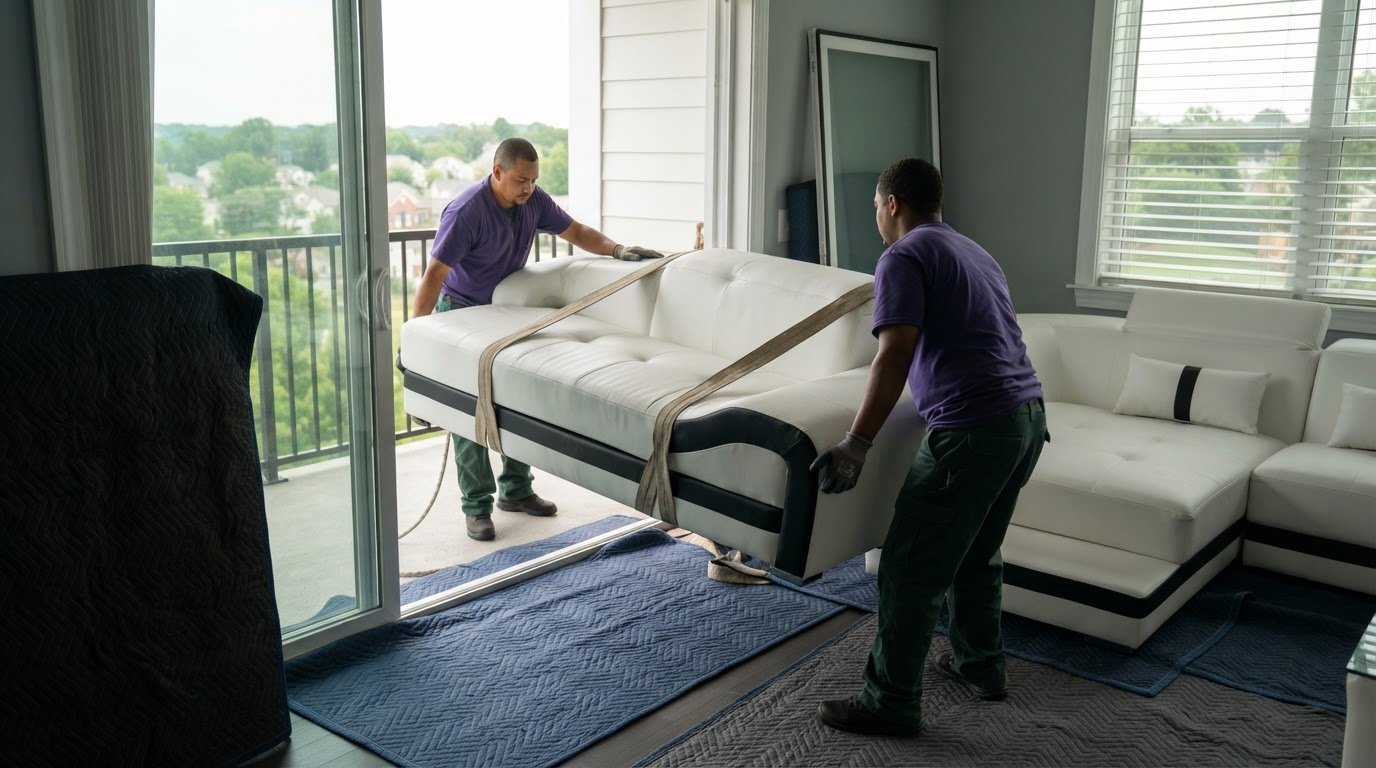
You don’t always have to disassemble a sectional to get it through an apartment sliding glass door, but separating its pieces often makes the route easier to manage. To work out how to hoist a heavy sectional couch through an apartment sliding glass door in McLean, measure the opening and each section first. Then check whether a controlled tilt-and-pivot can clear the tightest point.
A large sectional can stretch from 110 to over 160 inches across its longest dimension, so carrying it in one piece may be a nonstarter in an apartment. That doesn’t mean you’re stuck. Removable legs, detachable sections, and a patio-door route can change what fits, but the door opening, the turn beyond it, and the couch’s shape all matter.
This guide explains how to measure the couch and route, decide whether to separate the sectional, and attempt a tilt-and-pivot without rushing the lift. You’ll also learn when a sliding glass door may offer a better path and when professional sofa hoisting can make a bulky move easier to manage.
Key Takeaways
- Measure the tightest point in the route, including the space available for a turn, not just the doorway opening.
- Removing a door slab can add 1.5 to 2 inches of horizontal clearance when a narrow opening is the obstacle.
- Compare each sectional piece’s diagonal depth with the opening to see whether angling it could help.
- Consider a sliding glass door or window route only after checking the full path and how the panel can be handled safely.
- When the sectional is too heavy or the route feels difficult to control, sofa hoisting can help with the move.
Removing a door from its hinges for extra clearance
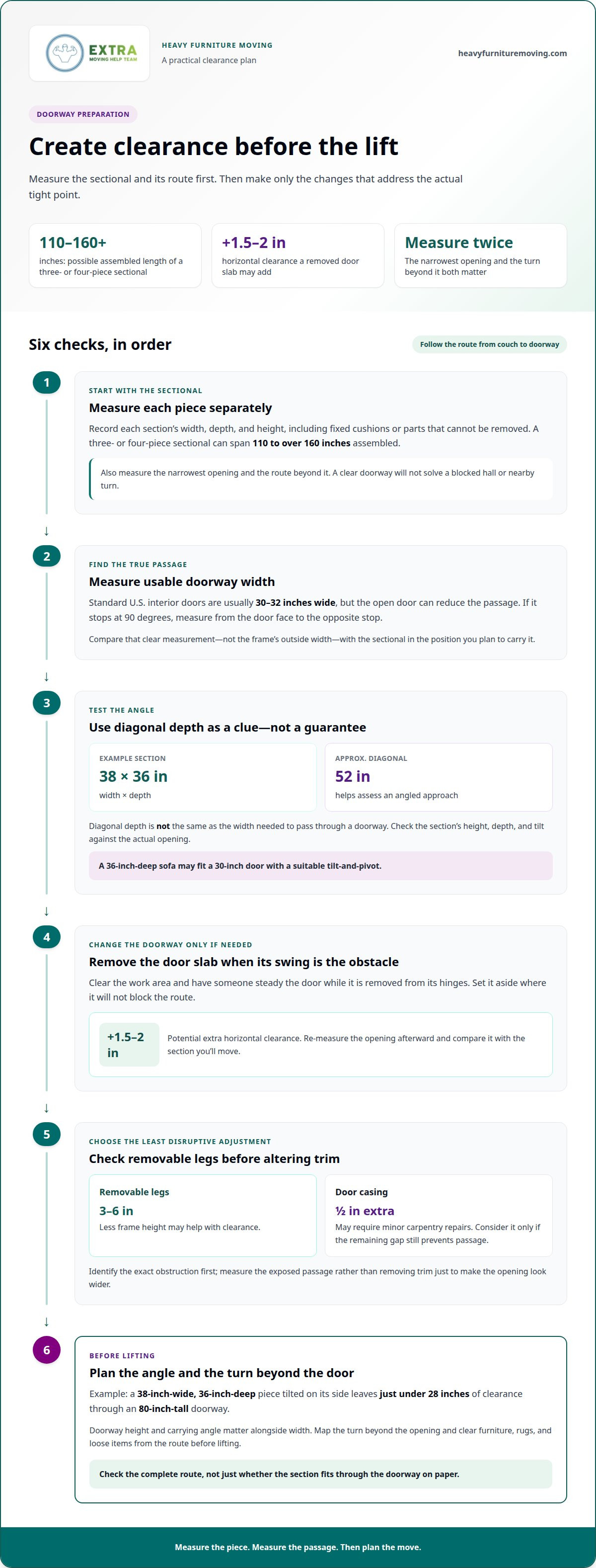
- Measure the sectional before changing the doorway. A three- or four-piece sectional can span 110 to over 160 inches assembled, so measure each piece separately if it disconnects. Record each section’s width, depth, and height, including fixed cushions or other parts that cannot be removed. Then measure the narrowest opening and the route beyond it. A clear doorway won’t help if a hall or nearby turn blocks the piece.
- Measure the actual usable doorway, not just the frame. Standard interior doors in the United States are usually 30 to 32 inches wide, but the open door can reduce the passage. If it stops at 90 degrees, measure from the door face to the opposite stop. Write down that clearance and compare it with the sectional’s dimensions in the position you plan to carry it.
- Check the section’s diagonal before deciding it cannot pass. For a 38-inch-wide, 36-inch-deep piece, the diagonal is approximately 52 inches. That measurement helps you assess angled approaches, but it isn’t the same as the width needed to pass through a doorway. Test how the section’s height, depth, and tilt affect the actual opening. A 36-inch-deep sofa may fit a 30-inch door with a suitable tilt-and-pivot.
- Remove the door slab only if its swing is the obstacle. Taking a door off its hinges can add 1.5 to 2 inches of horizontal clearance. First, clear the work area and have someone steady the door while you remove it. Set the slab aside where it won’t block the route. Re-measure the opening afterward, then compare the new clearance with the sectional section you’ll move through.
- Consider the casing only if the remaining gap still prevents passage. Removing door casing may add an extra half-inch, but it can require minor carpentry repairs. Don’t remove trim just to make the opening look wider; measure the exposed passage and identify the exact obstruction first. If legs are removable, taking them off can reduce frame height by 3 to 6 inches, which may help more than altering the trim.
- Plan the lift around the new opening and the section’s shape. A 38-inch-wide, 36-inch-deep piece tilted on its side leaves just under 28 inches of clearance through an 80-inch-tall doorway. Use that example to see why doorway height and carrying angle matter alongside width. Before lifting, map the turn beyond the door and clear furniture, rugs, and loose items from the route.
Using a window or sliding glass door as an alternative route
McLean apartments don’t all follow the same move rules, so ask building management whether balcony moves or furniture hoisting are allowed. Compare the patio opening with the standard 32-inch front door before choosing a route.
-
Check Whether Apartment Moves Are Allowed
Ask building management about furniture hoisting, balcony access, and move-day procedures before planning an exterior route. Clarify whether the building permits moving a sectional through a patio door or window and whether shared areas must remain clear. Follow the building’s instructions: a balcony is not automatically an approved entrance.
-
Use a Sliding Door as an Alternate Entry
Measure the patio door’s usable opening with the sliding panel open, then compare it with the sectional piece in its planned carrying position. Measure the approach from outside, too. A wide opening can still be hard to use if a railing, narrow patio, or sharp turn blocks the path. Check the entire route before moving furniture toward the glass.
- Compare the patio route with the front entrance, not just the door widths. A sliding glass door may offer a different clearance than the front entrance, so measure both openings. Measure the clear passage rather than the full frame. Include the doorway height and nearby walls, rails, and furniture in your route sketch.
- Choose the sectional piece that can pass through the opening most cleanly. If the couch separates, plan each piece as a separate load and identify where it can turn after crossing the threshold. Keep the piece controllable, and don’t force it against the door frame. The route must leave enough room for the people carrying it, not just fit on paper.
- Protect the glass and clear the patio before carrying anything through. Move planters, chairs, and loose items out of the way, then secure the sliding panel in its open position. Don’t brace against the panel or push the sectional against the glass. Have one person guide the leading end and watch the frame.
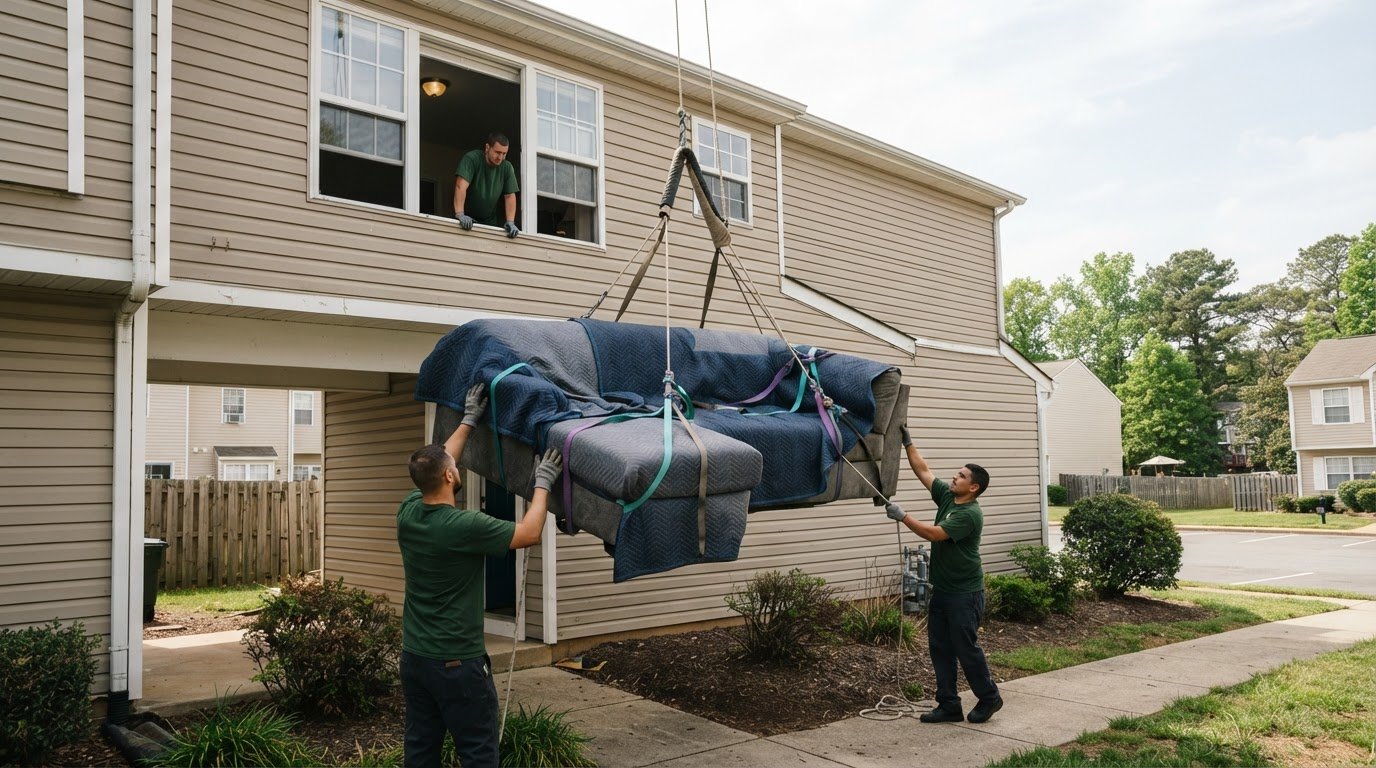
- Make the decision before lifting. If the patio route requires a balcony move that building management doesn’t allow, use an approved entrance instead. If the sectional is bulky and the route calls for a controlled exterior lift, professional sofa hoisting can help handle that part of the move.
Measuring sofa diagonal depth against doorway width
- Measure each sectional piece on its own, not only the assembled couch. Record the widest points across the front and the full depth from front edge to back. Separate sections typically measure 35 to 45 inches wide and 35 to 40 inches deep. Include any fixed arms or cushions that change the piece’s outline. These measurements show which section presents the tightest fit.
- Measure the doorway’s clear width at its narrowest point. A sectional doorway is about 36 inches wide, but the usable opening can be smaller when a door or hardware reduces the passage. If the door opens only 90 degrees, measure from its face to the opposite stop. Use that clear width for your comparison, not the frame’s outside measurement.
- Calculate the piece’s diagonal across its width and depth. Square each measurement, add the results, then find the square root. For a 35-inch-by-35-inch section, the diagonal is about 49.5 inches. This gives you a useful comparison for angled positioning, but it doesn’t mean the entire diagonal must pass through the doorway at once.
- Check the section in the position you plan to carry it. Turn it so one edge leads, then consider the width and height the doorway allows in that orientation. Compare those clearances with the section’s profile, including its arms and back cushions. A diagonal measurement can help assess whether angling may work, but the doorway’s height and available turning space matter, too.
- Measure the route immediately beyond the opening. A section that clears the doorway can still be blocked by a wall, narrow hall, or sharp turn. Mark the door swing and the direction the piece must rotate. A 90-degree turn close to the threshold can restrict the angle, so compare the turning space with the section’s length before lifting.
- Use your measurements to decide whether to separate the sectional or change its orientation. If one section is wider or deeper than the others, test that piece first with a careful rehearsal, without lifting it. Clear the path and decide where each carrier will stand. The diagonal is just one part of the fit test: check the opening, height, and turn together.
Tilt-and-pivot couch maneuver
- Clear the floor and map the turn before lifting. A sharp 90-degree turn immediately beyond a doorway can stop a couch from fitting, even when the opening seems wide enough. Move loose items out of the approach, then identify where the couch can rotate. Keep the path clear so carriers can reposition without stepping over obstacles.
- Choose two people and agree on simple commands before starting. Both carriers need a firm grip and a clear view of the couch’s edges. One person guides the leading end through the opening while the other controls the trailing end. Pause before each change of direction. Move together, and don’t twist while carrying a loaded end.
- Start with the couch upright and approach the doorway squarely. A 36-inch-deep couch may fit through a 30-inch door using the tilt-and-pivot technique. Raise one end while lowering the other, so the couch’s profile changes as it crosses the threshold. Keep the motion controlled rather than forcing the frame against the jamb.
- Feed one end through first, then pivot the couch around the door frame. As the leading end clears, rotate the piece gradually while the second carrier supports the opposite end. A couch that is 34 inches high may still fit through a 32-inch-wide doorway with an appropriate maneuver. The route beyond the opening must allow that turn.
- Watch the corners and stop if the frame catches. A sectional arm or back can hit the wall before the main body clears. Lower the piece, reset the angle, and try a smaller pivot instead of pushing harder. Keep hands clear of pinch points between the couch and doorway. Move only when both carriers are ready.
- Match the crew to the section’s weight and shape. Three people are preferable for chaise sections and corner pieces. Three are also preferable for pieces over 90 pounds or longer than 65 inches. Don’t attempt a two-person pivot with a load that needs more control.
- Once the couch clears the threshold, pause before turning toward its final position. Check that the entire section has passed the frame, then lower it together. If a tight turn blocks the maneuver, change the route or separate the sectional instead of forcing it around the corner.
How to remove a sliding glass door panel safely for furniture access
- Identify the sliding panel and its operating hardware before handling it. Look for visible fasteners, adjustment points, or labels on the frame. Sliding door designs differ, so don’t assume every panel lifts out the same way. If the removal method isn’t clear, follow the manufacturer’s instructions for that specific panel.
- Prepare the opening and landing area before moving the panel. Clear furniture, rugs, and loose items from both sides of the patio door. Choose a stable place to set the panel where it won’t block the route. Keep the sectional away until the glass panel is removed and the opening is ready.
- Ask another adult to help control the panel. Glass panels are awkward to handle, so one person should guide the top while the other supports the lower edge. Agree on where to grip and where to set the panel down. Keep fingers clear of the track and frame as the panel moves.
- Use the panel’s intended release method rather than prying at the frame. If the design uses adjustment screws or a removable stop, identify each part before changing anything. Keep removed hardware together so it doesn’t get lost. Stop if the panel binds, shifts unexpectedly, or requires force. Forcing it can damage the door or make the panel harder to control.
- Lift or angle the panel only as its design allows. Keep it upright and supported by both people while clearing the track. Don’t let one edge swing freely or rest the glass against a wall. If the panel won’t move smoothly, return it to a stable position and reassess the release method instead of pushing through resistance.
- Set the panel on a stable, protected surface away from the sectional’s path. Keep it upright and secure, then check the exposed track for debris or hardware. Measure the clear opening again before carrying furniture through. A larger opening helps only if the couch and its carriers can pass through safely.
- Reinstall the panel using its intended fitting method after the furniture move. Check that it sits correctly in the track and slides as expected. If handling the sectional is the harder part, arrange in-home furniture moving help for the carry through the prepared opening.
Heavy Furniture Moving: Movers Near Me
Heavy Furniture Moving provides Sofa Hoisting for bulky couches that need a carefully planned route through a tight apartment or patio opening. Consider this service when the sectional’s size, weight, or awkward approach makes the lift difficult to manage. For furniture already inside the home that needs repositioning, in-home furniture movers can help with the heavy handling.
Share the couch’s dimensions, the route, and any tight turns when describing the move. That helps keep the plan focused on the real obstacle, whether it’s the patio threshold or the path beyond it. If you’d like help with your sectional, contact Heavy Furniture Moving.
Make Your Moving Plan Before Moving Day
If you’re planning how to hoist a heavy sectional couch through an apartment sliding glass door in McLean, decide on the route before the couch is in motion. Choose who will coordinate the lift, keep the path clear, and guide the sectional through the tightest point. A calm, shared plan helps everyone move deliberately instead of making rushed adjustments mid-carry.
If you’d rather leave the heavy handling to a moving crew, choose support suited to the task. Heavy Furniture Moving provides Sofa Hoisting, along with Movers Near Me and Exercise Equipment Moving. Share details about your sectional and access route to plan the next step.
Connect with Heavy Furniture Moving about your sectional move, and take the next step with a plan that feels manageable.
Frequently Asked Questions
Do I have to disassemble my sectional to move it?
No, you don’t always have to disassemble a sectional. A small two-piece couch may pass assembled if the route has a wide opening. Separate the sections when connected pieces make the couch too long or difficult to turn. Check the connectors before moving, and keep removed hardware together so you can reconnect the sections after they reach the room.
How do I measure a sectional couch and sliding glass door opening before moving?
Measure each movable section at its widest, tallest, and deepest points, including fixed arms and attached cushions. Measure the sliding door’s actual open passage, not the full frame. Also note the distance from the doorway to the first wall or turn. For example, a wide patio opening may still be unusable if the sectional can’t rotate into the adjoining room.
Can a sectional couch be disassembled to fit through an apartment sliding door?
Often, yes, if the sections connect with detachable brackets or similar fittings. Inspect the underside and connection points before moving, and follow the couch maker’s instructions to avoid damaging the frame. Some designs separate into seats, a corner piece, and a chaise; others have fixed components. Keep removed fasteners in a labeled bag and protect exposed connectors during the carry.
How do I hoist a heavy couch through a balcony or sliding glass door safely?
Use an approved route and coordinate the crew, with one person directing the move and clear signals agreed upon beforehand. Keep the couch controlled throughout the lift, and don’t let it swing toward glass, railings, or people below. When planning how to hoist a heavy sectional couch through an apartment sliding glass door in McLean, decide on the approach and landing area before lifting.
What equipment is needed to lift a sectional couch through a sliding glass door?
Use sturdy moving blankets to protect the couch and nearby surfaces, plus ratchet straps to secure wrapped sections during handling. A suitable handhold and clear landing area matter, too. Heavy Furniture Moving includes wrap, blankets, and straps on every job. Don’t improvise lifting equipment from household objects, since unstable supports can shift while the sectional is being carried.
Is it safe to hoist furniture from an apartment balcony, and what are the risks?
Balcony hoisting is appropriate only when the building permits the route and the lift can be controlled from start to finish. Risks include a dropped or swinging couch, building damage, and injury to people near the lift. Keep the balcony and area below clear, and don’t attempt an improvised lift over a railing. Use an approved entry route instead.
How much does professional furniture hoisting or sofa delivery cost in McLean, VA?
The price depends on the job and is provided after a quote request. Cost factors include the sectional’s size and weight, the access route, stairs or landings, and whether the move needs hoisting or other handling. Share clear details about the couch and entry points when requesting a quote. That helps match the estimate to the actual work rather than a generic delivery.
Who should I choose for sectional couch hoisting in McLean, VA?
Heavy Furniture Moving provides Sofa Hoisting and Movers Near Me for heavy residential furniture moves. Local service includes McLean, Fairfax, Woodbridge, Manassas, Manassas Park, Aldie, Ashburn, Vienna, Reston, Centreville, Chantilly, Clifton, Dumfries, South Riding, Fairfax Station, Haymarket, and Gainesville. Wrap, blankets, and straps are included on every job. Share a photo of your sectional and access route to discuss the move.
Frequently Asked Questions
No, you don’t always have to disassemble a sectional. A small two-piece couch may pass assembled if the route has a wide opening. Separate the sections when connected pieces make the couch too long or difficult to turn. Check the connectors before moving, and keep removed hardware together so you can reconnect the sections after they reach the room.
Measure each movable section at its widest, tallest, and deepest points, including fixed arms and attached cushions. Measure the sliding door’s actual open passage, not the full frame. Also note the distance from the doorway to the first wall or turn. For example, a wide patio opening may still be unusable if the sectional can’t rotate into the adjoining room.
Often, yes, if the sections connect with detachable brackets or similar fittings. Inspect the underside and connection points before moving, and follow the couch maker’s instructions to avoid damaging the frame. Some designs separate into seats, a corner piece, and a chaise; others have fixed components. Keep removed fasteners in a labeled bag and protect exposed connectors during the carry.
Use an approved route and coordinate the crew, with one person directing the move and clear signals agreed upon beforehand. Keep the couch controlled throughout the lift, and don’t let it swing toward glass, railings, or people below. When planning how to hoist a heavy sectional couch through an apartment sliding glass door in McLean, decide on the approach and landing area before lifting.
Use sturdy moving blankets to protect the couch and nearby surfaces, plus ratchet straps to secure wrapped sections during handling. A suitable handhold and clear landing area matter, too. Heavy Furniture Moving includes wrap, blankets, and straps on every job. Don’t improvise lifting equipment from household objects, since unstable supports can shift while the sectional is being carried.
Balcony hoisting is appropriate only when the building permits the route and the lift can be controlled from start to finish. Risks include a dropped or swinging couch, building damage, and injury to people near the lift. Keep the balcony and area below clear, and don’t attempt an improvised lift over a railing. Use an approved entry route instead.
The price depends on the job and is provided after a quote request. Cost factors include the sectional’s size and weight, the access route, stairs or landings, and whether the move needs hoisting or other handling. Share clear details about the couch and entry points when requesting a quote. That helps match the estimate to the actual work rather than a generic delivery.
Heavy Furniture Moving provides Sofa Hoisting and Movers Near Me for heavy residential furniture moves. Local service includes McLean, Fairfax, Woodbridge, Manassas, Manassas Park, Aldie, Ashburn, Vienna, Reston, Centreville, Chantilly, Clifton, Dumfries, South Riding, Fairfax Station, Haymarket, and Gainesville. Wrap, blankets, and straps are included on every job. Share a photo of your sectional and access route to discuss the move.