Sofa Hoisting Through Sliding Glass Doors in McLean
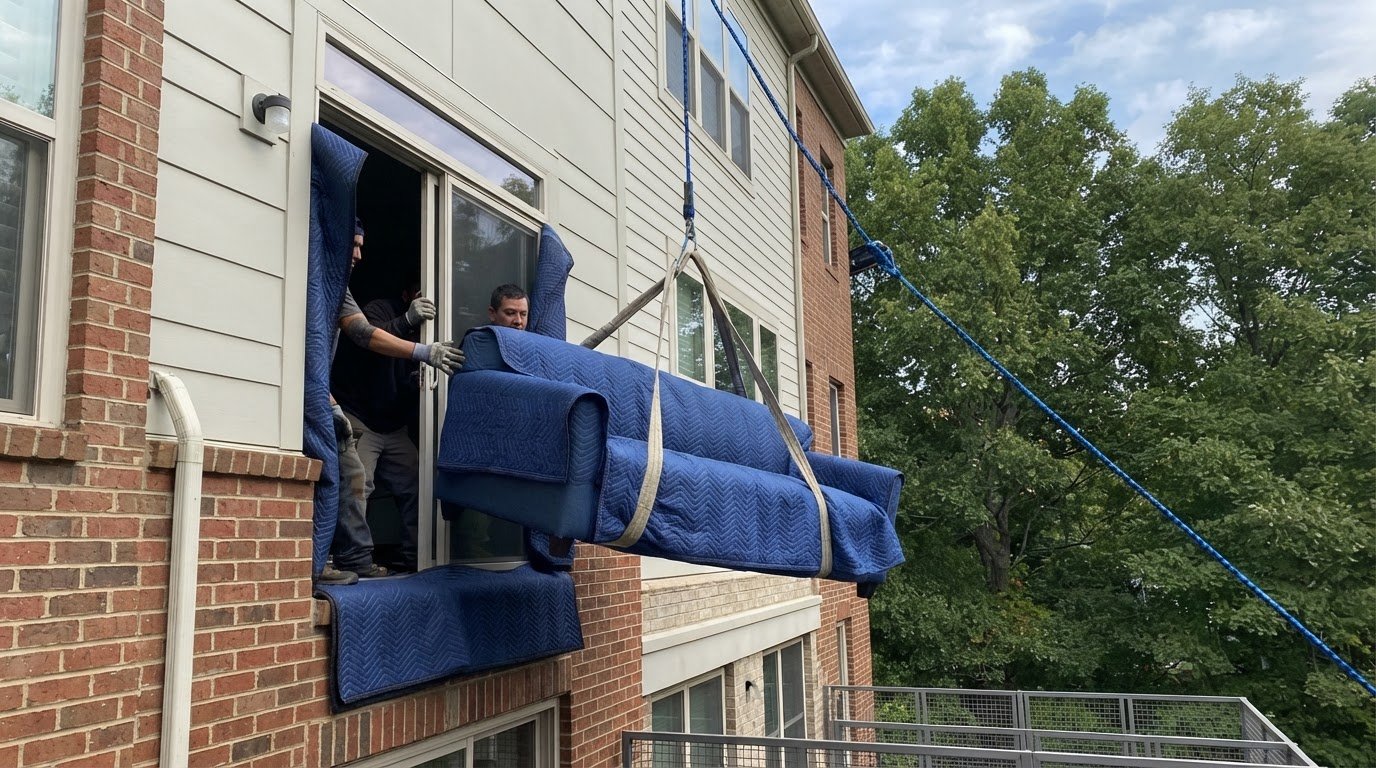
A sofa that won’t fit through a stairwell or hallway may still reach an upper-floor room. A sofa hoisting service through sliding glass doors in McLean can move it from outside when the opening, sofa dimensions, and access conditions allow a safe route. The key is to plan the lift around the furniture and building, rather than forcing it through a tight interior path.
It’s reasonable to worry about the glass, the sofa’s upholstery, and the space around the landing. Careful measurements and protective materials help address those concerns before the lift begins.
This guide explains how the opening and sofa dimensions shape the plan, how the team protects the furniture and home, and how the sofa is guided to its final position. You’ll also learn what details help determine whether hoisting is practical for your home.
Key Takeaways
- Furniture can sometimes be hoisted through an upper-floor opening when the access route and item dimensions make the lift workable.
- Building access, the sofa’s size, and the landing area all shape the hoisting plan.
- Protective materials and suitable lifting equipment help safeguard the furniture and nearby surfaces during the move.
- Planning the final placement in advance helps guide the sofa safely from the opening into the room.
- When stairs and standard entryways are too tight, sofa hoisting can offer another way to get bulky furniture into place.
Can you hoist furniture through a window on an upper floor?
Yes, a sofa can sometimes be hoisted through an upper-floor window or sliding glass door in McLean, Virginia. Heavy Furniture Moving’s sofa hoisting service through sliding glass doors in McLean assesses the opening, sofa dimensions, exterior access, and landing space before planning the lift.
Homeowner insurance doesn’t automatically establish coverage for furniture hoisting or property damage. Coverage depends on your policy terms and the circumstances and cause of any damage.
Reviews for furniture hoisting companies in McLean, Virginia, can offer insight into customers’ reported experiences. Look for comments about similar work, such as moving a sofa through a balcony opening, protecting surfaces, and placing furniture indoors.
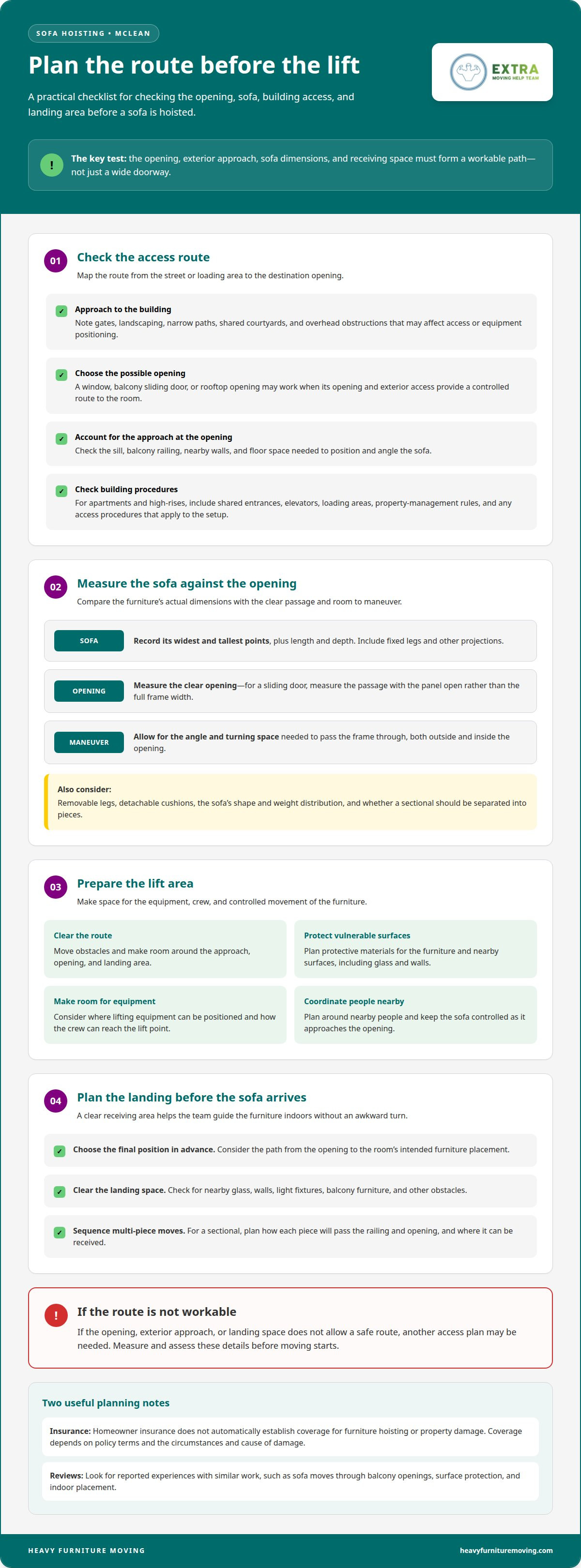
The route matters as much as the opening. A wide sliding door may seem suitable, but the balcony railing, nearby walls, and space to position the sofa can affect the approach. A window may work if its opening and exterior access provide a controlled path. A rooftop opening may also be an option if it connects directly to the destination and provides workable access.
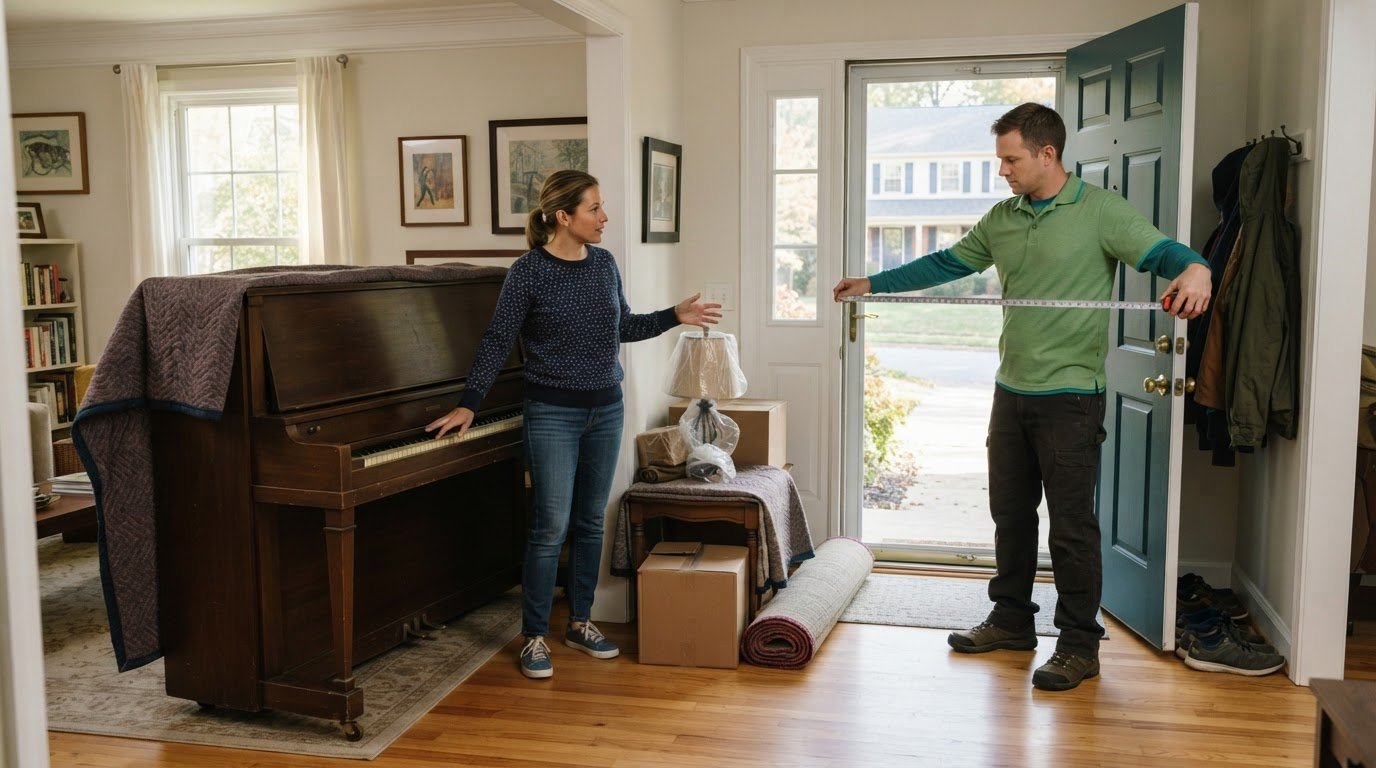
Each hoist starts with a practical assessment. The crew measures the sofa at its widest and tallest points, then compares those dimensions with the clear opening. They also consider projecting legs, detachable cushions, and the angle needed to pass the frame through. If the sofa must be tilted, there needs to be enough room to maneuver on both sides of the opening.
- Window: The opening, sill, and exterior approach must allow a manageable path for the sofa.
- Balcony: The railing and available floor space affect how the item approaches the doorway.
- Rooftop opening: The access route must connect sensibly to the room where the furniture will go.
Balcony hoisting requires planning for both the exterior approach and the interior landing. A sectional, for example, may need to be separated into pieces before lifting. The crew plans where each piece will pass, how it will clear the railing, and where it can be received without crowding the doorway. This sequence helps avoid awkward turns near glass and walls.
A workable plan also accounts for people nearby and movable obstacles. The team clears the path, protects vulnerable surfaces, and coordinates the lift to keep the sofa controlled as it reaches the opening. If the opening, exterior approach, or landing space doesn’t allow a safe route, another access plan may be needed. Measuring these details first turns an uncertain upper-floor move into a defined set of steps.
Planning hoists around building access, item size, and safety requirements
A sound hoist plan starts with the building route and the sofa’s actual dimensions. Checking both helps the team plan the equipment setup, crew access, and safe placement.
Property and Access Assessment
An advance assessment maps the route from the street or loading area to the destination opening. The crew considers gates, landscaping, balconies, overhead obstructions, and the space needed to position lifting equipment. A narrow side path, for example, can affect where the team approaches a townhouse, while a shared courtyard can shape how furniture reaches an apartment building.
Measurements should cover the sofa’s widest points and the clear opening, including room to angle or turn it. The plan also accounts for the landing area, nearby glass, and obstacles such as light fixtures or balcony furniture. These checks help identify a workable path before moving starts, rather than uncovering a tight turn during the lift.
Apartment Access and Building Rules
Apartment and high-rise access adds shared entrances, elevators, loading areas, and building procedures to the assessment. The team plans around the route available for the sofa and lifting equipment, including access limits set by property management. A service entrance, for example, may offer a clearer path than a busy lobby.
For furniture hoisting in McLean, permit needs and building rules depend on the setup and property. Relevant considerations include where equipment will stand, whether it uses shared or public space, and what access procedures the building requires. Account for those requirements before moving day.
The sofa’s size also shapes the work sequence. A long sofa may need a different angle than a compact loveseat, while removable legs can change the clearance needed. The crew considers the furniture’s shape, weight distribution, and planned landing position together. A clear receiving area gives the team room to guide the sofa through the opening without an awkward turn.
- Access: Map the approach, entrance, and route to the lift point.
- Furniture: Compare the item’s dimensions with openings and turning space.
- Safety: Plan the setup around nearby people, surfaces, and obstacles.
For a home with complicated access, a planned furniture hoist can be organized around the specific route and item. A clear assessment gives the crew practical details to build the move around, from apartment entry to final positioning.
Hoisting oversized furniture that will not fit through standard entryways
Hoisting can help when a sofa’s frame cannot turn through a hallway, stairwell, or doorway. It may also suit a large sectional going to an upper-floor room. The route still needs a usable exterior opening and enough space to receive the furniture. A careful assessment compares the sofa’s shape with the entire route, not just the doorway.
Before choosing a hoist, compare the available opening with the sofa’s measurements. Record its length, depth, and height, including fixed legs or other projections. Measure the sliding door’s clear passage with the panel open, rather than relying on the full frame width. Consider how the sofa must tilt or rotate as it passes through. A close fit on paper can still leave too little room to maneuver.
Hoisting and removing a sliding door or window are different approaches. A hoist uses an exterior route to move furniture through an opening, while removal changes the opening itself. The safer practical choice depends on the opening, the building, and the sofa’s path; either approach should account for the glass, frame, and surrounding surfaces.
Wrap, blankets, and straps are included on every Heavy Furniture Moving job, helping protect upholstery and exposed edges during handling. The crew can secure loose cushions, cover the fabric, and pad corners before moving the sofa. For a sofa with wooden feet, protecting the legs can help limit scuffs. Protective materials must stay secure without blocking the points used to control the lift.
- Measure: Capture the sofa’s full dimensions and the door’s clear opening.
- Prepare: Remove detachable parts when that makes the item easier to handle.
- Protect: Cover upholstery and vulnerable edges before the move.
Same-day sofa hoisting in McLean depends on scheduling and the work required at the site. The crew, lifting setup, access route, and building procedures all affect whether the job can be arranged that day. A move needing advance coordination differs from one with a clear path and straightforward access.
Hoisting is most useful when an oversized sofa has no workable interior route but a suitable exterior opening remains. A long couch, for example, may pass more directly through a balcony door than around a narrow stair landing. The decision depends on the item’s dimensions, the angle required, and the space available to guide it indoors. Comparing these factors helps avoid solving the doorway problem only to create a harder one at the landing.
Specialty lifting equipment and protective materials
The equipment setup and protective preparation should suit the sofa, opening, and lift path. Each helps control the item and protect nearby surfaces during the move.
Rigging Equipment and Lifting Techniques
Rigging connects the sofa to the lifting setup and helps control its position. The crew considers the sofa’s shape, weight distribution, and where lifting straps can support it. A broad sectional may need a different arrangement from a compact loveseat. The lift path also affects how the sofa is angled and guided toward the opening.
Before lifting, the team checks that the sofa is secured and the route is clear. During the hoist, crew members coordinate to keep the item from swinging toward a wall or door frame. They guide it steadily, adjusting its orientation to pass through the opening and reach the receiving area safely.
Protective Preparation and Materials
Preparation starts by covering the upholstery and padding exposed corners, arms, and legs. A fabric sofa, for example, needs a secure cover that stays in place as the item moves. The crew also considers the doorway, floor, and nearby walls, placing protection where the sofa could brush against a surface. Wrap, blankets, and straps are included on every job.
Loose cushions and detachable parts can shift during a lift. Securing or removing them helps keep the sofa manageable. Protective layers should not interfere with strap placement or block the crew’s grip. The sofa needs coverage while leaving the lifting points accessible.
The setup should suit the lift, rather than rely on a one-size-fits-all arrangement. A sofa with a narrow frame may need its support positioned differently from one with wide arms. The crew considers how straps contact the furniture, whether padding could bunch up, and how the item will pass the opening. These details help prevent shifting or snagging the fabric.
- Before lifting: Secure loose cushions and cover upholstery and exposed edges.
- At the opening: Keep nearby glass, frames, and walls protected.
- During movement: Coordinate the lift and guide the sofa without abrupt turns.
Clear communication supports every step. The crew coordinates who guides the sofa and who monitors the lifting setup, especially as the item nears a doorway or balcony opening. If the sofa shifts position, the team pauses and adjusts its handling rather than forcing it through. Rigging and protective materials work together: one supports control, while the other helps protect the furniture and home.
Item placement and final safety check
Once the sofa reaches the sliding door, the crew focuses on controlled entry and placement. The landing area should be clear before the lift, along with a route from the doorway to the intended spot. That preparation gives the team room to guide the sofa without rushing the final turn.
As the sofa passes through the opening, movers coordinate its angle and movement. One person can guide the frame while another watches its clearance near the door track, wall, and ceiling. If the sofa needs to rotate, the team makes small, deliberate adjustments instead of forcing a tight turn.
After the sofa is inside, the crew guides it along the planned route. A rug edge, coffee table, or narrow gap between furniture can interrupt the move, so address those obstacles before carrying continues. Clearing a direct path from the door to a living-room wall, for example, makes it easier to position a long sofa without repeated turns.
Placement should follow the agreed room layout. The crew can orient the sofa toward the intended wall or seating area, then adjust its position to leave usable space around nearby furniture. Check that doors open fully and walkways remain clear. A sofa placed near a sliding door, for instance, should not block access to its handle or track.
- Check the frame: Look for visible marks or damage after protective materials are removed.
- Check the route: Make sure the doorway, floor, and nearby walls remain clear.
- Check the position: Confirm the sofa sits where intended and doesn’t obstruct a walkway.
The final safety check includes the opening and surrounding area. The crew checks for loose padding, straps, and other materials, then clears them from the doorway. The sliding door should move freely, with no equipment or debris near its track. These simple checks help leave the room ready to use after the lift.
For a sectional, check each piece separately. Confirm that the sections are in the intended order and that connectors or removable parts are accounted for. If cushions moved during lifting, return them to their places and check that they sit securely. A final look from the doorway can reveal a crooked section or blocked path that’s harder to notice up close.
Keep the destination clear and the placement instructions straightforward. To arrange help with a planned sofa lift and room placement, request sofa hoisting service.
Heavy Furniture Moving: Sofa Hoisting
Heavy Furniture Moving provides Sofa Hoisting for bulky sofas that cannot pass through standard doors, hallways, or stairs. If an upper-floor room has a suitable sliding glass door or balcony opening, a planned hoist can create another route into the home. Wrap, blankets, and straps are included on every job.
The service is a practical fit when measurements show the sofa won’t clear the interior route and the exterior access and landing area can accommodate the lift. Share the sofa’s dimensions, the opening location, and any tight access points. Those details help shape the move around the furniture and home.
If your sofa needs an alternate route into place, contact Heavy Furniture Moving to discuss sofa hoisting.
Make the Next Move With a Clear Plan
A difficult doorway doesn’t have to decide where your sofa belongs. Gather the sofa’s measurements, destination room, and access details that will shape the plan. That gives the conversation a practical starting point and keeps your preferred placement in view.
For a sofa hoisting service through sliding glass doors in McLean, Heavy Furniture Moving can plan the lift and bring your sofa into your home. The team also handles Movers Near Me requests and Exercise Equipment Moving, so you can turn to the same company for other heavy-item moving needs.
Share what makes your route challenging and where you want the sofa placed. Contact Heavy Furniture Moving today to discuss your sofa hoisting needs and take the next step with confidence.
Frequently Asked Questions
Can you hoist to the second floor without closing the street?
Sometimes, depending on where the lifting equipment can be positioned and how the work area is laid out. A second-floor sofa hoist may use space on private property, while another setup could affect a sidewalk or street. The plan considers equipment placement, vehicle access, and a clear path for people nearby. Those details determine whether street access needs to be managed during the lift.
How do you price a sofa hoist?
Pricing depends on the job and is provided after a quote request. Most single heavy items receive a flat-rate quote, while hourly labor has a two-hour minimum. The quote accounts for details such as sofa dimensions, the access route, and stairs or landings, which are priced before the crew arrives. Share a photo of the sofa and access points to help the team prepare an upfront quote.
Is hoisting safe for my balcony or railing?
That depends on the balcony layout and planned lift path. A railing is not automatically a lifting point, and the plan should distinguish between moving furniture over a balcony and attaching equipment to the structure. The team considers clearances, the sofa’s route, and where the lift can be supported. A balcony, for example, may provide access while the equipment is positioned elsewhere.
Which furniture hoisting companies serve McLean, Virginia?
Heavy Furniture Moving provides Sofa Hoisting in McLean, Virginia. For a sofa that cannot pass through an interior route, share the item type and destination. Include whether the room is upstairs and whether the route involves an apartment entrance or shared access area. Those details help frame the hoisting plan around the actual move.
What is the sofa hoisting cost in McLean, Virginia?
The cost is quoted for the specific job rather than given as a universal McLean rate. The quote reflects practical details such as sofa dimensions, equipment setup, and the route between staging and the destination. A complicated approach or landing can change the work involved. A photo of the sofa and access area helps Heavy Furniture Moving prepare an upfront quote.
Is there a furniture hoisting minimum charge in Northern Virginia, and what affects pricing?
Hourly labor has a two-hour minimum; most single heavy items receive a flat-rate quote. Pricing depends on the work involved, including stairs and landings, which are priced before the crew arrives. An hourly minimum does not describe every single-item hoist. For a sofa, the access details and handling plan help determine the pricing approach.
What are the safety risks and weather restrictions for furniture hoisting?
Key risks include a swinging load, snagged upholstery, and contact with glass, walls, or a balcony edge. Wind, rain, or slick surfaces can also make a suspended sofa harder to guide. The lift plan considers the conditions along the route and the control needed to move the furniture. An exposed balcony, for example, may require closer attention to wind and footing than a sheltered opening.
furniture hoisting company reviews McLean Virginia
Reviews for furniture hoisting companies in McLean, Virginia, can offer insight into customers’ reported experiences. Look for comments about similar work, such as moving a sofa through a balcony opening, protecting surfaces, and placing furniture indoors.
Frequently Asked Questions
Sometimes, depending on where the lifting equipment can be positioned and how the work area is laid out. A second-floor sofa hoist may use space on private property, while another setup could affect a sidewalk or street. The plan considers equipment placement, vehicle access, and a clear path for people nearby. Those details determine whether street access needs to be managed during the lift.
Pricing depends on the job and is provided after a quote request. Most single heavy items receive a flat-rate quote, while hourly labor has a two-hour minimum. The quote accounts for details such as sofa dimensions, the access route, and stairs or landings, which are priced before the crew arrives. Share a photo of the sofa and access points to help the team prepare an upfront quote.
That depends on the balcony layout and planned lift path. A railing is not automatically a lifting point, and the plan should distinguish between moving furniture over a balcony and attaching equipment to the structure. The team considers clearances, the sofa’s route, and where the lift can be supported. A balcony, for example, may provide access while the equipment is positioned elsewhere.
Heavy Furniture Moving provides Sofa Hoisting in McLean, Virginia. For a sofa that cannot pass through an interior route, share the item type and destination. Include whether the room is upstairs and whether the route involves an apartment entrance or shared access area. Those details help frame the hoisting plan around the actual move.
The cost is quoted for the specific job rather than given as a universal McLean rate. The quote reflects practical details such as sofa dimensions, equipment setup, and the route between staging and the destination. A complicated approach or landing can change the work involved. A photo of the sofa and access area helps Heavy Furniture Moving prepare an upfront quote.
Hourly labor has a two-hour minimum; most single heavy items receive a flat-rate quote. Pricing depends on the work involved, including stairs and landings, which are priced before the crew arrives. An hourly minimum does not describe every single-item hoist. For a sofa, the access details and handling plan help determine the pricing approach.
Key risks include a swinging load, snagged upholstery, and contact with glass, walls, or a balcony edge. Wind, rain, or slick surfaces can also make a suspended sofa harder to guide. The lift plan considers the conditions along the route and the control needed to move the furniture. An exposed balcony, for example, may require closer attention to wind and footing than a sheltered opening.