Movers to Get a Sofa Into a Basement in Clifton, VA
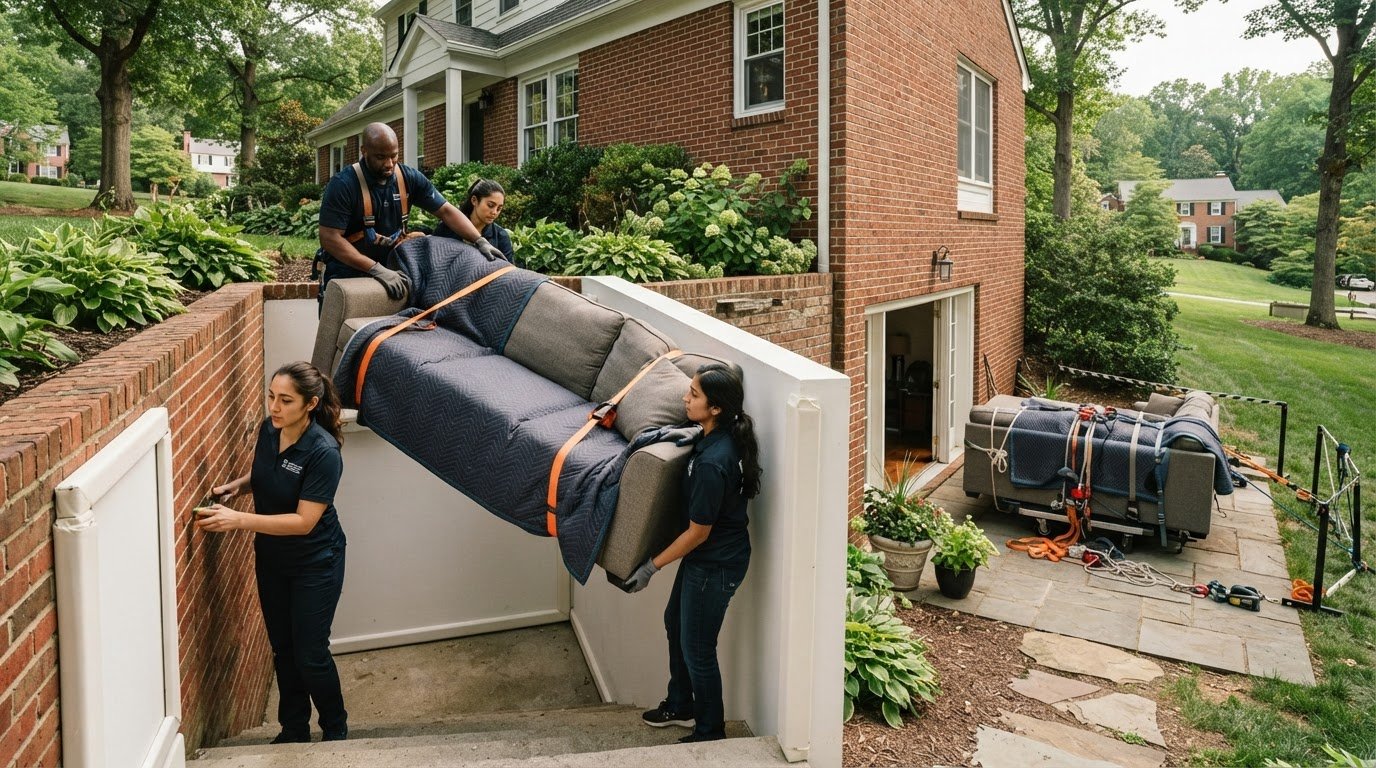
Brute force won’t solve a basement sofa move. A clear route will. Need movers to get a sofa into a basement Clifton home? Tight turns, low ceilings, and narrow landings can make it hard to know whether the sofa will fit. A rushed lift can scrape walls or strain your back.
Before moving day, share the sofa’s dimensions and details about the stairs, landings, doorways, and ceiling height. Movers can use this information to assess access and plan the route. If the stairs won’t work, sofa hoisting may be an option. Heavy Furniture Moving handles heavy-item moves, including sofa hoisting.
In this guide, you’ll learn which access details to provide, how movers compare the stair route with other options, and when hoisting may make sense. You’ll also find practical ways to prepare the space so your sofa can reach the basement with less strain and disruption.
Key Takeaways
- Learn how movers to get a sofa into a basement Clifton assess the sofa and route before choosing a moving plan.
- See which measurements and tight spots help determine whether the basement stairs offer a workable path.
- Compare stairs with sofa hoisting to understand when an alternate route may suit the property better.
- Use a prep checklist to gather sofa dimensions, access measurements, and photos of challenging areas.
- Explore how Heavy Furniture Moving’s heavy-item moving and sofa hoisting services can help with a focused sofa move in Clifton.
Why Moving a Sofa Into a Clifton Basement Takes More Than Muscle
The sofa fits in the living room, so it should fit downstairs, right? Not always. The challenge often comes at the basement stairs, where the sofa must angle around a turn or pass through a tight landing. Searching for “movers to get a sofa into a basement Clifton” is really asking whether the sofa and the entire route work together.
A basement sofa move starts with assessing the furniture and the path from its current spot to the basement. Movers consider the sofa’s size and shape, examine each doorway and stair turn, and plan how to handle and position it. Muscle matters, but a workable plan helps limit strain and avoid forcing the sofa against walls, floors, or railings. That careful approach also reflects the ergonomics of lifting, where body position and handling are part of the task.
Which sofa and basement details affect the route?
A compact sofa may be easier to guide than a heavier, boxier sleeper. A sectional adds another challenge: its pieces may separate, but each piece still needs a clear path and room to turn. Sofa width, depth, height, and overall shape all affect how it can be angled. Whether a sofa fits depends on its dimensions and the narrowest clearance along the route.
Look at the full path, not just the stair opening. Key details include stair width, ceiling height, landing depth, doorway openings, and sharp turns. The basement room matters, too. A sofa may clear the stairs but still be difficult to rotate through the final doorway or position where you want it. Plan for that last move as well.
Why can a route be difficult even when the sofa seems small enough?
A sofa doesn’t travel straight down a staircase like a narrow box. Movers may need to tilt or angle it, changing how much room its corners and broad surfaces need at each point. A sofa that looks narrower than the stair opening can still catch at a turn, where the landing and ceiling limit the angle. One measurement can’t tell the whole story.
Obstacles can reduce usable space further. Handrails protrude into the stairway, door frames create narrow points, and low ceilings restrict how high the sofa can be lifted or tilted. A small change in angle can bring an edge close to a wall or railing. That’s why movers assess pinch points along the whole route instead of relying on one doorway or stair measurement.
Before anyone lifts, map the route from the sofa’s current location to its final spot downstairs. The goal is controlled handling, not a last-second push through a tight turn.
How Movers Plan a Safe Sofa Move Down Basement Stairs
A safe basement move follows a sequence, not a rushed lift. Movers identify the sofa, assess the full route, plan how to handle it, and move it into position. Each step informs the next. If the sofa has detachable sections or moving parts, those can affect how it should be carried and where it can turn.
A reliable plan considers the sofa and every turn between the entry and destination. That matters for homeowners looking for movers to get a sofa into a basement Clifton, especially when the stairway has tight corners or limited headroom.
Start with sofa measurements and route information
Before arranging the move, note the sofa’s height, width, and depth. Include detachable sections and any features that change its shape. Then trace the whole route from the sofa’s current location to the basement room, including entry doors, interior doorways, stair openings, landings, and turns. Clear photos of the sofa and tight areas can show details that measurements alone may miss.
Movers use those details alongside their observations. They compare the sofa’s dimensions with clearances at likely pinch points, then consider how it could be angled through each one. A doorway may look wide enough from the front but leave little room to turn beyond it. A landing may provide space to pause while still limiting how the sofa can rotate. Measurements help guide the assessment, but they don’t prove the sofa will fit.
Plan the move around stairs, surfaces, and final placement
Once the route has been assessed, movers can plan how to coordinate the lift. That includes agreeing on who leads each movement, where to pause, and how to adjust the sofa at a turn. A clear path gives the team room to work and reduces sudden corrections. Remove loose items and open doors along the route before the move begins.
Protective steps matter, too. Movers take care around vulnerable walls, floors, and stair edges while guiding a heavy, awkward item through a narrow space. The destination shapes the plan: the sofa needs room to clear the basement entrance and reach its intended spot, not merely arrive at the foot of the stairs. Confirming where it should go helps prevent extra handling in a crowded room.
The sequence is straightforward: identify the sofa, assess the route, plan the handling, then move and place the item with coordinated movements. If an obstacle makes the stair route unsuitable, consider another approach rather than forcing the sofa through. For focused heavy-item moving help in Clifton, Heavy Furniture Moving’s sofa-moving team can help.
Basement Stairs or Sofa Hoisting: Which Clifton Route Fits?
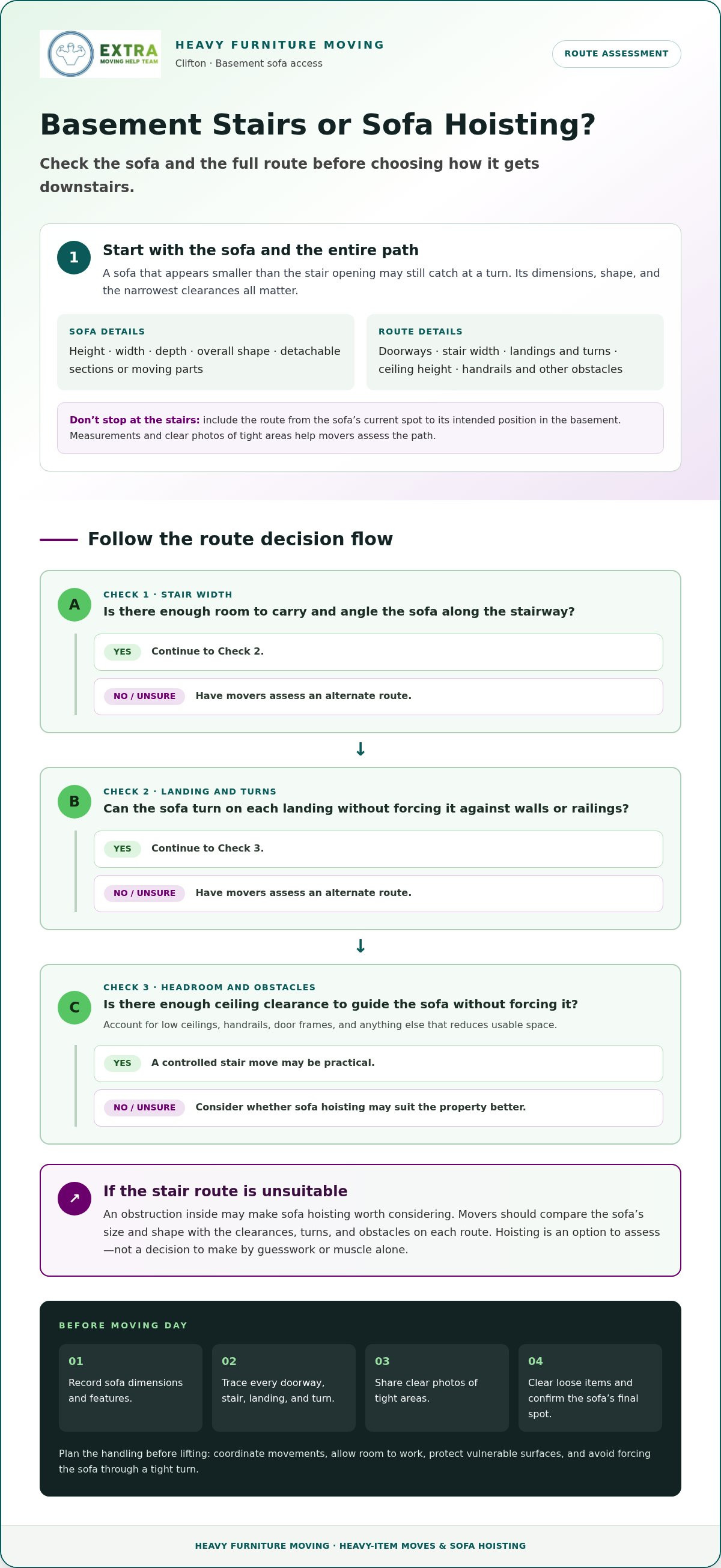
The right route depends on more than whether the sofa can pass through the basement doorway. Movers compare the item’s size and shape with clearances, turns, and obstacles along each option. For some homes, a controlled stair move is practical. For others, an obstruction inside may make sofa hoisting worth considering. Choose neither route by guesswork or muscle alone.
When moving the sofa down the stairs may be suitable
A stair route may work if there’s enough width to carry and angle the sofa, enough turning space on landings, and enough headroom to guide it without forcing it against the ceiling. The path also needs to be clear of obstacles that limit movement or block a safe pause. Movers consider the sofa’s dimensions alongside the full route, since an open stair entrance doesn’t mean a tight turn will be manageable.
For example, a straight, unobstructed stairway may offer a simpler path than stairs that turn sharply at a shallow landing. The sofa still needs room to move through every point without excessive tilting or contact with nearby surfaces. The entry, stairwell, basement doorway, and final room all count. A stair move is suitable only when the item and route allow controlled handling from start to finish.
When sofa hoisting may be worth considering
If interior access presents a serious obstacle, moving the sofa through an exterior opening may be an alternative. Hoisting avoids a difficult stair turn, but it depends on the home and the conditions outside. The available opening, path to the destination, and surrounding property all affect whether this approach is appropriate. It’s a specialized option, not an automatic answer whenever the stairs look tight.
A route assessment helps compare the practical challenges of both methods. Stairs require workable clearances and turning room throughout the interior path. Hoisting requires suitable exterior access and conditions for the move. Heavy Furniture Moving provides specialized sofa hoisting for Clifton homes.
Use these questions to understand what the route decision hinges on:
- Can the sofa turn through each stair landing without being forced into walls or railings?
- Are there low ceilings, narrow openings, or fixed obstacles along the indoor path?
- Is there suitable exterior access if the stair route isn’t workable?
- Can the sofa reach its intended basement location by either route?
For homeowners searching for movers to get a sofa into a basement Clifton, the goal is a route that suits both the furniture and the property. Comparing the options before lifting helps identify a sensible approach, instead of treating hoisting as a last-second fix or pushing through an unsuitable stairway.
Prepare Your Clifton Home for a Sofa Move Into the Basement
A little preparation makes it easier to assess the move before anyone starts lifting. Gather details about the sofa and the full route, from its current location to the basement room. For homeowners searching for movers to get a sofa into a basement Clifton, clear measurements and useful photos can show where a stair turn, doorway, or low ceiling may affect the plan.
What to share about the sofa and basement access
Note the sofa type, approximate height, width, and depth, along with any detachable sections. Describe each part of the route, including the entry door, interior doorways, basement stairs, landings, handrails, and ceiling constraints. Photos should show how these areas connect, not just a close-up of one tight corner. Views from both sides of a turn can make the space easier to understand.
- Sofa: Type, approximate dimensions, and detachable sections.
- Access: Doorway and stair clearances, landing depth, handrails, and low ceilings.
- Route: Photos that show the path from the sofa’s current spot to the basement destination.
- Placement: The room and area where you want the sofa positioned.
Include anything that could change how the sofa is carried or turned, such as a narrow hallway before the stairs or a doorway just beyond the landing. These details help build a clearer picture of the route. The movers near me in Fairfax and Northern VA guide also covers local moving help and broader service options.
How to make the route ready for the moving team
Before the move, clear small items, rugs, and other loose obstacles from the planned path. Make sure doors can open fully and leave enough room around the basement destination for the sofa to be placed. Keep pets away from the work area so they don’t enter the route during handling. Don’t try to lift or test the sofa on the stairs yourself; leave the heavy move until the route has been assessed.
Preparation doesn’t mean moving every large object or deciding on the route yourself. Focus on sharing accurate information and clearing items that are easy to move safely. If a doorway or turn looks especially tight, point it out and include a photo rather than trying to test the fit with the sofa.
Have the sofa and access details ready for a focused single-item move. Share your sofa-move details with Heavy Furniture Moving for local heavy-item moving help in Clifton.
Hire Heavy Furniture Moving for Your Clifton Basement Sofa Move
A single sofa can still be a tough move when basement stairs are narrow or the route has a sharp turn. Heavy Furniture Moving handles specialized heavy-item moves, including sofa hoisting, and Clifton is within its local service area. The team considers the sofa, interior route, and property access when planning an approach for your home.
Heavy Furniture Moving serves Clifton and nearby communities, including Fairfax, Woodbridge, Manassas, Manassas Park, Aldie, Ashburn, Mclean, Vienna, Reston, Centreville, Chantilly, Dumfries, South Riding, Fairfax Station, Haymarket, and Gainesville.
What to expect when arranging sofa-moving help
Share the sofa type and approximate dimensions, along with any detachable sections. Describe the route from the entry point to the basement, including doorways, stair width, landings, handrails, ceiling limits, and the destination room. Photos of the sofa and tight areas add useful context. These details help the team understand the specific challenge and plan how to handle the move.
Stair access and sofa hoisting are different route options. If the sofa can be moved through the home with controlled handling, the stairs may be suitable. If interior access presents a serious obstacle, hoisting may be considered when exterior access and property conditions suit that approach. The right plan depends on the home and sofa.
It also helps to explain what worries you most. Is the main concern a tight landing, low ceiling, heavy sleeper sofa, or a sectional that may not turn? A clear description focuses the assessment on the pinch point that matters, instead of treating the job as a generic furniture move. Heavy Furniture Moving is veteran-family owned and operated, with local heavy-item help for this focused sofa job.
Take the next step for your Clifton sofa move
You don’t need to solve the route yourself. Send the key sofa details and describe the basement access, especially the turn, doorway, or obstruction causing concern. That gives the team a useful starting point to plan the move and determine whether sofa hoisting is appropriate.
Ready to discuss the move? Get help moving your sofa into a Clifton basement through Heavy Furniture Moving’s website.
Make Room for What Comes Next
A sofa that’s stuck upstairs can keep your basement from becoming the space you planned. The next step is to turn uncertainty about access into a clear plan for the move. You don’t have to decide between stairs and hoisting by guesswork or risk a difficult lift just to find out whether the route works.
If you’re searching for movers to get a sofa into a basement Clifton, share what makes your home’s access challenging and where you want the sofa placed. A focused discussion can help plan a practical route for the furniture and your property. Then you can look ahead to using the room instead of worrying about how to get furniture into it.
Get help moving your sofa into a Clifton basement and take the next step.
Frequently Asked Questions
Can movers get any sofa down basement stairs?
No, not every sofa can go down every basement stairway. Fit depends on the sofa’s height, width, depth, and shape, plus the stair width, turns, landing space, and overhead clearance. A bulky sleeper, for example, may need more room to angle than a compact sofa. A route assessment helps determine whether the stairs allow controlled movement or another access approach better suits the home.
Do movers move just one sofa into a basement?
Yes, a sofa move can be a focused job without relocating an entire household. A search for movers to get a sofa into a basement Clifton often comes down to one item and one challenging route. Heavy Furniture Moving provides heavy-item moving and sofa hoisting for focused sofa moves. Share whether the move is within the home and where the sofa needs to go.
Can a sectional sofa be moved into a basement in pieces?
Sometimes, but it depends on how the sectional is built. Some models separate into sections, while others have pieces or connections that aren’t meant to come apart. Check the manufacturer’s guidance before removing components, especially if the sofa has a connecting bracket or attached chaise. For route planning, provide dimensions both assembled and in any manufacturer-approved separated configuration. That helps show whether separating it changes the tightest turn or doorway.
Is sofa hoisting always needed to get a couch into a basement?
No, hoisting isn’t automatically needed. Stairs may be suitable if the sofa can be guided through the interior access with control. Hoisting can be considered if the stairway or another interior obstacle makes that path unsuitable. The home also needs appropriate exterior access and conditions for the approach. A route assessment helps compare these options and determine whether hoisting fits the property.
How much does it cost to move a sofa into a basement in Clifton?
The job details shape the moving plan, so sofa size and route complexity matter. A compact sofa with straightforward access presents a different task from a large sleeper that must pass a tight landing. To discuss your move, share the sofa type, approximate dimensions, and challenging access details through the Heavy Furniture Moving website. Photos can help explain what makes the route difficult.
What should I measure before arranging a basement sofa move?
Measure the sofa’s height, width, and depth, then note doorway openings, stair width, landing space, and headroom. Turning room matters too: a sofa may clear the narrowest opening but still be difficult to angle around a corner. Take photos of awkward sections from more than one viewpoint, such as the top and bottom of a stair turn, so the route is easier to understand.
Frequently Asked Questions
A compact sofa may be easier to guide than a heavier, boxier sleeper. A sectional adds another challenge: its pieces may separate, but each piece still needs a clear path and room to turn. Sofa width, depth, height, and overall shape all affect how it can be angled. Whether a sofa fits depends on its dimensions and the narrowest clearance along the route. Look at the full path, not just the stair opening. Key details include stair width, ceiling height, landing depth, doorway openings, and sharp turns. The basement room matters, too. A sofa may clear the stairs but still be difficult to rotate through the final doorway or position where you want it. Plan for that last move as well.
A sofa doesn’t travel straight down a staircase like a narrow box. Movers may need to tilt or angle it, changing how much room its corners and broad surfaces need at each point. A sofa that looks narrower than the stair opening can still catch at a turn, where the landing and ceiling limit the angle. One measurement can’t tell the whole story. Obstacles can reduce usable space further. Handrails protrude into the stairway, door frames create narrow points, and low ceilings restrict how high the sofa can be lifted or tilted. A small change in angle can bring an edge close to a wall or railing. That’s why movers assess pinch points along the whole route instead of relying on one doorway or stair measurement. Before anyone lifts, map the route from the sofa’s current location to its final spot downstairs. The goal is controlled handling, not a last-second push through a tight turn. A safe basement move follows a sequence, not a rushed lift. Movers identify the sofa, assess the full route, plan how to handle it, and move it into position. Each step informs the next. If the sofa has detachable sections or moving parts, those can affect how it should be carried and where it can turn. A reliable plan considers the sofa and every turn between the entry and destination. That matters for homeowners looking for movers to get a sofa into a basement Clifton, especially when the stairway has tight corners or limited headroom.
No, not every sofa can go down every basement stairway. Fit depends on the sofa’s height, width, depth, and shape, plus the stair width, turns, landing space, and overhead clearance. A bulky sleeper, for example, may need more room to angle than a compact sofa. A route assessment helps determine whether the stairs allow controlled movement or another access approach better suits the home.
Yes, a sofa move can be a focused job without relocating an entire household. A search for movers to get a sofa into a basement Clifton often comes down to one item and one challenging route. Heavy Furniture Moving provides heavy-item moving and sofa hoisting for focused sofa moves. Share whether the move is within the home and where the sofa needs to go.
Sometimes, but it depends on how the sectional is built. Some models separate into sections, while others have pieces or connections that aren’t meant to come apart. Check the manufacturer’s guidance before removing components, especially if the sofa has a connecting bracket or attached chaise. For route planning, provide dimensions both assembled and in any manufacturer-approved separated configuration. That helps show whether separating it changes the tightest turn or doorway.
No, hoisting isn’t automatically needed. Stairs may be suitable if the sofa can be guided through the interior access with control. Hoisting can be considered if the stairway or another interior obstacle makes that path unsuitable. The home also needs appropriate exterior access and conditions for the approach. A route assessment helps compare these options and determine whether hoisting fits the property.
The job details shape the moving plan, so sofa size and route complexity matter. A compact sofa with straightforward access presents a different task from a large sleeper that must pass a tight landing. To discuss your move, share the sofa type, approximate dimensions, and challenging access details through the Heavy Furniture Moving website. Photos can help explain what makes the route difficult.
Measure the sofa’s height, width, and depth, then note doorway openings, stair width, landing space, and headroom. Turning room matters too: a sofa may clear the narrowest opening but still be difficult to angle around a corner. Take photos of awkward sections from more than one viewpoint, such as the top and bottom of a stair turn, so the route is easier to understand.