McLean Balcony Hoisting for Leather Couches That Won’t Fit
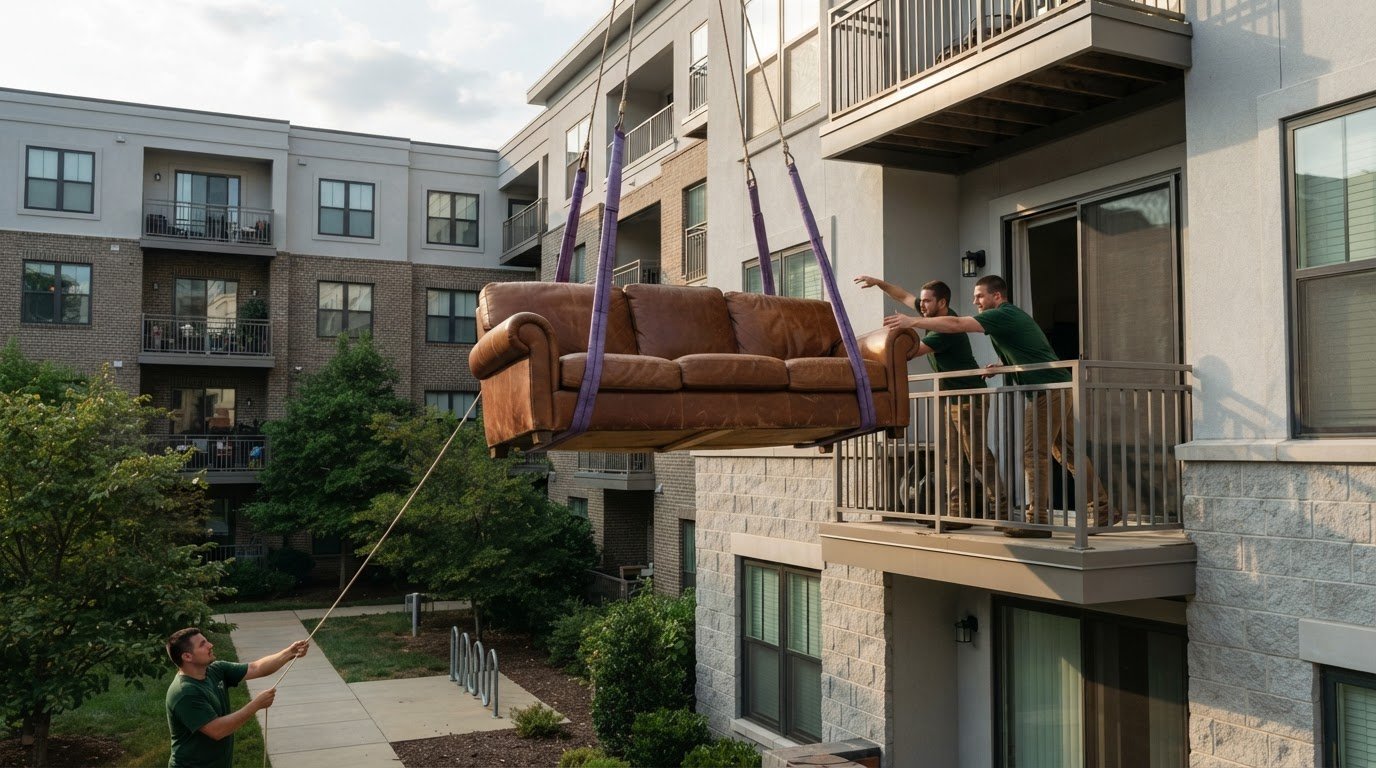
A carrying-capacity figure isn’t the same as a balcony-hoisting rating. Forearm Forklift furniture-moving straps are described as carrying objects up to 800 lbs, but that figure doesn’t establish whether a leather couch can be safely lifted over a balcony at a McLean property. For balcony hoisting straps for an oversized leather couch in McLean, access measurements and a controlled lift matter as much as the straps themselves.
It’s reasonable to worry about a tight stairwell, a balcony edge, and damage to the couch or building. This guide explains which measurements help determine whether hoisting is workable, how the lift is planned, and what can affect the move. You’ll also learn how professional sofa hoisting can help when an oversized couch won’t fit through the usual indoor route, and what details to share when arranging the job. Every property has different access points, obstacles, and landing space, so planning starts with the route, not a guess based on couch size alone.
Key Takeaways
- Map the full route from the pickup room to the balcony, including turns, railings, and nearby obstacles.
- Assess the couch’s shape and balance, not just its width, when deciding how it may pass through the opening.
- Learn how rigging and coordinated movement help keep a couch steady during an outdoor lift.
- Understand why balcony access, landing space, and the building layout all affect whether hoisting is practical.
- See when professional sofa hoisting can help avoid forcing an oversized couch through a tight interior route.
Assessing and measuring access points
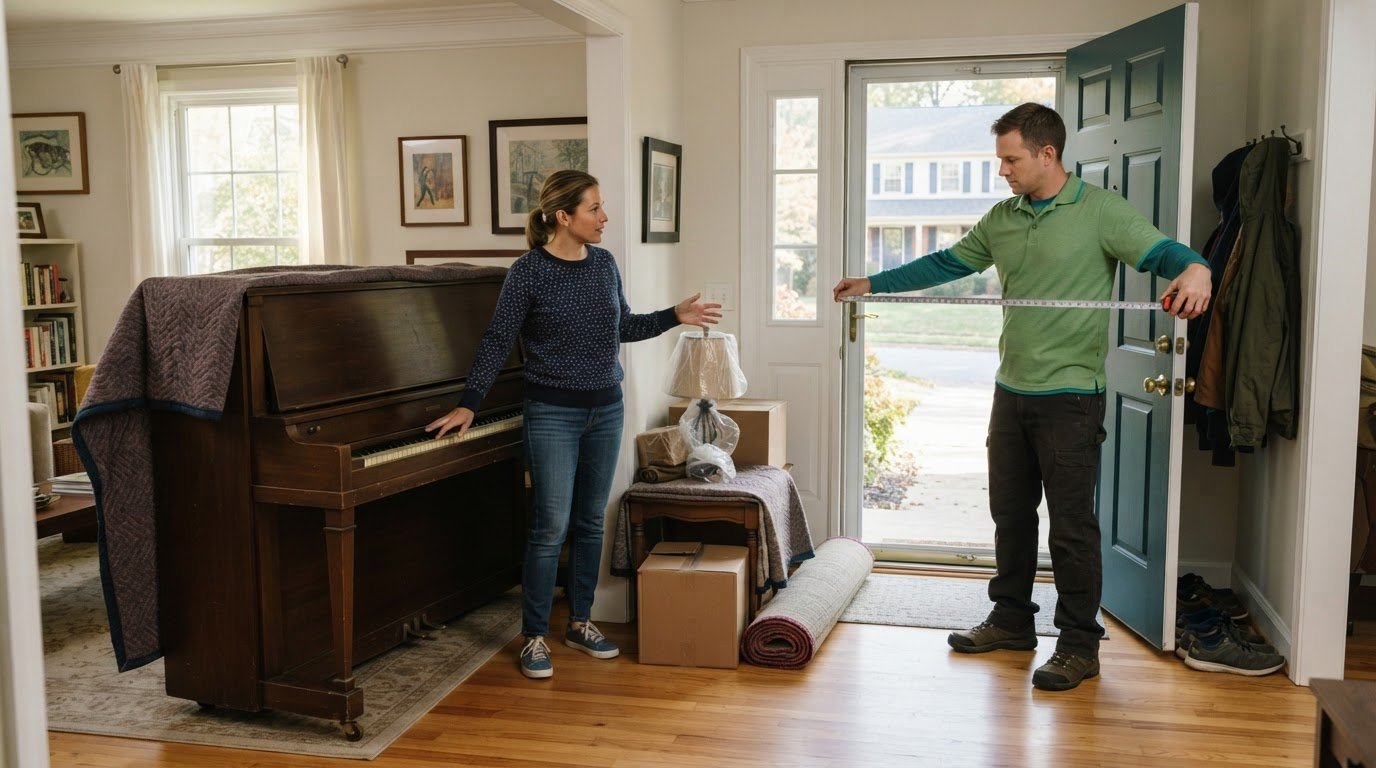
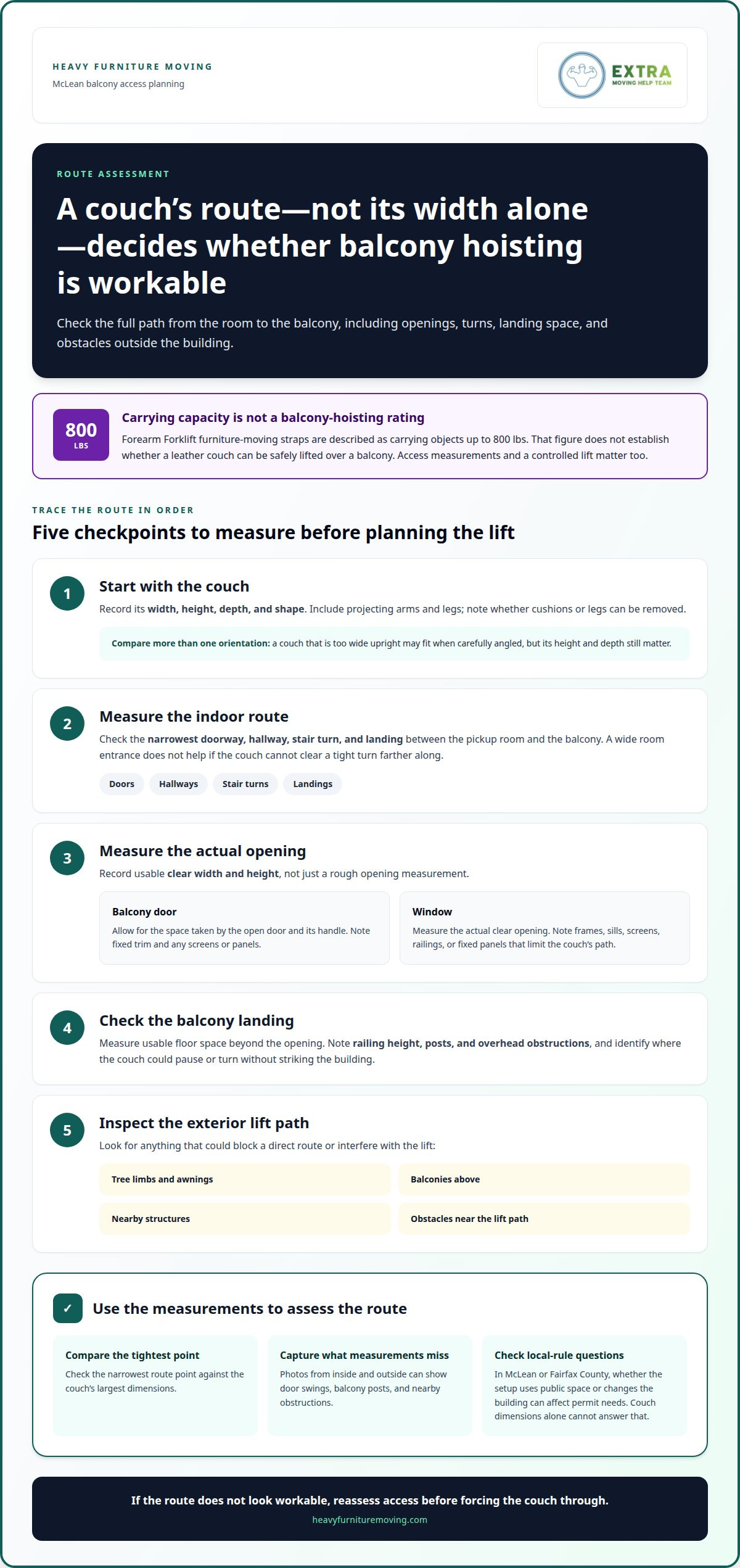
Start with the couch, then trace its full route to the balcony or window. Record its width, height, depth, and shape, including projecting arms and legs. Measure the narrowest doorway, hallway, stair turn, and landing on the indoor route. A wide room entrance won’t help if the couch can’t clear a tight turn before reaching the balcony.
To assess permit needs in McLean or Fairfax County, determine whether the planned setup uses public space or changes the building. Couch dimensions alone can’t answer that local-rule question.
Check each opening as a passage, not just as a width on paper. Measure the clear space between the door frame and fixed trim, then note the opening’s height. For a balcony door, account for the space taken by the open door and handle. For a window, record the actual clear opening and any frame or sill that limits the couch’s path. Screens, railings, and fixed panels can also affect access.
Compare the openings with the couch in more than one orientation. A couch that’s too wide upright may fit when carefully angled, but its height and depth still matter. Note whether removing cushions or legs changes its outline. Treat leather upholstery as a surface to protect, not a reason to force the couch past a sharp frame or railing.
Inspect the balcony itself. Measure the usable landing area beyond the doorway or window, then note the railing height, posts, and overhead obstructions. The lift path also needs clear space outside the building. Tree limbs, awnings, balconies above, and nearby structures can block a direct route. Identify where the couch could pause or turn without striking the building.
- Indoor route: Measure doors, hallways, stair turns, and landings.
- Opening: Record the usable width and height of the balcony door or window.
- Landing: Check the balcony floor space and railing layout.
- Exterior path: Note overhead and nearby obstacles along the proposed lift.
Compare the narrowest point on the route with the couch’s largest dimensions. Photos from inside and outside can reveal door swings, balcony posts, and nearby obstructions that measurements alone may miss. This access review helps determine whether balcony hoisting straps for an oversized leather couch in McLean suit the route or whether another access point is more practical.
Hoisting sofas and oversized furniture
A sofa lift starts with preparation, not the first pull. The crew clears the route, protects the couch, and agrees on a lifting plan. For a leather sectional, identify detachable cushions, loose feet, and pieces that can travel separately. The remaining frame needs balanced support so one end doesn’t swing toward a railing or wall.
If the couch can’t pass through a doorway, stairway, or balcony opening, alternatives may include another suitable opening, a different route, or removing detachable components. If no safe path remains, don’t force the couch through. Reassess the access and furniture construction before choosing another plan.
Leather needs a clean barrier against scuffs, friction, and contact with building surfaces. Cover exposed edges and corners with soft padding, then secure it without placing adhesive on the leather. Keep buckles, hooks, and strap hardware away from the upholstery. A loose cover can bunch during movement, so smooth and secure it before lifting.
- Remove loose pieces: Set cushions and detachable legs aside for separate handling.
- Pad contact points: Cover corners, arms, and edges that may approach walls or railings.
- Protect the finish: Keep straps and hardware from rubbing directly against leather.
- Secure the wrap: Check that padding stays in place as the couch changes angle.
Next, position the couch for a controlled lift. The team agrees who directs movement and which commands mean pause or lower. One person watches the couch’s orientation near the opening while the lifting crew manages movement from assigned positions. Clear communication matters most when the couch needs to rotate past a balcony door or railing.
Make small, deliberate adjustments rather than jerking or dragging the frame. Pause if padding shifts, the couch tilts unexpectedly, or the route becomes obstructed. Keep cushions, tools, and other furniture clear of the landing area. A leather sofa needs room to turn and settle on the balcony before anyone removes its protective wrap.
Straps help support furniture, but a strap alone can’t determine whether an outdoor lift is workable. The couch’s shape, balance, attachment points, and route all affect the plan. For an oversized leather couch, the lifting setup should suit the piece and opening, not rely on a generic assumption about furniture size.
Rigging and equipment for controlled lifts
A controlled couch lift needs equipment suited to the furniture and route. The setup may include lifting straps, protective padding, and lines to guide movement. Each has a different purpose: straps support the couch, padding protects its finish, and guiding lines help limit unwanted rotation. The crew chooses and positions equipment after assessing the couch’s balance and lift path.
The required crew size depends on the couch’s weight, shape, and route. A lead directs movement while other crew members manage the lift and watch clearance. A large sectional with an uneven frame needs different handling from a compact sofa. The crew must keep the load controlled throughout the move, including as it passes the balcony edge.
Before lifting, the crew checks straps and attachment points for damage, wear, or slippage. Straps must support the load without pressing on vulnerable leather or crushing the frame. The attachment arrangement should keep the couch balanced as it rises. A railing, door frame, or decorative balcony feature isn’t a suitable substitute for a load-bearing point.
- Straps: Position them to support the frame and limit shifting.
- Padding: Protect leather, corners, and nearby building surfaces.
- Guiding lines: Help manage rotation without replacing load-bearing gear.
- Communication: Use clear commands to start, pause, adjust, or lower.
The main risks include a shifting load, sudden swinging, contact with the building, and hands caught near pinch points. Keep people out from beneath the couch and clear the landing zone before movement begins. The crew watches the couch, opening, and nearby obstacles throughout the lift. If equipment shifts or the load moves unexpectedly, pause and regain control before continuing.
Leather requires careful surface protection. Strap pressure or rubbing can mark the finish, especially at the arms and corners. Place padding between the couch and contact points, then check that it stays in position during movement. Straps and metal hardware shouldn’t drag across exposed upholstery. Protective wrap must stay secure without bunching beneath a strap.
Each person needs a clear role before the couch moves. The lead gives one instruction at a time, and the crew repeats or acknowledges commands as agreed. That keeps movement coordinated when people have different views of the load. Balcony hoisting calls for deliberate adjustments, not sudden pulls. The crew stops if communication breaks down, clearance changes, or the couch begins to rotate beyond control.
Can an oversized leather couch be hoisted onto a balcony in McLean, Virginia?
A balcony lift can work when the couch, opening, landing, and exterior path allow controlled movement. In McLean, Virginia, the building layout matters as much as the sofa’s size. A clear doorway won’t solve a blocked balcony route. The lift plan must account for the couch’s balance, turning space, and suitable lifting equipment.
Compare the couch’s dimensions with the usable opening of the balcony door or window. Include its arms, frame, and any parts that can’t be removed. A sectional may need to travel in separate pieces if its sections disconnect safely. The landing also needs room for the crew to guide and settle the furniture without forcing it against a railing.
Next, assess the space outside the building. A balcony above, awning, tree limb, or nearby structure can obstruct the route. The crew needs a clear working area below and a controlled path from the ground to the opening. The building exterior and planned lift method determine where equipment can be positioned.
- Couch: Note its largest dimensions, shape, and removable components.
- Opening: Compare the usable doorway or window space with the couch’s profile.
- Balcony: Identify landing space, railing positions, and turn clearance.
- Exterior: Locate overhead obstacles and the intended working area.
A fit assessment should consider movement, not just direct measurements. For example, a couch may clear a balcony door when angled but lack space to rotate outside. The crew assesses that transition before lifting. If the route requires an abrupt turn or contact with the building, the plan needs another approach.
Leather also affects how the couch is prepared. Protective padding should cover exposed corners and likely contact points. Straps should support the frame without rubbing directly against the upholstery. Before lifting, the crew checks that the wrap is secure and that loose cushions or detachable pieces won’t shift.
The lift proceeds in controlled stages. The crew positions the couch, confirms clear communication, and guides it toward the opening. They pause if the couch swings, padding moves, or the route becomes obstructed. Keep the landing area clear so the couch can be brought inside without dragging it across the floor or railing.
For a McLean home or commercial property, balcony hoisting is workable when the entire route allows controlled movement. A narrow opening, blocked exterior path, or inadequate landing space can rule out that approach. The decision depends on the couch’s shape, the building’s access, and the planned lift path together.
What couch dimensions and weight can balcony hoisting straps safely handle?
No single couch dimension determines whether straps can support a balcony lift. Width, height, depth, weight, shape, and balance all affect the setup. A long leather sofa can be awkward despite modest weight, while a compact sleeper sofa may be heavy because of its internal frame and mechanism.
Some furniture-moving straps are described as carrying objects up to 800 lbs. That figure is not a universal safe limit for hoisting a couch over a balcony. It does not, by itself, establish that a particular strap arrangement, attachment point, or lift route can safely carry that load. The couch and the complete lifting setup must be assessed together.
Dimensions help determine how a couch can be positioned and supported. Measure the widest arm-to-arm span, tallest point, and deepest section. For a sectional, assess each connected piece and detachable components separately. A chaise end or recliner mechanism can shift the balance, even when the main sofa frame looks symmetrical.
Weight also depends on construction. A sleeper mechanism, dense frame, and built-in storage can make two similar-sized sofas feel very different to move. Use manufacturer details if available. If there’s no reliable weight information, the materials and construction can still inform the lifting plan, but appearance alone can’t establish the exact weight.
- Dimensions: Record the widest, tallest, and deepest points.
- Configuration: Identify connected sections, recliners, and removable parts.
- Weight: Consider available product information and construction.
- Straps: Match the full setup to the couch and lift route.
Straps also need to support the couch in a stable position. A narrow contact area may press into the leather or let the frame tilt. Poorly placed straps can shift as the sofa changes angle. Padding helps protect the upholstery, but it doesn’t increase strap capacity or correct an unbalanced load.
The balcony opening and lifting path also affect whether the setup is suitable. A couch may fall within a strap’s stated capacity and still be unsuitable for a particular route. The crew considers clearance, attachment points, couch balance, and landing space together. Stop if the setup can’t keep the load controlled.
For professional sofa hoisting, share the couch’s dimensions, configuration, and available weight information. Those details help shape an assessment around the actual furniture, rather than a strap rating alone.
Heavy Furniture Moving: Sofa Hoisting
Heavy Furniture Moving provides Sofa Hoisting for oversized couches that can’t follow a home’s usual route. Turn to this service when a tight stairwell, narrow doorway, or awkward turn makes moving a leather sofa indoors impractical. Planning focuses on the couch, the building’s access, and a controlled route to the balcony or window.
Share the couch’s shape, dimensions, and any available weight details, along with the pickup room and intended opening. These details help plan the hoisting work. If the sofa can move through the home without a lift, in-home furniture moving may be a better fit. The right approach depends on the route and furniture.
Contact Heavy Furniture Moving to discuss sofa hoisting for your McLean property.
Plan the Next Move With Confidence
Once you’ve decided that a balcony lift suits your property, turn the access details into a practical moving plan. Share the couch’s configuration and the building route when arranging help. This gives the team a clearer picture of the job and the furniture involved.
For balcony hoisting straps for an oversized leather couch in McLean, Heavy Furniture Moving can handle the sofa hoisting. The company also offers Movers Near Me and Exercise Equipment Moving for other heavy-item needs. Choose help that fits the move, whether you’re moving one couch or handling a broader household task.
Ready to discuss your couch and access route? Contact Heavy Furniture Moving to take the next step. With the right plan, you can move forward without trying to force an oversized sofa through a route that doesn’t suit it.
Frequently Asked Questions
How do professional furniture hoisting companies lift a couch to a balcony?
The crew assesses the furniture and access route before choosing a lifting setup. Heavy Furniture Moving measures doorways, stairs, and item dimensions before lifting. The crew then prepares the couch, positions the equipment, and guides the move toward the balcony opening. Wrap, moving blankets, and straps are included on every job. For example, a sectional’s separate pieces may need individual handling if its sections come apart.
How can leather upholstery be protected from strap marks, scratches, and weather during a hoist?
Use clean moving blankets between leather and straps, and secure protective wrap so it can’t bunch during handling. Keep buckles and other hardware away from the upholstery. Protect the couch from weather, avoid leaving it exposed on a balcony in the rain, and move it indoors promptly after landing. If the leather gets damp, let it dry naturally before covering it again. Heavy Furniture Moving includes wrap, blankets, and straps on every job.
Do McLean or Fairfax County rules require permits for hoisting furniture from a balcony?
Permit needs depend on whether the planned setup uses public space or changes the building. Couch dimensions alone don’t determine them.