Manassas Couch Hoisting Professionals: Safe Solutions for Tight Spaces
What if your couch’s best route into your Manassas home isn’t through the front door? A sofa that won’t clear a stairwell, hallway, or elevator can stall a move before it starts. Manassas couch hoisting professionals can help plan an exterior route when the indoor path won’t work, taking the couch, opening, and surrounding property into account.
It’s reasonable to worry about scuffs, damage, and a difficult lift. The practical first step is to map the access route before moving day, rather than improvising when the couch is already stuck. Gather the couch’s dimensions and details about doorways, stairs, windows, balconies, and outdoor obstacles so the team can understand the challenge.
This guide explains when couch hoisting makes sense, what to measure before arranging service, and how sofa-hoisting professionals can help with a difficult-access move in Manassas. You’ll be better prepared to compare an indoor route with an exterior one.
Key Takeaways
- Hoisting can be a practical option when a couch can’t safely pass through an entryway, hallway, or elevator.
- Compare the full indoor route, possible disassembly, and exterior access before choosing an approach.
- Help Manassas couch hoisting professionals plan by sharing couch measurements, access details, and clear photos.
- Prepare the route and landing area by moving obstacles out of the way before the work begins.
- Heavy Furniture Moving offers sofa hoisting in Manassas for couches that standard access can’t accommodate.
When Manassas Couch Hoisting Professionals Can Solve an Access Problem
The couch is ready to move, but the hallway turn is too tight, the stairs feel risky, or the elevator opening won’t accommodate its shape. Don’t force it through and hope for the best. Manassas couch hoisting professionals can help plan an exterior route when the home’s standard path won’t work.
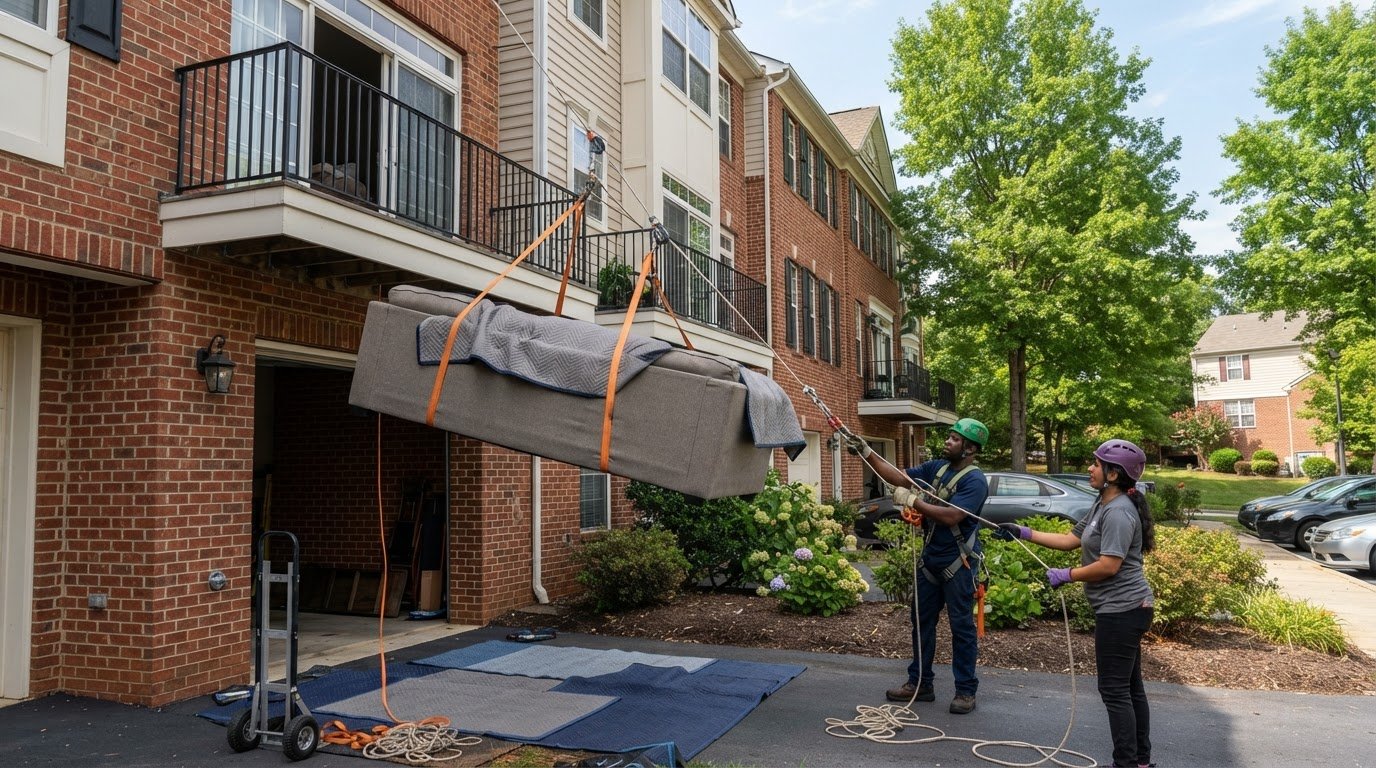
Couch hoisting means moving a sofa through a suitable exterior opening, such as a window or balcony access point, when indoor passage is impractical. It provides another way around an access constraint, but it isn’t automatically the right answer for every large sofa. The couch, building, opening, and destination all affect the plan. Assess the entire route to distinguish a blocked indoor path from one that is simply awkward to navigate.
Which couch-access problems may call for another route?
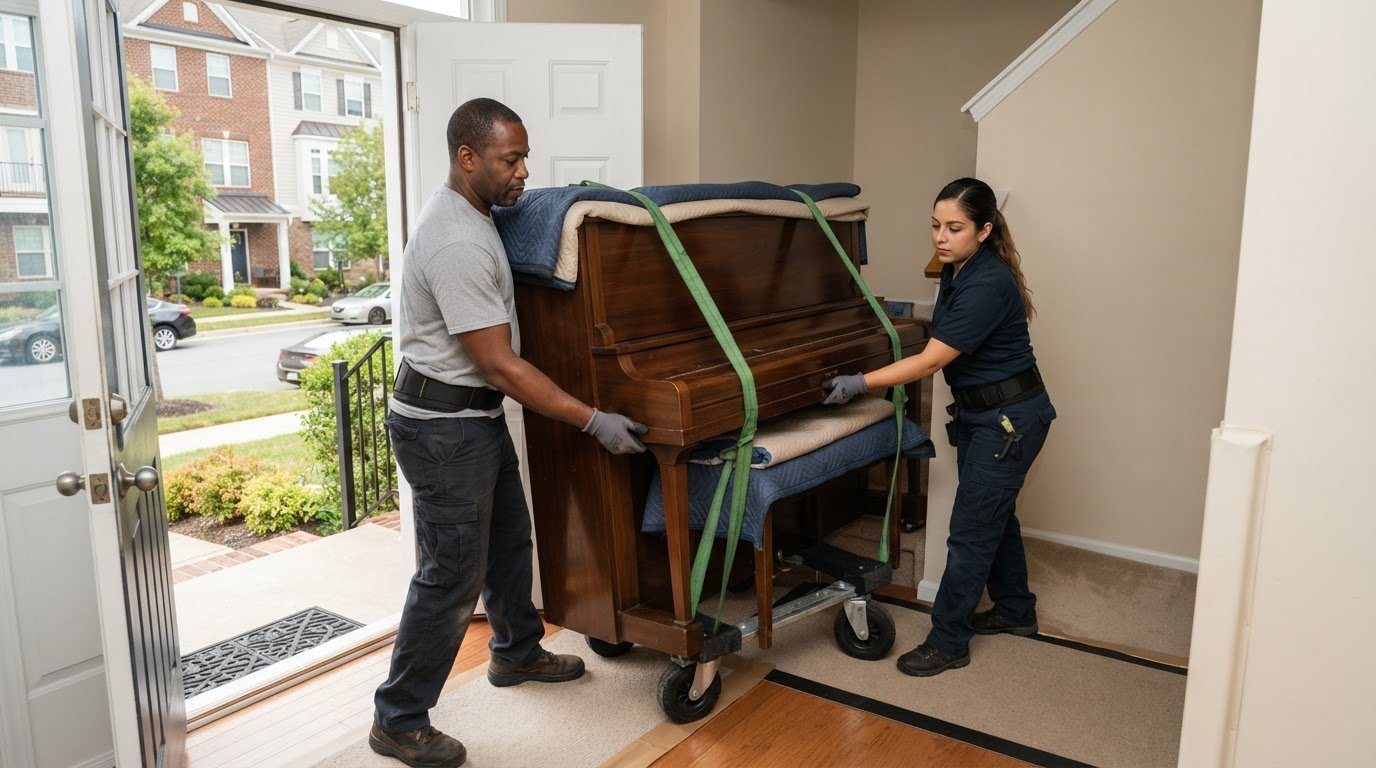
A couch’s length is only part of the puzzle. Its depth, height, arms, legs, and overall shape affect the space it needs when tilted or turned. A sofa that clears a doorway straight on may not make the turn into a narrow hall. A stair landing can limit room to pivot, while an elevator may not have enough interior space to angle the sofa toward the doors.
Check the whole route, not just the tightest doorway. Note where the couch must turn, where ceilings or railings restrict movement, and whether there’s room to reposition it without pressing against walls or fixtures. A difficult indoor carry doesn’t prove that hoisting is necessary. The couch may fit by another route, or its configuration may allow a different approach. Consider hoisting when the indoor path has no workable option after those constraints are reviewed.
What makes a Manassas home’s access plan unique?
Every home creates a different route puzzle. A ground-level home has a different exterior approach from a multi-story residence. The opening also needs to suit the couch’s current location and its destination. Think through both ends of the move: the room and exit point, followed by the receiving room and landing area.
Apartment and shared-building moves add details to the plan. Consider common hallways, shared entrances, elevator access, and the path from the building exterior to the intended opening. These details affect how the move is organized, even when the couch itself seems straightforward. Describe the building layout and access points so the team can account for the full route.
Couch hoisting is an alternate route through a suitable exterior opening when indoor access can’t accommodate a sofa. The service addresses an access problem, not simply furniture size. Heavy Furniture Moving provides sofa hoisting in Manassas for couches that cannot fit through standard entryways or elevators.
How Manassas Couch Hoisting Professionals Assess the Route and the Risks
A useful hoisting plan starts with details, not guesswork. Manassas couch hoisting professionals need to understand the couch, its current route, the proposed exterior opening, and the destination. Reviewing each point helps identify tight clearances, obstacles, and questions to resolve before the move. Careful planning can reduce uncertainty, but it can’t eliminate every risk.
What couch and opening details should you gather?
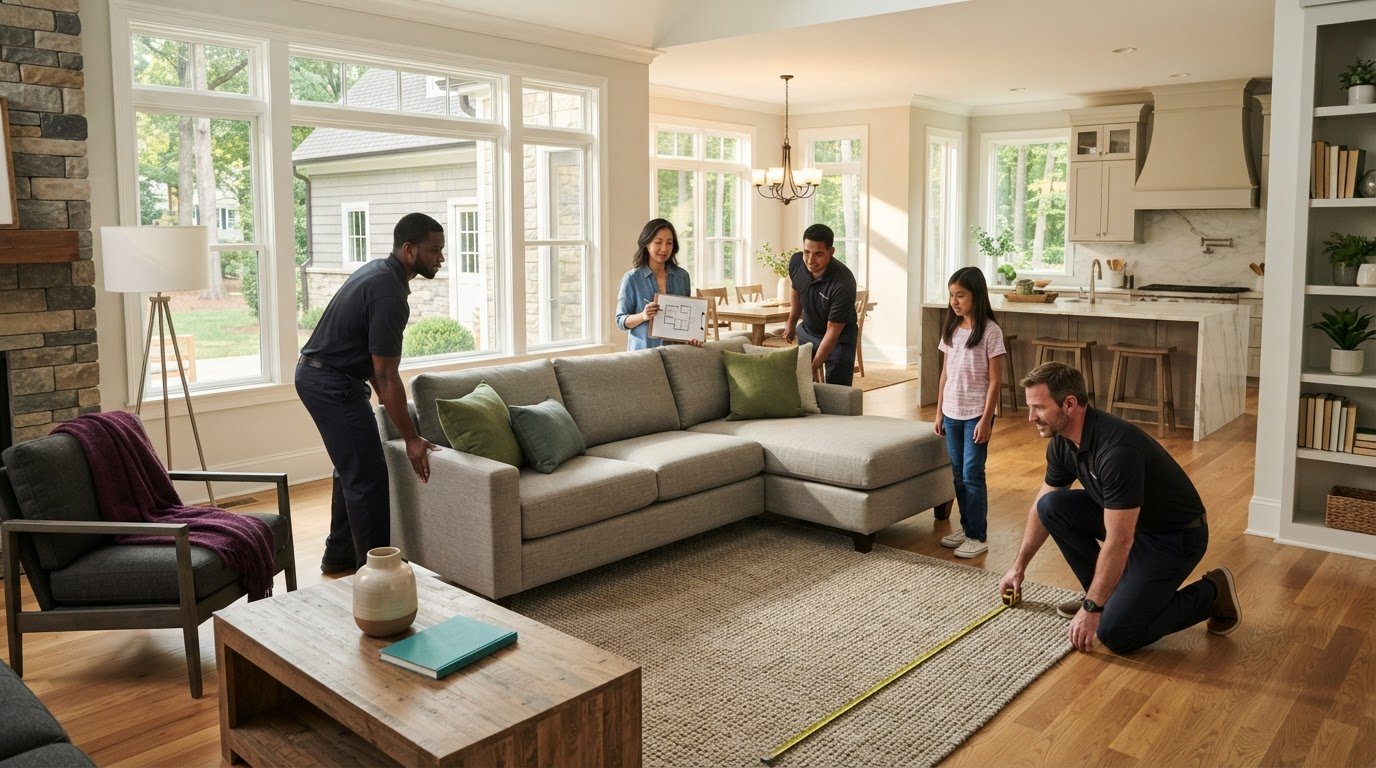
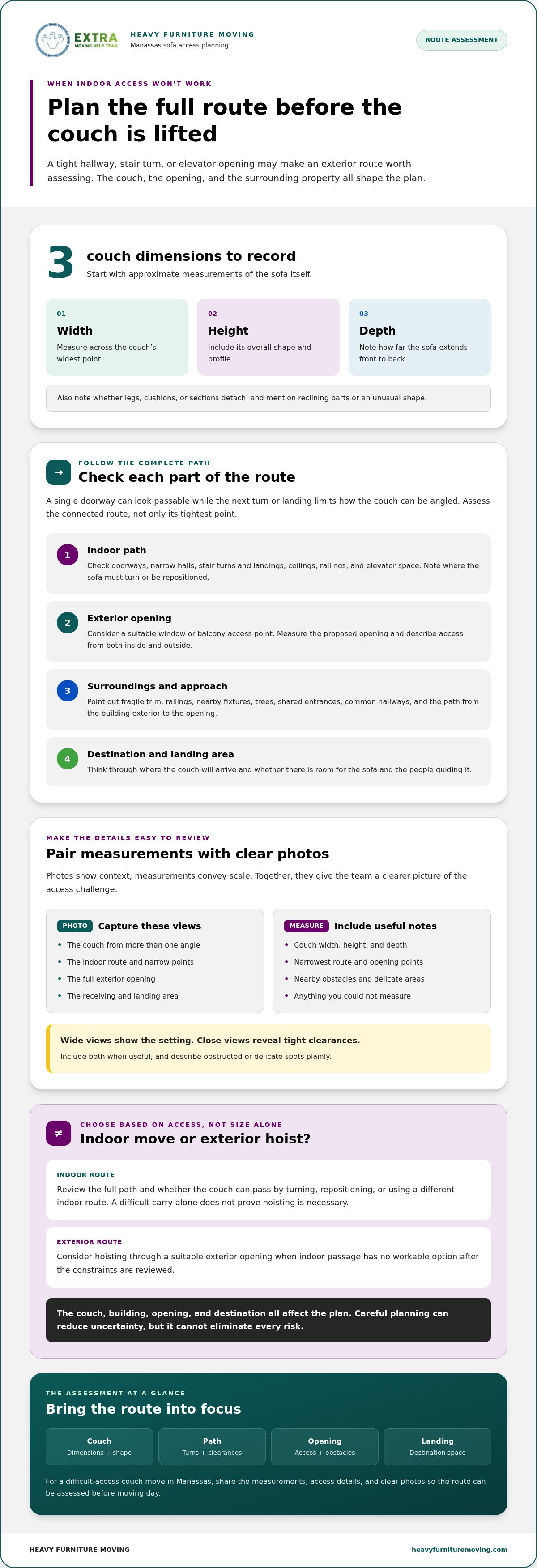
Start with the couch. Record its approximate width, height, and depth, and note whether its legs, cushions, or sections detach. Mention reclining parts or an unusual shape. Then measure likely pinch points along the route, including doorways, narrow halls, stair turns and landings, and the proposed exterior opening. Measurements at the narrowest points are especially useful.
Include the surroundings. Note fragile trim, railings, nearby fixtures, trees, or other obstacles around the opening, along with where the couch needs to land. A window that looks spacious from inside may have limited access outside. The receiving area also needs space for the couch and the people guiding it. Point out anything that could affect how the sofa approaches, passes through, or leaves the opening.
How can a route review reduce uncertainty?
A route review connects the measurements into one continuous path. A doorway might be wide enough, for example, while the next turn or stair landing limits how the couch can be angled. The proposed exterior opening and access around it matter just as much. Reviewing the full path helps identify tight clearances and focus attention on the parts that need care.
Photos can make your description easier to understand. Take clear views of the couch from more than one angle, the indoor route, the full exterior opening, and the landing area. Include wide shots showing nearby obstacles and closer views of narrow points. Pair images with measurements and brief notes: photos show context, while measurements convey scale. Together, they give the team a clearer picture of the job.
A useful hoisting assessment brings together couch dimensions, route measurements, clear photos, and details about the opening and landing area. Share what you know and identify anything you couldn’t measure. This gives the professionals a practical starting point and highlights the parts of the route that may need attention.
Careful planning is part of a safety-minded approach, alongside sound work practices. OSHA offers broad OSHA safety guidelines for workplace safety. For your preparation, keep the route and landing area visible in your photos and describe delicate or obstructed spots plainly. If you’re planning a difficult couch move in Manassas, Heavy Furniture Moving’s sofa hoisting service provides specialized help with access challenges.
Couch Hoisting or an Indoor Move: Compare the Options in Manassas
A couch that looks too large for a doorway may still have an indoor route, or it may need a different approach. Compare the entire path before deciding. A doorway measurement alone won’t tell you whether the sofa can clear a turn, stair landing, or elevator interior. The best option depends on the couch’s dimensions and construction, the home’s layout, and the available exterior access.
| Option | Route fit | Handling complexity | Homeowner preparation |
|---|---|---|---|
| Indoor passage | Works when the couch can clear each doorway, turn, stair, and elevator. | Depends on maneuvering room and the full route. | Measure tight points and clear the path. |
| Disassembly, where appropriate | May help if removable parts meaningfully reduce the couch’s dimensions. | Depends on how the couch is built and which parts can be removed. | Identify detachable sections; don’t assume the frame can be taken apart. |
| Professional hoisting | May suit a move when normal indoor access doesn’t provide a workable path and an exterior opening is suitable. | Requires planning for the opening, surrounding access, and landing area. | Share measurements, photos, and access details. |
When might an indoor route still work?
Check more than the front door. A sofa may fit through the entry but meet a tight turn just beyond it. Measure stair landings and elevator interiors, and consider whether the couch can be angled through each section without hitting walls or fixtures. Removable cushions or sections are useful only if taking them off reduces the dimensions enough to address a specific pinch point.
If the path is clear but the carry is awkward, professional moving help may make sense without hoisting. That’s different from having no workable indoor route. Focus on where the couch needs to turn and how much room there is to guide it. Don’t force a passage based on one measurement or a guess about how far the couch can tilt.
When is exterior hoisting worth considering?
Consider an exterior route when doors, stairs, or elevators don’t provide a workable way in or out after you assess the full path. The opening must suit the couch’s dimensions and planned movement, and the outside area must allow access to it. The destination matters too: the landing area needs to be reachable and clear.
Disassembly is an alternative only when the couch’s construction allows it and removing parts addresses the access problem. Don’t assume a sofa can be taken apart or that doing so will solve a tight turn. For a couch that standard entryways or elevators can’t accommodate, Manassas couch hoisting professionals offer a specialized alternative. Heavy Furniture Moving provides sofa hoisting for difficult-access residential moves in Manassas.
How to Prepare Your Manassas Home for a Couch Hoist
Preparation makes it easier to explain the job and ready the home for the move. Gather the couch details, show the route clearly, and make space at both ends. You don’t need to solve every access question yourself. Give Manassas couch hoisting professionals the information you have so they can understand the layout and challenge.
What should you share before the service visit?
Put the key details in one note. Include the couch’s approximate dimensions and shape, any detachable sections, the proposed exterior opening, and the destination. Describe the indoor route and identify tight turns, stair landings, narrow halls, or elevator access that could affect the move.
- Measure the couch’s width, height, and depth, and note removable parts.
- Describe the path from the couch’s current location to the exterior opening.
- Identify the destination and intended landing area.
- Flag visible obstacles, delicate trim, or limited access around the opening.
- Take clear photos of the couch, indoor path, opening, and landing area.
Take photos from useful angles. A wide view can show how rooms and access points connect; a closer view can make a narrow passage or nearby obstacle easier to understand. Label approximate measurements as estimates instead of presenting them as exact. Include relevant shared-building details, such as common hallways or the route from the entrance to the apartment, so the plan reflects the whole setting.
How can you ready the home and access area?
Before the work begins, clear loose belongings from the indoor route and landing area. Move small furniture, shoes, floor lamps, and anything else that narrows the path. Keep the area around the exterior opening accessible and move nearby belongings out of the way. A clear route makes the space easier to assess and keeps attention on the planned movement.
Plan for people and pets, too. Let household members know which areas will be used, and keep pets away from the route during the move. If the couch is in a shared building, note access considerations such as common entrances or corridors. Taking care of these details can help the day run more smoothly.
For broader room-by-room planning ideas, use this Manassas furniture-moving preparation guide to think through furniture placement and access. Then gather your couch measurements, route notes, and photos. Arrange sofa hoisting with Heavy Furniture Moving for a difficult-access couch move in Manassas.
Book Manassas Couch Hoisting Professionals for a Difficult Move
A couch that won’t fit through a standard entryway or elevator can turn a straightforward move into a frustrating puzzle. Heavy Furniture Moving offers specialized sofa hoisting in Manassas for difficult-access situations. Start by describing what blocks the normal route. Clear details help the team understand the challenge and plan around the home’s layout.
What to expect when arranging couch-hoisting help
Describe the couch’s approximate width, height, and depth, its shape, and any sections that detach. Outline the indoor route, the exterior opening, and the destination. Photos of the furniture, access points, and surrounding obstacles can clarify the details. You don’t need a perfect plan before you get started. Explain what you know, including the tight spots that concern you.
Each home and couch creates its own access problem, so the plan should reflect the specific move. The information you provide gives the team a starting point for understanding the route and planning the work. A clear conversation keeps the focus on the couch, access points, and destination rather than guesswork.
Choose local help for couch hoisting in Manassas
Heavy Furniture Moving serves Manassas with residential moving help, including sofa hoisting for items that can’t pass through standard entryways or elevators. The company is veteran-family owned and operated. If you’re comparing the couch task with broader moving needs, this Fairfax and Northern Virginia moving-services guide offers more local service context.
Before reaching out, gather the measurements you have and take photos of the couch, indoor path, proposed opening, and landing area. Mention apartment or shared-building access if it affects the route. These steps help you explain the challenge without needing to solve it yourself. Manassas couch hoisting professionals can use the details to understand what makes the move difficult and plan a project-specific approach.
Don’t let a narrow passage leave you stuck. Contact Heavy Furniture Moving about your Manassas couch move to get started.
Make the Next Move a Clear One
A difficult couch move doesn’t have to begin with guesswork. Make a short access note while the details are fresh: where the couch is now, what makes the usual route challenging, and where you want it to go. Add measurements and photos if you have them. This gives you a practical starting point for a conversation with Manassas couch hoisting professionals and keeps the focus on your home’s layout.
You don’t need to know the right solution before reaching out. Describe the challenge plainly, including access concerns that feel uncertain. Heavy Furniture Moving is a veteran-family owned and operated business serving Manassas, with sofa hoisting for couches that can’t fit through standard entryways or elevators. The team can plan a project-specific approach using the information you provide.
Take the next step with the details you’ve gathered. Contact Heavy Furniture Moving about couch hoisting in Manassas to get started.
Frequently Asked Questions
When should I hire couch hoisting professionals in Manassas?
Consider professional couch hoisting when the assembled sofa has no workable indoor path, or maneuvering it could put the furniture or home at risk. Professional help is also useful when you’re unsure how to assess a tight turn or exterior opening. Heavy Furniture Moving serves Manassas and Fairfax, Woodbridge, Manassas Park, Aldie, Ashburn, McLean, Vienna, Reston, Centreville, Chantilly, Clifton, Dumfries, South Riding, Fairfax Station, Haymarket, and Gainesville.
Can a couch be hoisted through a window or balcony?
Yes. A window or balcony may work as part of a hoisting route when the opening, outside approach, and receiving area suit the couch and planned movement. The type of opening alone doesn’t determine whether the route works. Consider what surrounds it, where the sofa needs to go, and whether the landing area is accessible. Share clear photos and details so the full route can be considered.
How do I know if my couch will fit through a doorway or stairwell?
Measure the couch and the narrowest points along its route, including door openings, stair turns, and landings. Compare those measurements while allowing room to angle or pivot the sofa. Length alone won’t tell you whether a turn is possible. If the path changes direction sharply, note nearby walls, railings, and ceiling constraints. Measurements are a useful guide, not a guarantee of fit.
What information should I provide before arranging couch hoisting?
Describe the sofa’s dimensions and shape, and whether any sections or legs detach. Explain where it is now, the route you’ve considered, the possible exterior opening, and its destination. Note anything unusual, such as a reclining section or shared-building entrance. Photos from a few angles can add context. If you don’t know a measurement, say so rather than guessing; an honest estimate is more useful than false precision.
Do I need to prepare my home before couch hoisting professionals arrive?
Yes. Clear loose belongings from the route and landing space, and move breakable or valuable items away from the work area. Let household members know which spaces may be used, and keep pets away from the path during the move. For an apartment or shared building, consider access through common areas. These steps make the route easier to see and keep the surrounding space less cluttered.
Can professionals move a sectional couch by hoisting it?
A sectional can be considered for hoisting, but the plan depends on its construction, dimensions, and access route. Note whether it separates into individual pieces, and measure both the assembled sofa and any detachable sections. Include photos of connectors or separable parts if they’re easy to show. Separate pieces may create other movement options, but don’t assume disassembly is possible or that it will resolve every access constraint.
How is couch hoisting different from moving a sofa through the house?
An indoor move carries the sofa through the home’s doors, halls, stairs, or elevator. Hoisting uses an exterior opening as an alternate route when indoor access doesn’t work for the couch. An indoor plan centers on the passage through rooms, while an exterior plan also accounts for the opening and the space outside it. The right route depends on the home and the furniture.
Frequently Asked Questions
A couch’s length is only part of the puzzle. Its depth, height, arms, legs, and overall shape affect the space it needs when tilted or turned. A sofa that clears a doorway straight on may not make the turn into a narrow hall. A stair landing can limit room to pivot, while an elevator may not have enough interior space to angle the sofa toward the doors. Check the whole route, not just the tightest doorway. Note where the couch must turn, where ceilings or railings restrict movement, and whether there’s room to reposition it without pressing against walls or fixtures. A difficult indoor carry doesn’t prove that hoisting is necessary. The couch may fit by another route, or its configuration may allow a different approach. Consider hoisting when the indoor path has no workable option after those constraints are reviewed.
Every home creates a different route puzzle. A ground-level home has a different exterior approach from a multi-story residence. The opening also needs to suit the couch’s current location and its destination. Think through both ends of the move: the room and exit point, followed by the receiving room and landing area. Apartment and shared-building moves add details to the plan. Consider common hallways, shared entrances, elevator access, and the path from the building exterior to the intended opening. These details affect how the move is organized, even when the couch itself seems straightforward. Describe the building layout and access points so the team can account for the full route. Couch hoisting is an alternate route through a suitable exterior opening when indoor access can’t accommodate a sofa. The service addresses an access problem, not simply furniture size. Heavy Furniture Moving provides sofa hoisting in Manassas for couches that cannot fit through standard entryways or elevators. A useful hoisting plan starts with details, not guesswork. Manassas couch hoisting professionals need to understand the couch, its current route, the proposed exterior opening, and the destination. Reviewing each point helps identify tight clearances, obstacles, and questions to resolve before the move. Careful planning can reduce uncertainty, but it can’t eliminate every risk.
Start with the couch. Record its approximate width, height, and depth, and note whether its legs, cushions, or sections detach. Mention reclining parts or an unusual shape. Then measure likely pinch points along the route, including doorways, narrow halls, stair turns and landings, and the proposed exterior opening. Measurements at the narrowest points are especially useful. Include the surroundings. Note fragile trim, railings, nearby fixtures, trees, or other obstacles around the opening, along with where the couch needs to land. A window that looks spacious from inside may have limited access outside. The receiving area also needs space for the couch and the people guiding it. Point out anything that could affect how the sofa approaches, passes through, or leaves the opening.
A route review connects the measurements into one continuous path. A doorway might be wide enough, for example, while the next turn or stair landing limits how the couch can be angled. The proposed exterior opening and access around it matter just as much. Reviewing the full path helps identify tight clearances and focus attention on the parts that need care. Photos can make your description easier to understand. Take clear views of the couch from more than one angle, the indoor route, the full exterior opening, and the landing area. Include wide shots showing nearby obstacles and closer views of narrow points. Pair images with measurements and brief notes: photos show context, while measurements convey scale. Together, they give the team a clearer picture of the job. A useful hoisting assessment brings together couch dimensions, route measurements, clear photos, and details about the opening and landing area. Share what you know and identify anything you couldn’t measure. This gives the professionals a practical starting point and highlights the parts of the route that may need attention. Careful planning is part of a safety-minded approach, alongside sound work practices. OSHA offers broad OSHA safety guidelines for workplace safety. For your preparation, keep the route and landing area visible in your photos and describe delicate or obstructed spots plainly. If you’re planning a difficult couch move in Manassas, Heavy Furniture Moving’s sofa hoisting service provides specialized help with access challenges. A couch that looks too large for a doorway may still have an indoor route, or it may need a different approach. Compare the entire path before deciding. A doorway measurement alone won’t tell you whether the sofa can clear a turn, stair landing, or elevator interior. The best option depends on the couch’s dimensions and construction, the home’s layout, and the available exterior access.
Check more than the front door. A sofa may fit through the entry but meet a tight turn just beyond it. Measure stair landings and elevator interiors, and consider whether the couch can be angled through each section without hitting walls or fixtures. Removable cushions or sections are useful only if taking them off reduces the dimensions enough to address a specific pinch point. If the path is clear but the carry is awkward, professional moving help may make sense without hoisting. That’s different from having no workable indoor route. Focus on where the couch needs to turn and how much room there is to guide it. Don’t force a passage based on one measurement or a guess about how far the couch can tilt.
Consider an exterior route when doors, stairs, or elevators don’t provide a workable way in or out after you assess the full path. The opening must suit the couch’s dimensions and planned movement, and the outside area must allow access to it. The destination matters too: the landing area needs to be reachable and clear. Disassembly is an alternative only when the couch’s construction allows it and removing parts addresses the access problem. Don’t assume a sofa can be taken apart or that doing so will solve a tight turn. For a couch that standard entryways or elevators can’t accommodate, Manassas couch hoisting professionals offer a specialized alternative. Heavy Furniture Moving provides sofa hoisting for difficult-access residential moves in Manassas. Preparation makes it easier to explain the job and ready the home for the move. Gather the couch details, show the route clearly, and make space at both ends. You don’t need to solve every access question yourself. Give Manassas couch hoisting professionals the information you have so they can understand the layout and challenge.
Put the key details in one note. Include the couch’s approximate dimensions and shape, any detachable sections, the proposed exterior opening, and the destination. Describe the indoor route and identify tight turns, stair landings, narrow halls, or elevator access that could affect the move. Take photos from useful angles. A wide view can show how rooms and access points connect; a closer view can make a narrow passage or nearby obstacle easier to understand. Label approximate measurements as estimates instead of presenting them as exact. Include relevant shared-building details, such as common hallways or the route from the entrance to the apartment, so the plan reflects the whole setting.
Before the work begins, clear loose belongings from the indoor route and landing area. Move small furniture, shoes, floor lamps, and anything else that narrows the path. Keep the area around the exterior opening accessible and move nearby belongings out of the way. A clear route makes the space easier to assess and keeps attention on the planned movement. Plan for people and pets, too. Let household members know which areas will be used, and keep pets away from the route during the move. If the couch is in a shared building, note access considerations such as common entrances or corridors. Taking care of these details can help the day run more smoothly. For broader room-by-room planning ideas, use this Manassas furniture-moving preparation guide to think through furniture placement and access. Then gather your couch measurements, route notes, and photos. Arrange sofa hoisting with Heavy Furniture Moving for a difficult-access couch move in Manassas. A couch that won’t fit through a standard entryway or elevator can turn a straightforward move into a frustrating puzzle. Heavy Furniture Moving offers specialized sofa hoisting in Manassas for difficult-access situations. Start by describing what blocks the normal route. Clear details help the team understand the challenge and plan around the home’s layout.
Consider professional couch hoisting when the assembled sofa has no workable indoor path, or maneuvering it could put the furniture or home at risk. Professional help is also useful when you’re unsure how to assess a tight turn or exterior opening. Heavy Furniture Moving serves Manassas and Fairfax, Woodbridge, Manassas Park, Aldie, Ashburn, McLean, Vienna, Reston, Centreville, Chantilly, Clifton, Dumfries, South Riding, Fairfax Station, Haymarket, and Gainesville.
Yes. A window or balcony may work as part of a hoisting route when the opening, outside approach, and receiving area suit the couch and planned movement. The type of opening alone doesn’t determine whether the route works. Consider what surrounds it, where the sofa needs to go, and whether the landing area is accessible. Share clear photos and details so the full route can be considered.
Measure the couch and the narrowest points along its route, including door openings, stair turns, and landings. Compare those measurements while allowing room to angle or pivot the sofa. Length alone won’t tell you whether a turn is possible. If the path changes direction sharply, note nearby walls, railings, and ceiling constraints. Measurements are a useful guide, not a guarantee of fit.
Describe the sofa’s dimensions and shape, and whether any sections or legs detach. Explain where it is now, the route you’ve considered, the possible exterior opening, and its destination. Note anything unusual, such as a reclining section or shared-building entrance. Photos from a few angles can add context. If you don’t know a measurement, say so rather than guessing; an honest estimate is more useful than false precision.
Yes. Clear loose belongings from the route and landing space, and move breakable or valuable items away from the work area. Let household members know which spaces may be used, and keep pets away from the path during the move. For an apartment or shared building, consider access through common areas. These steps make the route easier to see and keep the surrounding space less cluttered.
A sectional can be considered for hoisting, but the plan depends on its construction, dimensions, and access route. Note whether it separates into individual pieces, and measure both the assembled sofa and any detachable sections. Include photos of connectors or separable parts if they’re easy to show. Separate pieces may create other movement options, but don’t assume disassembly is possible or that it will resolve every access constraint.
An indoor move carries the sofa through the home’s doors, halls, stairs, or elevator. Hoisting uses an exterior opening as an alternate route when indoor access doesn’t work for the couch. An indoor plan centers on the passage through rooms, while an exterior plan also accounts for the opening and the space outside it. The right route depends on the home and the furniture.