How to Protect Door Jambs When Moving Recliners in Ashburn
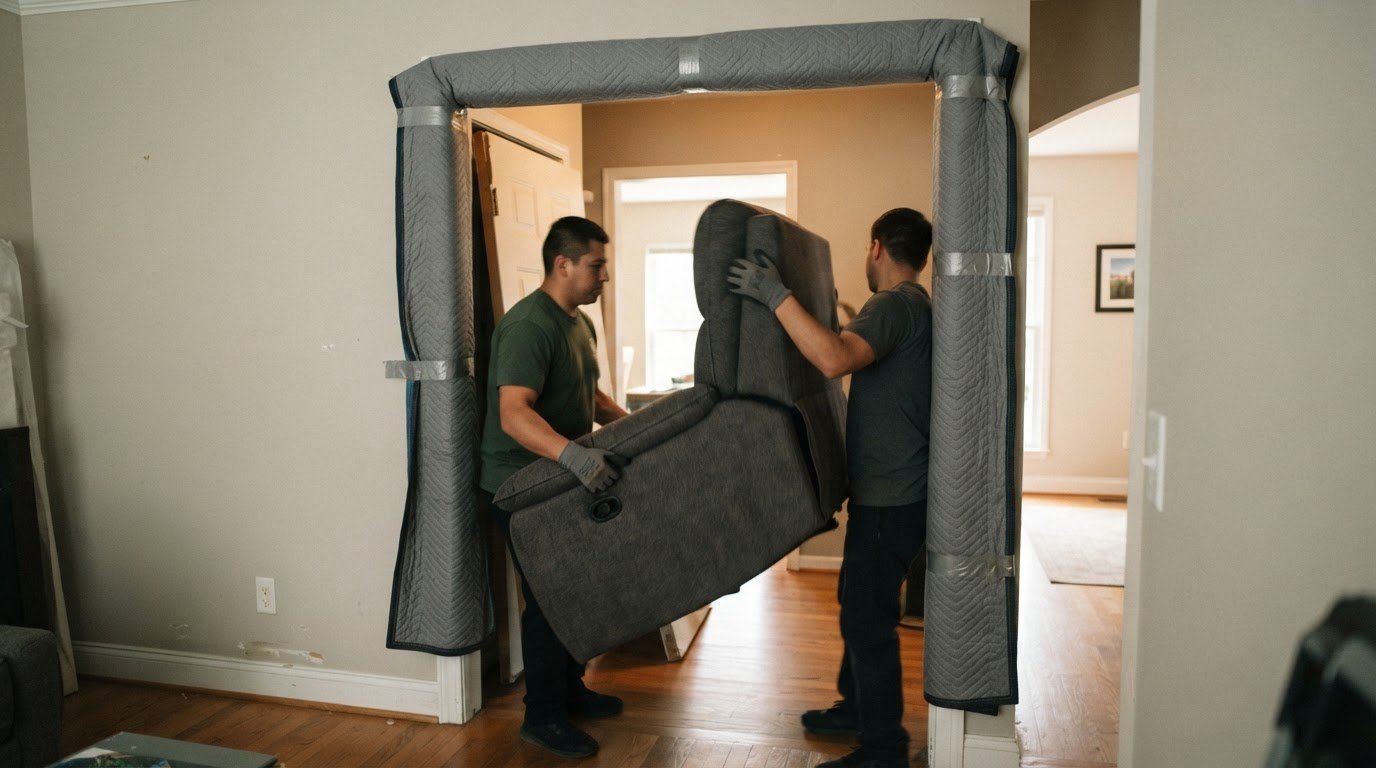
Protect the doorway before moving the recliner. To learn how to protect door jambs when carrying oversized recliners through entryways in Ashburn, measure the chair and opening, clear the route, secure padding, and remove the door if needed for clearance. These steps help prevent scratches and gouges when a bulky chair brushes the frame.
It makes sense to focus on the recliner’s weight and shape, but the door jamb needs attention too. A moving blanket can shift during the carry, exposing the frame just as the chair turns or passes through a tight spot.
This guide explains why jamb protection matters and how to prepare the doorway before lifting. You’ll learn what to measure, when removing the door can help, and which pathway hazards to clear for a more controlled move.
Key Takeaways
- Protect the side and top jambs before moving, since a shifting blanket can leave parts of the frame exposed.
- Measure the recliner and doorway, including the tightest points, to plan a controlled route before lifting.
- Removing the door from its hinges can create extra clearance when the recliner is wider than the opening.
- Clear rugs, loose cables, and small decorative items from the path to reduce trip hazards and awkward stops.
- Plan turns as well as straight passage; a clear route and steady control can help keep the recliner from striking the frame.
Why is Door Jamb Protection Important?
Movers protect a door frame by covering exposed jambs, controlling the recliner’s movement, and planning turns before carrying. For an oversized chair, that preparation matters because even a brief brush against painted trim can leave a scratch, chip, or gouge. The side jambs and head jamb form the main frame; an exterior doorway also has a sill.
- Identify every surface the recliner could strike. Before lifting, look at both side jambs, the head jamb, nearby trim, and any exterior sill. Include the wall beside the opening, especially where a recliner’s wide arms or raised footrest could swing outward. A quick inspection shows where protection needs to go and where the carry needs extra control.
- Fit a dedicated protector over the frame. Choose a door jamb protector that covers the exposed edge and stays in position as the chair passes. Follow the protector’s fitting directions, then make sure it doesn’t obstruct the opening or create a loose flap. A Ram Jamb-style protector must fit the doorway’s shape and dimensions; don’t assume every model fits every frame.
- Check the fit and reuse condition. A reusable protector can serve again when it remains secure and undamaged. Before another move, inspect its contact surface, edges, and attachment points for wear that could loosen coverage. Fit it to the jamb, then test that it stays put with light hand pressure before carrying the recliner. Remove it carefully after the move.
- Choose protection and moving tools together. Use a door jamb protector, moving blankets, and lifting straps as appropriate for the route. A four-wheel dolly can help control furniture on a suitable, clear path, but it doesn’t replace careful lifting at a threshold. Blankets can slip when bulky furniture brushes them, leaving the door frame exposed. Tape on cardboard can peel paint during removal, while cardboard may not absorb a heavy impact. Foam tubing can leave gaps or come loose.
- Pivot with a planned, controlled movement. Keep the recliner supported, move slowly, and make small adjustments rather than twisting the chair through the opening in one motion. One person should guide the turn and watch the nearest arm, back, and footrest. Stop if the frame contacts the protector, then reset the angle before continuing. This reduces sudden bumps against the jamb.
In Ashburn, moving-supply and hardware retailers are places to find furniture-moving supplies and door-jamb protectors to buy or rent. Choose protection that fits the doorway, not just a covering that looks wide enough.
Measuring furniture and doorways before moving
Measure the recliner and doorway before lifting. Protect walls, floors, hinges, and hardware by checking the route, covering vulnerable surfaces, and keeping the chair clear of fixtures.
Measure the Recliner and Doorway
Start with the recliner in the position you’ll carry it. Measure its widest points, including the arms and any attached footrest, then compare them with the doorway’s narrowest clear opening. Check the height and turning space, not just the straight path. A chair that fits front-on may still catch the jamb when angled.
- Measure the opening. Record the clear width between the jambs and the height beneath the head jamb. Include trim or hardware that reduces usable space. Check the route from the room where the chair starts through each doorway it must cross.
- Check the recliner’s shape. Measure across the arms and back, and account for protruding controls or a raised footrest. Compare the chair’s dimensions with the opening before deciding how to position it. Don’t force the chair through if the measurements leave no room to turn.
- Consider the full route. Mark narrow turns and changes in direction. Widening a doorway can improve accessibility and reduce the chance of damage, but it involves changing the opening itself. Treat it as a separate accessibility project, not a quick adjustment during moving day.
Prepare the Doorway Area
Clear the floor and protect nearby surfaces before carrying the chair. A rug edge, loose covering, or dusty threshold can disrupt footing or shift under a moving load. Keep the doorway visible and the route open, including space around grab bars and door hardware.
- Secure floor coverings. Remove rugs and loose mats from the doorway and approach. If a floor covering must stay, make sure it lies flat and won’t slide beneath the movers’ feet or the recliner.
- Contain dust at the threshold. Sweep loose dirt from the floor and sill before moving. If the doorway or nearby work area is dusty, cover adjacent flooring and keep the carrying path clear of loose coverings that could bunch up.
- Protect hinges and hardware. Notice handles, locks, hinges, and nearby wall fixtures before positioning the chair. Keep the recliner’s arms and back away from them as it passes. Don’t use a grab bar as a furniture handle; leave it clear for wheelchair users who rely on it to control movement through narrow spaces.
- Make space for the turn. Move small items away from both sides of the opening. A clear approach gives the carriers room to adjust the chair’s angle without pushing it into the wall or door frame.
For help planning a bulky in-home move, in-home furniture moving help can take the measuring and doorway layout into account.
Removing doors from hinges for extra clearance
If the recliner is wider than the doorway’s clear opening, removing the door may create more room to pass it through. Protect the door, hinges, and surrounding frame while making the opening easier to use.
- Confirm that removing the door will help. Compare the recliner’s widest point with the open doorway. Look at the hinge-side and latch-side edges to see where the door narrows the route. Removing it can add clearance, but it won’t widen the fixed opening between the jambs. Plan the chair’s approach and turn before taking the door down.
- Identify the hinge type. Inspect each hinge before touching it. Some hinges have removable pins; others use a different design. Check how the door is attached and which fasteners hold the hinge leaves to the door and frame. Don’t force a pin or pry against painted trim. If the hinge design doesn’t allow straightforward removal, stop rather than risking damage.
- Set up a stable work area. Clear the floor on both sides of the doorway. Put a protective covering nearby where the door can rest without scraping the floor or wall. Keep the recliner out of the opening while working. A door resting against a frame or left in a walking path can create a new obstacle.
- Support the door before releasing it. Have another person hold the door steady while you work at the hinges. Keep it supported as each connection is released, and avoid letting its weight pull on a hinge or frame. A door can shift suddenly once it’s no longer secured at every hinge, so don’t work alone with an unstable door.
- Remove the door without levering against the frames. For a removable-pin hinge, use a suitable tool to work the pin out carefully while the helper supports the door. For another hinge style, use the appropriate fastener method. Keep tools away from the jamb’s painted surface. Never use the trim as a brace or pry point.
- Store the door and hardware together. Set the door flat on its protective covering, away from the recliner’s route. Keep hinge pins and removed fasteners in one container so they don’t get lost or dropped near the threshold. Check that no hardware remains protruding into the opening before moving the chair.
- Rehang the door after the move. Keep the opening clear while the recliner passes, then reinstall the door using its original hinge connections. Align the hinges before securing them, and make sure the door swings freely afterward. If removal or reinstallation requires force, pause instead of scraping the frame or loosening the hardware.
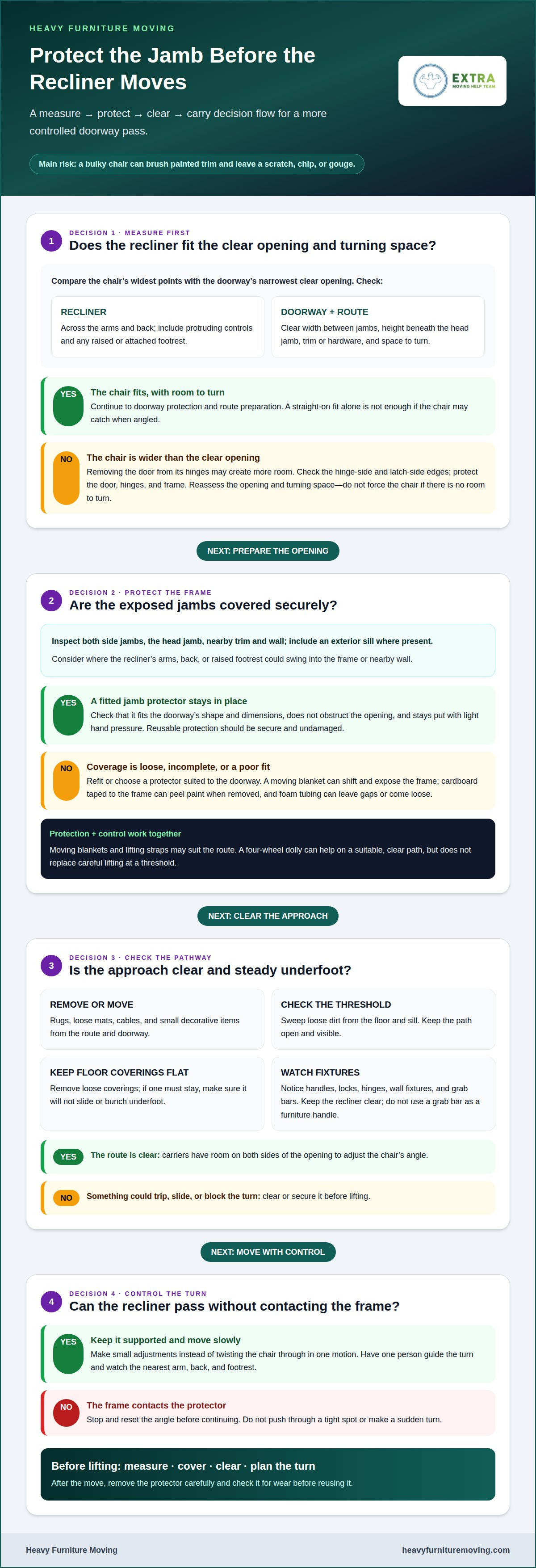
Clearing hazards from the moving pathway
Clear the route from the recliner’s starting room to its destination before lifting. Rugs, loose cables, and small decorative items can cause trips or force a sudden stop near a doorway. An important part of how to protect door jambs when carrying oversized recliners through entryways in Ashburn is making the entire route safe before the carry begins.
- Walk the full route first. Trace the recliner’s planned path from room to room, including hallways, turns, and thresholds. Look down for rug corners, charging cords, toys, shoes, and decorative objects. Move each obstacle out of the carrying lane so nobody has to step around it while supporting the chair. Check the destination, too, so there’s room to set the recliner down.
- Remove rugs and loose mats. Lift runners and mats from the approach to each doorway. A rug edge can catch a shoe or drag beneath the recliner, disrupting a steady carry. If a floor covering must stay, make sure it lies flat and keep its edges outside the path.
- Move cables away from feet and furniture. Unplug or reroute loose cords along the wall, including lamp and phone chargers. Keep cables away from the doorway and any turn where a carrier might step backward. Don’t cover a loose cable with a rug; the hidden bump can still affect footing.
- Relocate small objects and furniture. Clear plant pots, baskets, side tables, and floor decorations from the route. A small item near a hallway corner can force carriers to twist the recliner or pause with it tilted. Move nearby furniture far enough to leave space for a controlled turn.
- Check the doorway from both sides. Look for objects behind the door, near the threshold, or beside the jamb. A shoe or doorstop can become a trip point when carriers focus on the recliner’s arms. Clear the area where the chair will enter, pass through, and exit.
- Keep the floor clean and visible. Sweep dirt and loose debris from the path. Small debris can make footing less predictable, especially at a threshold. Use a floor covering only if it lies flat and won’t bunch beneath the recliner or a carrier’s feet.
- Plan turns before lifting. Identify narrow corners and decide where the chair will pivot. Clear obstacles from both sides of each turn, not just the straight approach. This preparation is a useful part of how to protect door jambs when carrying oversized recliners through entryways in Ashburn, since sudden corrections can bring the chair against the frame.
- Make one final route check. Walk the path again from the carrying position. Confirm rugs, cables, and decorative items remain out of the way, and the destination has room for the recliner. Keep the route clear until the chair is fully in place.
Why door jambs need protection
Protect the frame because a recliner can strike more than the doorway’s side edges. Contact during a tight turn can mark the trim, walls, or sill, damaging more than the furniture itself.
- Identify each part of the doorway. A door jamb includes the side jambs and head jamb; an exterior doorway also has a sill. Check all of these surfaces before moving. A recliner’s arm may catch a side jamb, while its upper back can bump the head jamb during a tilt.
- Account for contact during turns. The chair’s widest point may swing outward as carriers angle it through an opening. That movement can strike a frame even when the recliner clears the doorway while held straight. Plan for the arms, back, and footrest to move through the space, not just the chair’s center.
- Cover exposed frame edges. Place a dedicated door jamb protector where the recliner could make contact. Make sure it sits securely and covers the likely impact area. High-impact door frame guards are designed to shield frames from repeated wheelchair contact; use a protector suited to the doorway and moving task.
- Don’t rely on a blanket alone. A moving blanket can shift when a bulky object brushes against it. If it slips, painted trim may be exposed during the next turn. Check that any temporary covering stays in place, and don’t let loose material hang into the route.
- Consider the wall beside the frame. A recliner can brush an adjacent wall while passing a narrow opening. Protective edge and corner products can help guard walls from contact with mobile items. Position protection where the chair’s outer edge could swing, rather than covering only the center of the jamb.
- Remember that small impacts add up. Wheelchair users, especially those using power wheelchairs, can accidentally scratch, chip, or dent frames and nearby walls in narrow doorways. A bulky recliner also needs controlled movement through tight spaces. Protecting contact points helps prevent avoidable marks during the move.
- Check coverage before the carry. Look along the side jambs, head jamb, sill, and nearby wall. Press the protector gently to confirm it stays in place, then verify it doesn’t block the opening. If a section remains exposed, adjust the protection before bringing the recliner to the doorway.
- Choose protection based on the route. Repeated traffic through a doorway calls for durable coverage, while a single furniture move still needs stable protection at likely contact points. Keep the key takeaway simple: guard the frame and adjacent wall, then control the recliner so it doesn’t strike them.
For hands-on support with a bulky recliner, get help with heavy furniture moving.
Heavy Furniture Moving: Exercise Equipment Moving
Heavy Furniture Moving helps with bulky household moves that call for careful handling. If a recliner’s size, weight, or route makes the carry difficult, in-home furniture moving help can handle the lifting and doorway maneuvering. The team also offers Exercise Equipment Moving for heavy, awkward items that need controlled movement through a home. Consider professional help when the chair is difficult to manage safely, the entryway is tight, or you want to reduce the risk of damage to the frame or furniture. Contact Heavy Furniture Moving to discuss your move.
Set Up Your Move for a Confident Start
Before moving day, agree on who will guide the recliner at each doorway and choose a clear cue for pausing. A simple plan keeps everyone coordinated when the chair needs a careful adjustment. If you’re considering how to protect door jambs when carrying an oversized recliner through entryways in Ashburn, decide whether to handle the lift yourself or get experienced help.
Heavy Furniture Moving offers Movers Near Me and Sofa Hoisting, alongside the Exercise Equipment Moving service discussed above. Choose support that fits the work, whether the recliner is one difficult item or part of a larger move.
Contact Heavy Furniture Moving for help with planning your recliner move. A steady plan can help you start with confidence.
Frequently Asked Questions
What padding or door jamb protector works best when moving an oversized recliner through a doorway?
A fitted, impact-resistant jamb protector is a strong choice for moving a recliner. Select one that covers the areas the chair could contact and stays secure without blocking the opening. Check the fit before carrying. A loose protector can shift, while padding that leaves a gap may expose the frame as the recliner turns. Avoid relying on adhesive tape on painted trim.
How do you measure a recliner and doorway to determine whether it will fit?
Measure the recliner at its widest and tallest points, including the arms and any parts that remain extended. Then measure the doorway’s clear width and height between obstacles in the frame. Compare the dimensions and consider the chair’s angle during the turn, not just a straight approach. Assess the hallway space on both sides too. A tight corner can block passage even when the recliner appears narrower than the opening.
Can you remove a door or its hinges to create more clearance, and how?
Yes. Removing the door leaf can clear space occupied by the open door, but it won’t widen the fixed opening between the jambs. First check how the hinges attach. Have someone support the door while carefully releasing the hinge pins or fasteners using the appropriate method. Set the door and hardware aside safely. Don’t force a stuck pin or pry against the painted frame.
How much do reusable door jamb protectors cost, and are they worth buying?
Protector prices vary with the design, material, coverage, and fit. Reusable guards can be worthwhile if you move bulky furniture often or need protection for repeated trips. For a single move, consider whether the guard’s coverage and secure fit make it worth keeping for future use. Inspect reusable protection for cracks, loose edges, or worn attachment points before each move, since damaged coverage may shift or leave parts exposed.
Do Ashburn, Virginia moving companies provide door-frame protection, and what do they charge?
Professional movers protect door frames by covering exposed jambs and controlling the recliner’s movement. No pricing information is available.
Frequently Asked Questions
A fitted, impact-resistant jamb protector is a strong choice for moving a recliner. Select one that covers the areas the chair could contact and stays secure without blocking the opening. Check the fit before carrying. A loose protector can shift, while padding that leaves a gap may expose the frame as the recliner turns. Avoid relying on adhesive tape on painted trim.
Measure the recliner at its widest and tallest points, including the arms and any parts that remain extended. Then measure the doorway’s clear width and height between obstacles in the frame. Compare the dimensions and consider the chair’s angle during the turn, not just a straight approach. Assess the hallway space on both sides too. A tight corner can block passage even when the recliner appears narrower than the opening.
Yes. Removing the door leaf can clear space occupied by the open door, but it won’t widen the fixed opening between the jambs. First check how the hinges attach. Have someone support the door while carefully releasing the hinge pins or fasteners using the appropriate method. Set the door and hardware aside safely. Don’t force a stuck pin or pry against the painted frame.
Protector prices vary with the design, material, coverage, and fit. Reusable guards can be worthwhile if you move bulky furniture often or need protection for repeated trips. For a single move, consider whether the guard’s coverage and secure fit make it worth keeping for future use. Inspect reusable protection for cracks, loose edges, or worn attachment points before each move, since damaged coverage may shift or leave parts exposed.
Professional movers protect door frames by covering exposed jambs and controlling the recliner’s movement. No pricing information is available.