How to Move a King Mattress Upstairs Without Gouging Walls
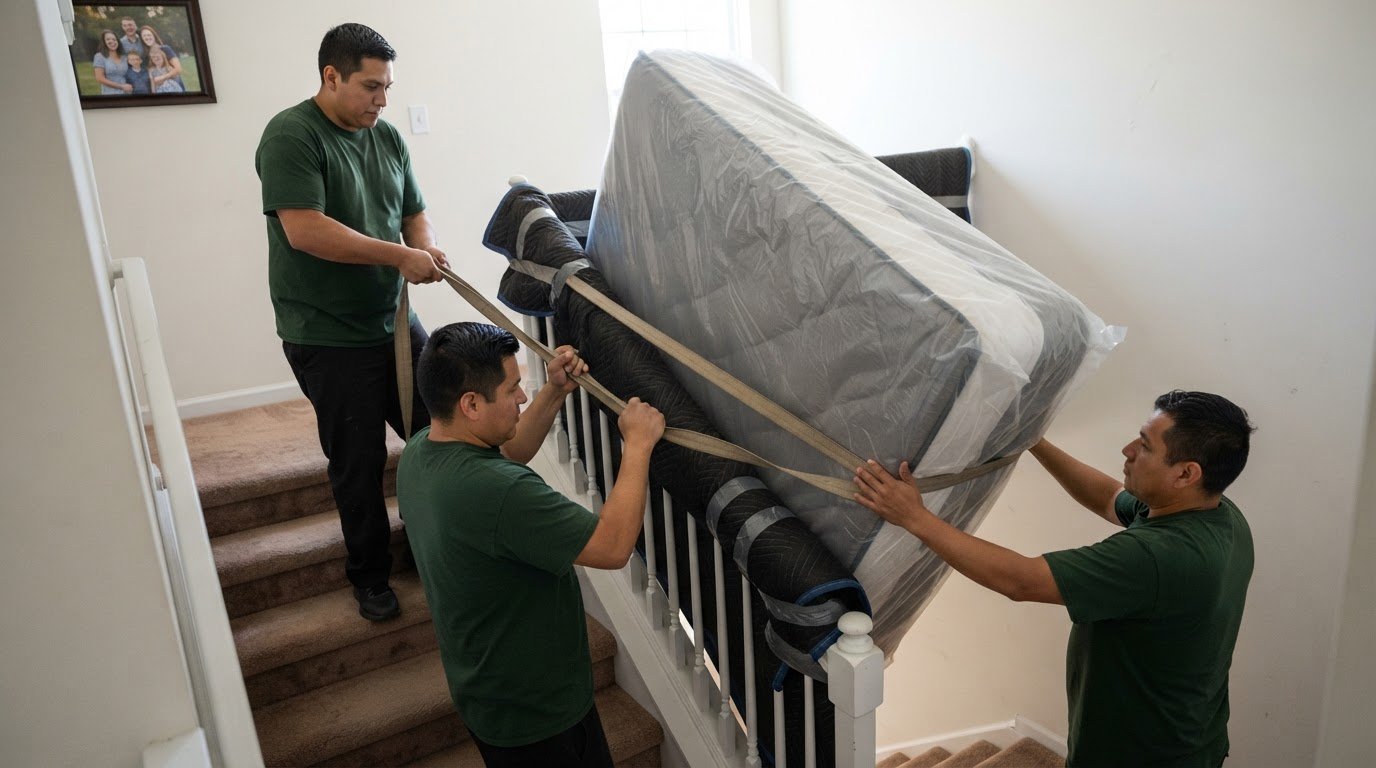
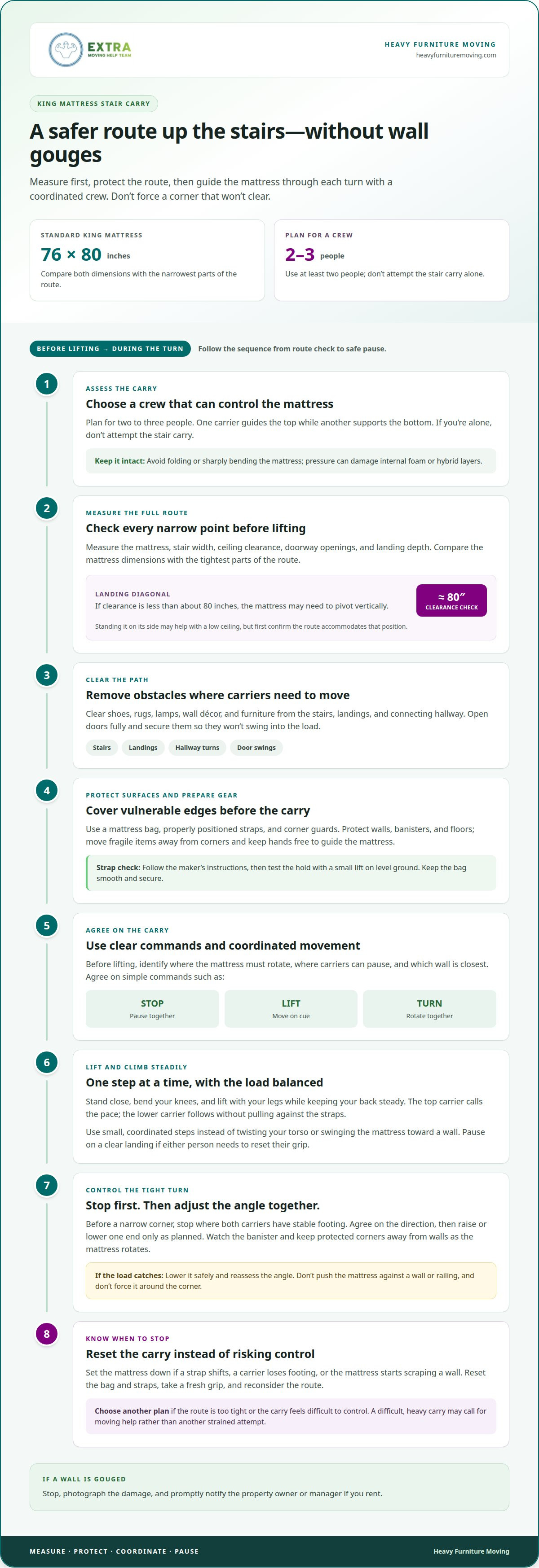
A tight stairwell corner is often the real obstacle, not the number of steps. Plan on two or three people to carry a king mattress upstairs rather than trying to manage it alone. A safe plan for how to prevent wall gouges when moving a heavy king mattress up stairs in South Riding starts with measuring the route and controlling the mattress through every turn.
It’s easy to assume a mattress will bend around a landing, but its size can make a tight pivot awkward. A standard king measures 76 inches wide and 80 inches long, so rushing or forcing it around a corner can put walls at risk.
Assess the carry, measure the stairs and doorways, and prepare the route before lifting. Use straps and steady, coordinated movement, and know when to stop instead of forcing a tight turn. Planning ahead helps protect both the walls and the people carrying the mattress.
Key Takeaways
- Use moving straps to steady the mattress and coordinate each lift with your partner.
- Protect walls, banisters, and floors before carrying the mattress into the stairwell.
- Angle the mattress through tight turns instead of forcing it against a wall or railing.
- Pause if a corner won’t clear, then adjust your approach before trying again.
- Get moving help when the route is too tight or the carry feels difficult to control.
Can I move a king mattress up stairs by myself?
Don’t carry a king mattress upstairs alone; plan for two to three people to control its size and movement. Avoid folding or sharply bending it, since pressure can damage its internal layers, including foam or hybrid components. If a move gouges a wall in South Riding, Virginia, stop, photograph the damage, and promptly notify the property owner or manager if you rent.
Measure the route before lifting. A king mattress is large, and a tight stairwell can turn a straightforward carry into a struggle that scrapes walls.
Measure Stairwell and Mattress Clearance
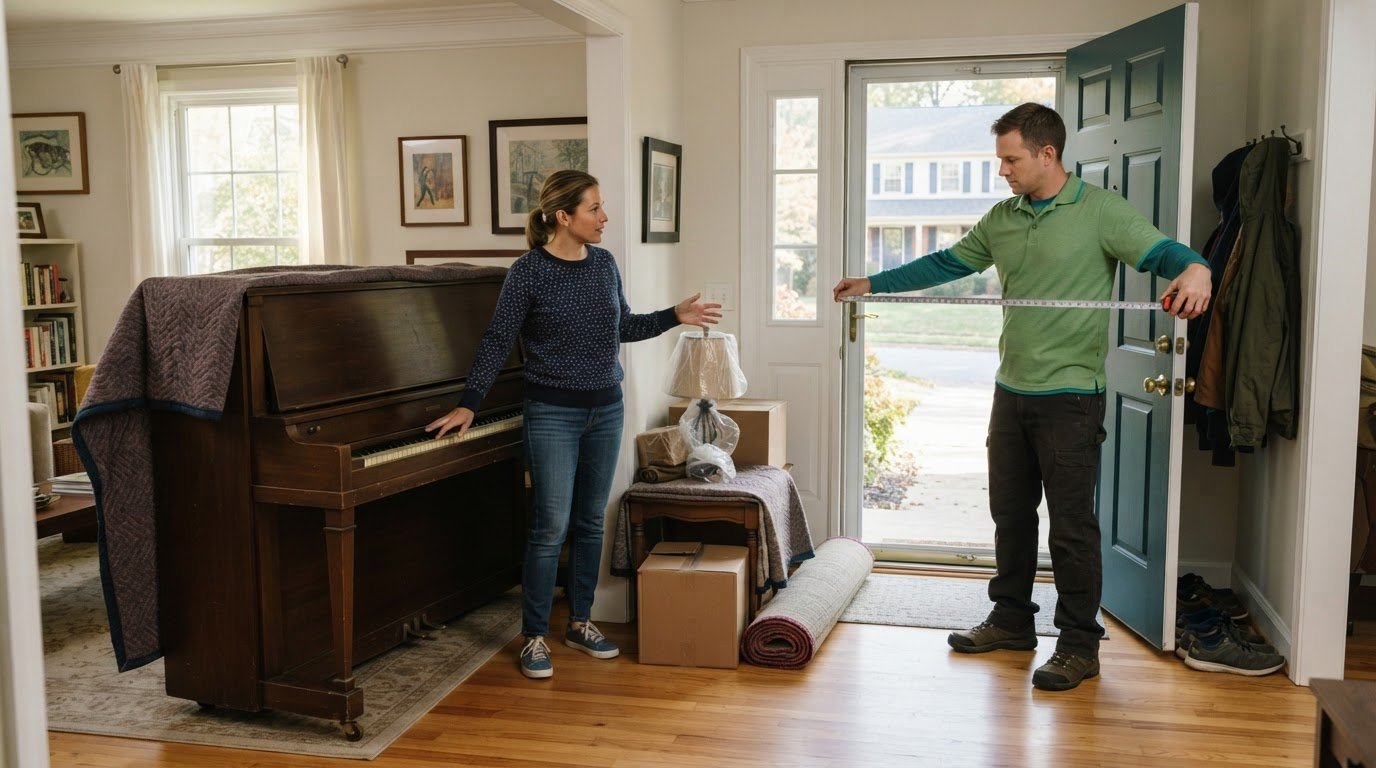
Measure the mattress, stair width, ceiling clearance, doorway openings, and landing depth before choosing a carrying position. A standard king mattress measures 76 inches wide and 80 inches long, so compare both dimensions with the narrowest parts of the route.
Check the landing’s diagonal clearance, too. If it’s less than about 80 inches, the mattress may need to pivot vertically. Standing the mattress on its side may help with a low ceiling, but check that the route accommodates that position.
Clear Obstacles from the Moving Path
Remove shoes, rugs, lamps, wall décor, and furniture from the stairs, landings, and connecting hallway. A loose runner or small table can force a sudden stop while the mattress is tilted, increasing the chance of hitting a wall or banister.
Open doors fully and secure them so they won’t swing into the load. Clear the route from the bedroom to the stairs, including the space carriers need to turn and adjust their grip.
- Decide whether you can control the carry. A king mattress typically weighs between 115 and 180 pounds, and its broad surface can be hard to steer on stairs. Use at least two people, with one carrier guiding the top and another supporting the bottom. If you’re alone, don’t attempt the stair carry.
- Plan each change in direction. Before lifting, identify where the mattress must rotate, where carriers can pause, and which wall is closest. Agree on simple commands such as “stop,” “lift,” and “turn.” That keeps both carriers moving together instead of twisting the mattress in opposite directions.
- Protect the route before carrying. Move fragile items away from corners and keep hands free to guide the mattress. Don’t rely on bending a king mattress to make it fit. Its foam, coil, or hybrid layers may not tolerate folding, and forcing the frame against a wall can leave a gouge.
- Reassess when clearance is tight. Compare the mattress orientation with the narrowest doorway and landing. If the route won’t allow a controlled turn, set the mattress down safely and reconsider the approach rather than pushing through. Careful measuring helps prevent wall damage before the first stair.
Moving straps and lifting technique
Use a mattress bag, properly positioned straps, and corner guards before lifting. On narrow stairs, keep the mattress controlled and move only when both carriers are ready.
-
Secure and Use Moving Straps
Slide the straps beneath the mattress and position them where both carriers can grip comfortably. Follow the strap maker’s instructions, then test the hold with a small lift on level ground. Keep the mattress bag smooth and secure; loose plastic can bunch beneath a strap or slip against a carrier’s hands. Add corner guards before approaching walls or railings.
-
Lift and Turn the Mattress Safely
Stand close to the mattress, bend your knees, and lift with your legs while keeping your back steady. One carrier guides the top while the other supports the bottom. Turn with small, coordinated steps instead of twisting your torso or swinging the mattress into a stair wall. Agree on “stop” and “lower” before starting.
- Coordinate each stair. Keep the mattress balanced and move one step at a time. The top carrier calls the pace while the lower carrier follows without pulling against the straps. Pause on a clear landing if either person needs to reset their grip. Don’t let one carrier push while the other is still repositioning.
- Control the turn. Before a narrow corner, stop where both carriers have stable footing. Raise or lower one end only after agreeing on the direction of movement. Keep protected corners away from the wall, and watch the banister as the mattress rotates. If the load catches, lower it safely instead of forcing the turn.
- Stop when control slips. Set the mattress down if a strap shifts, a carrier loses footing, or the mattress starts scraping a wall. Reset the bag and straps, then take a fresh grip before lifting again. A difficult, heavy carry may call for a heavy lifting moving service rather than another strained attempt.
Weight should shape the plan before the mattress leaves the room. A mattress may weigh 150 pounds, making it difficult to lift and maneuver, while a full mattress weighs 50-60 pounds. The page states that OSHA recommends using two or more people to lift loads heavier than 50 pounds. Treat that threshold as a reason to avoid solo lifting, and make sure the people carrying the mattress can communicate clearly and keep it under control throughout the move. Straps can help distribute the load, but they do not remove the need for a coordinated crew or a safe route.
For a giant mattress, the guide identifies Two people as the minimum number needed to move it and recommends Three people as the preferred crew. An extra person can help steady and guide the mattress through a turn, provided everyone agrees on who is directing the movement. That rating describes the system’s capacity, not a reason to take on an awkward carry without preparation. Check the equipment instructions, confirm the straps are fitted securely, and pause if the crew cannot maintain a balanced hold. If the mattress is too heavy or difficult to control, choose a safer moving plan rather than trying to manage it with less support.
Measuring stairs, landings, and doorways before moving
Measure the entire route before lifting, not just the staircase. Compare each tight point with the mattress dimensions and the position you plan to carry it in.
-
Measure Stair Dimensions
Measure the stair width at its narrowest point, including the handrail and any trim that reduces clearance. Check the ceiling above the steps and note where the angle changes. A standard king is 76 inches wide and 80 inches long, so record whether it can pass flat or needs a vertical position.
-
Check Landing Clearance
Measure the landing’s width, depth, and diagonal space between opposing corners. A stairwell turn with less than about 80 inches of diagonal clearance may require pivoting the mattress vertically. Also note the ceiling height above the landing. A vertical carry needs enough overhead space for the mattress’s full length.
-
Measure Doorway Clearance
Measure each doorway’s usable width and height with the door open. Include the frame, hinges, knobs, and nearby walls in your route plan. A mattress that clears the stairs can still catch at a bedroom entrance if the doorway requires a sharp turn. Note which doors can be opened wider or safely removed.
- Map the tightest points. Record each narrow measurement in order, from the bedroom to the destination. Compare the narrowest stair width, landing diagonal, and doorway opening with the mattress in both horizontal and vertical positions. If a low ceiling prevents an upright carry, plan another orientation before lifting. Mapping the route helps prevent damage and avoids repeated lifting that adds strain.
- Check the turning space, not just the straight run. The mattress needs room to rotate as carriers move around a landing or doorway. Stand in the clear space and trace the turn with your hands, allowing for the mattress’s full length. Mark a likely pivot point with removable tape, away from painted surfaces. If a banister or wall blocks the turn, revise the approach before carrying.
- Use measurements to make a go-or-stop decision. Compare every clearance with the mattress position needed at that point. A king mattress stood on its end is roughly 203 cm tall, so check overhead clearance along the full route, not only at the landing. If the mattress can’t pass without force, don’t try to squeeze it through. A planned pause is safer than scraping a wall or straining under an awkward load.
Moving a mattress around tight stairwell corners
A 90-degree landing can stop a king mattress even when the stair run is clear. Pivot slowly, keep both carriers coordinated, and don’t force the mattress against a wall.
-
Guide the Mattress Around Tight Corners
Stop before the landing and agree which end will lead through the turn. Angle the mattress about 45 degrees, then pivot it in small, controlled movements while one person guides each end. Watch the leading corner and the wall behind the trailing edge. To prevent wall gouges while moving a heavy king mattress upstairs in South Riding, pause whenever either carrier loses sight of an edge.
- Choose the turn position before lifting. At a 90-degree landing, check where each carrier can stand without blocking the other’s movement. Keep the mattress balanced and rotate its top edge toward the open part of the landing. Avoid swinging the lower end across the stairs, where it can strike a banister or pull a carrier off balance.
- Move in small adjustments. Shift one end slightly, pause, and check the opposite corner before continuing. A broad mattress can brush one wall while its far edge clips the railing. Use clear calls such as “hold” and “turn” so both people move the load together. Don’t twist sharply while carrying.
-
Protect Walls, Banisters, and Floors
Cover exposed wall corners and banister contact points before starting. Secure the padding so it won’t slide under pressure, and keep the mattress bag smooth around the edges. Clear loose rugs from the landing, since unstable footing can turn a careful pivot into a collision with a wall or railing.
- Check the contact points during the turn. As the mattress rotates, watch the top edge, lower corner, and side nearest the banister. Keep hands clear of pinch points between the load and the wall. If padding shifts or a corner guard catches, stop and reset it before moving upstairs. A controlled pause helps prevent gouges when guiding a bulky mattress around a tight turn in South Riding.
- Stop after repeated failed attempts. If the mattress won’t pass after two or three attempts, don’t keep forcing the same angle. Set it down safely, reassess the available pivot space, and try another orientation only if both carriers can maintain control. Repeated scraping can gouge drywall, and forceful lifting can strain the carriers.
How to protect stair walls, corners, banisters, and floors during a move?
Protect each surface before the mattress enters the stairwell. Set up padding and floor coverings, and clear the route so carriers can focus on controlling the load.
- Cover exposed wall corners. Place padded corner guards where the mattress might brush a turn, especially at the bottom and top of the stairs. Secure them so they stay in place on contact. On painted drywall, avoid adhesive that could pull off paint. Make sure the padding covers likely contact points without narrowing the carrying path.
- Pad the banister and handrail. Wrap sections likely to touch the mattress with moving blankets or other soft padding. Keep the covering snug, not bunched, so it won’t snag. Pay special attention to newel posts and rail ends, which can catch an edge during a turn. Keep the handrail usable if carriers need it for balance.
- Protect floors along the route. Lay floor coverings at the bedroom entrance, hallway, and stair landing. Choose material that lies flat and won’t slide underfoot, and smooth out wrinkles before carrying. A loose rug can shift as someone steps backward, so remove it rather than covering it with another layer.
- Keep doors and nearby furniture clear. Move hallway tables, shoe racks, and lamps out of the path. Hold doors fully open so they won’t swing into the mattress or carriers. Clear the landing too, leaving room to adjust the mattress without dragging an edge along a doorframe or wall.
- Inspect protection before each tight turn. Pause at the landing and check that corner guards, blankets, and floor coverings haven’t shifted. Reposition loose padding before moving the mattress. Keep the mattress bag’s seams and excess material from catching on a railing. If the protection blocks secure footing or narrows the route, adjust it before lifting again.
- Finish with a careful surface check. Once the mattress is upstairs, inspect the stair corners, banister, and floor coverings before removing them. Look for shifted padding or fresh scuffs around the turn. If the carry feels too difficult to control through a tight stairwell, get help with the heavy stair carry instead of risking damage.
Heavy Furniture Moving
Heavy Furniture Moving helps with residential moves involving heavy, bulky items and difficult access, including awkward carries through narrow stairwells. The crew measures the item, stairs, and doorways before lifting to plan the route and help protect walls, banisters, and floors.
Consider professional help if measurements reveal a difficult turn, the mattress catches during a controlled attempt, or you can’t keep the load steady. Don’t risk damage by forcing it upstairs. Contact Heavy Furniture Moving to discuss help with your mattress move.
Choose a Move You Can Control
A careful plan protects more than the stairwell. It also helps you decide whether the carry is manageable or whether you need help. Preventing wall gouges when moving a heavy king mattress upstairs in South Riding starts with a move you can control, not pushing through a tight turn.
Heavy Furniture Moving offers Movers Near Me, Exercise Equipment Moving, and Sofa Hoisting. For a mattress that feels awkward to guide through your home, reach out to discuss moving help suited to the task. You can contact Heavy Furniture Moving and talk through the move.
Take the next step at your own pace. With the right support, you can focus on getting the mattress where it belongs while protecting your home.
Frequently Asked Questions
What’s the best tool for moving a mattress upstairs?
Moving straps help carriers get a steady grip and share the load. Pair them with a mattress bag to protect the fabric, and secure loose material so it doesn’t snag on a railing. Straps alone won’t prevent wall marks, so add corner protection and keep the mattress under control through every turn.
How Many People Do You Actually Need?
Plan for at least two people to carry a king mattress upstairs, rather than attempting the stairs alone. One carrier can guide the upper end while the other supports the lower end. A third person can watch the landing and call out clearance at a blind turn, staying clear of the carriers’ path. Agree on commands before lifting so nobody moves unexpectedly.
How heavy is a king mattress and how many people are needed to move it up stairs?
A king mattress typically weighs between 115 and 180 pounds, and some constructions weigh more than 200 pounds. Plan for two or three people to control the load on stairs. Weight isn’t the only challenge: the mattress’s wide, flexible shape can make it hard to grip and steer. If carriers can’t keep it stable, pause instead of pushing onward.
What equipment helps move a king mattress up stairs without damaging walls?
Use moving straps for grip, a mattress bag to cover the fabric, and padded guards for exposed wall corners. Moving blankets can shield banisters, while floor runners help protect the landing. Choose coverings that stay flat and secure. Avoid loose plastic, shifting rugs, and tape that could pull paint from a wall. Each item serves a different purpose, so don’t rely on just one.
How to measure a staircase, landings, and turns before moving a king mattress?
Measure the narrowest stair width, ceiling height, landing depth, doorway openings, and the landing’s diagonal. A standard king is 76 inches wide and 80 inches long. Compare those dimensions with the mattress’s planned position at each turn. If carrying it vertically, account for its full length and the overhead clearance along the route, not just above the landing.
Which local moving companies serve South Riding and provide wall protection?
Heavy Furniture Moving serves South Riding and offers local help moving heavy household items. Before lifting, the crew measures the item, stairs, and doorways. Wrap, blankets, and straps are included on every job, along with floor and corner protection. This service can help when a mattress is awkward to carry through a stairwell and nearby surfaces need protection.
Frequently Asked Questions
Moving straps help carriers get a steady grip and share the load. Pair them with a mattress bag to protect the fabric, and secure loose material so it doesn’t snag on a railing. Straps alone won’t prevent wall marks, so add corner protection and keep the mattress under control through every turn.
Plan for at least two people to carry a king mattress upstairs, rather than attempting the stairs alone. One carrier can guide the upper end while the other supports the lower end. A third person can watch the landing and call out clearance at a blind turn, staying clear of the carriers’ path. Agree on commands before lifting so nobody moves unexpectedly.
A king mattress typically weighs between 115 and 180 pounds, and some constructions weigh more than 200 pounds. Plan for two or three people to control the load on stairs. Weight isn’t the only challenge: the mattress’s wide, flexible shape can make it hard to grip and steer. If carriers can’t keep it stable, pause instead of pushing onward.
Use moving straps for grip, a mattress bag to cover the fabric, and padded guards for exposed wall corners. Moving blankets can shield banisters, while floor runners help protect the landing. Choose coverings that stay flat and secure. Avoid loose plastic, shifting rugs, and tape that could pull paint from a wall. Each item serves a different purpose, so don’t rely on just one.
Measure the narrowest stair width, ceiling height, landing depth, doorway openings, and the landing’s diagonal. A standard king is 76 inches wide and 80 inches long. Compare those dimensions with the mattress’s planned position at each turn. If carrying it vertically, account for its full length and the overhead clearance along the route, not just above the landing.
Heavy Furniture Moving serves South Riding and offers local help moving heavy household items. Before lifting, the crew measures the item, stairs, and doorways. Wrap, blankets, and straps are included on every job, along with floor and corner protection. This service can help when a mattress is awkward to carry through a stairwell and nearby surfaces need protection.