How to Move a Heavy Quartz Island Top in Reston Without Damage
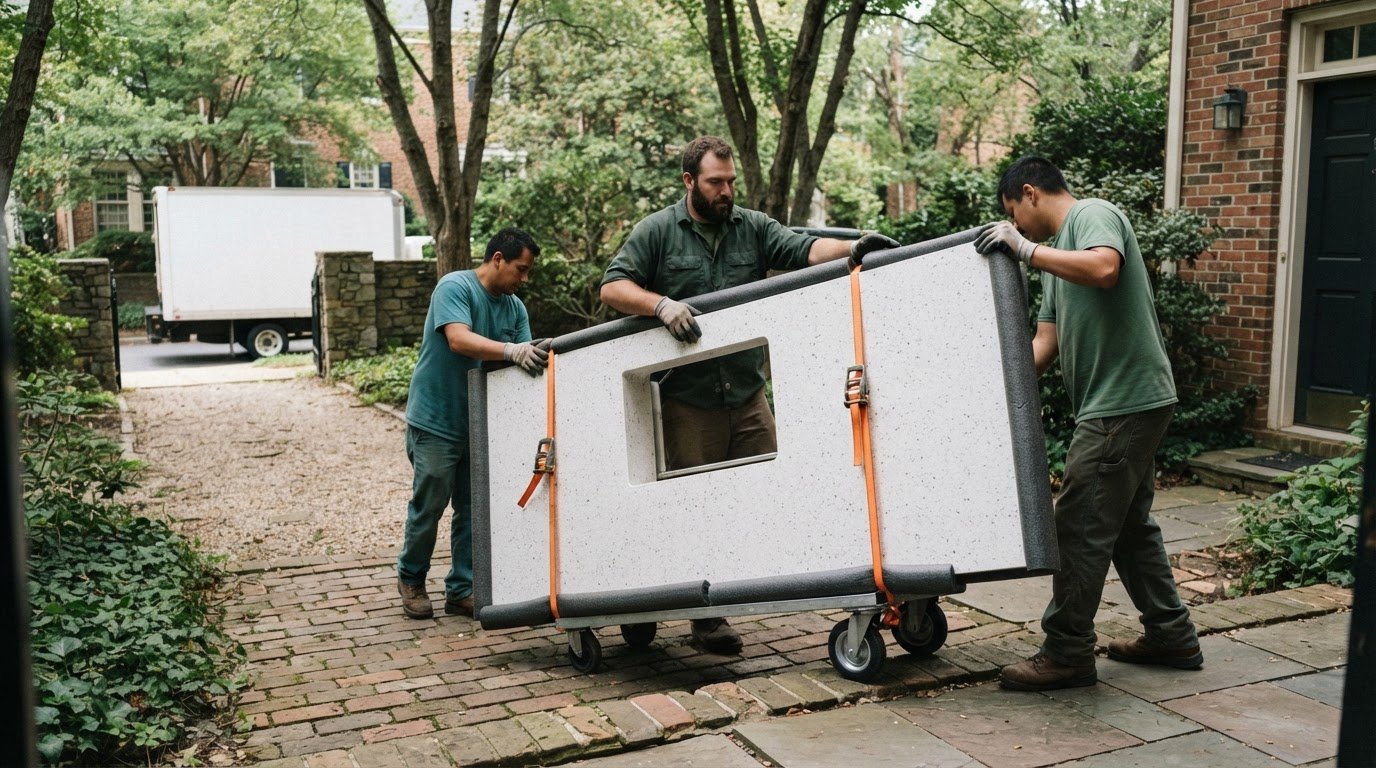
A countertop dolly can help move a quartz island top, but the slab must stay upright, supported, and secured against shifting. To transport a heavy quartz kitchen island top without snapping it in Reston, plan a controlled carry with enough help and move slowly over thresholds, gravel, and uneven pavement. Don’t drag it.
It’s tempting to think the dolly does the hard part. The real challenge is supporting the stone continuously, from the moment it leaves the cabinets until it reaches its destination. Cutouts, corners, and narrow sections need particular care because they’re more vulnerable to cracking.
This guide explains how to prepare the route, lift and carry the top, and secure it for transport. You’ll learn when a dolly is useful, how padding and an A-frame help stabilize the slab, and why careful handling matters at every transition. Take the move step by step to avoid shortcuts that put unnecessary strain on the quartz.
Key Takeaways
- Plan a coordinated lift and carry so the slab stays supported, especially around cutouts, corners, and narrow sections.
- Use a dolly only with the countertop held upright and secured; slow down over thresholds and uneven surfaces.
- Protect the stone with padding and secure it to a suitable support to limit shifting during transport.
- Measure the top and account for its dimensions and thickness to make a more useful weight estimate.
- Learn when heavy-item moving help can make a challenging countertop move easier to manage.
Getting help to lift and carry slabs
Plan the lift before loosening or moving the island top. Keep the slab supported, assign clear roles, and choose equipment suited to its size and shape.
-
Check Quartz Weight per Square Foot
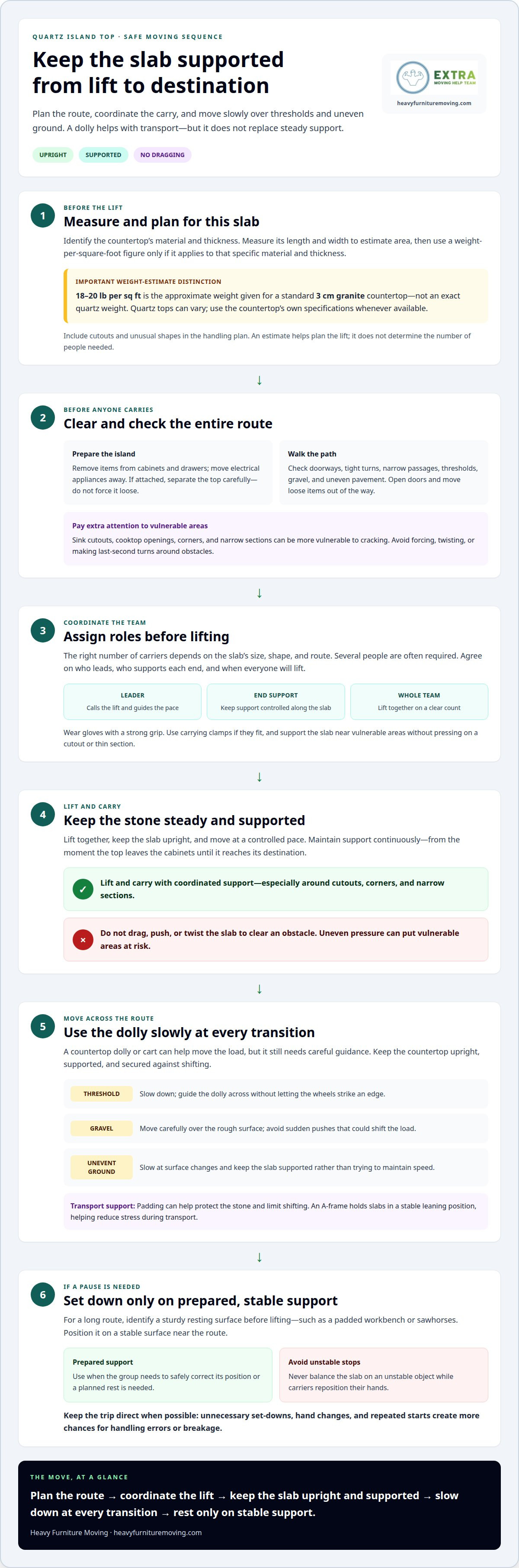
Identify the slab material and thickness before using any weight estimate. A standard 3 cm granite countertop weighs approximately 18-20 pounds per square foot, but that figure describes granite, not quartz. Don’t use it as an exact quartz weight. Quartz tops can vary, so base your plan on the countertop’s own specifications whenever available.
-
Estimate the Top’s Total Weight
Measure the island top’s length and width, then use those dimensions to estimate its area. Multiply the area by a weight-per-square-foot figure only if it applies to that countertop’s material and thickness. Include cutouts and unusual shapes in your planning, since the slab’s dimensions and construction affect how it must be handled.
- Use the estimate to plan the lift, not to guess the number of people needed. Several people are often required to move a stone countertop safely, but the right number depends on the slab’s size, shape, and route. A long island top with a sink opening needs controlled support along its length. Agree on who leads, who supports each end, and when everyone will lift.
- Prepare the slab before anyone takes hold. Remove items from the cabinets and drawers, and move electrical appliances away from the counter. If the top is still attached, separate it carefully rather than forcing it loose. Careless removal can break quartz, especially around sink cutouts, corners, cooktop openings, and narrow sections.
- Choose a grip that keeps hands secure and the slab balanced. Wear gloves with a strong grip, and use carrying clamps if they fit the countertop. Clamps grip the sides and can help coordinate a steady carry. Support the slab near vulnerable areas without pressing on a cutout or thin section.
- Use specialty lifting equipment for particularly large pieces. Professional movers or countertop installers may use it to control a slab that’s awkward to carry by hand. Keep the stone upright and properly supported. A-frame supports hold slabs in a stable leaning position, helping reduce stress during transport.
- Walk the route before lifting. Check doorways, tight turns, and changes in floor level, then clear the path. If the route is long, identify a sturdy resting surface, such as a padded workbench or sawhorses. Never balance the slab on an unstable object while people reposition their hands.
- Lift together on a clear count, keep the slab steady, and move at a controlled pace. Don’t drag or twist it to clear an obstacle. For a difficult, heavy stone move, Heavy Furniture Moving provides professional heavy-item moving help with coordinated lifting and carrying.
Avoiding dragging, pushing, and unnecessary stops
Keep the stone supported throughout the trip. Plan each transition before moving the countertop from the island to its destination.
- Lift the slab instead of dragging or pushing it. Dragging can put uneven pressure on the stone, especially where a sink cutout, corner, or narrow section interrupts the surface. Keep the countertop lifted and supported with suitable equipment and enough people. Don’t slide one end across a floor, vehicle bed, or work surface to save a step.
- Choose a dolly or cart route that stays smooth and controlled. Before moving the slab, identify thresholds, gravel, uneven pavement, and changes between floor surfaces. These transitions can jolt the load. Slow the dolly as it reaches each one, keep the countertop upright and supported, and guide it across without letting the wheels strike an edge.
- Clear obstacles before the lift begins. Open doors and remove loose items from the planned path. Check tight turns and narrow passages for anything that could force carriers to stop or pivot suddenly. For example, move a chair out of the hallway before carrying the slab through it. A clear route reduces last-second changes in direction.
- Coordinate movement over each change in level. One person should guide the pace while the others keep the stone supported. Approach a doorway threshold slowly, then move the dolly across without a sharp bump. On gravel or uneven pavement, avoid sudden pushes that could shift the load. Pause only when the group needs to safely correct its position.
- Prepare a resting support if the route is long. A sturdy workbench, sawhorses, or padded supports can provide a planned place to set the countertop down. Position the support before starting, on a stable surface near the route. Use it only when needed, since each stop creates another chance for a handling error or breakage.
- Keep the trip continuous once the slab is moving. A direct trip avoids unnecessary set-downs, hand changes, and repeated starts. Confirm the destination is ready before lifting, with a clear approach and stable support surface. If an obstacle blocks the route, stop in a controlled way and use the prepared support rather than pushing through or balancing the stone awkwardly.
- Match the equipment to the ground and the slab. A countertop dolly or cart helps move the load, but it doesn’t remove the need for careful guidance. Keep the stone upright and supported as the wheels cross each transition. If the route includes gravel, thresholds, or uneven pavement, slow down at every surface change instead of trying to maintain speed.
- Decide the next move before lifting again. If the countertop has to be set down, place it on a sturdy, prepared support, not directly on an uneven floor. Reposition the carriers and equipment before raising it again. This keeps the lift deliberate and avoids a rushed push, twist, or drag to get moving.
Ratchet straps and protective padding
Use an A-frame, padding, and moving straps to keep a quartz slab supported and steady. Carrying clamps can help movers grip the countertop edges during handling.
For transport, pad the stone, secure it to the A-frame with straps, and keep it upright. A dolly also needs vertical support and protection against shifting.
-
Apply Protective Padding
Cover the countertop with moving blankets before loading it for transport. Bubble wrap can provide extra cushioning. Place padding between the slab and hard contact points, including the A-frame supports, so the surface and edges don’t rub against the frame. Keep sink and cooktop openings clear of pressure from folded material or tightly placed supports.
- Set the padded slab against an A-frame or similar support system. An A-frame holds large stone slabs upright at a lean, helping support them during transport. Check that padding stays between the countertop and frame wherever they touch. Don’t let a bare edge rest against a hard surface, especially near a corner or cutout.
-
Secure the Top with Ratchet Straps
Fasten moving straps around the padded slab and A-frame to limit shifting and wobbling. Keep the countertop upright and supported, then tighten the straps enough to hold it in place without crushing the stone or concentrating pressure on a vulnerable section. Route the straps across stable areas, not sink openings, cooktop cutouts, or narrow sections.
- Check the setup before moving the A-frame into a truck. Look for loose strap sections, gaps in the padding, and points where the slab could rock against its support. Adjust the padding or strap position before transport. The goal is a steady fit, not forceful tightening that puts extra stress on the stone.
- Keep the countertop secured to its vertical support during the trip. If using a dolly, keep the slab upright and secured against shifting rather than laying it flat on the cart. Move slowly over thresholds, gravel, and uneven pavement. Impacts can damage stone even when the load is strapped down.
- Use carrying clamps for a controlled grip while lifting or repositioning the countertop. Clamps grip the slab’s sides and can help coordinate the carry, while straps secure it to the A-frame for transport. These tools have different roles: a strap around the frame can’t replace support during the lift.
- Inspect the padding and straps again after any necessary repositioning. A shifted blanket can expose an edge, and a loose strap can let the slab wobble. Correct those problems while the countertop rests securely on its support, before continuing.
How much does a quartz kitchen island countertop weigh per square foot?
- Separate the quartz estimate from the granite reference. The available weight figure is for standard 3 cm granite: approximately 18-20 pounds per square foot. It isn’t a quartz weight rating. Don’t label that granite figure as the weight of a quartz island top or use it as an exact quartz estimate.
That distinction matters when planning the lift. A material-specific weight-per-square-foot figure can help estimate the total load. Using a granite figure for quartz can produce a misleading estimate.
- Use the quartz top’s own material and thickness details. Quartz countertops vary, so weight per square foot depends on the particular top. Identify its material and thickness before using a figure. If you have the countertop specifications, use them to choose an applicable weight estimate. Don’t treat a general stone reference as a product specification.
For example, the 3 cm value belongs to the granite reference above. It doesn’t establish the thickness or weight of a quartz island top.
- Measure the island surface before planning the carry. Record the top’s length and width, then calculate its surface area. Use that area with a weight-per-square-foot value that matches the quartz top. The calculation helps you understand the size of the load, but it doesn’t replace the slab’s own specifications.
For an irregular island shape, account for each section instead of treating the surface as one simple rectangle. Keep the measurements and material details together so your estimate reflects the actual piece being moved.
- Use the estimate to plan handling, not to guess a safe headcount. A larger top means a larger total load, while cutouts and narrow sections also affect how people can support it. Plan the carry around the slab’s dimensions, shape, and route. Don’t assume the lift is manageable just because a rough calculation seems low.
A sink opening, for example, interrupts the slab and creates a vulnerable area. Balance support around the whole piece instead of focusing only on its estimated weight.
- Keep the granite number in its proper role. The 18-20 pounds per square foot figure can explain a standard 3 cm granite countertop, but it cannot answer the quartz-specific question by itself. For a quartz island top, use a matching specification and measured surface area to build the estimate. Then plan the lift with the full slab’s shape and support needs in mind.
How to measure and estimate the weight of a quartz island top?
- Measure the stone itself, not just the cabinet. Record the countertop’s full outside length and width, including any overhang. Cabinet dimensions may miss stone that extends beyond the base. Keep these measurements with the top’s material and thickness details so the estimate describes the actual slab.
- Break an irregular outline into manageable sections. Sketch the island from above and divide its footprint into simple rectangles. Measure each section separately, then add their areas for a working surface total. For a curved or unusual edge, don’t treat a rectangle as an exact measurement. Use a countertop template or specifications for a closer estimate.
- Record openings as part of the slab layout. Mark the sink or cooktop cutout on the sketch and measure its dimensions. Subtract an opening’s area when estimating the remaining stone surface, but keep its position visible. The cutout changes the outline and can affect where the slab needs support during lifting.
- Separate distinct pieces before totaling the load. If the island has separate stone sections, measure each piece individually. Record each piece’s length, width, and shape instead of combining them into one imagined slab. This gives you a clearer handling plan, since separate pieces may need different grips, supports, or routes through the home.
- Find a weight figure that matches this quartz top. Use the countertop’s material and thickness details with an applicable weight-per-square-foot specification. Don’t substitute a figure for another stone or thickness. If the available information doesn’t match the slab, keep the calculated surface area ready, but don’t present it as a precise weight.
- Calculate each piece before adding the totals. Multiply a section’s measured area by the matching weight per square foot. Repeat for each distinct slab, then add the estimates for the overall load. Keep units consistent throughout, since mixing inches with square feet can distort the result. Label each calculation with the piece it describes.
- Use the estimate to plan handling, not to judge the lift alone. The outline, cutouts, narrow areas, and carrying route all matter alongside total weight. A long slab with an opening may need different support from a compact, solid piece. Use the measurements to describe the load’s shape and size before moving it.
For help coordinating the lift and transport, get support with a heavy countertop move.
Heavy Furniture Moving
Heavy Furniture Moving can help when a quartz island top feels too heavy or awkward to lift and carry alone. Its heavy-item moving service supports demanding bulky-item moves, while Movers Near Me and local moving helpers can assist with broader moving needs. Consider help when the slab’s size, cutouts, or route make a controlled move difficult.
Share the top’s measurements, shape, and transport route when arranging the move. These details clarify the lifting and handling involved, without relying on a rough weight estimate alone. To plan the move with Heavy Furniture Moving, get in touch.
Set Up the Move Before the Lift
Decide who will coordinate the move, not just what equipment to use. The measurements, slab shape, and route give you a clear starting point for keeping the countertop supported from pickup to placement. If you’re deciding how to transport a heavy quartz kitchen island top without snapping it in Reston, base the plan on the actual piece and the obstacles along its path.
Heavy Furniture Moving supports demanding residential moves with services such as Movers Near Me, Exercise Equipment Moving, and Sofa Hoisting. For an island top that feels too awkward or heavy to manage, contact Heavy Furniture Moving for moving support suited to the job.
Contact Heavy Furniture Moving about your countertop move, and take the next step with a clear plan.
Frequently Asked Questions
Can I move a countertop with a dolly?
Yes, a countertop can be moved with a dolly if it stays upright, supported, and secured against shifting. If you’re planning how to transport a heavy quartz kitchen island top without snapping it in Reston, choose a route without abrupt jolts and slow down at thresholds or uneven ground. A dolly rolls the load, but people still need to guide and stabilize the slab.
Can a granite countertop be moved without breaking?
Yes, granite can be moved intact with careful handling and continuous support. Keep the slab upright, avoid twisting or dragging, and protect vulnerable points such as cutouts and narrow sections. Before moving a removed countertop, inspect its shape and identify areas that need extra support. A sink opening, for example, leaves less continuous stone than an uncut section and calls for deliberate handling.
Should a granite countertop be transported flat or upright?
Transport granite upright and properly supported rather than flat. A suitable A-frame or similar support holds the slab at a lean during the trip. In a truck, keep the support stable and prevent the stone from shifting. Don’t let the countertop rest unsupported across a wide gap. A sudden bump can stress the slab, especially around openings or corners.
What is the most fragile part of a stone countertop?
Cutouts, corners, and narrow sections are especially vulnerable to cracking. A sink or cooktop opening interrupts the stone, while a slim strip beside an opening has less material around it. Keep those areas away from hard contact points and avoid gripping or pressing directly on them. For a countertop with a large cutout, position support along solid sections, not across the opening.
How many people are needed to carry a heavy quartz countertop safely?
Several people are often needed, but the right number depends on the slab’s size, shape, and route. A long island top with a sink cutout needs a different support arrangement from a compact, solid piece. Consider tight corners, doorways, and changes in level when planning the carry. Assign clear positions and a lead caller so everyone lifts and moves together.
How should a quartz island top be lifted, supported, and oriented to prevent cracking?
Lift the slab together, keep it upright, and support it along its length. Use carrying clamps for a secure side grip when appropriate, and avoid pressure on cutouts or thin strips. For example, a top with a cooktop opening needs support on the solid sections around it. Keep the slab steady through turns instead of twisting one end to clear an obstacle.
Can quartz countertops be transported flat, or must they be carried vertically?
Carry and transport quartz upright with proper support; don’t lay the slab flat for the trip. To transport a heavy quartz kitchen island top without snapping it in Reston, use an A-frame or comparable support and prevent rocking or sliding. In a truck, stabilize the frame and slab together to help avoid uneven stress during movement.
Frequently Asked Questions
Yes, a countertop can be moved with a dolly if it stays upright, supported, and secured against shifting. If you’re planning how to transport a heavy quartz kitchen island top without snapping it in Reston, choose a route without abrupt jolts and slow down at thresholds or uneven ground. A dolly rolls the load, but people still need to guide and stabilize the slab.
Yes, granite can be moved intact with careful handling and continuous support. Keep the slab upright, avoid twisting or dragging, and protect vulnerable points such as cutouts and narrow sections. Before moving a removed countertop, inspect its shape and identify areas that need extra support. A sink opening, for example, leaves less continuous stone than an uncut section and calls for deliberate handling.
Transport granite upright and properly supported rather than flat. A suitable A-frame or similar support holds the slab at a lean during the trip. In a truck, keep the support stable and prevent the stone from shifting. Don’t let the countertop rest unsupported across a wide gap. A sudden bump can stress the slab, especially around openings or corners.
Cutouts, corners, and narrow sections are especially vulnerable to cracking. A sink or cooktop opening interrupts the stone, while a slim strip beside an opening has less material around it. Keep those areas away from hard contact points and avoid gripping or pressing directly on them. For a countertop with a large cutout, position support along solid sections, not across the opening.
Several people are often needed, but the right number depends on the slab’s size, shape, and route. A long island top with a sink cutout needs a different support arrangement from a compact, solid piece. Consider tight corners, doorways, and changes in level when planning the carry. Assign clear positions and a lead caller so everyone lifts and moves together.
Lift the slab together, keep it upright, and support it along its length. Use carrying clamps for a secure side grip when appropriate, and avoid pressure on cutouts or thin strips. For example, a top with a cooktop opening needs support on the solid sections around it. Keep the slab steady through turns instead of twisting one end to clear an obstacle.
Carry and transport quartz upright with proper support; don’t lay the slab flat for the trip. To transport a heavy quartz kitchen island top without snapping it in Reston, use an A-frame or comparable support and prevent rocking or sliding. In a truck, stabilize the frame and slab together to help avoid uneven stress during movement.