How to Move a Heavy Metal Tool Cabinet Down Basement Stairs
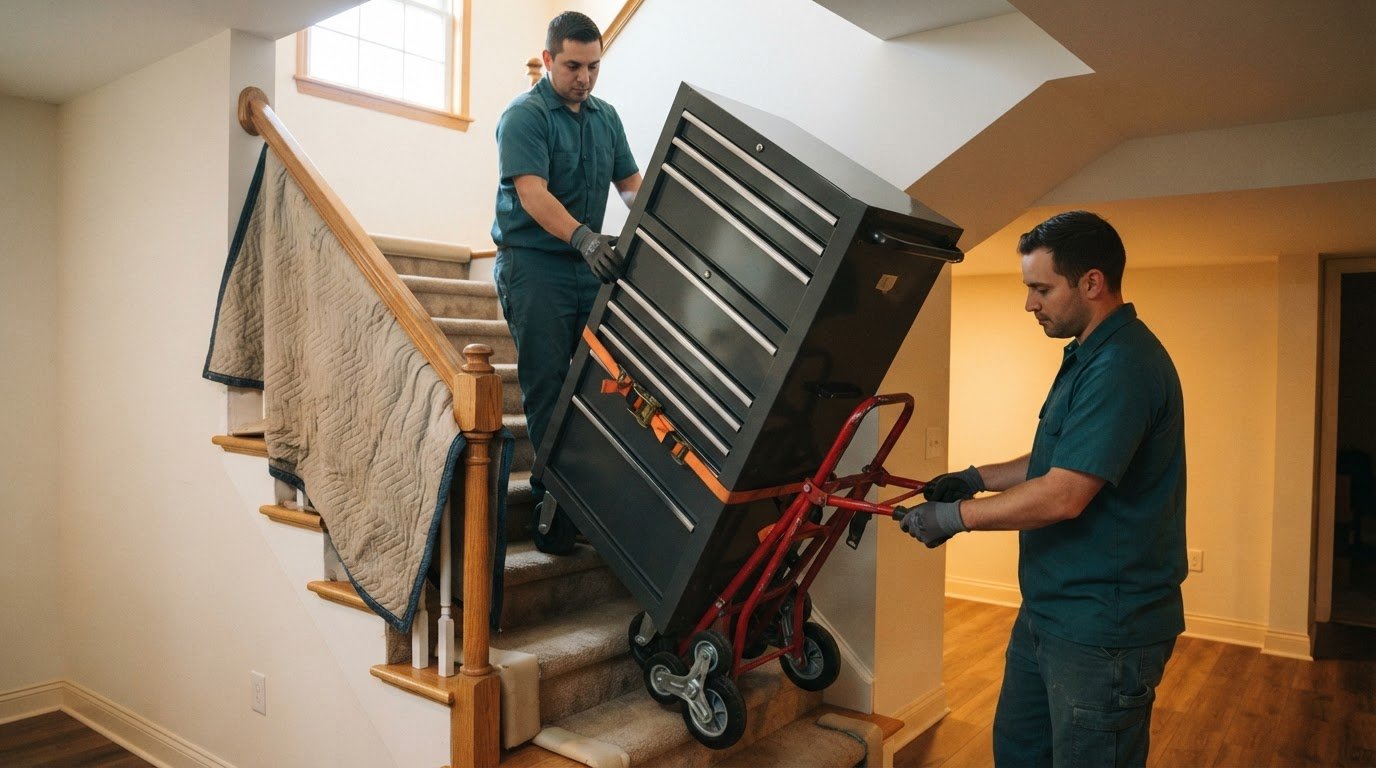
The hardest part of moving a heavy metal tool cabinet down basement stairs in Aldie isn’t lifting it; it’s keeping it controlled on the way down. Empty and secure the cabinet, then lower it slowly, one step at a time, with the person below taking more of the load. If the stairs or equipment won’t allow controlled movement, don’t force the descent.
It’s understandable to worry about a cabinet tipping, sliding, or damaging the stairs. A careful plan makes the job more manageable: assess the route, reduce and secure the load, protect nearby surfaces, and choose a carrying or dolly method suited to the cabinet and staircase.
This guide walks you through the key decisions and the descent itself. You’ll learn what to prepare, how to coordinate helpers, when a stair-climbing dolly may work, and when professional heavy-lifting help is the safer next step.
Key Takeaways
- Prepare the cabinet by removing loose contents and securing drawers or other moving parts before you start.
- Choose hand-carrying or a stair-climbing dolly based on the cabinet’s shape, the stairway, and how well the load can be controlled.
- Protect stair edges, walls, and floors with suitable padding and traction before moving the cabinet.
- Plan the descent one step at a time, with clear commands and a steady pace among helpers.
- Estimate the loaded cabinet’s weight by accounting for its empty weight and everything inside, then use that estimate to guide your moving plan.
Carrying furniture down stairs by hand
Hand-carrying a metal tool cabinet requires a clear route, controlled movement, and helpers able to manage its shape and load. Use the steps below to assess the risks and coordinate the descent before lifting.
-
Estimate the Cabinet’s Weight
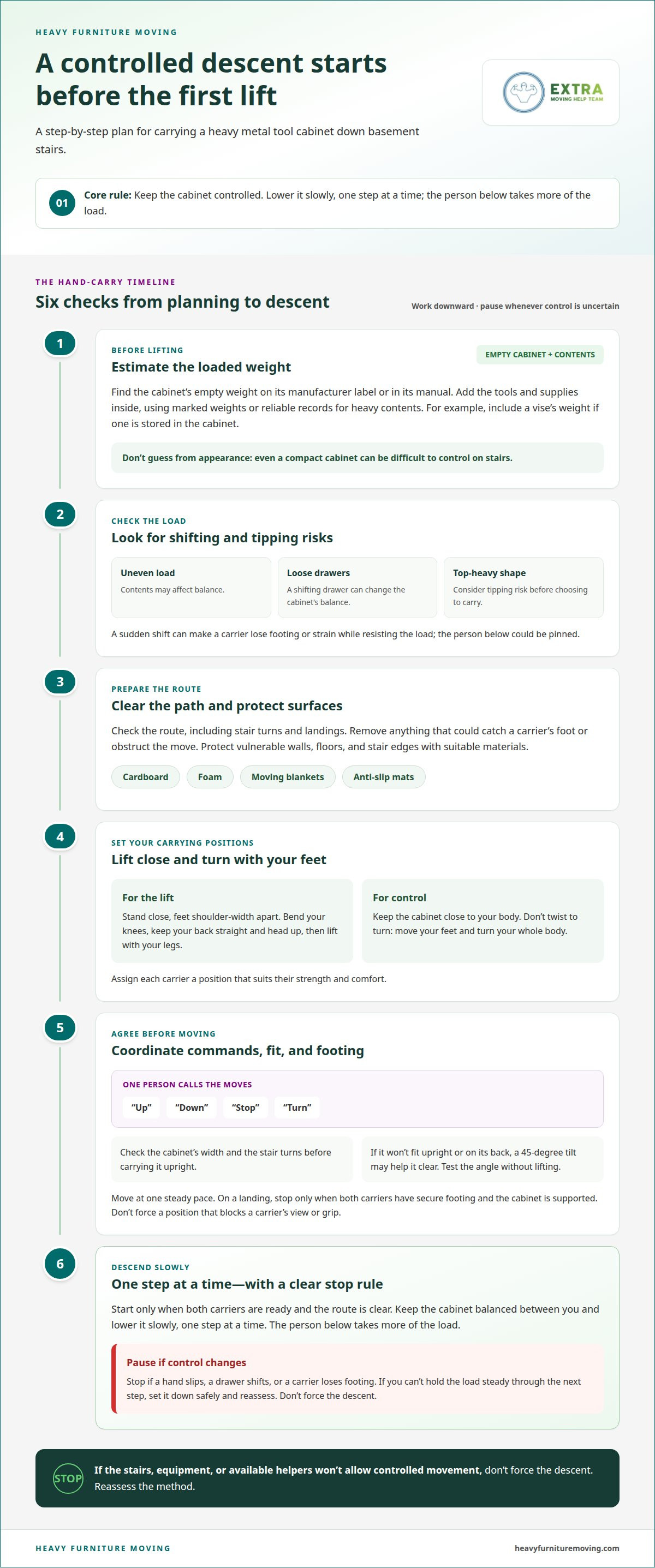
Start with the cabinet’s empty weight, then account for the tools and supplies inside. Check the manufacturer’s label or manual for the cabinet’s weight, and use marked weights or reliable records for heavy contents. A cabinet holding a vise, for example, includes the vise’s weight in the total. Don’t guess from appearance; even a compact cabinet can be difficult to control on stairs.
-
Assess Injury and Tipping Risks
Look for an uneven load, loose drawers, and a top-heavy shape before deciding to carry the cabinet. Furniture can tip and cause crushing injuries, according to the U.S. Consumer Product Safety Commission. A shifting drawer or tool may change the cabinet’s balance during a turn. The person below could be pinned, while either carrier may lose footing or strain while resisting a sudden shift.
-
Use Safe Lifting and Carrying Techniques
Stand close to the cabinet with your feet shoulder-width apart. Bend your knees, keep your back straight and head up, then lift with your legs. Keep the cabinet close to your body for control and to limit strain. Don’t twist to turn; move your feet and turn your whole body. Before lifting, assign each carrier a position that suits their strength and comfort.
- Choose one person to call commands such as “Up,” “Down,” “Stop,” and “Turn.” Agree on the words before the first lift, then move at one steady pace. On a landing, stop only when both carriers have secure footing and the cabinet is supported. Don’t let one person step ahead while the other is still managing the load.
- Check the cabinet’s width and the stair turns before carrying it upright. If it won’t fit upright or on its back, a 45-degree tilt may help it clear the stairway. Test the angle without lifting, and watch the cabinet’s corners near walls and railings. Don’t force a position that blocks a carrier’s view or grip.
- Begin the descent only when both carriers are ready and the route is clear. Move one step at a time, keeping the cabinet balanced between you. Pause if a hand slips, a drawer shifts, or a carrier loses footing. If you can’t hold the load steady through the next step, set it down safely and reassess the method.
Hand trucks and stair-climbing dollies
Choose a dolly only if its frame, wheels, and straps suit both the cabinet and the basement stairs. A tool chest that fits on a flat landing may still be awkward to maneuver around a narrow turn.
- If you plan to rent equipment near Aldie, look for a rental counter serving the area with stair-climbing dollies or heavy-duty appliance hand trucks. Match the equipment to the cabinet’s dimensions, estimated load, and stair layout before moving day.
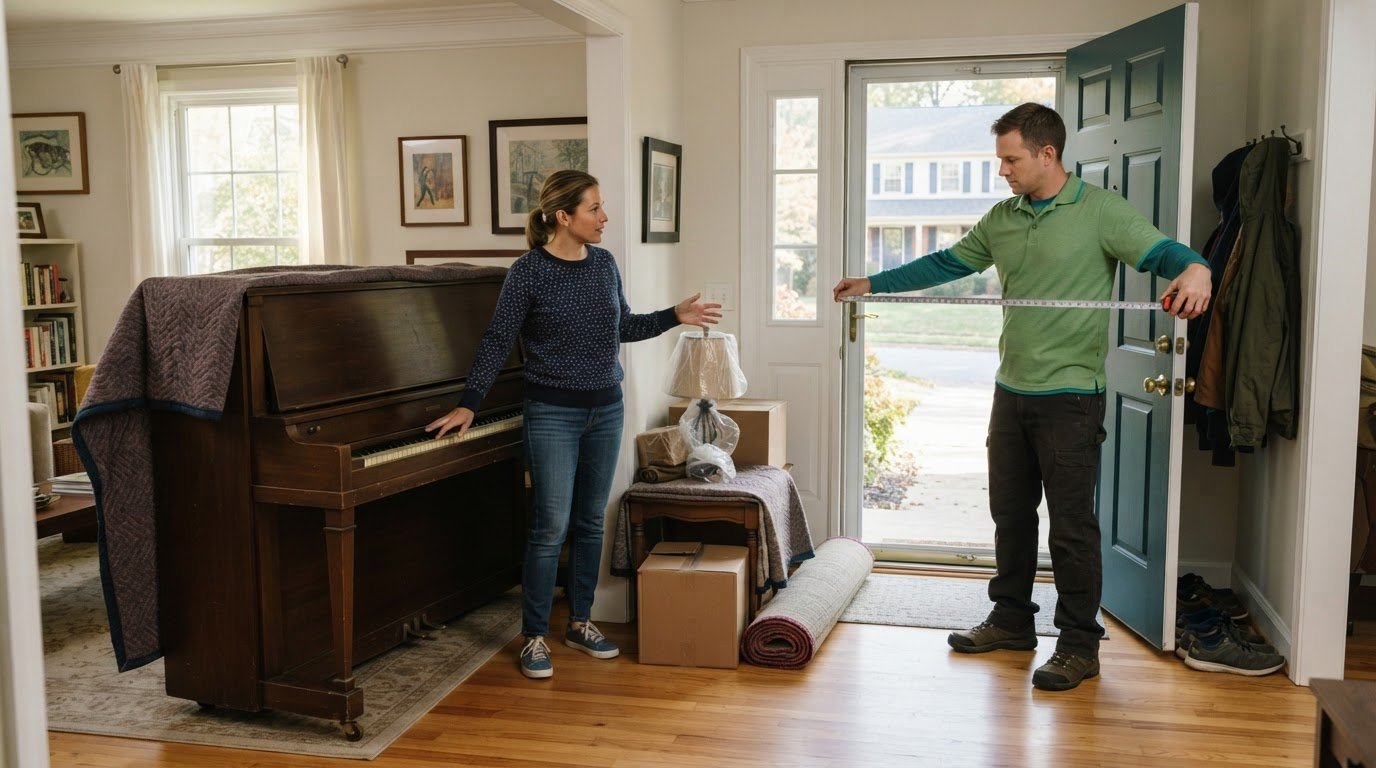
- Measure the cabinet’s width and depth, then compare them with the stairway’s clear width and landings. Include protruding handles and the dolly frame in your measurements. Check every turn, doorway, and low ceiling; a cabinet that clears a straight flight may not fit around a tight landing.
- Choose a stair-climbing dolly for a compact, upright load only if its frame can hold the cabinet securely. A common design uses three wheels on each side that rotate over stair edges as the dolly moves. That arrangement can ease movement, but it doesn’t eliminate the need to control the load.
- Use a standard hand truck only when the cabinet and staircase are a good fit. Center the cabinet over the toe plate and secure it with a ratchet strap before moving. Keep the load balanced over the wheels; a cabinet that shifts sideways or leans away from the frame can become difficult to control.
- Inspect stair sliders before choosing a hand truck for wood steps. Some models have built-in back tracks designed to glide over steps without scratching the wood. Check that the tracks contact the stairs evenly and that the dolly can turn at each landing. Don’t assume sliders will suit every stair surface or cabinet shape.
- Plan for the helpers needed to operate the equipment, not just lift. Stair rollers may require a third helper to reposition them, which can make control more complicated. A stair-climbing dolly also requires coordinated handling at turns. Assign one person to direct each movement, and stop if the cabinet tilts or the strap loosens.
- Test the setup on level ground before approaching the stairs. Secure the cabinet, tilt the dolly enough to take the load, and check that the wheels and frame remain stable. If the tool chest shifts against the strap or blocks the operator’s grip, reposition it before starting the descent.
- If the cabinet is too heavy or awkward for the equipment and available helpers, don’t force the dolly down the steps. Heavy lifting help can be a practical next step for a difficult cabinet move.
Protecting walls, floors, and stair edges
Prepare the entire route before moving the cabinet. Cardboard, foam, moving blankets, and anti-slip mats can protect vulnerable surfaces.
-
Clear the Moving Path
Walk the route from the starting point to the basement, including every landing and turn. Remove loose tools, rugs, boxes, and doorstops that could catch a dolly or a carrier’s foot. Open doors fully and secure them so they don’t swing into the load. Check the stair edges for existing damage, loose coverings, or debris before laying down protection.
- Cover exposed wall sections beside narrow stairs with cardboard or foam panels. Secure them so they stay in place without creating a trip hazard or blocking a handhold. Pay particular attention to corners and landing turns, where the cabinet’s edge may swing outward. On a tight Aldie basement stairway, protect the wall at the turn as carefully as the straight run.
- Lay anti-slip mats or rugs where they protect floors and stairs while adding traction. Keep each piece flat and stable; a curled edge can catch a foot or dolly wheel. Don’t place loose padding directly under a carrier’s walking path. At stair edges, arrange protection so it won’t bunch up or slide as the cabinet passes.
-
Use Moving Straps and Protective Gear
Choose straps suited to the planned carrying method, then position them before lifting. Straps can help two people handle long items, while a ratchet strap can secure a cabinet to a hand truck. Place carpet pieces or moving blankets where straps touch painted metal; bare strap edges can scuff the finish. Keep straps clear of drawer pulls and sharp corners.
- Wrap the cabinet in moving blankets before guiding it through tight clearances. Secure the blankets so they can’t slip over handles or obscure a carrier’s grip. Pad corners likely to pass near a railing or wall. Keep protective layers away from the underside, where they could interfere with the dolly’s toe plate or wheel contact.
- Make a final route check with the protective materials in place. Walk the stairs again and confirm the mats lie flat, the panels are secure, and the landing is clear. Assign one helper to watch the wall and stair-edge clearances during the move. If a blanket shifts or a mat moves, stop and reset it before continuing.
Descending stairs with a heavy item
Control the cabinet at every step; gravity keeps pulling it downhill. Finalize the lowering plan before the load reaches the first stair.
- Inspect the entire staircase, including the bottom landing, before moving. Look for loose steps, a steep pitch, narrow turns, and anything blocking the route. A cabinet that fits on the straight section may not clear the landing. If the stairs feel unstable or the load cannot fit safely, stop and choose another plan.
- Reduce the cabinet’s weight and bulk before the descent. Remove drawers or a detachable top when the cabinet design allows it, then secure loose parts separately. A reported move of a 54-inch tool cabinet used this approach before lowering it with a come-along. Treat that as an example, not a substitute for equipment suited to your staircase and load.
- Assign positions before lifting: the person at the bottom should take more of the load to help prevent sliding. The upper helper controls the movement and calls each step. Agree on “Stop” and “Down” before starting. Keep a steady pace, and don’t let one person move ahead while the other is still supporting the cabinet.
- Lower the cabinet slowly, one step at a time. Before each move, the person descending should test the next step with a foot for stability. Keep the load supported during pauses, and proceed only when both helpers are ready. If the cabinet slips, shifts, or becomes difficult to hold, stop the descent rather than trying to catch it mid-step.
- Use a moving blanket or tarp as a sliding surface only when you can control the route and load. Place the cabinet securely, then use the material’s corners to guide its speed and direction. A blanket can bunch or slide, so position helpers to manage the load. Don’t use this method on stairs if control is uncertain.
- Don’t improvise a ramp from loose boards or plywood. A commenter described using 2×4s as a skid surface, while another suggested a 3/4-inch plywood sheet fitted to basement stairs. Those approaches require a stable, secured path; unsecured boards can shift beneath a heavy cabinet.
- Leave rope systems and mechanical advantage setups to people who can rig and control them properly. One described method used two people above, ropes arranged for 2x mechanical advantage, and a guide below. The setup depends on secure anchors and controlled lowering, not simply adding rope to the cabinet.
- Change the route if the stairs are too narrow or steep for a controlled descent. An external staircase or window may be an alternative when practical, but each route requires suitable access and equipment. For an especially heavy or valuable cabinet, a difficult staircase, or insufficient helpers and gear, professional heavy-lifting help is the safer next step.
How much does a fully loaded metal tool cabinet weigh, and how can I estimate its weight?
- Start with the cabinet’s empty weight, then add the weight of everything inside. There’s no single reliable weight for a fully loaded cabinet because its shell, drawers, and contents vary. Look for the cabinet’s label or manual, and use recorded weights for tools where available. Treat the result as a planning estimate, not a reason to test the load by lifting.
- Make a contents list before calculating. Record heavy items such as a bench vise, power tools, metal stock, and boxed hardware. Use each item’s marked weight or a reliable scale reading, then add the figures to the cabinet’s empty weight. Include items on shelves and inside drawers, not just the tools visible when the cabinet doors open.
- Weigh loose tools in manageable groups if individual weights aren’t marked. Place each group on a suitable scale, record the reading, and keep the groups separate in your notes. For example, weigh a drawer’s contents together, then add that total to the cabinet shell and other drawers. Don’t lift a loaded drawer just to estimate its weight.
- Separate removable parts before estimating the load. If the cabinet has detachable drawers or a top that can be removed safely, note their weights as separate loads. This gives you the assembled total and the weight of each piece. Use those separate figures to plan handling and access to the stairs.
- Check whether the contents shift or concentrate weight in one area. A drawer packed with dense metal tools can make one side heavier, even when the overall estimate seems manageable. Note where heavy items are located, then plan to remove or redistribute them before moving. Track each removed load so nothing gets added back unintentionally.
- Use familiar equipment weights only for context, not as a substitute for measuring your cabinet. They don’t establish a tool cabinet’s weight, which depends on its construction and stored tools.
- Write down the estimated total and the heaviest component before choosing a moving method. Share both figures with everyone involved, along with the cabinet’s dimensions and any uneven loading. The total helps with planning, while the component list shows which pieces could be removed to reduce the load.
- If you can’t make a dependable estimate from the cabinet information and contents, don’t use a trial lift to find out. Keep the tools secured, reduce the load in controlled stages, and plan around the heaviest remaining piece. A clear estimate helps determine whether the cabinet can be moved as one unit or needs a different approach.
Heavy Furniture Moving
Heavy Furniture Moving helps with challenging household moves that require careful handling and physical support. If your metal tool cabinet is too heavy to control on basement stairs, or the route feels too tight for your equipment, its heavy lifting moving service offers a practical next step. The right approach depends on the cabinet’s size and load, the stair layout, and access.
When you get in touch, share details about the cabinet and basement stairs so the move can be considered in context. Contact Heavy Furniture Moving to discuss help with your tool cabinet move.
Choose a Controlled Next Step
Before committing to the move, decide whether the cabinet can stay controlled from its starting point to its final position. A plan works only if the people and equipment available can follow it without rushing. If the route, load, or available help makes control doubtful, pause rather than turning a difficult descent into a test of strength. That keeps the next step deliberate.
For moving a heavy metal tool cabinet down basement stairs in Aldie, describe the cabinet, stair access, and tight turns when arranging help. Those details make it easier to focus on the challenge in your home. If you’d like support with the move, contact Heavy Furniture Moving to discuss your next step. Take your time, make a clear plan, and move forward with confidence.
Frequently Asked Questions
How much does it cost to hire movers in Aldie, VA to move a heavy tool cabinet downstairs?
The cost depends on the cabinet, stair access, and handling required. Heavy Furniture Moving provides pricing after a quote request. Share the cabinet’s dimensions and estimated loaded weight, along with details about stair turns, landings, and the destination. This information helps determine the work involved: a straight stairway and a tight turn present different moving challenges.
What moving companies near Aldie, VA handle heavy safes, tool cabinets, or machinery?
Heavy Furniture Moving serves Aldie and offers Movers Near Me and heavy lifting moving service for difficult household moves. The company handles heavy items such as safes and exercise equipment. When discussing a tool cabinet move, describe its size, contents, and basement access. These details give the team practical context about the item and route without assuming every cabinet or staircase is alike.
What equipment is needed to move a heavy tool cabinet down basement stairs?
Equipment choice depends on the cabinet and staircase. If you’re moving a heavy metal tool cabinet down basement stairs in Aldie, a stair-climbing dolly or suitable hand truck may help when the cabinet fits the equipment and route. Straps can secure the load to a dolly, while moving blankets and protective panels help guard surfaces. Check that the equipment suits the cabinet’s estimated weight and can pass through stair turns.
How many people are needed to move a tool cabinet down stairs safely?
There isn’t one fixed crew size for every cabinet. The number of helpers depends on the load’s weight and shape, the stairway’s turns, and whether you’re using a dolly or other equipment. Each person needs a clear position and role, with one helper coordinating the movement. If the load can’t be controlled without blocking someone’s footing or view, add appropriate help or choose another method.
How do I measure basement stairs, landings, and doorways before moving a tool cabinet?
Measure the narrowest clear width along the route, including door openings with doors positioned as they’ll be during the move. Record the cabinet’s height, width, and depth, then compare them with each landing and turn. Also check overhead clearance and space for the cabinet to pivot. For angled movement, compare the cabinet’s diagonal dimensions with the available turning space, not just the straight stair width.
What are the safest steps for moving a heavy cabinet down stairs without damaging walls or floors?
Plan the route before moving, and protect exposed corners, floors, and stair edges with stable padding. Keep loose items and doorways clear so helpers can maintain their footing. Secure cabinet parts that might move, then guide the load at a controlled pace. Assign one person to watch clearances near walls and railings. If protection shifts or the cabinet makes contact, stop and reset the path before continuing.
Should I hire professional movers or use a stair-climbing dolly to move a tool cabinet?
Use a stair-climbing dolly only when the cabinet fits the device and the staircase allows controlled movement. If you’re moving a heavy metal tool cabinet down basement stairs in Aldie, a narrow turn, uneven steps, top-heavy load, or limited helper strength can make a dolly unsuitable. Professional help is practical when equipment or experience is lacking, or the cabinet is too valuable to risk. Heavy Furniture Moving offers support for heavy household items in Aldie.