How to Move a Heavy Gun Safe Around a Tight Hallway Corner in Manassas
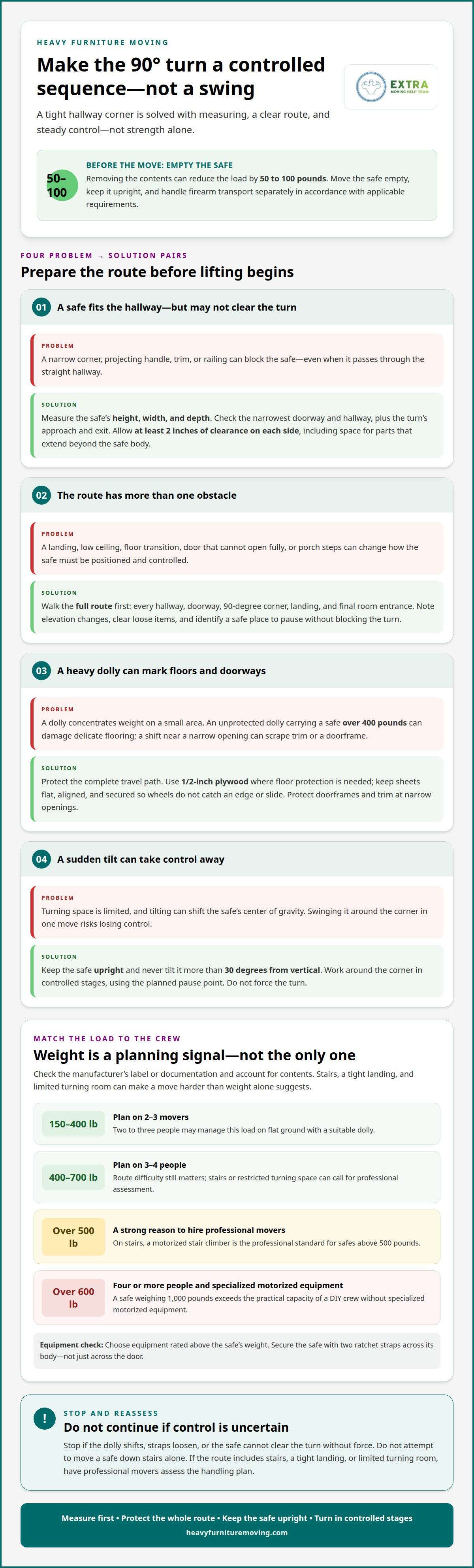
Empty the safe before moving it, then guide it around the corner in controlled stages rather than swinging it in one move. Removing the contents can reduce the load by 50 to 100 pounds, and the safe should stay upright. For how to move a heavy gun safe through a tight 90-degree hallway corner in Manassas, careful measuring and a clear path matter as much as strength.
A tight turn can make even a safe that fits the hallway difficult to maneuver. It’s reasonable to worry about scraping walls, damaging floors, or losing control of a heavy load. Take the pressure off by planning the turn before the safe starts moving.
This guide explains what to remove, how the safe’s weight affects the people and equipment needed, and how to protect the route. You’ll also learn how to work through the corner in stages and when professional movers are the safer choice. Preparation helps you make a clear decision before lifting begins.
Key Takeaways
- Measure the narrowest doorway, hallway, corner, and landing, and plan for at least two inches of clearance on each side.
- Use the safe’s weight to judge the crew and equipment needed; a safe over 500 pounds is a strong reason to hire professional movers.
- Protect the full route, not just the corner. Delicate floors can be damaged by an unprotected dolly carrying a safe over 400 pounds.
- Break the turn into controlled stages and keep the route clear so the safe stays under control through the tightest point.
When Should You Hire Professional Gun Safe Movers?
For a household move in Virginia, separate moving the safe from transporting any firearm inside it. Move the safe empty, and follow applicable firearm-transport requirements for firearms themselves.
Use these route checks to decide whether you can move the safe under control or need professional handling.
-
Assess Hallways, Corners, and Landings
Walk the full route before lifting: include each hallway, doorway, 90-degree corner, landing, and the final room entrance. Look for protruding trim, railings, low ceilings, floor transitions, and doors that cannot open fully. A landing or four porch steps changes the move, so mark each elevation change. Clear loose items from the path and identify where the safe can pause without blocking the turn.
-
Measure Doorways and Tight Corners
Measure the safe’s height, width, and depth, then compare them with the narrowest doorway and hallway opening. Allow at least two inches of clearance on each side along the route. A safe that is just an inch too wide for a corner can block the move, even if it passes through the straight hallway. Measure the approach and exit at the turn, too, including handles or other parts that extend beyond the safe’s body.
-
Protect Floors and Doorways
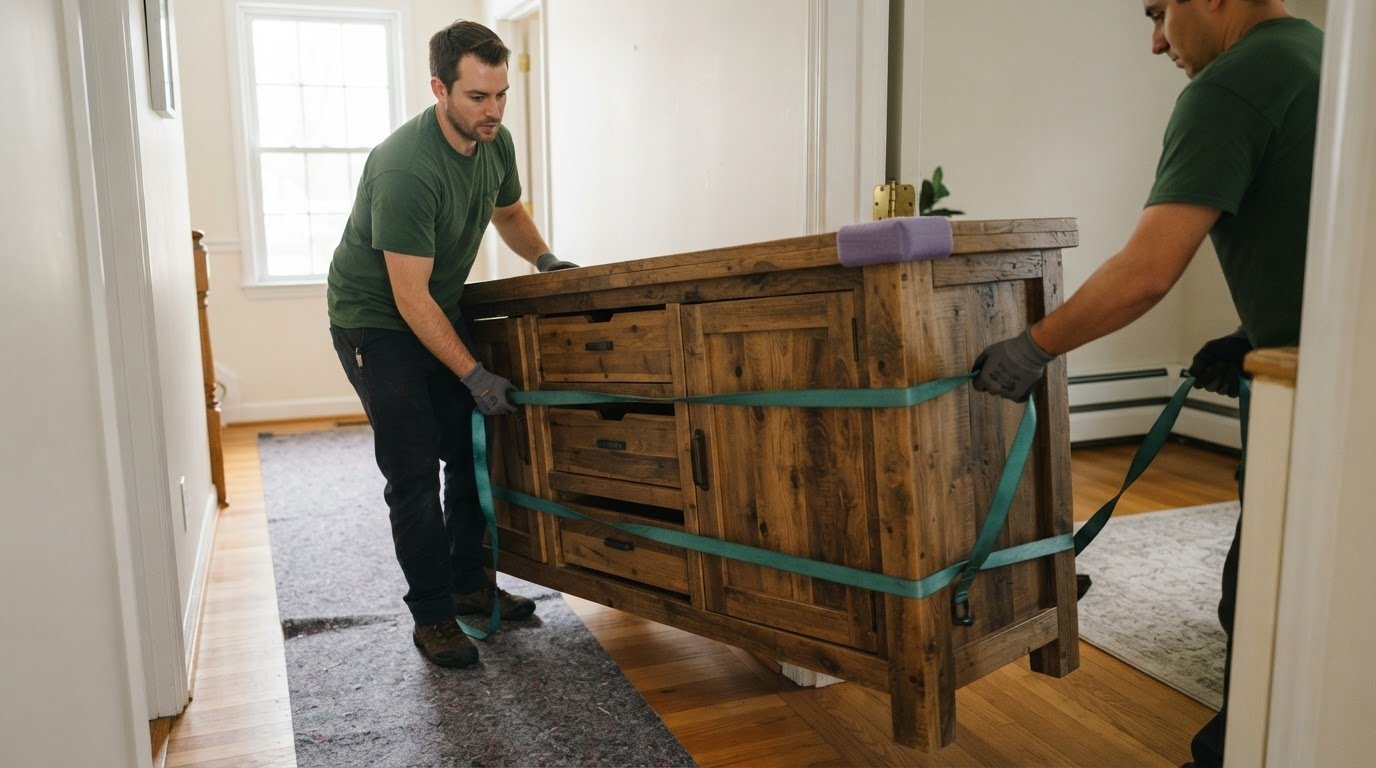
Cover the complete travel path before loading the safe onto a dolly. Use 1/2-inch plywood sheets where the floor needs a firm protective surface, and secure the sheets so they cannot slide under the wheels. Delicate flooring can be damaged by an unprotected dolly carrying a safe over 400 pounds. Protect doorframes and trim at narrow openings, where a small shift during transport can cause a scrape or impact.
- Match the route to the load. A safe’s pounds matter, but so do stairs, turning space, and the team’s ability to control gravity. Keep the safe upright; don’t lay it on its back or side. Never tilt it more than 30 degrees from vertical. If the route has stairs or a tight landing, professional movers can assess whether the available equipment and lifting plan suit the safe.
- Hire help when control is uncertain. Professional movers are recommended for safes over 500 pounds, and a safe over 600 pounds is a strong reason to hire a professional safe mover. A safe weighing 1,000 pounds exceeds the practical capacity of a DIY crew without specialized motorized equipment. Stop if the dolly shifts, straps loosen, or the safe cannot clear a turn without force. Don’t risk a sudden loss of control.
Safe weight categories and moving requirements
For a 150- to 400-pound safe, plan on two to three movers. A 400- to 700-pound safe calls for three to four people. Tilting can shift the center of gravity, letting gravity pull the safe off balance.
- Classify the safe by its actual weight. Small home safes may weigh 20 to 100 pounds, while gun safes commonly range from 150 to 1,500 pounds. Treat a 200-pound floor safe differently from a 1,200-pound fire-proof safe. Check the manufacturer’s label or documentation, and include the safe’s contents when estimating the load. Removing contents can reduce weight, but it doesn’t change the safe’s dimensions or turning space.
- Match the crew to the load and route. Two to three people may manage a 150- to 400-pound safe on flat ground with a suitable dolly. A 400- to 700-pound safe may require three to four people. A safe over 600 pounds calls for four or more people and specialized motorized equipment. Stairs, a narrow landing, or a tight turn can make the move harder than the weight alone suggests.
- Choose equipment rated above the safe’s weight. A four-wheel refrigerator dolly differs from a standard two-wheel appliance dolly. Secure the safe with two ratchet straps across its body, not just across the door. Keep it upright to maintain control during transport.
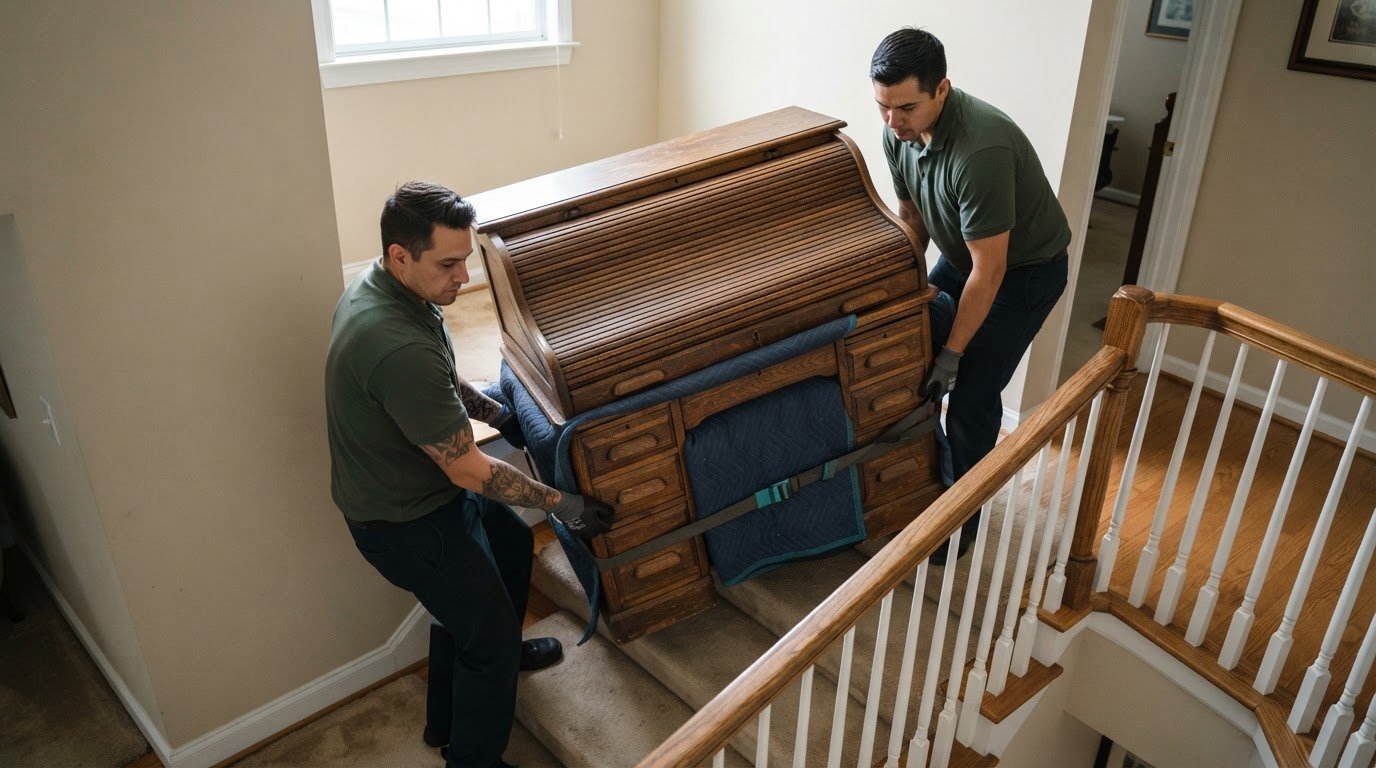
- Plan stair moves around the landing. Clear the stairs and landing before moving begins, and make sure the dolly can turn without striking walls or railings. On stairs, a motorized stair climber is the professional standard for safes above 500 pounds. Don’t attempt to move a safe down stairs alone. A sudden shift can make the load difficult to control and put people, floors, and doorways at risk.
- Prepare the route before moving day. Remove obstacles, protect floor surfaces, and identify where the crew can pause safely. Note every stairway, landing, and doorway, since each affects equipment and positioning. A safe weighing 600 to 1,000 pounds isn’t recommended for DIY moving. If the route involves stairs or limited turning room, heavy lifting moving help can take on the challenging handling.
Popular residential gun safes can weigh from 300 pounds to over 1,500 pounds.
Protecting floors and walls
Protect the entire route, from the safe’s starting room to its final position. A heavy dolly concentrates the load on a small area, while a tight turn brings the safe close to walls, trim, and doorframes.
- Lay a stable protective path. Place 1/2-inch plywood sheets along the entire route where floor protection is needed. Keep the sheets flat, aligned, and firmly joined so dolly wheels don’t catch an edge during transport. Check each seam before the safe rolls over it. On a long hallway, plan the sheet placement around doorways and corners, not only the straight sections. A gap near the turn can leave the floor exposed at the moment the load pivots.
- Protect delicate flooring from the dolly. An unprotected dolly carrying a safe over 400 pounds can damage delicate flooring. That risk applies even when the wheels look broad or the safe moves slowly. Put the plywood between the wheels and the finished floor, and keep it underneath the full wheel path. Don’t let a wheel roll off the sheet while the safe is turning. If the route crosses from hardwood to tile, protect both surfaces before moving begins.
- Cover exposed doorways and wall edges. Use thick padding or moving blankets on doorframes, baseboards, and the wall facing the safe’s outer edge. Secure the covering so it can’t slip into the dolly wheels or obstruct the opening. At a 90-degree corner, protect both the inside corner and the opposite wall. The safe may swing outward as it pivots, so protect the full contact area rather than one small spot.
- Check floor coverings before rolling. Look for loose rugs, lifted thresholds, cords, or debris that could catch a dolly. Remove loose items and flatten protective material before loading. A sheet that shifts beneath a wheel can interrupt the move and pull the safe toward a wall. Keep hands and feet clear of the dolly’s contact points, since a shifting load can cause injury. Pause if the path is uneven.
- Inspect the protection during the move. Stop at each doorway and corner to check that plywood remains flat and wall padding stays secure. If a sheet has moved, reposition it before continuing. Follow the safe manufacturer’s handling guidance for transport, and don’t force the appliance dolly over a snag. For gun safes, slow, controlled movement protects the home and gives the crew a chance to respond if the route changes.
Recognizing when to hire professional movers
Consider the safe’s weight, route, and floor surface together when deciding whether to hire professional movers. A narrow turn or hardwood stairs can increase the risk even when the safe fits through the doorway.
- Set a clear weight threshold. Hire professional safe movers for a safe over 600 pounds, especially when the route includes stairs or a tight landing. Professional help is also recommended when the safe exceeds roughly 600 to 700 pounds. A 1,000-pound safe exceeds the practical capacity of a DIY crew without specialized motorized equipment. Don’t treat a strong group of helpers as a substitute for equipment suited to the load.
- Count route hazards, not just stairs. Walk from the safe’s current position to its destination and note each doorway, turn, step, and floor transition. A hallway corner may leave little room to correct a tilt, while a landing limits where movers can reposition. If the path would force the safe against a wall or require uncontrolled lifting, stop the DIY plan. Those are clear reasons to hire experienced movers.
- Use a tape measure to test the tightest point. Measure the safe’s full width, depth, and height, then compare those dimensions with the narrowest doorway and turn. Check whether handles or a protruding door affect clearance. A straight hallway measurement alone won’t show whether the safe can pivot around a 90-degree corner. If the safe only clears when tilted sharply, the route calls for a professional assessment.
- Protect hardwood and other finished floors. An unprotected dolly carrying a safe over 400 pounds can damage delicate flooring. If the route crosses hardwood, tile, or a threshold, account for that surface before moving. A professional crew can plan protection and equipment around the full route, rather than reacting after the wheels begin rolling. Don’t proceed if the floor covering shifts or the load becomes difficult to control.
- Choose experienced, insured movers for a high-risk move. Look for a crew whose work includes heavy safes, not only ordinary furniture. Experience matters when movers must control a heavy load through a narrow doorway or around a landing. Make sure insurance coverage is part of the move plan, and understand how the safe and home are covered. If the contents add substantial weight or the safe’s door changes its balance, include that detail in the plan.
- Stop when the equipment or control falls short. A safe over 600 pounds, stairs, a tight turn, or delicate flooring can each raise the stakes. If the safe shifts, a dolly cannot turn cleanly, or the crew can’t keep it upright, don’t force the move. Hiring professionals before lifting begins is safer than trying to recover control midway through a difficult corner.
Turning a safe around tight corners in stages
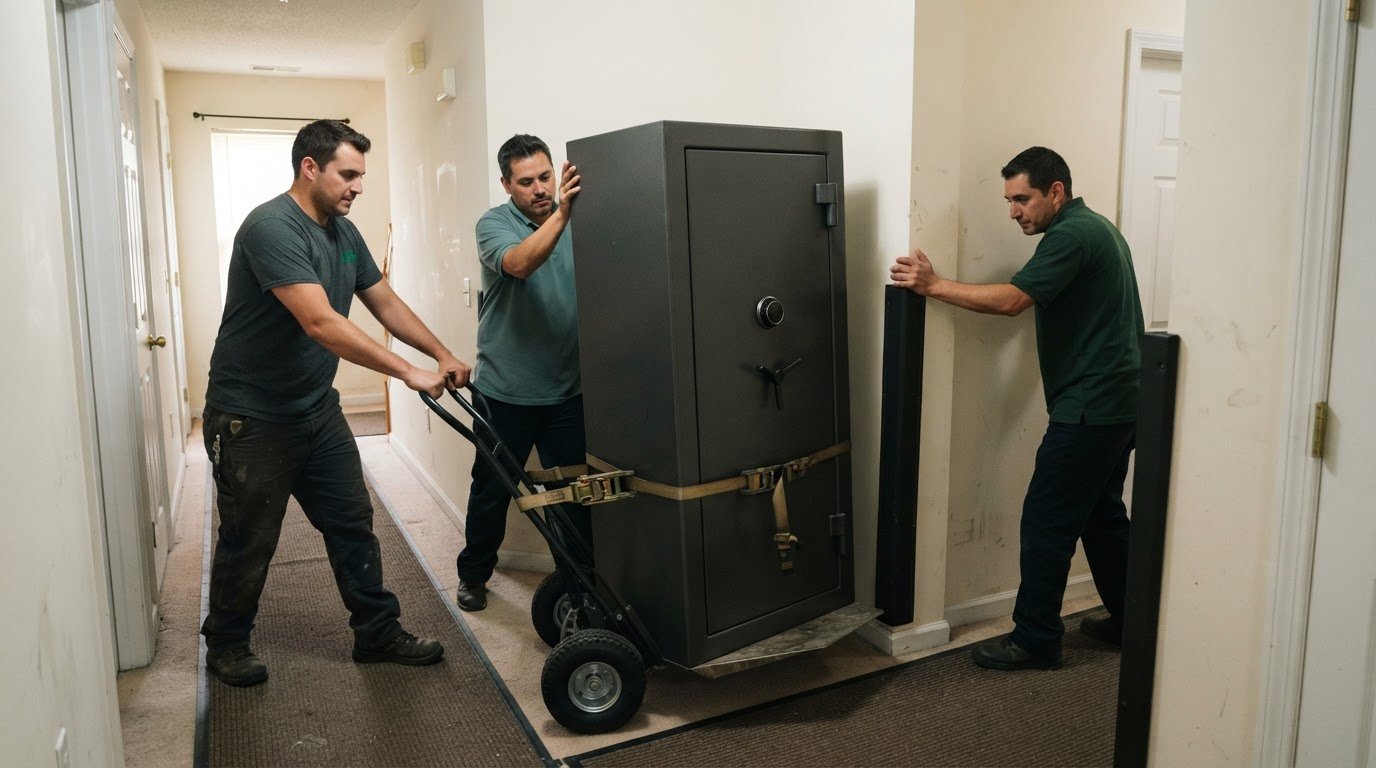
Don’t swing a gun safe around a 90-degree corner in one motion. A practical approach to how to move a heavy gun safe through a tight 90-degree hallway corner in Manassas is to break the turn into controlled stages. Stop whenever the dolly, straps, or available clearance no longer allow steady control.
- Set the turn up before the safe moves. Clear the hallway and both sides of the corner. Compare the safe’s dimensions with the approach, turn, and exit, including any handles or door protrusions. Position floor protection so the dolly wheels stay supported throughout the pivot. Choose a pause point before the corner where the crew can stop without blocking the route or resting the safe against a wall.
- Secure the safe to a suitable dolly. Use a heavy-duty dolly rated for at least 800 lbs, with two ratchet straps across the safe’s body. Don’t rely on a strap across the door alone. A four-wheel refrigerator dolly may suit a safe better than a standard two-wheel appliance dolly. Keep the safe upright during transport, and don’t start the turn if the load shifts against its straps.
- Approach the corner slowly and squarely. Move the safe toward the turn in small, deliberate increments. Pause before its leading edge reaches the corner, then check the space ahead and beside it. Agree on clear commands before moving again. Avoid pushing or pulling from positions where someone could be pinned between the safe and a wall, doorway, or railing.
- Pivot in stages, not with a sudden swing. Move the safe only as far as the crew can control, then pause and reassess its alignment. Guide the front edge around first, keeping the opposite edge clear of the wall. Continue with a small adjustment at a time until the safe faces the next hallway. Keep the safe within 30 degrees of vertical; a sharp tilt can shift the load and reduce control.
- Stop if the corner demands more tilt or force. Don’t attempt to squeeze the safe through a turn if it catches, leans, or pulls the dolly off line. Recheck the route, straps, and dolly position before continuing. Tilting a safe back about 15 degrees is used to slide a dolly plate underneath, not to force a tight corner. If you’re deciding how to move a heavy gun safe through a tight 90-degree hallway corner in Manassas, stop when the safe can’t turn under control and arrange heavy lifting moving help.
Heavy Furniture Moving
Heavy Furniture Moving handles demanding lifts and heavy household items, including gun safes. If the safe’s weight, stairs, or tight hallway turn in Manassas make a do-it-yourself move difficult to control, professional help can take the strain off your hands. The route, access points, and safe dimensions shape the handling plan, especially when a corner leaves little room to maneuver. Wrap, blankets, and straps are included on every job.
Identify the challenging parts of your move, such as a narrow doorway, finished floors, or a landing. Then contact Heavy Furniture Moving to discuss your safe’s weight, dimensions, and hallway turn in Manassas and arrange professional help.
Make the Next Move With Confidence
Planning how to move a heavy gun safe through a tight 90-degree hallway corner in Manassas starts with choosing who will take responsibility for the move. If the route leaves little room to recover from a shift, or the safe feels beyond your crew’s control, don’t turn the corner into a test of strength. Put experienced moving help in charge of the difficult handling.
Heavy Furniture Moving also offers Movers Near Me, Exercise Equipment Moving, and Sofa Hoisting for other demanding household moves. For a safe move, focus on the safe, the hallway turn, and any access challenges so the handling plan accounts for the full route.
Contact Heavy Furniture Moving to talk through your move. Take the next step with a clear plan and less strain on your household.
Frequently Asked Questions
Should you empty a gun safe before moving it?
Yes, empty the safe before moving it. Removing the contents reduces the load and keeps loose items from shifting. Pack the contents separately and keep them clear of the moving route. Check drawers, shelves, and door pockets for overlooked items. An empty safe is easier to assess, but its weight and dimensions still determine the equipment and route required.
Can you move a gun safe on a regular dolly?
A regular household dolly isn’t suitable unless it’s rated for the safe’s full weight and fits the route. An undersized or unstable dolly can shift under load, especially at a turn or doorway. Choose equipment designed for heavy appliances or safes, and secure the safe to it. If the dolly rocks, its wheels catch, or the load won’t stay upright, stop before moving farther.
When Should You Stop and Call for Help Instead?
Stop if the safe leans unexpectedly, the dolly shifts, a strap loosens, or the crew can’t make controlled progress. Don’t try to catch a slipping load by grabbing its door or stepping into its path. Stairs, a cramped landing, or a turn with no room to pause are also reasons to halt. Get professional help before another attempt, not after damage or injury occurs.
What equipment is needed to move a heavy gun safe through a narrow hallway?
Use a heavy-duty dolly rated for at least 800 lbs, with two ratchet straps holding the safe across its body. A four-wheel refrigerator dolly can provide a more suitable setup than a standard two-wheel appliance dolly. Protect the route with plywood and guard doorframes and corners with padding. The equipment must suit both the safe’s weight and the route; stairs may require specialized moving equipment.
How much does professional gun safe moving cost in Manassas, Virginia?
The price depends on the case and is given after a quote request. Key cost factors include the safe’s weight and dimensions, travel distance, stairs, landings, doorway access, and the equipment needed. Share the route details and safe information when requesting a quote so the move can be assessed accurately. Avoid relying on a broad estimate that doesn’t account for a tight hallway turn or difficult access.
Frequently Asked Questions
Yes, empty the safe before moving it. Removing the contents reduces the load and keeps loose items from shifting. Pack the contents separately and keep them clear of the moving route. Check drawers, shelves, and door pockets for overlooked items. An empty safe is easier to assess, but its weight and dimensions still determine the equipment and route required.
A regular household dolly isn’t suitable unless it’s rated for the safe’s full weight and fits the route. An undersized or unstable dolly can shift under load, especially at a turn or doorway. Choose equipment designed for heavy appliances or safes, and secure the safe to it. If the dolly rocks, its wheels catch, or the load won’t stay upright, stop before moving farther.
Stop if the safe leans unexpectedly, the dolly shifts, a strap loosens, or the crew can’t make controlled progress. Don’t try to catch a slipping load by grabbing its door or stepping into its path. Stairs, a cramped landing, or a turn with no room to pause are also reasons to halt. Get professional help before another attempt, not after damage or injury occurs.
Use a heavy-duty dolly rated for at least 800 lbs, with two ratchet straps holding the safe across its body. A four-wheel refrigerator dolly can provide a more suitable setup than a standard two-wheel appliance dolly. Protect the route with plywood and guard doorframes and corners with padding. The equipment must suit both the safe’s weight and the route; stairs may require specialized moving equipment.
The price depends on the case and is given after a quote request. Key cost factors include the safe’s weight and dimensions, travel distance, stairs, landings, doorway access, and the equipment needed. Share the route details and safe information when requesting a quote so the move can be assessed accurately. Avoid relying on a broad estimate that doesn’t account for a tight hallway turn or difficult access.