How to Move a Heavy Ceramic Kamado Grill Without Hinge Damage
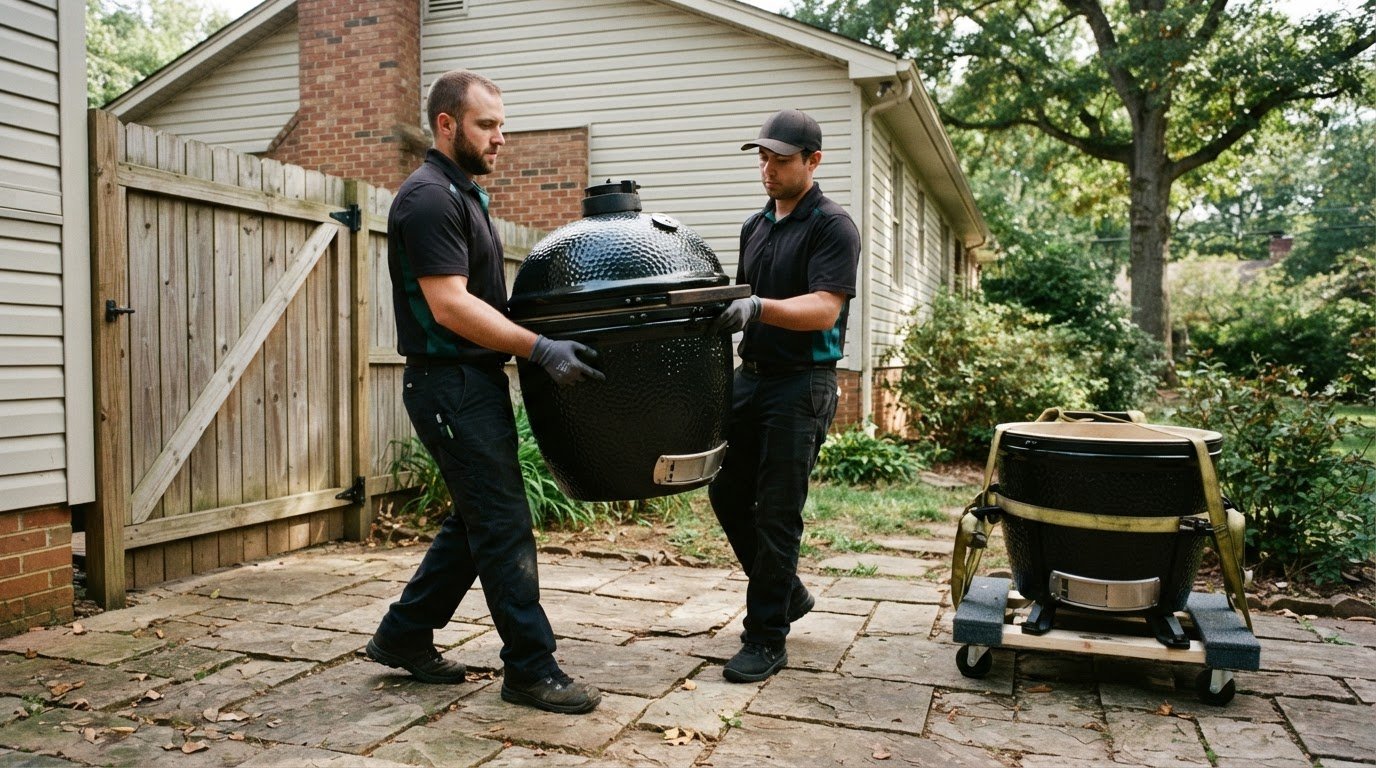
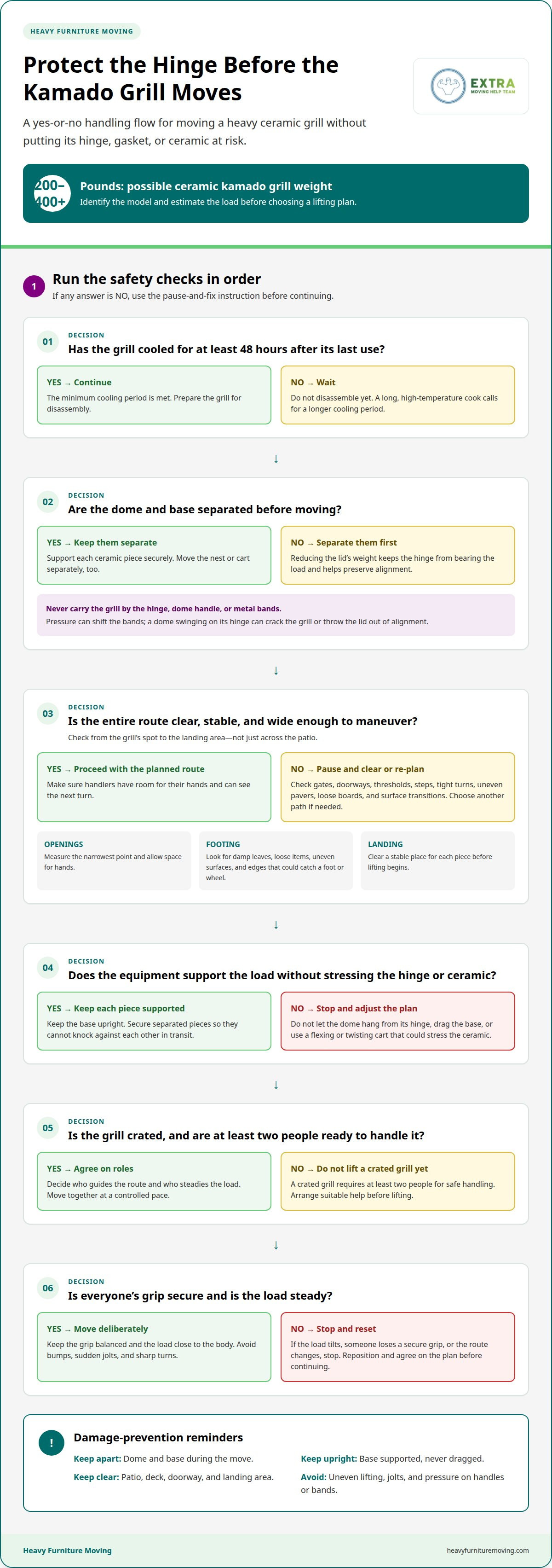
Moving a heavy ceramic kamado grill without damaging its cast iron hinge in Centreville starts with letting it cool for at least 48 hours after its last use. Separate the dome from the base before moving, and don’t let the hinge carry the grill’s weight. Use at least two people to handle a crated grill safely.
It’s easy to focus on a grill’s weight and overlook how a poorly planned lift can strain its hinge and gasket. Careful handling protects the grill’s alignment and makes the move more manageable.
Plan the route, prepare the cooled grill, and choose suitable help and equipment to protect the hinge and gasket at every stage. When heavy lifting is difficult, professional moving help can take the strain off your hands.
Key Takeaways
- Plan the path from patio or deck to the destination before moving day, paying attention to tight turns, steps, and uneven surfaces.
- Let the grill cool for at least 48 hours after its last use before disassembly.
- Use at least two people for a crated grill, and choose equipment that supports the load without putting pressure on the hinge.
- Separate the dome from the base before moving to reduce strain on the cast iron hinge and help preserve alignment.
- For a difficult route or heavy lift, heavy-lifting moving help can take on the physical handling.
Ceramic kamado grill weight and fragility
To move a kamado grill intact in Centreville, secure it for transport and plan the access route at both properties. Disposal only applies if you’re discarding the grill, not moving it.
-
Assess Grill Weight and Fragility
Identify the model and estimate the load before choosing a lifting plan. Ceramic kamado grills can weigh 200 to 400+ pounds.
Treat the dome, base, and cart as separate pieces. Ceramic can crack after an impact, even if the outside looks undamaged. Never lift by the handles or metal bands. Pressure on the bands or dome handle can shift the bands and allow the base to fall.
-
Prevent Ceramic Cracks During the Move
Separate the dome from the base to reduce the lid’s weight and keep the hinge from bearing the load. Support each ceramic piece securely instead of letting the dome hang from its hinge. Move the nest or cart separately, since a flexing or twisting frame can stress the ceramic base.
Use a coordinated crew and a route that avoids bumps and sharp turns. Keep the base upright and supported, and don’t drag it across a patio or deck or let it hit a doorway, stair edge, or railing. Secure the separated pieces so they cannot knock against each other in transit.
-
Recognize Common Causes of Damage
Avoid uneven lifting, sudden jolts, and pressure on the dome handle or bands. These can shift the bands or twist the ceramic. A dropped base or a dome swinging on its hinge can crack the grill or throw the lid out of alignment.
Check for thresholds, tight turns, and loose patio surfaces before moving. A cart that flexes or catches on an edge can jolt the base. Keep the dome and base apart, and stop if the load tilts or someone loses a secure grip.
- Reduce the load before lifting. Remove the dome from the base and set it on a stable, protected surface. Handle the base separately, without using the hinge, band, or handle to carry its weight. This makes the lid easier to manage and keeps the hinge out of the load.
Move the cart separately, too. A moving or flexing nest can twist the base. Clear the patio, deck, and doorway route before lifting, and prepare the landing spot so no one has to hold a heavy ceramic piece while obstacles are moved.
- Agree on roles before lifting. A crated ceramic grill requires at least two people for safe handling. Decide who guides the route and who steadies the load, then move together at a controlled pace. Never lift by the dome handle or cast iron bands, which can shift under pressure and put the base at risk of falling.
Keep the grip balanced and the load close to the body. Stop if the path narrows, the surface changes, or the piece starts to tilt. Reposition before continuing rather than correcting a wobble mid-lift. These checks help protect the ceramic and hinge throughout the move.
Access considerations for patios and decks
Trace the full route from the patio or deck to the destination before moving the grill. A gate, stair landing, or tight doorway may change the safest path.
- Walk the route from the grill’s current spot to the exit, then continue to the landing area. Note every turn, threshold, step, gate, and change in surface. A straight path across a patio may still end at a narrow gate or sharp turn. Mark obstacles that can be moved, such as a chair, planter, or grill cover.
Measure the narrowest opening and compare it with the grill component and carrying setup. Allow space for hands, not just the ceramic. Check whether a gate swings into the route or a door must stay open. Measurements can reveal a pinch point before anyone is carrying the load.
- Inspect deck boards, stairs, and patio surfaces along the route. Look for loose boards, uneven pavers, damp leaves, and anything that could catch a foot or wheel. Even a small raised edge can jolt a cart or throw off someone’s balance. Clear movable obstacles and choose the smoothest continuous path.
If the route includes deck stairs, assess each landing and turn first. A narrow landing may not leave room to reposition a bulky piece safely. Avoid twisting the load around a railing. If a route requires an awkward turn, consider another exit or destination point.
- Plan every transition between surfaces, such as patio pavers to grass or a deck to a walkway. Wheels can stop suddenly at a lip, soft ground, or loose gravel, shifting the load. Choose firm footing and remove loose items that could slide under a shoe or wheel.
Check the destination, too. Clear a stable spot where each piece can be set down without blocking the next step. For example, move garden tools and patio furniture out of the landing area so no one has to hold a heavy component while space is cleared.
- Account for gates and shared access points before moving. Confirm that the route remains open from start to finish, and secure doors or gates so they don’t swing shut. Keep pets and other people away from the path. A clear route lets handlers focus on footing, balance, and controlled movement instead of reacting to interruptions.
At a Centreville home with a side yard, compare the side gate with the front entrance. The shortest route may include a tight turn or uneven ground. Choose the path with the best footing and room to maneuver, even if it takes longer.
- Walk the route again just before moving. Recheck the gate, doorway, stairs, and landing area in case furniture or garden items have shifted. Clear the entire path and ensure each handler can see the next turn. If the route changes, pause and agree on a new plan before lifting.
Move deliberately at every threshold. Take one component at a time through a tight opening, and don’t rush to clear a doorway. A planned route across the patio, deck, and exit reduces sudden stops and awkward adjustments that could damage the grill.
Cooling the grill before disassembly
Wait at least 48 hours after the grill’s last use before disassembly. A long, high-temperature cook calls for a longer cooling period.
- Record when the cook ended, then start the cooling period. A ceramic kamado grill should cool for at least 48 hours after its last use before disassembly. After a long, high-temperature cook, allow 72 hours before taking it apart. Use the longer interval when that type of cook applies.
Don’t decide when to disassemble by checking only the exterior. The ceramic can feel cool while the firebox and internal parts still retain heat. Note when the grill was last used so everyone follows the same waiting period.
- Leave the grill undisturbed while it cools. Don’t begin removing the dome, firebox parts, or other components during the 48-hour cooling period. If the last cook was long and hot, wait the full 72 hours instead. Rushing this step can expose handlers to hot components during disassembly.
Keep the moving schedule separate from the cooling period. If a Centreville move is planned soon after a high-temperature cook, reschedule the move rather than taking the grill apart early.
- Keep track of the conditions that affect the wait. Note whether the last use was a long, high-temperature cook, since that calls for 72 hours before disassembly. For other use, wait at least 48 hours after the grill was last used.
A brief pause between cooking and handling doesn’t replace the required cooling period. Use the time since the grill was last used as your reference, not when the lid was closed or the grill was moved into the shade.
- Plan disassembly only after the correct interval has passed. Before separating any components, confirm the 48-hour minimum or the 72-hour wait after a long, high-temperature cook. Then set out the pieces’ landing area and organize the removal sequence, so the cooled grill isn’t left partly dismantled while the crew prepares.
Make sure every handler knows the timing. A written note showing the last-use and planned disassembly times helps prevent someone from starting early just because the exterior feels cool.
- Use the cooling period to prepare without taking the grill apart. Clear the patio or deck route, set up a stable spot for each component, and coordinate the crew. These tasks won’t shorten the required cooling time.
Once the appropriate 48- or 72-hour interval has passed, proceed with disassembly in a controlled sequence. If the cook was long and high-temperature, use the 72-hour period even when the exterior seems ready sooner.
Crew and equipment requirements
Match the crew and equipment to the separated components and the route. Decide how each piece will be lifted, carried, and secured before the move begins.
-
Prepare the Crew and Equipment
Use at least two people to move a crated ceramic grill safely. Before lifting, decide who leads and who steadies the load. Choose equipment that supports the grill without using its hinge, band, or handle as a lifting point.
Prepare protective padding, secure straps, and a stable surface for each piece. Check the equipment for damage and ensure the crew can maintain a firm grip along the route. Don’t start until everyone understands the lifting sequence.
-
Secure the Grill in a Vehicle
A kamado grill can travel in a vehicle if its components fit securely. Separate the dome and base, cushion them, and secure them with straps attached to the vehicle’s cargo tie-down points. Keep straps off the hinge and protect exposed ceramic edges from pressure.
Choose a level cargo area with enough room to keep the pieces apart. Don’t stack other items against the grill or leave components free to roll. Before departure, check that padding separates hard surfaces and the load cannot slide during a turn or stop.
- Prepare the route before bringing equipment to the grill. Check that each doorway, gate, stair landing, and turn has enough clearance for the widest component. Clear loose items, then place pads and straps within reach so no piece is left unsupported.
Use a cart only if its platform supports the load steadily and its wheels suit the surface. A wheel catching on a threshold can jolt the grill. Don’t force a cart through a tight turn if handlers cannot keep the load balanced and controlled.
- Agree on a lifting sequence for each component. One handler can guide the route while the other steadies the piece. Use clear commands such as “lift,” “stop,” and “set down” to coordinate movement. Pause before obstacles and reposition hands and feet before continuing.
Place protective padding between the grill and nearby walls, railings, or vehicle panels. Each handler should be able to see the route or receive clear signals from the guide. If anyone loses a secure grip, stop and set the piece down on a stable surface.
- Recheck the equipment and cargo area before travel. Ensure straps secure the separated pieces without pressing on the hinge, band, or ceramic edges. Remove loose tools and packing materials that could shift against the grill. Close the vehicle only once the load is stable.
At the destination, unload one piece at a time and keep the landing area clear. Don’t pull a component by its handle or let it strike the vehicle opening. Use the same steady, coordinated handling from the cargo area to the final placement spot.
Protecting the hinge and gasket
Keep the hinge free of load during handling and check dome alignment after reassembly. To move a heavy ceramic kamado grill in Centreville without damaging its cast iron hinge, support each component without pressing on the hardware.
- Separate the dome from the base before moving either piece. This prevents sideways force from pulling on the hinge and its ceramic attachment points. Set the dome on a stable, padded surface and protect the hinge from bumps. Don’t let the dome hang open or swing during handling.
Keep the base steady as you lift it. Twisting or shifting the bands can change the hinge geometry, leaving the dome uneven and affecting the gasket seal after the move.
- Keep straps and lifting pressure away from the hinge assembly. Support stable areas of the ceramic, not the cast iron hinge or dome handle. A strap pressing on the hinge can push it sideways, while uneven pressure on a band can shift it.
Before lifting, check how the dome and base are supported. If a piece tilts or a strap presses on metal hardware, stop and reposition it. Never use the hinge as a handle or anchor during carrying or vehicle transport.
- Protect the gasket from scraping or compression. Keep the dome and base apart so their edges cannot rub together. Set each piece on a stable surface, and keep tools and other objects off the gasket’s contact area.
When repositioning the dome, lower it gently rather than dropping it onto the base. A hard landing can disturb alignment and put uneven pressure on the gasket. Keep hands and padding clear of the sealing surface as you position the pieces.
- After reassembly, lower the dome carefully and check how it meets the base. Look for even contact around the gasket, without a visible gap on one side. If the dome sits crooked, don’t force it down or adjust it while the grill is under load.
Before using the grill, check the bands and hinge for visible shifts. Excessive lifting pressure can flex or twist the hinge assembly and affect its geometry. Careful support from the first lift through reassembly helps preserve dome alignment and gasket contact.
- Adjust the Air Lift Hinge only after the grill is reassembled and stable. Turn its adjustment nut counterclockwise to reduce tension or clockwise to increase it. Make the adjustment gradually, then check the dome’s movement and seating instead of forcing the lid.
For moving a heavy ceramic kamado grill in Centreville without hinge damage, keep the cast iron hinge free from pressure throughout handling. If the hinge or gasket looks displaced after transport, pause before cooking and recheck the dome’s alignment and band position. For a difficult lift, get help with heavy lifting.
Heavy Furniture Moving
When a heavy grill, tight access, or careful handling makes a solo move impractical, Heavy Furniture Moving provides moving help and heavy-lifting services. The crew can handle the physical work while your preparation ensures the route and grill components are ready for a controlled move.
Consider help if stairs, narrow gates, uneven patio surfaces, or vehicle loading make the lift difficult to manage. Share the route and handling concerns so the move can account for the grill’s ceramic body, hinge, and gasket.
Contact Heavy Furniture Moving to discuss help with your move.
Make the Move Plan Easy to Follow
Turn your preparation into a simple handoff plan. Choose one person to coordinate, share the agreed route with everyone, and identify where each grill component will go. Clear roles help prevent rushed decisions during handling.
To move a heavy ceramic kamado grill in Centreville without damaging its cast iron hinge, focus on controlled handling rather than speed. If the lift or route is difficult, heavy-lifting help can take the physical strain off your household, leaving you free to coordinate the move.
Heavy Furniture Moving offers residential moving help for heavy and bulky items. Contact Heavy Furniture Moving for help with planning the lift and moving your grill. A clear plan and the right support can make your next step feel more manageable.
Frequently Asked Questions
How much does a large ceramic kamado grill weigh, including its cart and accessories?
There isn’t one total weight for every large kamado grill and its accessories. For planning, identify the model and account separately for the cart and any accessories being moved.
Should the kamado grill lid be removed or secured before moving it?
Remove the dome from the base before moving the grill. Leaving it attached can expose the hinge and its ceramic attachment points to sideways force during lifting or transport. Set the dome on a stable, padded surface and keep it from shifting or hitting the base. If transporting the pieces in a vehicle, cushion and secure them separately so they cannot slide into each other.
How do I protect a cast iron hinge while transporting a kamado grill?
Keep lifting pressure, straps, and other cargo away from the hinge. Excessive pressure can shift the bands or hinge geometry, affecting how the dome aligns and seals against the gasket. Separate and secure each piece, then inspect the hinge, bands, and dome alignment for visible movement before using the grill again.
What equipment is best for moving a heavy kamado grill, such as a furniture dolly or appliance straps?
Use equipment that supports the ceramic securely without loading the hinge, band, or dome handle. A suitable dolly can help on a firm, smooth route, but don’t let its frame flex or wheels catch on thresholds. Secure the load with straps that don’t press on metal hardware or exposed ceramic edges. Keep the cart or nest separate because frame movement can stress the ceramic base.
How many people are needed to lift and move a ceramic kamado grill safely?
Use at least two people to move a crated ceramic grill safely. Before lifting, decide who guides the route and who steadies the load. Communicate clearly at turns and thresholds, and stop if anyone loses a secure grip. The grill model, separated components, and access route all affect how the crew should coordinate the move.
How much do local movers charge to move a heavy grill in Centreville, Virginia?
The price depends on the case and is provided after a quote request; the route, access, handling needs, and transport arrangement affect the quote. A patio move with clear access differs from one involving stairs, tight gates, or vehicle loading. Describe the grill and its path from pickup to destination so the work can be scoped around the actual lift.
Which Centreville, Virginia movers handle heavy or fragile outdoor grills?
Heavy Furniture Moving helps with residential moves involving heavy and bulky items, making it a local option for a challenging grill lift in Centreville. Its Movers Near Me and heavy-lifting moving services address difficult household moves. Share details about the grill, access route, and destination so the handling plan can account for the ceramic body and hinge.
Frequently Asked Questions
There isn’t one total weight for every large kamado grill and its accessories. For planning, identify the model and account separately for the cart and any accessories being moved.
Remove the dome from the base before moving the grill. Leaving it attached can expose the hinge and its ceramic attachment points to sideways force during lifting or transport. Set the dome on a stable, padded surface and keep it from shifting or hitting the base. If transporting the pieces in a vehicle, cushion and secure them separately so they cannot slide into each other.
Keep lifting pressure, straps, and other cargo away from the hinge. Excessive pressure can shift the bands or hinge geometry, affecting how the dome aligns and seals against the gasket. Separate and secure each piece, then inspect the hinge, bands, and dome alignment for visible movement before using the grill again.
Use equipment that supports the ceramic securely without loading the hinge, band, or dome handle. A suitable dolly can help on a firm, smooth route, but don’t let its frame flex or wheels catch on thresholds. Secure the load with straps that don’t press on metal hardware or exposed ceramic edges. Keep the cart or nest separate because frame movement can stress the ceramic base.
Use at least two people to move a crated ceramic grill safely. Before lifting, decide who guides the route and who steadies the load. Communicate clearly at turns and thresholds, and stop if anyone loses a secure grip. The grill model, separated components, and access route all affect how the crew should coordinate the move.
The price depends on the case and is provided after a quote request; the route, access, handling needs, and transport arrangement affect the quote. A patio move with clear access differs from one involving stairs, tight gates, or vehicle loading. Describe the grill and its path from pickup to destination so the work can be scoped around the actual lift.
Heavy Furniture Moving helps with residential moves involving heavy and bulky items, making it a local option for a challenging grill lift in Centreville. Its Movers Near Me and heavy-lifting moving services address difficult household moves. Share details about the grill, access route, and destination so the handling plan can account for the ceramic body and hinge.