How to Move a Heavy Cast Iron Wood Stove Through Doorways and Corners
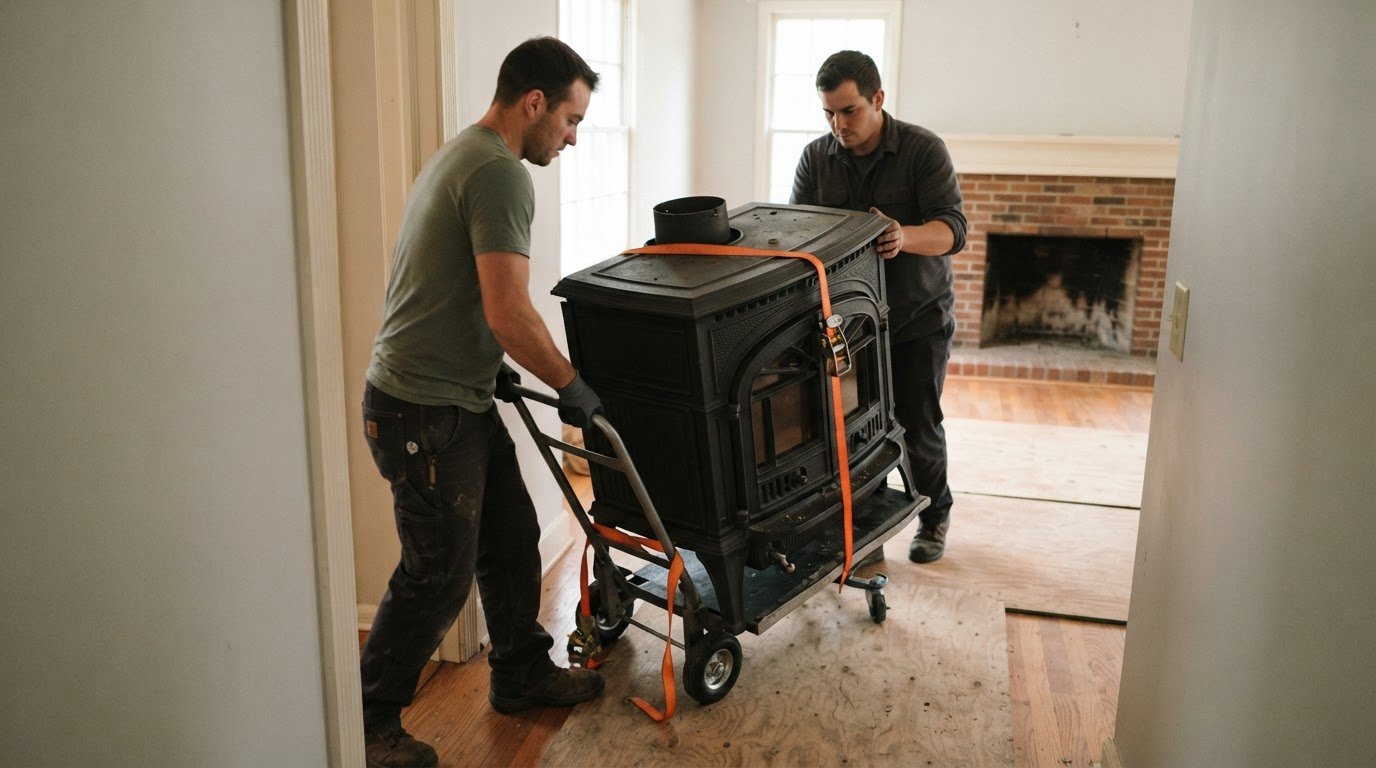
A heavy stove is hardest to control where the path narrows. Wood stoves can weigh 300 to 800 pounds, with an average around 500 pounds, so moving a heavy cast-iron wood-burning insert out of a fireplace surround in Dumfries takes a planned route, suitable equipment, and coordinated lifting. Tight doorways and corners leave little room to adjust once the load is moving.
If the weight and awkward shape have you worried, that’s understandable. A rushed lift or unplanned turn can put people, floors, and doorframes at risk. Prepare the path before moving the stove and make sure everyone knows their role.
This guide covers clearing the route, choosing helpers and equipment, and moving a heavy stove through doorways and around corners. You’ll learn what to measure, how to protect the floor, and when professional heavy-lifting help can make the move easier to manage.
Key Takeaways
- Plan a clear route before the stove moves, and identify narrow doorways and tight turns that may need extra maneuvering room.
- Choose helpers and moving equipment based on the stove’s weight, shape, and path, not on guesswork.
- Use controlled movements through corners to keep the load steady and reduce the chance of striking walls or doorframes.
- Prepare the wood burner and surrounding area so loose parts and obstacles don’t complicate the move.
- Learn when heavy-lifting help can make a difficult stove move more manageable.
Moving a stove through doorways and corners
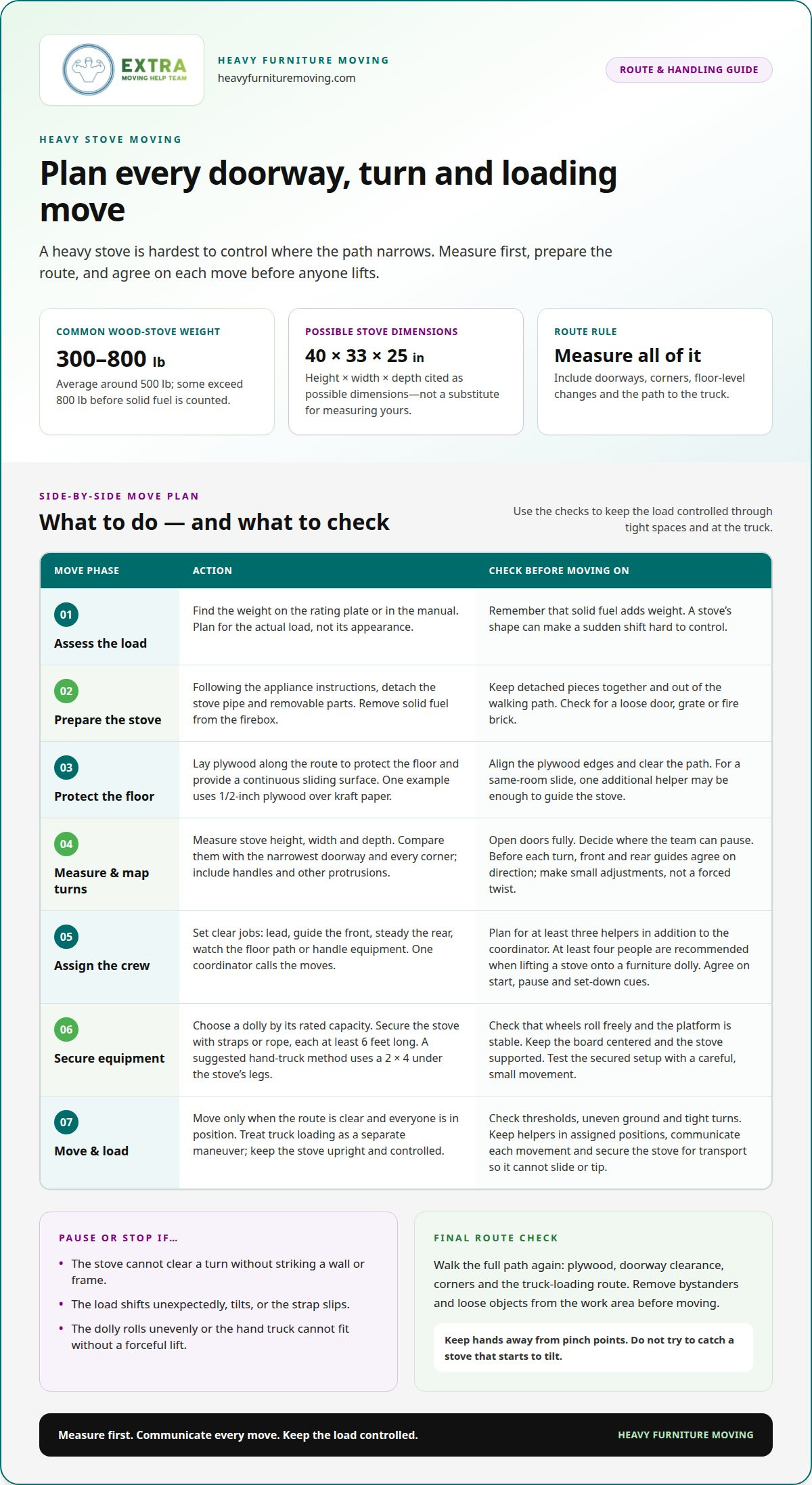
Measure the entire route from the fireplace to the truck before moving the stove. Plan for every doorway, turn, and change in floor level before the load starts moving.
-
Assess Stove Weight and Handling Risks
Find the stove’s weight on its rating plate or in its manual, then plan around that load. Wood stoves commonly weigh 300 to 800 pounds, and some exceed 800 pounds before solid fuel inside is counted. Their shape can make a sudden shift difficult to control. Don’t estimate weight from appearance or expect one person to steady the appliance through a turn.
-
Remove Stove Pipes and Detachable Parts
Detach the stove pipe and removable parts before shifting the stove, following the appliance’s instructions. Keep the pieces together and out of the walking path. Check for a loose door, grate, or fire brick that could move during handling. Remove solid fuel from the firebox, since it adds weight and could spill if the stove tilts.
-
Slide the Stove Across Plywood
Lay plywood along the room’s route to protect the floor and create a continuous sliding surface. One example used 1/2-inch plywood over kraft paper to protect hardwood. Align the plywood edges and clear the path before moving the stove onto it. For a same-room slide, one additional helper may be enough. Keep that helper ready to guide the stove, not pull against an uncontrolled load.
-
Measure Doorways and Map Each Corner
Measure the stove’s height, width, and depth, then compare them with the narrowest doorway and turn. Some stoves can reach 40 inches tall, 33 inches wide, and 25 inches deep. Those are possible dimensions, not a substitute for measuring your appliance. Include handles and other protruding parts in the clearance check. Open doors fully and decide where the team can pause before each turn.
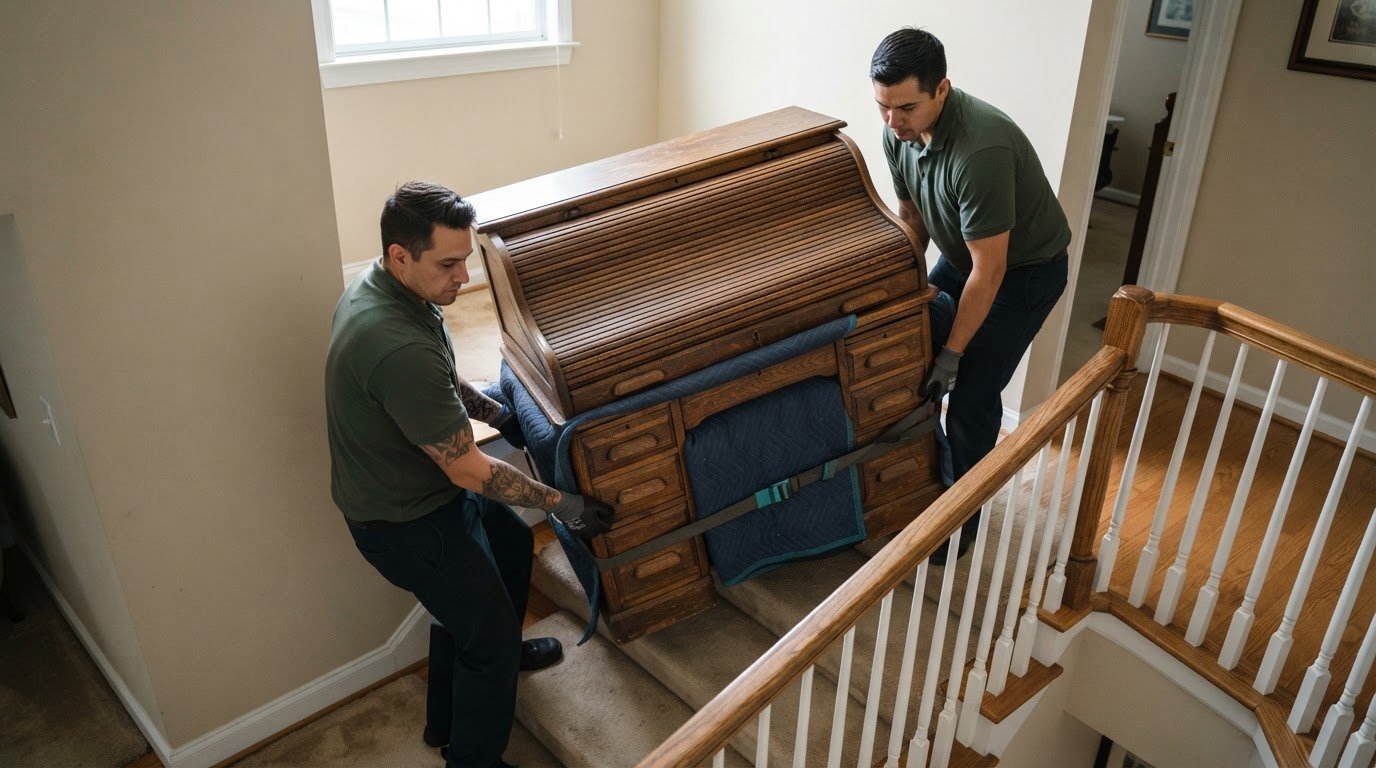
Moving a heavy cast-iron wood-burning insert out of a fireplace surround in Dumfries starts with planning where the load must turn. Stop before each corner and have the front and rear guides agree on the direction. Make small adjustments rather than twisting while someone pushes straight ahead. If the stove cannot clear the turn without hitting a wall or frame, change the route before proceeding.
-
Coordinate the Lift and Keep the Load Steady
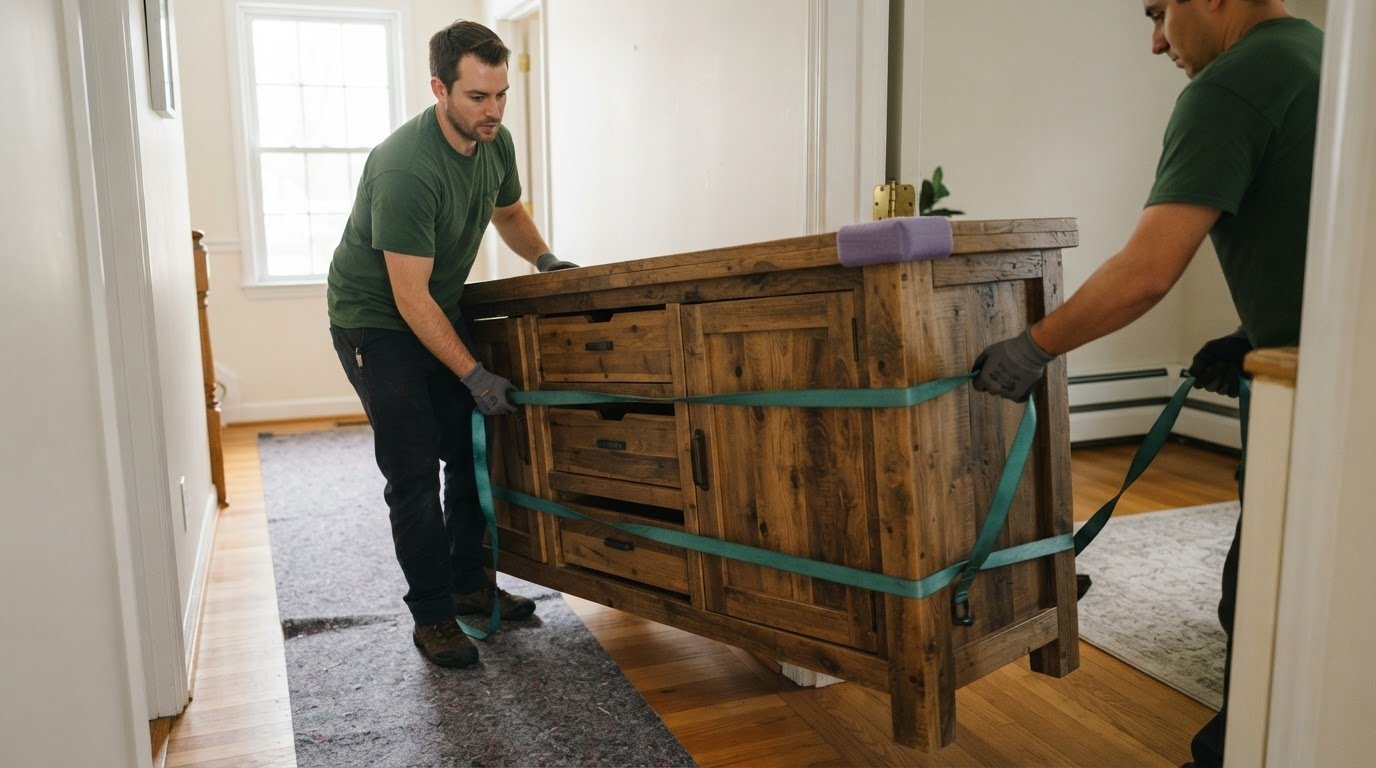
Assign clear roles before lifting: one person leads while the others steady and guide the stove. At least four people are recommended when lifting a stove onto a furniture dolly. Agree on a cue to start, pause, and set the load down together. Keep hands away from pinch points, and don’t try to catch a stove that starts to tilt.
Move only when the route is clear and everyone is in position. At a tight doorway, pause to adjust the alignment instead of forcing the stove through. Moving a heavy cast-iron wood-burning insert out of its fireplace surround in Dumfries requires controlled turns, especially where there is little clearance. Stop if the stove shifts unexpectedly.
-
Prepare the Truck Loading Path
Clear the route from the doorway to the moving truck before taking the stove outside. Check for thresholds, uneven ground, and tight turns, then choose safe places to pause. Keep the stove upright and under control as it approaches the truck. Don’t start loading until the truck and route are ready.
Treat loading the stove into the truck as a separate maneuver. Keep helpers in their assigned positions, communicate each movement, and stop if the load shifts. Secure the stove for transport so it cannot slide or tip. Keep detached pipe sections and other parts together, not loose beside the load.
-
Finish With a Clear, Deliberate Route
Walk the route once more before moving. Check plywood, corners, doorway clearance, and the truck-loading path. Keep bystanders and loose objects out of the work area while the stove is moving. Fireplaces create 20 times the amount of air pollution as EPA-certified wood heaters, according to the U.S. Environmental Protection Agency.
Helpers and moving equipment
Choose the crew and equipment based on the stove’s weight, the route, and how you plan to move it. Assign roles before anyone lifts, and check the equipment’s load rating.
- Set the crew size and assign roles. Plan for at least three helpers in addition to the person coordinating the move. Give each person a clear job: guide the front, steady the rear, watch the floor path, or handle the equipment. The coordinator calls each start, pause, and set-down. Avoid having several people give directions at once. Agree on simple commands before lifting so everyone moves together and can stop promptly if the stove shifts.
- Choose a dolly by its rated capacity. Read the label rather than judging capacity by the dolly’s size. A typical heavy-duty model has four swivel wheels, which help with turns on a suitable, clear surface. Check that all wheels roll freely and the platform stays stable before placing the stove on it.
- Secure the stove before rolling. Use straps or rope to hold the appliance against the dolly, with each strap or rope at least 6 feet long. Position the securing material so it holds the load without catching on protruding parts. Tighten it enough to limit shifting, then test the setup with a careful, small movement. Stop if the stove tilts, the strap slips, or the dolly rolls unevenly. Never use a strap as a substitute for people steadying the load.
- Protect the legs while positioning a hand truck. One suggested method places a 2 x 4 under the stove’s legs before sliding the hand truck beneath it. The board gives the truck clearance without forcing its frame against the legs. Keep the board centered and the appliance supported as the truck moves into place. Check that the stove sits securely before tilting or rolling. If the hand truck cannot fit without a forceful lift, stop and choose another approach.
- Consider rollers only on a prepared path. Two lengths of PVC pipe can serve as rollers, with a helper moving each pipe ahead as the stove rolls forward. Move slowly and under control, and prepare the next section of the route before advancing. Rollers can shift sideways, so helpers must watch the stove’s position, not just the pipes. Avoid this method at doorways, corners, or uneven surfaces where the load could become difficult to control.
- Keep lifting equipment within its intended role. A 6-ton floor jack and a 2-ton engine hoist have been considered or used in stove moves, but neither replaces a planned route and coordinated handling. An engine hoist has been used with straps to place a stove in a basement. That example doesn’t make it the right choice for every doorway or home. Use lifting equipment only when its setup, reach, and load rating suit the specific move.
- Make the final equipment check before moving. Confirm the dolly rating, wheel movement, strap position, and helper roles before the stove leaves its starting point. Keep hands clear of pinch points and don’t let anyone stand where a shifting load could trap them. If the equipment can’t keep the stove stable through the route, pause instead of improvising. For a stove move that needs coordinated heavy lifting, heavy lifting moving help can take on the demanding handling.
The guide describes a heavy-duty furniture dolly as having 4 swivel wheels; verify their condition as well as the dolly’s rating before use. The guide recommends having at least 3 helpers in addition to the person moving the stove. A forum member reported installing a 600 lb. fireplace insert with two people, but that individual experience does not replace the guide’s crew recommendation.
A forum member used two sheets of 3/4 inch plywood to make a ramp from the floor to a platform by the hearth. Treat this as a reported setup, not a universal solution: check that the ramp is secure and that the crew can control the stove through the transition.
Wood burner
Prepare the wood burner itself, not just the route. An insert sits within a fireplace opening, so its firebox, flue connection, hearth, and nearby clearances all affect its removal and later placement.
- Identify whether the appliance is an insert or a freestanding stove. The U.S. Environmental Protection Agency describes fireplace inserts as wood stoves designed to fit existing fireplace openings. The distinction matters during removal: an insert may sit within a surround, while a freestanding stove stands separately. Note visible connections and how the appliance meets the hearth before moving it. Don’t pull against the surround or handle the insert like an ordinary loose appliance.
- Empty the firebox before handling the appliance. Remove solid fuel and loose contents so they don’t add mass or spill along the route. A wood stove can weigh more than 800 pounds even before the solid fuel inside is counted. Keep the firebox clear, and make sure nothing shifts when the appliance tilts or moves. Don’t begin handling while the stove is hot; wait until it has fully cooled.
- Plan for nearby combustible materials. Keep combustibles at least four feet from the front of a wood-burning insert, stove, or fireplace. Move rugs, boxes, firewood, and other loose items away from the work area before preparing the appliance. This clearance also helps keep the route open as the stove is shifted. Check the destination landing area, too, rather than focusing only on the fireplace opening.
- Account for a raised hearth before choosing the direction of travel. A stove may need to cross a change in floor level between the hearth and the room. One reported setup had a hearth raised 12 inches above a hardwood floor. That example shows why the transition deserves attention: a sudden drop or lift can change the load’s balance. Plan how the appliance will move across the edge before it reaches that point.
- Inspect an older burner for loose or damaged parts. A wood-burning stove may have been in service for more than 30 years. Age alone doesn’t establish its condition, so look for loose panels, unstable legs, or parts that could move during handling. Don’t use a damaged component as a lifting point. Keep removable parts together and separate from the moving path, so they don’t become tripping hazards or get lost.
- Use the appliance’s instructions when preparing it for use again. If the destination appliance is new cast iron, the described break-in sequence uses three small fires. The first should stay at or below 200°F for about one hour; let the stove cool to room temperature afterward. The second reaches 300°F for one hour, followed by cooling for a couple of hours. The third gradually reaches 400°F for one hour.
- Measure surface temperature during a new cast-iron break-in. A magnetic thermometer records the stove’s surface temperature. For the described kindling setup, use ten to 15 pieces, each about ½ to ¾ inch in diameter and 12 to 18 inches long. Cast iron expands as it heats and contracts as it cools, which is why the initial fires are low-temperature and short-duration. Follow the appliance’s own instructions for the final setup.
Check clearance guidance for the specific appliance and installation instead of assuming it based on appearance. One commenter said their woodstove needed at least three feet of clearance from nearby items; that is an individual report, not a universal requirement. Consult the burner’s instructions and consider the surrounding materials before choosing a location. If the instructions are unavailable or the setup is unclear, pause and get qualified guidance rather than guessing. Keep the intended position and route clear of objects that could obstruct careful handling.
Before moving the burner, agree on where it will be set down and how it will be aligned with the fireplace or hearth. Clear the landing spot so nobody needs to reach across or around the appliance while positioning it. If the clearance or fit looks uncertain, don’t force the stove into place; reassess the location first. Once it is settled, check that it sits securely and nearby items remain outside the required clearance. This preparation helps prevent last-minute shifts and leaves the appliance ready for proper connection and use.
Heavy Furniture Moving: Exercise Equipment Moving
Heavy Furniture Moving provides heavy-lifting support for demanding household moves. If the wood burner’s weight, tight route, or truck loading makes the job difficult to manage safely, the team can help with the lifting. Heavy Furniture Moving also handles bulky items such as exercise equipment that need careful movement through a home. This support can be especially useful when the appliance needs steady coordination from the fireplace to its destination.
For a smaller move, Movers Near Me can connect you with local moving support. Describe the stove, the route, and any narrow turns so the work can be planned around the actual task. Contact Heavy Furniture Moving to discuss the help you need.
Plan the Next Move With Confidence
Before moving day, decide who will handle the insert and how it will reach its destination. If the route, lifting, or loading feels beyond your crew’s capabilities, arrange help rather than improvising once the stove is in motion. For moving a heavy cast-iron wood-burning insert out of a fireplace surround in Dumfries, share the appliance’s location, destination, and any tight turns when you get in touch. These details help plan the lifting work around the actual move.
Heavy Furniture Moving provides local moving help, exercise equipment moving, and sofa hoisting for heavy and bulky household items. Choose support that fits the work ahead and leave difficult handling to a coordinated team.
Contact Heavy Furniture Moving to discuss your move and take the next step with confidence.
Frequently Asked Questions
Why are wood stoves so risky to move?
Wood stoves combine substantial weight with a shape that can be difficult to grip and balance. Their center of mass may shift as the appliance tilts, making sudden movement hard to control. A narrow doorway can leave little room to correct its path. Poorly coordinated lifting can injure helpers or damage floors, walls, and doorframes, so plan the route and agree on clear stop commands first.
Which Dumfries or Prince William County companies remove and haul away wood stove inserts?
Heavy Furniture Moving provides local moving help in Dumfries, including support for heavy household items. The team can help with lifting and moving when an insert needs to leave its current position or be loaded for transport. Fireplace removal and disposal are separate parts of the job, so plan the destination and transport arrangements as part of your move.
How much does a typical cast iron wood-burning insert weigh?
A wood stove commonly weighs between 300 and 800 pounds, and an average is around 500 pounds. The exact weight depends on the model and manufacturer, so use the appliance’s model information rather than estimating from its appearance. Some stoves exceed 800 pounds before solid fuel inside is counted. That added mass is one reason to empty the firebox before handling.
What tools and equipment are needed to remove a heavy fireplace insert safely?
Equipment depends on the appliance and route, but a rated furniture dolly, securing straps, protective floor boards, and gloves can be useful. A hand truck may suit a route with appropriate access, while plywood can protect a vulnerable floor. Make sure the chosen equipment supports the load and fits the path. Keep an exit route clear, and don’t rely on improvised lifting gear.
What are the steps for disconnecting and removing a wood-burning insert from a fireplace?
Start by letting the appliance cool, clearing the firebox, and identifying how the flue connects. Remove detachable pipe sections and loose components without pulling against the fireplace surround. Once the connection is free, secure the insert for controlled movement and guide it along the prepared route. If the flue connection is stuck or difficult to reach, stop rather than forcing it or damaging the chimney opening.
What safety risks are involved in removing an old wood-burning fireplace insert?
Older inserts can have loose or damaged components, hidden attachment points, and pipe connections that resist movement. Ash or debris may spill, while shifting weight can trap hands or strike nearby surfaces. A tight opening also makes it harder to correct a tilt. Keep people clear of the moving path, avoid using weak parts as lifting points, and stop if the insert moves unpredictably.
Frequently Asked Questions
Wood stoves combine substantial weight with a shape that can be difficult to grip and balance. Their center of mass may shift as the appliance tilts, making sudden movement hard to control. A narrow doorway can leave little room to correct its path. Poorly coordinated lifting can injure helpers or damage floors, walls, and doorframes, so plan the route and agree on clear stop commands first.
Heavy Furniture Moving provides local moving help in Dumfries, including support for heavy household items. The team can help with lifting and moving when an insert needs to leave its current position or be loaded for transport. Fireplace removal and disposal are separate parts of the job, so plan the destination and transport arrangements as part of your move.
A wood stove commonly weighs between 300 and 800 pounds, and an average is around 500 pounds. The exact weight depends on the model and manufacturer, so use the appliance’s model information rather than estimating from its appearance. Some stoves exceed 800 pounds before solid fuel inside is counted. That added mass is one reason to empty the firebox before handling.
Equipment depends on the appliance and route, but a rated furniture dolly, securing straps, protective floor boards, and gloves can be useful. A hand truck may suit a route with appropriate access, while plywood can protect a vulnerable floor. Make sure the chosen equipment supports the load and fits the path. Keep an exit route clear, and don’t rely on improvised lifting gear.
Start by letting the appliance cool, clearing the firebox, and identifying how the flue connects. Remove detachable pipe sections and loose components without pulling against the fireplace surround. Once the connection is free, secure the insert for controlled movement and guide it along the prepared route. If the flue connection is stuck or difficult to reach, stop rather than forcing it or damaging the chimney opening.
Older inserts can have loose or damaged components, hidden attachment points, and pipe connections that resist movement. Ash or debris may spill, while shifting weight can trap hands or strike nearby surfaces. A tight opening also makes it harder to correct a tilt. Keep people clear of the moving path, avoid using weak parts as lifting points, and stop if the insert moves unpredictably.