How to Maneuver an Oversized Chaise Through a Tight Manassas Entry
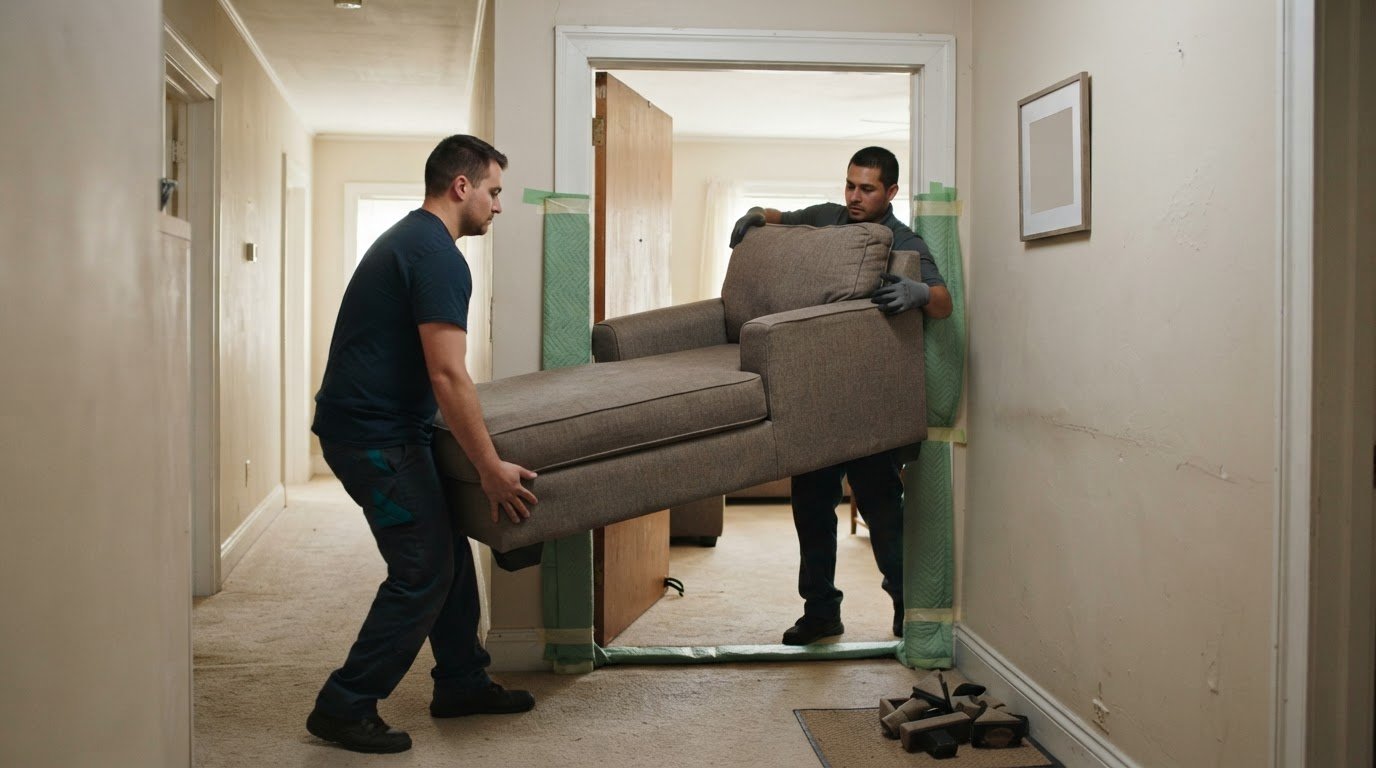
A tight entry is a measurement problem, not a strength test. To work out how to maneuver an oversized chaise lounge through a tight apartment entry in Manassas, measure the chaise and the narrowest point on the route, remove any parts designed to come off, and plan the angle before lifting. Standard doorways are 30 to 36 inches wide, but the actual opening and hallway turns determine whether your chaise can pass.
If you’re concerned about scraping a door frame, damaging the upholstery, or getting the chaise stuck halfway through, careful preparation can make the move more manageable. Measure the furniture and the full route, protect contact points, and check whether removable parts or another entrance could help. If the fit remains difficult, professional movers can assess whether indoor handling or sofa hoisting is appropriate.
Key Takeaways
- Measure the chaise and the tightest points along the route before you lift, then protect upholstery and door frames.
- Plan the sofa’s angle and orientation to see whether it can pass through the doorway without forcing it.
- Remove only parts designed to come off, such as screw-in legs or a removable back, to reduce the chaise’s profile.
- Consider another entrance or professional disassembly when the doorway and route leave too little room to maneuver.
- Use professional movers or sofa hoisting specialists when a tight turn, heavy piece, or limited access makes the move difficult to manage.
Protecting furniture and door frames during a move
Before lifting, measure the chaise and its route, then protect contact points with moving blankets and padding. For a Manassas apartment move, follow the building’s move-in and elevator reservation procedures set by property management.
-
Measure furniture and entryways
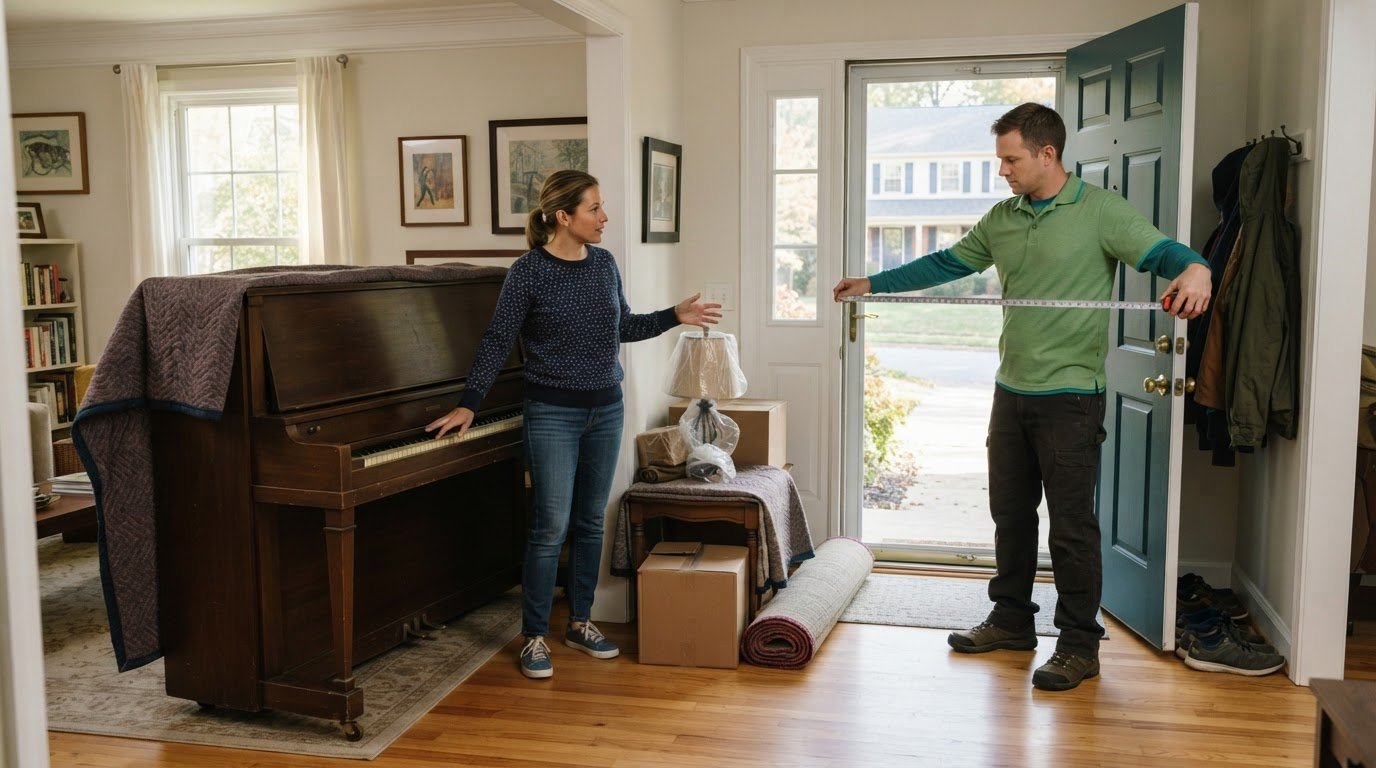
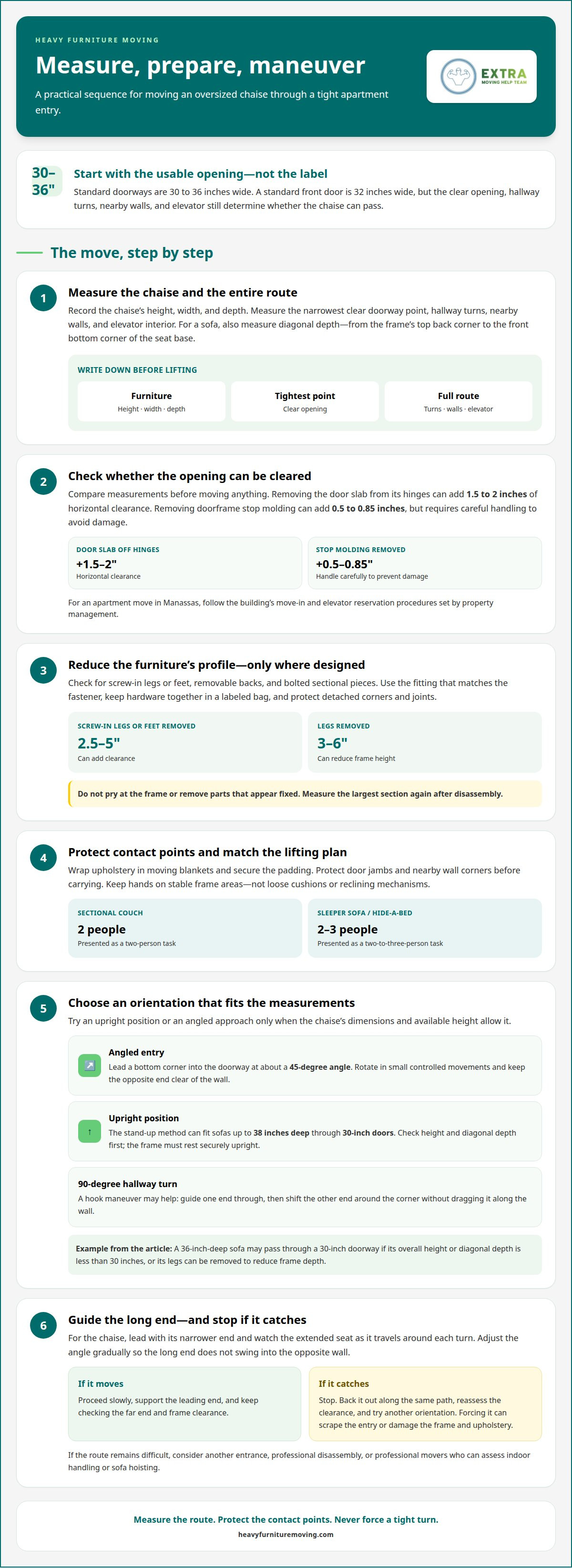
Measure the chaise’s height, width, and depth, then measure the doorway at its narrowest clear point. Include the hallway turn, nearby walls, and elevator interior in your route assessment. For a sofa, measure diagonal depth from the frame’s top back corner to the front bottom corner of the seat base. Compare the measurements before lifting: a doorway’s stated width may not reflect its usable clearance.
Record the tightest point and plan which side will lead. Removing a door slab from its hinges can add 1.5 to 2 inches of horizontal clearance. Removing doorframe stop molding can add 0.5 to 0.85 inches, but these changes require careful handling to avoid damage. Protect the exposed frame and keep tools away from upholstery.
-
Choose guidance by furniture type
Match the lifting plan to the furniture. A sectional couch is presented as a two-person task, while a sleeper sofa or hide-a-bed is presented as a two-to-three-person task. A chaise has an extended seat, so check whether its long end can clear the doorway and hallway turn without scraping the wall or twisting the frame.
Wrap exposed upholstery in moving blankets and secure the padding so it stays in place during turns. Protect door jambs and nearby wall corners before carrying the piece. Keep your hands on stable frame areas, not loose cushions or reclining mechanisms. If the furniture catches, stop and reassess. Forcing it can scuff the frame, tear fabric, or damage the entry.
-
Disassemble bulky furniture
Check the chaise, sofa, and sectional for removable legs, backs, or bolted sections before moving. Most modern sectional sofas can be unbolted into smaller pieces. Keep fasteners together in a labeled bag, and set removed parts away from the walking path so nobody trips over them.
Protect each detached piece with a blanket, especially at corners and exposed joints. Don’t pry at the frame or remove parts that appear fixed; damage can make the furniture harder to carry and reassemble. Once the pieces are separated, measure the largest section against the entry again. Smaller components may fit more easily, but the hallway turn and elevator opening still matter.
How do you move a couch through a narrow doorway?
Compare the sofa’s measurements with the opening, then test an upright position or angled approach. For a chaise, keep its long end clear of the jamb and plan each turn before lifting.
-
Compare sofa diagonal depth with doorway width
Measure the sofa’s diagonal depth and compare it with the doorway’s clear width. A standard front door is 32 inches wide, while standard doorways are 30 to 36 inches wide. A 36-inch-deep sofa may pass through a 30-inch doorway if its overall height or diagonal depth is less than 30 inches, or its legs can be removed to reduce frame depth.
Use the measurements to choose an upright or angled position, allowing for the door’s full opening and the space beyond it. A chaise that clears the threshold can still catch at a hallway turn, so don’t judge the fit by doorway width alone. Planning how to maneuver an oversized chaise lounge through a tight apartment entry in Manassas means assessing the entire route.
-
Stand the sofa upright
Tip the sofa onto one end only if its frame can rest securely in that position. The stand-up method can fit sofas up to 38 inches deep through 30-inch doors. Check the sofa’s height and diagonal depth against the opening, and keep the feet or frame from striking the top jamb as the sofa rises.
Move slowly through the doorway, supporting the chaise as its leading end crosses the threshold. If the back or seat catches, don’t force it against the frame. Pause, lower it carefully, and reassess the angle. This approach works only if the furniture’s dimensions and available height allow it.
-
Angle and rotate the couch
Lead the sofa’s bottom corner into the doorway at about a 45-degree angle. This turns the leading edge toward the opening instead of pushing the full sofa width straight through. Keep the opposite end clear of the wall, and rotate the frame in small controlled movements as the leading corner enters.
For a hallway turn of 90 degrees, the hook maneuver may help. Guide one end through first, then shift the other end around the corner without dragging it along the wall. Stop if the frame binds. Forcing a rotation can damage upholstery or scrape the doorway.
-
Maneuver the chaise around tight corners
Position the chaise so its narrower end leads through the doorway, then assess how the extended seat will travel around the corner. Keep the long section from swinging into the opposite wall. At each turn, adjust the angle gradually and watch the far end as closely as the leading corner.
If the chaise catches, back it out along the same path rather than twisting harder. Reassess the clearance and try a different orientation. A careful plan for how to maneuver an oversized chaise lounge through a tight apartment entry in Manassas should account for every turn. If the route remains difficult, professional moving help can take over the maneuver.
Removing sofa legs, feet, and removable backs
- Inspect the chaise’s underside and back before removing anything. Screw-in sofa legs or feet can add 2.5 to 5 inches of clearance when removed, while taking off legs can reduce frame height by 3 to 6 inches. Those gains matter when a doorway catches the lower frame or the sofa’s height is the limiting measurement.
Look for visible screws, bolts, or release points, and use a fitting that matches the fastener. Don’t twist a fixed leg or pull at a back without a clear release. For a chaise with an attached extension, identify which parts move independently before changing its setup.
- Remove only parts designed to come off, starting with screw-in legs. Turn each leg carefully and stop if it resists; forcing a stubborn fitting can damage the leg or its attachment point. Put removed parts in a container, and keep them out of the walking path.
After removing the feet, measure the frame again. A 3-inch reduction in height may change how the piece clears a low edge, while the 2.5-to-5-inch clearance gain from screw-in legs may help at a tight opening. The useful change depends on which dimension blocks the route.
- Check the sofa back’s connection points to see whether it is removable. Some backs have visible fasteners or release mechanisms; others are fixed to the frame. Follow the furniture’s instructions when available, and support the back as it separates so it doesn’t drop or twist against the upholstery.
Removing a back can change the sofa’s profile, but it won’t necessarily shorten every measurement. Recheck the largest remaining section against the entry and turn. For a chaise, include the extended seat in your plan: detaching the back won’t necessarily make the long end easier to swing around a corner.
- Label each removed part before carrying the furniture. If left and right legs differ, keep them in separate marked groups and store matching screws with each component. This prevents confusion when reassembling the chaise in its new room.
After removing parts, protect exposed attachment points with padding and avoid setting the frame directly on rough flooring. Check for loose fittings underneath before lifting. If the piece still won’t clear the route after adjustment, stop rather than forcing the frame through the entry.
Alternative entrances and professional disassembly
- Check for another route before deciding the chaise cannot enter. Consider the building’s other entrance, stairwell, elevator, and every turn between the outside door and apartment. Compare the narrowest opening and turning space with the chaise’s shape. A wider entrance won’t help if a tight stairwell landing blocks the long end.
For a Manassas apartment, coordinate access with property management before using a different entrance. Follow the building’s move-in procedures and elevator reservation requirements, and plan how to protect shared walls and floors. Keep the alternate route clear, and don’t carry the chaise through a space that forces it against railings or door frames.
- Inspect stair railings along the alternate route before choosing stairs. Unbolting a wall-mounted stair handrail can add 3 to 4.25 inches of clearance. That extra room may matter where the chaise’s frame meets the railing, but removing a rail affects the stairway. Arrange the work and protect the railing and its fittings.
Extra width doesn’t solve every turn. The chaise still needs room for its long section to pivot at a landing without striking the opposite wall. Walk the route first, identify where a railing narrows the path, and compare that point with the chaise’s widest part. Restore the handrail after the move.
- Consider professional frame disassembly when another entrance still won’t accommodate the chaise. Professional sofa frame disassembly and reassembly can separate a sofa into pieces 14 to 20 inches wide. Unbolting a frame can reduce component size by 30% to 50%, depending on its construction and which sections separate.
Disassembly goes beyond removing screw-in legs: it separates the frame into smaller sections that must be reassembled. A professional can assess the frame’s joints, connection points, and access route before taking it apart. This can suit a chaise whose fixed frame cannot turn through a narrow hall or stairwell.
- Plan for the full disassembly process, not only the time spent taking the sofa apart. Professional disassembly and reassembly is listed as taking 60 to 90 minutes. The work includes separating the frame, moving the sections through the restricted route, and rebuilding the sofa in its destination room.
Before the move, clear space for each separated piece and keep the route open from the entrance to the destination. Note which components belong together, and keep hardware with the relevant section. If the frame cannot be safely separated or the alternate route remains too tight, don’t force the chaise through. Choose another access plan.
Using professional movers or hoisting specialists
- Get professional help if the chaise still cannot pass after measuring, removing detachable parts, and testing a controlled angle. A stuck frame, narrow stair landing, or tight hallway turn can make repeated attempts risky for the furniture and entry. Stop before the chaise wedges against a jamb or wall.
Professional movers can assess the full route, not just the doorway. The entry, hallway, stairs, elevator, and destination room all affect the handling plan. A chaise that clears the front door may still be too long to pivot at the next turn.
- Consider sofa hoisting when the indoor route cannot accommodate the chaise and an exterior opening offers a workable path. Hoisting can move a sofa through an elevated opening rather than forcing it around a tight interior corner. The building exterior, opening, furniture dimensions, and access below all shape the plan.
In an apartment building, account for shared spaces and building procedures before arranging an exterior move. Keep the indoor route clear for receiving the chaise, and identify where it will go once inside. Hoisting is an alternative route, not a solution if the opening itself cannot accommodate the furniture.
- Prepare useful details when arranging help: the chaise’s overall dimensions, the narrowest doorway, the tightest turn, and the apartment floor. Photos of the entry, hallway, stair landing, elevator, and possible exterior opening can reveal obstacles that measurements alone may miss.
Point out removable legs or backs, attached chaise sections, and delicate upholstery. Mention any low ceilings, railings, or limited staging space along the route. These details help identify whether indoor maneuvering, frame disassembly, or sofa hoisting suits the access problem.
- Set a clear stopping point for a difficult move. If the chaise binds, shifts unexpectedly, or presses against a door frame, pause and reset instead of pulling harder. Professional movers can coordinate the lift and guide the frame through a tight route while protecting the furniture and nearby surfaces.
For a bulky chaise that needs a different access route, request professional sofa hoisting help. Share the measurements and route details so the move can be matched to the actual entry challenge. The key decision is simple: use the interior route only when the chaise can travel through it without force.
Heavy Furniture Moving
Heavy Furniture Moving handles bulky furniture moves when a chaise cannot clear an apartment entry through ordinary indoor maneuvering. The team can help plan the lift and route, and sofa hoisting offers an alternative when the interior path is too tight. Moving blankets, wrap, and straps are included on every job.
Turn to Heavy Furniture Moving when the chaise’s frame, a narrow stair landing, or a sharp hallway turn makes the move difficult. Share the furniture’s dimensions and describe the entry, turns, stairs, and possible exterior access. This helps the team plan for the challenge without forcing the chaise against walls or door frames.
Contact Heavy Furniture Moving to discuss your chaise and apartment entry in Manassas.
Plan Your Chaise’s Next Move
Before moving day, focus on keeping the chaise intact, protecting the apartment, and getting the furniture into its intended room. The best route lets it move steadily without scraping, forcing, or awkward last-minute turns. If the path is uncertain, pause and make a plan before lifting.
Planning how to maneuver an oversized chaise lounge through a tight apartment entry in Manassas is easier when you treat the move as a route problem, not a test of strength. A professional can help assess whether indoor handling or another access method suits the furniture and building.
Contact Heavy Furniture Moving for help with your chaise move. Take the next step with a clear plan, and move forward with confidence.
Frequently Asked Questions
How do you measure an oversized chaise lounge and apartment entryway before moving it?
Measure the chaise in its moving configuration, including its arms, back, and extended seat. Note cushions or detachable parts that change its outer shape. Measure the entry’s clear opening with the door positioned as it will be during the move. In a Manassas apartment, record each measurement and mark which end of the chaise will lead. This makes it easier to compare its widest points with the available opening.
How do you measure doorways, hallways, stairwells, and elevators for furniture clearance?
Measure every part of the route, not just the apartment doorway. Record the clear width of hallway turns, stair landings, and elevator doors, as well as the elevator interior. Note changes in ceiling height, protruding railings, and door closers that reduce usable space. An elevator may admit the chaise through its doors but lack room to turn it inside. Sketch the route and mark each tight point so your plan accounts for the whole trip.
Can a chaise lounge be disassembled to fit through an apartment entrance?
Some chaise lounges can be made smaller by removing legs, backs, or connected sections designed to detach, but construction varies. Check the furniture’s assembly instructions or visible fasteners before removing anything. Don’t cut fabric, pry joints, or remove fixed frame pieces. Keep screws and fittings in a labeled bag, and photograph connections before separating components. If the frame itself needs dismantling, professional disassembly can help prevent damage and support proper reassembly.
How do you protect walls, floors, and the chaise while moving bulky furniture?
Clear loose objects from the route, then cover exposed chaise surfaces with moving blankets secured so they won’t slip. Protect floor sections where the furniture will turn or rest, and pad wall corners near the tightest maneuver. Keep the path dry and free of cords or small rugs. Have someone watch the chaise’s trailing end, which can swing into a wall even when the leading end clears the doorway.
When is it safe to tilt or rotate a chaise lounge during a move?
Tilt or rotate the chaise only if its frame stays stable and the planned movement clears the ceiling, doorway, and nearby walls. Hold sturdy frame areas and make small adjustments rather than twisting suddenly. Stop if the chaise shifts, flexes, or catches on an edge. A position that works at the doorway may fail at a hallway turn, so reassess the available space before changing direction.
What moving equipment or number of movers is needed for an oversized chaise lounge?
Use equipment suited to the chaise’s weight, shape, and route, such as moving blankets and carrying straps. The right number of movers depends on the piece and the tightest maneuver; there isn’t a reliable fixed count for every chaise. As a guide for other furniture types, a sectional couch is presented as a two-person task, while a sleeper sofa or hide-a-bed is a two-to-three-person task. Don’t assume those counts apply to your chaise.
What should you do if an oversized chaise lounge will not fit through an apartment entrance?
If the chaise won’t pass, stop rather than forcing it. Consider a different entrance, professional disassembly, or an exterior route. Heavy Furniture Moving offers sofa hoisting for items that cannot fit through standard entryways or elevators. Wrap, blankets, and straps are included on every job. When arranging help, share the chaise’s dimensions and access details, including any stairwell, elevator, or exterior-opening constraints.