How to Hoist a Heavy Armoire Over a McLean Deck Safely
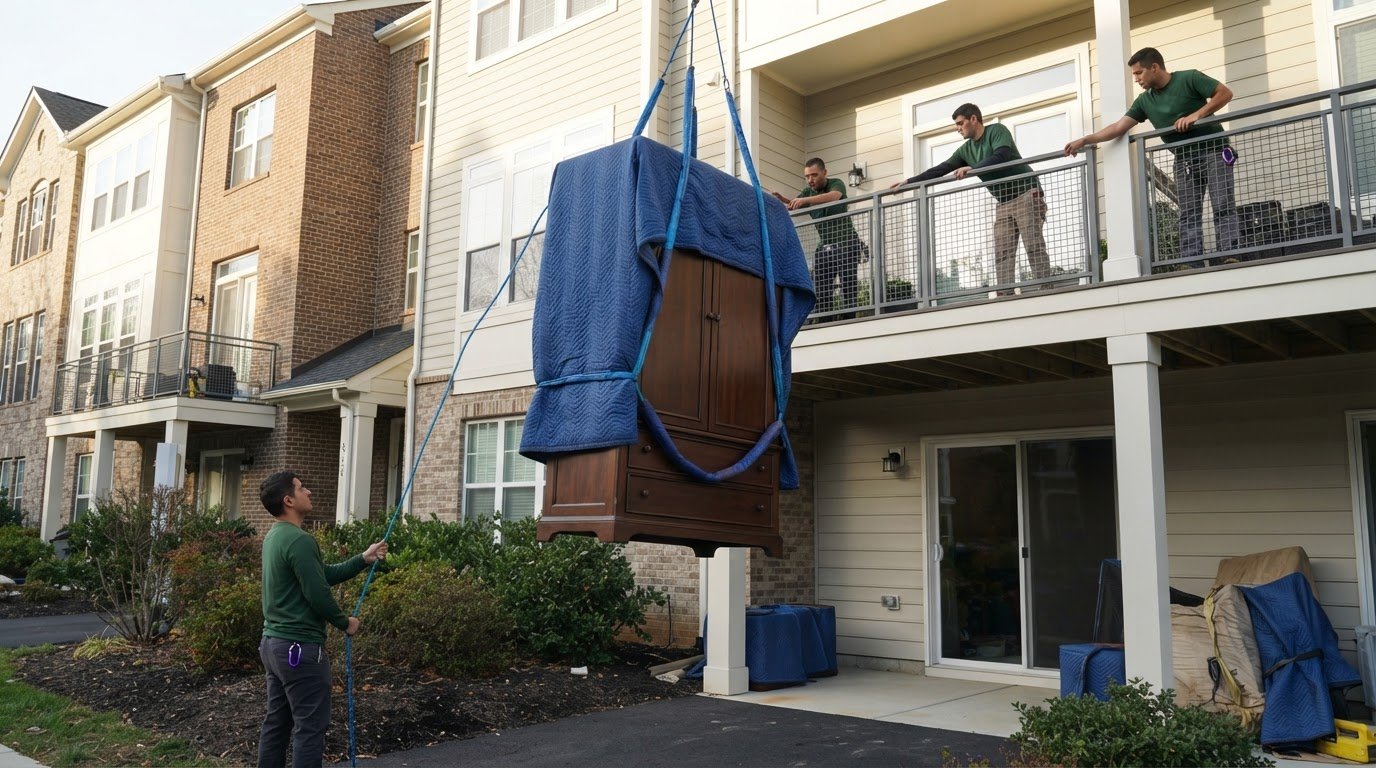
A deck railing is not a lifting plan. To hoist a heavy solid wood armoire over a second-floor deck railing in McLean safely, measure the armoire and the full route, remove detachable parts and contents, protect and secure the piece, and plan a controlled lift with suitable equipment. If the staircase and turns can’t accommodate the armoire, a hoist may be an option, but a swinging or poorly secured load can put people and the home at risk.
It’s understandable to consider carrying it upstairs yourself, especially if the armoire looks manageable on the ground. But its size, weight, grip points, and the space around the stairs or deck can make the move much harder than it first appears. A careful assessment comes before lifting.
This guide explains how to measure the armoire and route, prepare and protect the furniture, and plan the lift over the railing. You’ll also learn when a hoist may suit the route better than an indoor carry, and which conditions call for stopping rather than attempting the move.
Key Takeaways
- Measure the armoire, doorways, stairs, turns, deck opening, and overhead clearance before choosing a route.
- Compare the indoor path with a deck hoist; if the armoire can’t clear the stairs or turns, plan a controlled hoist instead of forcing it through.
- Empty the armoire, remove detachable parts, and protect and secure it before moving it on a dolly or lifting system.
- Plan the lift around secure attachment points, clear communication, and a landing area free of people and obstacles.
- Factor in the home’s layout, lot, building schedule, and weather when deciding whether and how to hoist.
Measuring furniture, stairs, and overhead clearance
Measure the armoire and every part of its route before choosing an indoor carry or deck hoist. Planning how to hoist a heavy solid wood armoire over a second-floor deck railing in McLean starts with clearances, protection, equipment, weather, and the landing area.
-
Measure the Armoire and Route
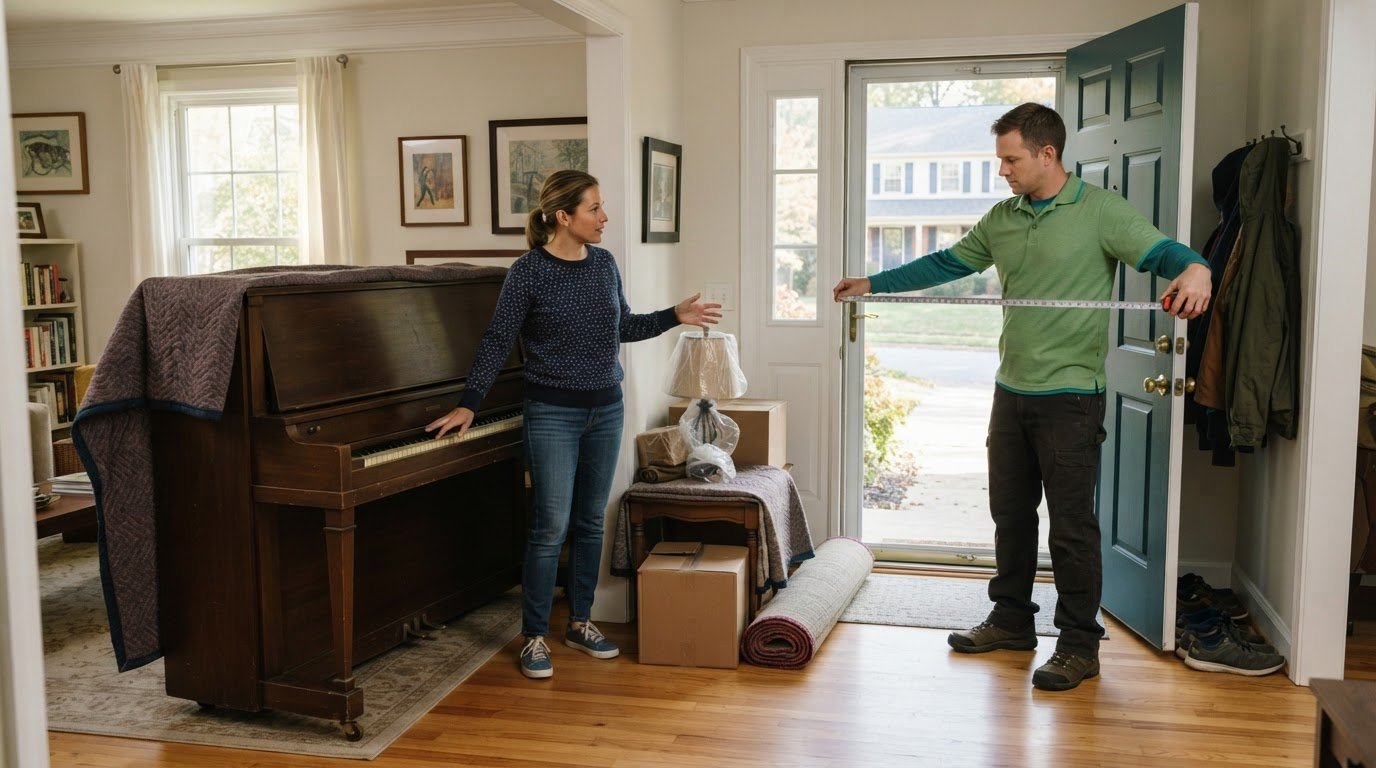
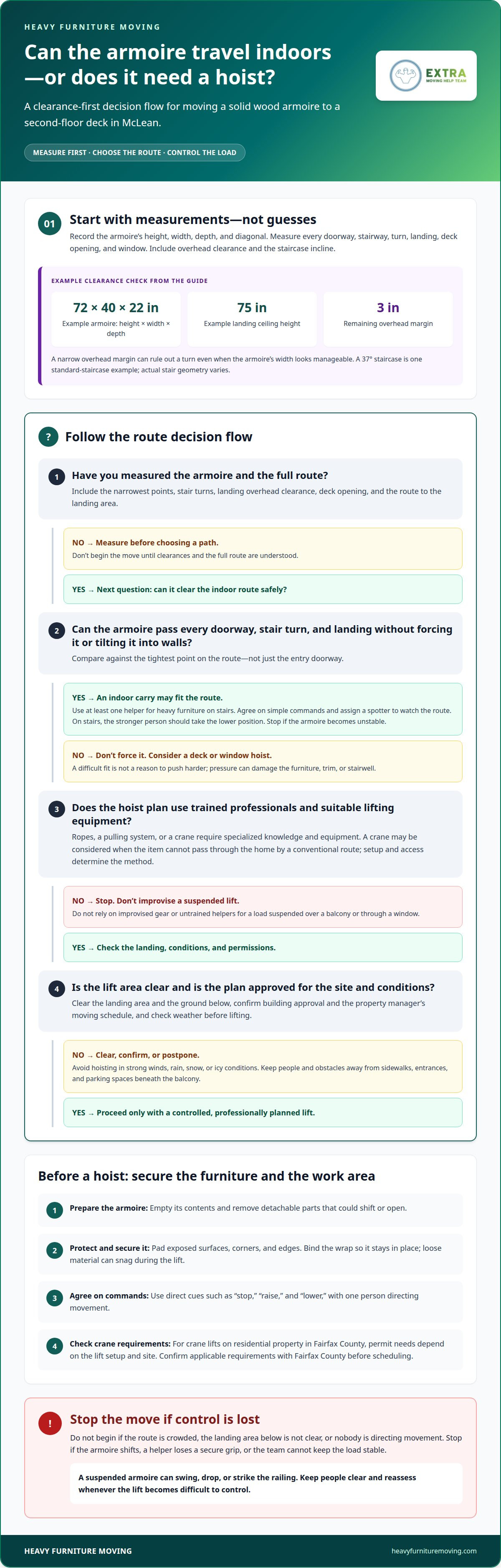
Record the armoire’s height, width, depth, and diagonal measurements, then measure each doorway, stairway, turn, deck opening, and window. Include overhead clearance at landings; an example armoire measuring 72 inches high, 40 inches wide, and 22 inches deep leaves only 3 inches beneath a 75-inch landing ceiling. That tight margin can rule out a turn even when the item’s width seems manageable.
Measure the staircase and its incline, too. A standard staircase example has a 37-degree incline, but actual stair geometry varies. Compare the armoire’s measurements with the narrowest point along the route, not just the entry. If the conventional path cannot accommodate the piece safely, a hoist over a balcony or through a window may be considered.
-
Plan and Clear the Moving Route
Map the full path from the room to the deck, including the landing area and the ground below. Move toys, shoes, and rugs out of the walkway, and don’t leave loose blankets or rugs on stairs. Clear people and obstacles from sidewalks, entrances, and parking spaces beneath the balcony before any lift begins.
Agree on direct commands with everyone involved, such as “stop,” “raise,” and “lower.” Confirm building approval and the permitted moving schedule with the property manager. Avoid hoisting in strong winds, rain, snow, or icy conditions. Bad weather or a crowded landing can turn a workable route into an unsafe one.
- Choose equipment only after measuring the route and identifying how the armoire will travel. Ladders or a pulling system may be used to hoist furniture through a window, but the armoire must be properly wrapped and secured first. A crane can lift household items over a balcony when they cannot pass through the home by a conventional route. The setup and available access determine which method fits.
- Prepare the armoire before wrapping it. Empty its contents and remove detachable parts that could shift or open during movement. Pad exposed surfaces, corners, and edges, then bind the wrap so it stays in place as the load moves. Keep protective material secure rather than loose, since snagging can interrupt the lift or scrape the furniture and surrounding surfaces.
- Treat a suspended armoire as a load that can swing, drop, or strike the railing. Reduce the risk of injury and damage by keeping people clear, securing the furniture, using a planned lifting system, and guiding movement with clear commands. For crane lifts on residential property in Fairfax County, permit needs depend on the lift setup and site; confirm applicable requirements with Fairfax County before scheduling. Building approval and the property manager’s moving schedule also belong in the plan. These checks help anyone planning how to hoist a heavy solid wood armoire over a second-floor deck railing in McLean avoid preventable hazards.
When Is Hoisting Furniture the Best Moving Solution?
Choose the route that gives the armoire controlled movement, enough clearance, and a safe landing. Use these decision steps to tell when an indoor carry is practical and when trained movers should handle the lift.
- Compare the indoor route with a hoist. Choose an indoor carry only if the armoire can pass through each doorway, stair turn, and landing without forcing or tilting it into walls. A deck or window hoist may be the better route when the furniture cannot clear those obstacles. Don’t treat an awkward fit as a reason to push harder; pressure can damage the armoire, trim, or stairwell.
- Bring in professional movers for a suspended load. Hoisting furniture over a balcony or through a window requires specialized knowledge and equipment. A poorly controlled armoire can swing against the building, slip, or injure someone below. Get professional help when the plan depends on ropes, a pulling system, or a crane, rather than attempting a lift with improvised gear or untrained helpers.
- Use helpers and a spotter for any stair carry. Heavy furniture on stairs should involve at least one helper. Agree on simple commands before lifting, and assign one person to watch the route and call a stop if the load shifts. On stairs, the stronger person should take the lower position because that person carries more of the weight. If the team cannot keep the armoire stable, stop and reassess.
- Hire specialty movers when the lift needs dedicated equipment. A solid wood armoire may be difficult to grip securely, especially when its shape limits handholds or the deck landing offers little working room. Certified specialty movers are recommended for furniture hoisting or crane moves. Their experience with the lifting method, load control, and building access helps reduce risks from a swinging load, a fall, or contact with the railing.
- Set a clear stop point before moving. Don’t begin if the route is crowded, the landing area below isn’t clear, or the team lacks one person directing movement. Stop if the armoire shifts, a helper loses a secure grip, or conditions make the lift difficult to control. For a planned heavy-furniture move, professional furniture moving support can help address the demanding lift.
Using dollies, straps, and protective materials
Choose moving equipment that controls the armoire without creating new pressure points. Protect the furniture and deck, and don’t use a dolly unless the load is secured first.
For a heavy lift, protect the deck, railing, and landing with padding at likely contact points before moving the armoire. Padding guards surfaces, but it doesn’t make a railing a lifting anchor or support point.
-
Use Dollies and Straps
Secure the armoire to a suitable dolly before rolling it across a floor or deck. Check that the load stays balanced and can’t slide when the dolly turns; never place unsecured heavy furniture on wheels. Moving straps work best when two people lift together and communicate clearly. Coordinate each change in direction so one person doesn’t pull while the other is still positioning the load.
-
Protect the Deck and Railing
Cover deck boards, railing edges, and the landing where the armoire may pass or rest. Keep the protective material flat and secure, so it doesn’t bunch beneath a dolly or become a tripping hazard. Identify surfaces the armoire could touch during the lift, then add protection at those points. Don’t treat deck padding as a substitute for a sound lifting plan.
- Prepare the armoire before applying straps. Empty the cabinet and remove parts that could open, shift, or catch during movement. Close doors and secure them so they can’t swing against a wall or railing. Wrap exposed corners and finished surfaces with protective material, then bind the wrap snugly. Loose coverings can slip or snag, leaving wood exposed just when the load needs to move cleanly.
- Check how the straps meet the furniture. Place them around stable sections of the armoire, not handles, trim, or decorative pieces. Keep pressure spread across sturdy areas, and make sure a strap won’t slide toward a narrow edge when the item tilts. Before lifting, pause to inspect every contact point. A strap that shifts during a small test movement needs repositioning before the full move.
- Keep the landing ready for the final transfer. Clear the spot where the armoire will rest, and protect the floor or deck beneath it. Move tools and loose objects away from the dolly path. Set the item down under control before removing straps or padding. If the dolly rocks, the load leans, or a strap loosens, stop and stabilize the furniture rather than trying to correct it while moving.
Attaching ropes and guiding the load
Use a planned rigging setup, secure attachment points, and clear commands before raising an armoire. Each rope should be at least twice the distance from the floor to the deck or window, with a few extra feet for maneuvering.
-
Attach Ropes to the Armoire
Secure the ropes around the wrapped armoire, using strap eyelets at each of its four upper corners. Keep the attachment points balanced so the furniture can rise without tipping sharply. Avoid relying on handles, doors, trim, or a deck railing as anchor points. Check that wrapping and bindings stay tight, and that no rope can slide across an edge as the load changes position.
-
Guide the Load Safely
Assign one person to direct the movement and use short commands such as “raise,” “hold,” and “lower.” Keep the armoire moving slowly enough for the team to respond if it turns or sways. People should stay clear of the suspended load and its path. If communication breaks down or the armoire becomes difficult to control, stop the lift before continuing.
- Match rope length to the height. Measure the vertical distance from the floor to the deck or window before preparing each rope. Make every rope at least twice that distance, then add a few feet for maneuvering. A rope that is too short can limit movement near the landing, while extra working length gives the team room to guide the armoire into position.
- Check the attachments before raising. Inspect each of the four upper-corner strap eyelets and confirm the ropes remain secure around the wrapped furniture. Look for slack, slipping, or uneven tension. Don’t start the lift if one side hangs lower or an attachment point shifts during a gentle test. Correct the setup while the armoire is still resting securely.
- Control the route from lift to landing. Keep the intended path clear, including the space above the railing and the landing area. Use agreed commands so the person directing the move can pause the lift before the armoire contacts the deck, railing, or building. Avoid pulling the load around an obstacle with sudden force. A slow, coordinated movement makes it easier to respond when the furniture turns or drifts.
- Set the armoire down before releasing the rigging. Guide it onto a stable landing surface, then confirm it’s resting securely before loosening ropes or bindings. Keep hands and feet away from pinch points between the furniture and the deck or railing. If the load shifts during lowering, pause and regain control rather than trying to catch or steady it by hand.
Factors affecting hoisting plans, including house layout and lot
For a residential crane lift in McLean, coordinate with neighbors, protect landscaping, keep access clear, and identify overhead utilities before planning equipment placement. The house layout, height, and lot shape affect where a lift can be staged and how the armoire can reach the deck.
-
Account for the House Layout and Lot
Map the route from the armoire’s room to the deck, then note obstacles inside and outside. A narrow hallway, upper-floor turn, recessed deck, or sloped yard can change how the load approaches its landing. Consider the home’s height and the lot together: available space for equipment and a clear travel path both shape the plan.
For an apartment or detached home, include shared entries, driveways, and nearby structures in the site map. Mark where the armoire must turn, where it can pause, and where it will land. Don’t plan around the railing alone; the approach angle and space beyond it can determine whether the load can be guided into place.
-
Coordinate Neighbors, Utilities, and Access
Notify neighbors about the planned lift and identify the work area before equipment arrives. Check the route for overhead utility lines and tree branches, and account for fences, garden beds, and other landscaping. Keep sidewalks, entrances, and parking spaces below the deck clear of people and obstacles while the lift is underway.
Confirm building approval and the permitted moving schedule with the property manager, especially in a shared apartment building. Keep the access route open from the staging area to the home, and plan how people will move around the work zone. A blocked driveway or crowded entry can interrupt the lift and leave the load waiting in an awkward position.
- Choose the staging area carefully. Identify where equipment can be positioned without blocking the route or placing the armoire over occupied spaces. The lot may offer a direct approach, or it may require a longer path around a garden, fence, or neighboring structure. Include the landing point in the same plan, so the lift ends where the team can set down and secure the furniture.
- Account for landscaping and surfaces. Walk the full outdoor route and note lawn edges, planted beds, low branches, and uneven ground. Keep people away from the area beneath the deck, and move loose objects from the path. Protect surfaces where equipment or furniture may contact the property, while avoiding any assumption that a cover makes an unsuitable staging spot safe.
- Set the schedule around site conditions. Coordinate the permitted moving window with building management and communicate the plan to affected neighbors. Keep the sidewalk, entrance, and parking access clear for the duration of the lift. If the site becomes crowded or the approach is blocked, pause the move until the travel path and landing area are ready.
For a difficult route involving bulky furniture, arrange furniture moving help suited to the lift and property access.
Heavy Furniture Moving: Sofa Hoisting
Heavy Furniture Moving offers Sofa Hoisting for bulky sofas that can’t make the usual route through a home. A deck or window lift also calls for careful access planning, secure handling, and a clear landing area. If you’re arranging a sofa lift or need help moving heavy furniture through your home, Heavy Furniture Moving can help. The right approach depends on the item and route, so describe the furniture and access details when arranging moving help.
Make the Next Move a Planned One
Planning how to hoist a heavy solid wood armoire over a second-floor deck railing in McLean starts with a clear picture of the item, the building, and the route. That plan also helps identify whether an indoor carry or a deck lift fits the situation. If the job feels too difficult to manage safely, you don’t have to tackle it alone.
Heavy Furniture Moving offers Movers Near Me, Exercise Equipment Moving, and Sofa Hoisting. For a bulky piece or a challenging home layout, share what needs moving and the access details so the right kind of moving help can be discussed. A straightforward plan can make the next step easier to approach.
Contact Heavy Furniture Moving to talk through your move. You can take the next step with a clearer plan and capable support.
Frequently Asked Questions
Is It Practical to Carry Heavy Furniture Upstairs Yourself?
It’s practical only when the furniture can be controlled through the entire stair route without forcing it around tight turns. A solid wood armoire can be awkward to grip, and stairs leave little room to recover if it tilts. Don’t attempt a solo carry. If the piece blocks your view, strains your grip, or can’t be steadied at a landing, arrange experienced moving help instead.
What tools help move heavy furniture upstairs?
A secured furniture dolly can help move an armoire across a level floor, while moving straps can assist a coordinated two-person carry. Moving blankets and corner protection help shield the furniture and nearby surfaces. Match the equipment to the route: wheels don’t solve a staircase, and straps don’t replace a hoisting setup. Keep loose tools out of the walking path so nobody trips while guiding the item.
Which professional furniture hoisting or crane services operate in McLean and Northern Virginia?
Heavy Furniture Moving serves McLean and nearby communities, including Fairfax, Vienna, and Reston. Its listed services include Movers Near Me, Exercise Equipment Moving, and Sofa Hoisting. Sofa Hoisting is specifically relevant to bulky sofas that need a different route into the home. For an armoire, describe the item and access situation clearly so the requested moving help matches the actual lift.
How do movers assess whether an armoire can fit through a deck railing or upstairs doorway?
Movers compare the armoire’s dimensions with the narrowest clear opening and the space needed to turn it. They account for door stops, hinges, protruding handles, and the railing’s actual opening, not just the visible doorway or deck width. The assessment also considers whether the armoire can change angle without striking a wall or ceiling. Resolve a tight fit before moving begins, not by forcing the item through.
What measurements and weight information are needed before scheduling an armoire hoist?
To plan how to hoist a heavy solid wood armoire over a second-floor deck railing in McLean, gather its height, width, depth, diagonal measurement, and available weight information. Also note the deck opening, railing height, and floor-to-deck distance. Share photos of the armoire and access points to clarify details measurements may miss. Use a label or product information for weight rather than treating a guess as exact.
When is a crane or material lift required to raise furniture to a second-floor deck?
A crane or material lift may be needed when the armoire can’t pass through the home and the site allows a controlled lift to the deck. For how to hoist a heavy solid wood armoire over a second-floor deck railing in McLean, the plan depends on the building’s height, approach, staging space, and path to the landing. A second-floor location alone doesn’t determine the equipment.
Is it safer or cheaper to disassemble an armoire or remove part of the railing instead of hoisting it?
Disassembly can make sense if the armoire is designed to separate into manageable sections and can be reassembled without harming its joints or finish. Removing railing components changes the deck barrier and may require restoration, so don’t remove them casually. The better option depends on the furniture’s construction, reassembly effort, access, and follow-up work. Compare the full scope rather than judging by the lift alone.