Heavy Cast Stone Garden Fountain Relocation in Centreville
Cast stone fountains are much heavier than plastic or lightweight concrete models. A safe heavy cast stone garden fountain relocation in Centreville starts with assessing the fountain’s weight, dimensions, and route. Drain and disassemble it before lifting. Larger or heavier sections may require multiple people or suitable equipment, and the new base matters too.
It’s understandable to worry about cracking a basin, losing track of parts, or setting the fountain back unevenly. Careful planning helps make the move manageable and protect the fountain at each stage.
This guide explains how weight and access affect equipment choices, how labels and photos can simplify reassembly, and what to check for a level, stable setup. It also covers how Heavy Furniture Moving can help with the heavy lifting, so you can understand the process and what details matter when planning the move.
Key Takeaways
- Match moving equipment to the fountain’s weight, and choose a dolly or hand truck rated above that load.
- Photograph the fountain as it comes apart, then label and secure removable pieces to make reassembly easier.
- Rebuild from the base upward on a level, stable surface so the fountain sits securely and water flows evenly.
- Watch for shifting throughout the move, and pause to address instability before continuing.
- Heavy Furniture Moving can help when relocating a bulky fountain calls for experienced heavy-lifting support.
Cast stone fountain weight and relocation
A safe fountain move starts with its weight, dimensions, and route through the Centreville property. These details shape the lifting plan and help protect the fountain and nearby surfaces. For heavy cast stone garden fountain relocation in Centreville, plan around the actual sections and access path, not appearance alone.
Weight and Dimension Assessment
Measure the fountain’s height, width, and largest sections, then identify the weight of each piece if available. A 16-foot Grande Palazzo Fluted Fountain presents different handling challenges from a 44-inch Palazzo Urn. Cast stone is significantly heavier than plastic or lightweight concrete. Draining the fountain reduces its overall weight and helps prevent spills. In Fairfax County and Centreville, permit needs depend on the full scope, including any separate foundation, drainage, or electrical work.
Fountain Stability Considerations
Weight affects how a fountain rests on its base and responds to movement. A heavy basin may feel steady once settled, but uneven support can leave it tilted or unstable. Tiered fountains need a level setup so water spills evenly between bowls. Before moving it, note how the fountain sits and whether its base appears uneven. Support each section throughout relocation to prevent sudden shifts in balance.
Protection from Cracks and Chips
Cast stone can crack or chip if its weight rests on a fragile edge or sections knock together. Drain the fountain, remove delicate parts, and wrap components separately. Keep lifting points away from narrow rims, decorative details, and projecting edges. Straps securing a fountain to a dolly should sit underneath it to help prevent damage. Inspect the stone before and after the move, especially around edges and joints.
Coverage and damage procedures depend on the written terms for the specific move. Read them to understand applicable coverage, exclusions, and how to report damage. Keep verbal assurances distinct from the written terms.
Access and Site Conditions
Walk the route from the fountain’s current position to its new location. Look for narrow gates, steps, tight turns, uneven ground, and obstacles that could block equipment. In Centreville, driveway width and the path from the driveway to the garden can affect equipment placement and carrying access. Assess the destination ground too. Medium-to-large fountains without a ground pool should sit on concrete, compacted gravel, or paver stone.
For heavy cast stone garden fountain relocation in Centreville, compare the fountain’s measurements with the full route. A wide basin might clear an open driveway but still be difficult to turn through a narrow garden gate. Matching the load, access, and destination helps shape a plan that protects the stone and supports a stable setup.
Choosing dollies, hand trucks, or heavy equipment
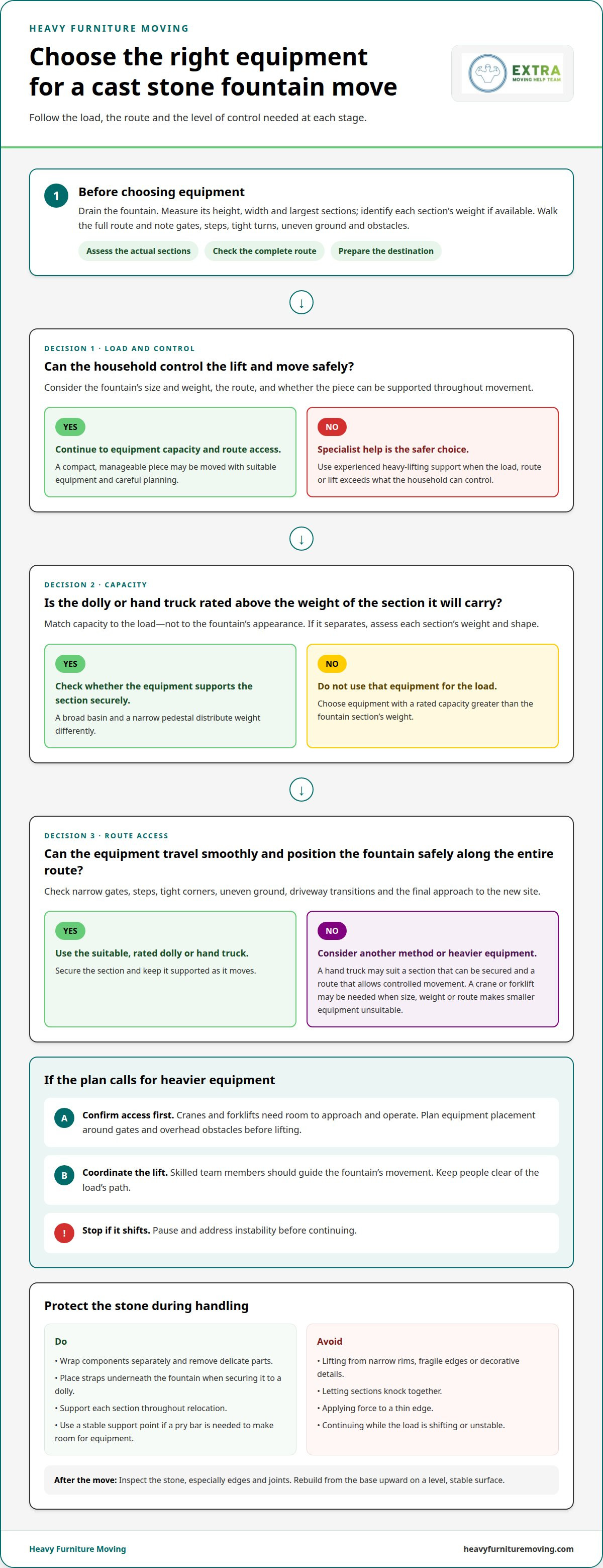
Choose equipment only after matching the fountain’s load to the route and lifting points. A dolly, hand truck, straps, pry bar, crane, or forklift may suit different parts of the move.
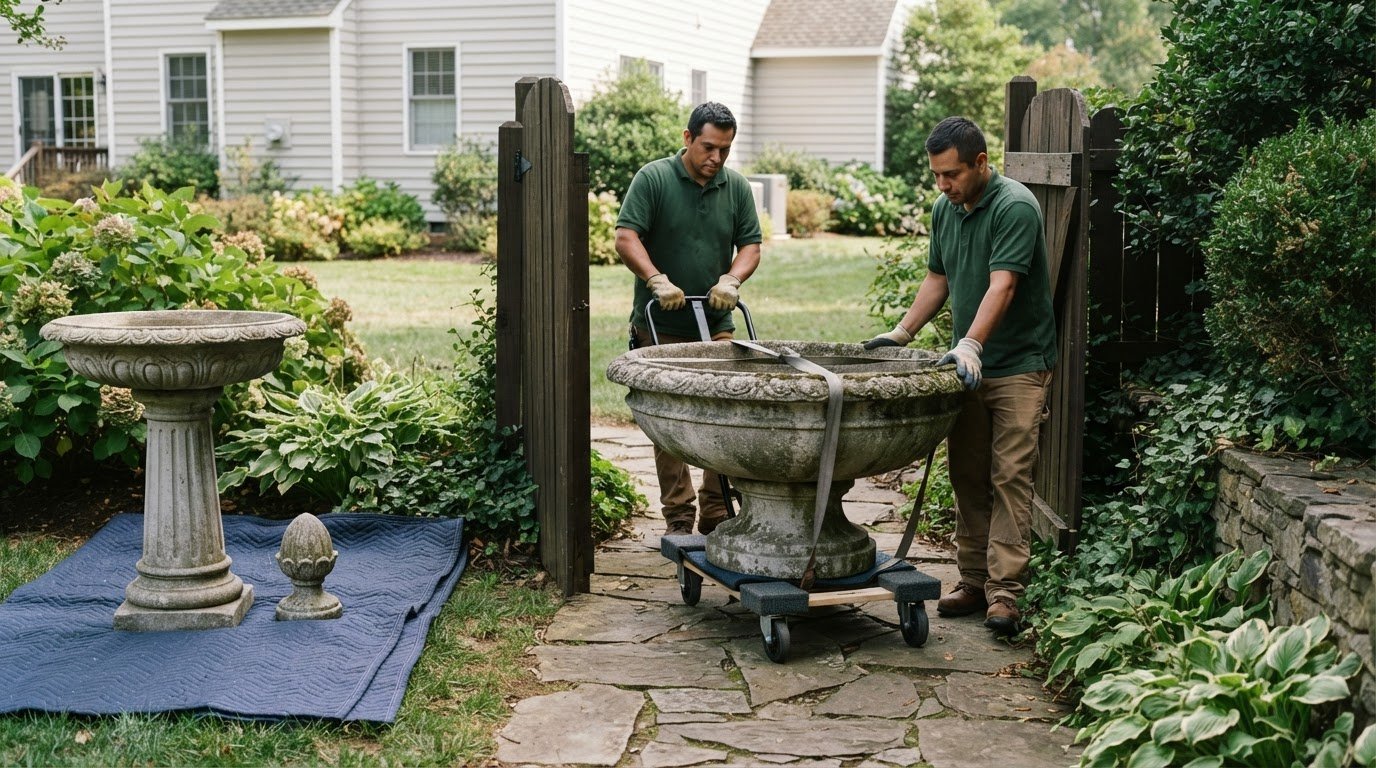
A dolly or hand truck must have a rated capacity greater than the fountain’s weight. Compare its capacity with the load it will carry, not just the fountain’s overall appearance. If the fountain separates into sections, consider each section’s weight and shape. A broad basin and a narrow pedestal distribute weight differently, so the equipment must support each piece securely.
Wheel access matters as much as capacity. A dolly that works on a clear, level path may not pass through a narrow garden gate or turn easily on uneven ground. Check the complete route, including steps, tight corners, driveway transitions, and the final approach to the new site. If wheels cannot travel smoothly or the fountain cannot be positioned safely, a hand truck or heavier lifting equipment may be more suitable.
Straps help secure a fountain to a dolly, but placement matters. Position them underneath the fountain to help prevent damage, clear of fragile rims or decorative details. A pry bar can create room for equipment beneath a section, while controlled lifting keeps the piece supported as it shifts. Don’t apply force to a thin edge. Choose a stable support point instead.
Some fountains call for a crane or forklift because their size, weight, or route makes smaller equipment unsuitable. These machines need room to approach and operate, and their movements should be coordinated by skilled team members guiding the fountain. If the route includes a narrow gate or overhead obstacle, plan equipment placement before lifting. Keep people clear of the load’s path and stop if the fountain shifts.
Can homeowners move a heavy cast stone fountain, or should specialists handle it? A compact, manageable piece may be moved with suitable equipment and careful planning. Larger fountains often need multiple people or equipment. Specialist help is the safer choice when the load, route, or lift exceeds what the household can control.
- Dolly: Use one with a capacity above the fountain’s weight and a platform that supports its shape.
- Hand truck: Consider it when the section can be secured and the route allows controlled movement.
- Crane or forklift: Plan access and coordinated guidance when the fountain’s size or route demands heavy equipment.
For a difficult lift or bulky load, heavy lifting support can help with the physical handling involved. Choose the method that fits the fountain, its route, and the control needed at each stage.
Reassembling and leveling the fountain
Rebuild the fountain from its base upward, then level and adjust each section before adding water. Prepare the new site first: a stable foundation supports the basin and helps tiered bowls spill evenly.
For a medium-to-large fountain without a ground pool, use a concrete foundation, compacted gravel, or paver stone. A concrete patio block or permanent concrete pad can also provide a level surface. If the basin will sit on concrete or pavers, place a 1- to 2-inch layer of sand beneath it. This gives the basin a bed beneath its base while the supporting surface remains level.
Start assembly with the base and work upward. Fit each component securely before placing the next section. Tiered fountains need particular attention: if their bowls sit unevenly, water may spill irregularly rather than flow evenly between tiers. Level the assembled fountain and adjust its position for both appearance and proper function. Don’t force a section into place if it doesn’t fit securely.
Reconnect the pump and water path in their original arrangement. For a pump or lights powered from an outlet, the fountain site requires a grounded 110-volt AC GCFI-protected receptacle nearby. Follow applicable local codes and regulations for installation, and use advice from a licensed electrician for electrical work.
Choose a new location within reach of a garden hose. A nearby hose makes it easier to refill the fountain as water evaporates and rinse the surface. Once assembly is complete, fill the fountain and let the water settle. Check for leaks or irregularities before considering the setup finished.
Use this sequence to catch problems before the fountain runs normally:
- Set the base: Place it on the prepared, level foundation. Check that the surface supports the fountain steadily.
- Build upward: Add each section in order, ensuring it fits securely before continuing.
- Level the assembly: Adjust the fountain so tiered bowls sit evenly and water can spill as intended.
- Reconnect components: Restore the pump and water path, and have electrical work follow applicable codes.
- Test with water: Refill, allow the water to settle, and inspect for leaks or irregularities.
Finally, inspect the cast stone for damage after relocation. A shifted basin, uneven tier, or visible chip needs attention before regular operation. Level checks are especially important for tiered fountains, while a water test can reveal issues that aren’t apparent during dry assembly. Correct the position or fit before relying on the fountain’s flow.
Disassembling and labeling fountain sections
Take a cast-stone fountain apart before lifting or transporting it. A large fountain may separate into a basin, pedestal, and tiers; smaller removable pieces need their own handling plan. Disassembly reduces the chance that connected sections twist, knock together, or transfer force through a joint. It also makes each piece easier to identify during reassembly.
Separate connected components carefully
Start by documenting how the fountain fits together. Photograph it from several angles, including close views of joints, openings, and the direction each tier faces. Add brief notes for details a photo may not show, such as which side faces the garden path. This record gives the reassembly team a practical reference instead of relying on memory.
Separate cast-stone components joined with silicone before lifting or moving them. Work through the connections carefully rather than pulling one section against another. Once a joint separates, handle the pieces individually. Remove fragile components, such as small decorative elements, and wrap them separately to help prevent damage. Keep loose pieces with the section they belong to.
Label each section for reassembly
Use clear labels that identify both the part and its position. For example, name the basin, pedestal, and upper tier, then note their order or facing direction where needed. A useful label answers two questions: what is this piece, and where does it belong? Attach labels to protective wrapping or a parts container, rather than relying on a loose note that could get separated.
Keep removable hardware and small components organized with their matching fountain section. If a part connects a pedestal to a tier, place it with the relevant pieces and label the group. Don’t combine loose items from different joints in one unmarked container. A simple parts list can link each component to a photograph, making the assembly sequence easier to follow.
Protect and organize pieces for transport
Wrap each fragile piece separately so stone surfaces don’t strike one another during handling. Keep the basin, pedestal, and tiers identifiable throughout loading and unloading. Place labels where they remain visible after wrapping, and keep photographs or notes accessible to the people handling the fountain. This makes matching each item easier without repeatedly unwrapping protected sections.
Before the move begins, compare the labeled pieces with the photographs and notes. Confirm that each major section is clearly named and removable parts are grouped with the correct component. This final review can catch a missing label or separated piece before transport makes the original arrangement harder to recognize.
Monitoring stability during the move
Monitor the fountain from the first lift until each section reaches its new position. A piece that starts level can shift when a dolly crosses uneven ground or turns along a tight route. Check its position throughout and address instability before moving farther. Continuing with a shifting load can put unwanted pressure on stone edges and joints.
During a crane or forklift lift, skilled team members should guide the fountain and coordinate each movement. Keep the lift controlled as the piece rises, travels, and lowers. Guides can watch for swinging, tilting, or contact with nearby obstacles, then signal a pause if the load changes position. A clear route helps the crew focus on the fountain instead of unexpected obstructions.
On a dolly, check that the fountain remains centered and secured as it moves. Pay close attention at driveway transitions, slopes, and turns, where the wheels meet different surfaces. If a strap slips or a section begins leaning, stop and correct the setup before continuing. Don’t try to steady a moving load by reaching beneath it or putting your hands near pinch points.
Check stability at each stage of the move, not only at the destination. Before lifting, confirm the section is supported. After raising it, watch for a change in balance. During travel, check for shifting at turns or on uneven ground. Before lowering, align the landing area and guide the piece into position without letting it bump the base or surrounding stone.
- Before the lift: Confirm the fountain section is supported and the path is clear.
- During a crane or forklift move: Coordinate movement with skilled team members guiding the load.
- On a dolly: Watch for leaning, strap movement, or shifting across uneven ground.
- At a turn or transition: Pause if the fountain changes position, then correct the issue before continuing.
- At the landing point: Guide the section down carefully and check its position before releasing support.
These checks matter for every section, including a broad basin and a tall pedestal. A slight shift can change how the load rests on its support or bring it close to a wall, gate, or other obstacle. If movement becomes difficult to control, pause the relocation and reset the support or route. Stability comes before speed.
For a challenging lift or heavy load, arrange heavy lifting moving support to help handle the physical work. Coordinated guidance and careful pauses help keep each fountain section under control as it moves.
Keep monitoring the fountain’s stability throughout the move. If an issue arises, address it before proceeding. Don’t continue while the fountain’s stability is in question.
Heavy Furniture Moving
Heavy Furniture Moving helps with demanding heavy lifts when a bulky item is difficult to handle alone. A cast stone fountain’s weight, separate sections, and access route can make the physical work especially challenging. The team’s heavy lifting moving service can help when the fountain’s load is difficult to control safely. Share details about the fountain and route to explain the work involved. Heavy Furniture Moving also offers Exercise Equipment Moving, Sofa Hoisting, and in-home furniture moving help for other heavy household items. For help with a heavy lift in Centreville, contact Heavy Furniture Moving to discuss your move.
Plan Your Fountain’s Next Move
For a heavy cast stone garden fountain relocation in Centreville, decide how much of the physical work you want handled for you. Consider the lift, the route through your property, and whether you need help with the fountain alone or other bulky household items too. Heavy Furniture Moving offers Movers Near Me, Exercise Equipment Moving, and Sofa Hoisting for different moving needs.
Share the key details of your move, including the fountain’s general size, how it’s accessed, and where it needs to go. That gives the conversation a practical starting point and helps clarify what moving support fits. You don’t need to map out every detail alone before reaching out.
Contact Heavy Furniture Moving to discuss your move and take the next step with a clear plan. A well-planned move can help you look forward to enjoying your fountain in its new place.
Frequently Asked Questions
Which Centreville-area companies move heavy cast stone fountains or landscape statuary?
Heavy Furniture Moving serves Centreville-area customers who need help with heavy household lifting. Its Movers Near Me and heavy lifting moving services suit situations involving bulky items and challenging handling. For a fountain, useful details to share include its material, overall dimensions, whether it comes apart, and the route from the garden to the pickup point. These details help describe the physical work involved.
How much does a cast stone garden fountain weigh, and how can its weight be estimated?
There isn’t one reliable weight for every cast stone fountain; the design and component sizes matter. Look for the maker’s model information or product documentation, then note the weight of the complete fountain or its individual sections. If there’s no identifying information, describe its dimensions and construction when planning the move. Avoid estimating from appearance alone, since similarly sized fountains can have different designs.
What equipment is needed to lift and transport a heavy garden fountain safely?
The right equipment depends on the fountain’s load, shape, and route. A suitably rated dolly or hand truck may work for supported sections, while a crane or forklift may suit a larger lift with adequate access. For example, a narrow garden path may rule out equipment that cannot turn through it. Straps, stable supports, and coordinated guidance help keep each piece controlled during handling.
How should a cast stone fountain be disassembled before relocation?
Drain the fountain and disconnect removable pump or lighting components before separating its stone sections. Keep cords, tubing, and small fittings together with the parts they serve, and note their original connections for setup at the destination. Protect delicate ornaments separately from larger stone pieces. A clear record of component groups can help prevent misplaced fittings and make it easier to restore the fountain’s original arrangement.
What insurance and damage guarantees should a fountain moving contractor provide?
Read the written terms for the specific move. They should explain applicable coverage, exclusions, and how to report damage. Treat verbal assurances separately from the written terms.
Frequently Asked Questions
Heavy Furniture Moving serves Centreville-area customers who need help with heavy household lifting. Its Movers Near Me and heavy lifting moving services suit situations involving bulky items and challenging handling. For a fountain, useful details to share include its material, overall dimensions, whether it comes apart, and the route from the garden to the pickup point. These details help describe the physical work involved.
There isn’t one reliable weight for every cast stone fountain; the design and component sizes matter. Look for the maker’s model information or product documentation, then note the weight of the complete fountain or its individual sections. If there’s no identifying information, describe its dimensions and construction when planning the move. Avoid estimating from appearance alone, since similarly sized fountains can have different designs.
The right equipment depends on the fountain’s load, shape, and route. A suitably rated dolly or hand truck may work for supported sections, while a crane or forklift may suit a larger lift with adequate access. For example, a narrow garden path may rule out equipment that cannot turn through it. Straps, stable supports, and coordinated guidance help keep each piece controlled during handling.
Drain the fountain and disconnect removable pump or lighting components before separating its stone sections. Keep cords, tubing, and small fittings together with the parts they serve, and note their original connections for setup at the destination. Protect delicate ornaments separately from larger stone pieces. A clear record of component groups can help prevent misplaced fittings and make it easier to restore the fountain’s original arrangement.
Read the written terms for the specific move. They should explain applicable coverage, exclusions, and how to report damage. Treat verbal assurances separately from the written terms.