Clifton Local Piano Movers Cost: What Shapes Your Moving Quote?
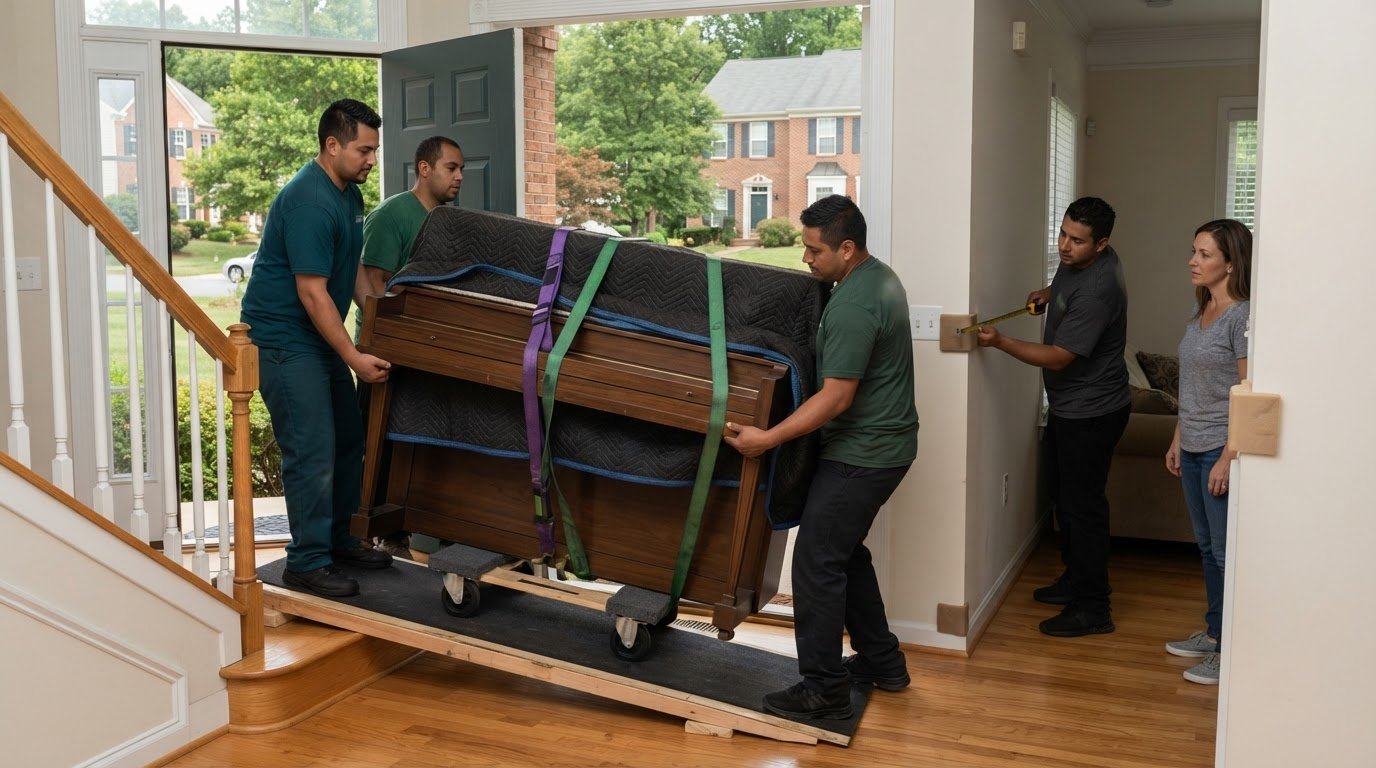
Could two pianos moving across Clifton receive very different quotes for the same distance? Absolutely. Clifton local piano movers cost depends on more than mileage. The piano’s type and size, stairs, tight turns, narrow hallways, and the distance movers must carry it all affect the work involved. If you’re concerned that a difficult entrance could change the scope, raise that detail when arranging the move.
A useful estimate starts with the instrument and access conditions, not a generic price average. To compare options fairly, find out what work each estimate describes. This guide explains the main factors behind a Clifton piano-moving quote and how specialized piano handling fits into the job.
You’ll learn what details to share about the piano, pickup and delivery locations, stairs, and long carries. We’ll also cover how to compare estimates by scope, so you can make a clear plan for your move.
Key Takeaways
- Clifton local piano movers cost depends on the instrument, move details, and service scope, not a generic average.
- Describe the piano separately from access challenges such as stairs, tight turns, and long carries.
- Compare estimates using the same pickup, destination, access notes, and requested work, not just the total.
- Gather details about your piano and both locations before requesting an estimate.
- Heavy Furniture Moving provides specialized piano handling for Clifton residents moving heavy household items.
What Shapes the Cost of Local Piano Movers in Clifton?
Piano moves aren’t interchangeable. A short trip with straightforward entryways calls for a different plan than a move involving a grand piano, stairs, or a tight turn. A generic price figure can mislead because it doesn’t describe the instrument, the route through either property, or the work included. Clifton local piano movers cost is shaped by the details of your move, not the city name alone.
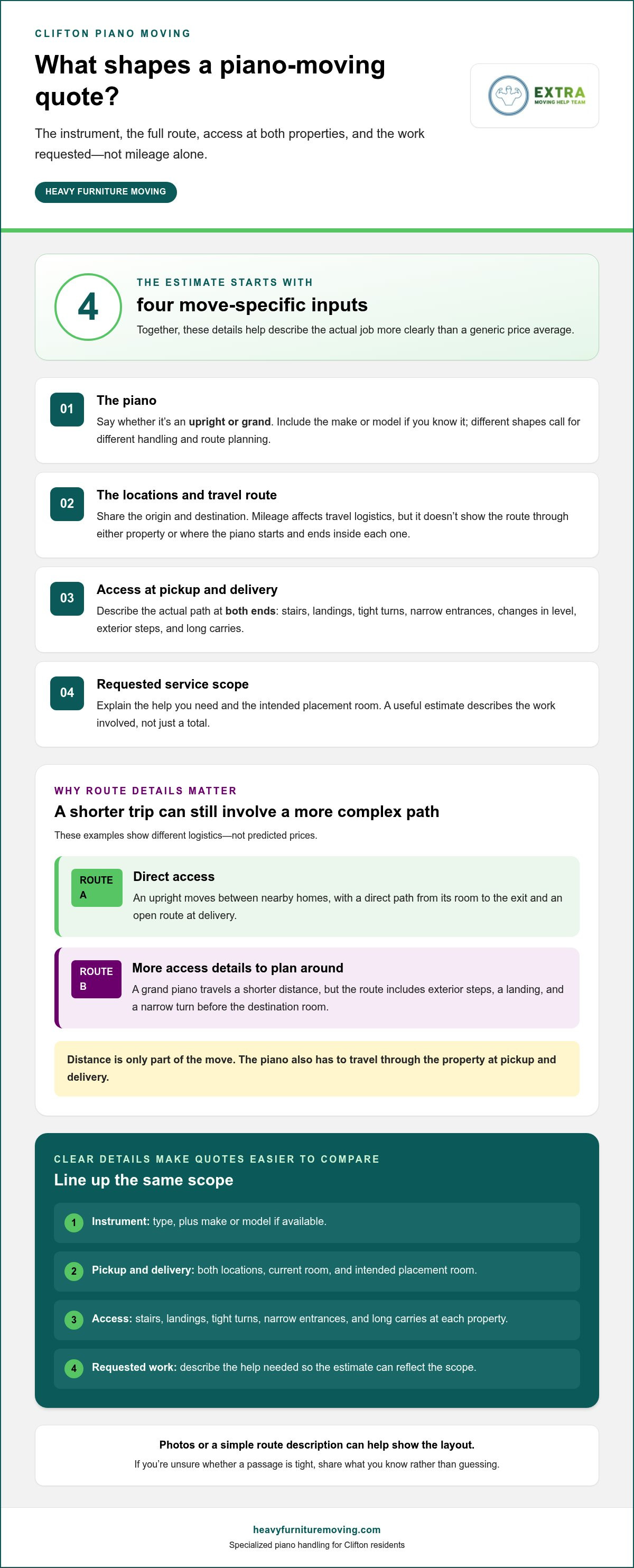
Movers need a clear picture of four things: the piano, the pickup and delivery locations, access at both ends, and the requested service scope. The route between addresses and the layout of each property help define the logistics. A quote based on those details is more useful than one based on location alone.
How piano type and move distance influence the work
An upright and a grand piano call for different handling and planning. Their shapes and construction affect how movers assess the instrument and plan its route through the home. For general background on how these designs differ, see Types of Pianos and Their Construction. Share the piano’s type, and include its make or model if you know it.
Distance matters, but mileage doesn’t tell the whole story. The route between addresses affects travel logistics, while the route inside each property determines how the piano can move from its current room to the destination room. A local move may still require careful planning at both ends. Describe the origin and destination, along with where the piano is now and where it needs to go.
Why Clifton property access belongs in the estimate
Access can change the work involved. Include stairs, landings, narrow turns, entryways, and long carries in your description. Conditions vary from one property to another, so don’t assume that a neighborhood or building type explains the whole route. Describe the actual path the piano must take.
Be specific. Note how many stair sections the route includes, where a landing or tight turn appears, and whether the piano must travel a long distance from the entrance to the room. Photos or a simple route description can help show the layout. If you’re unsure whether a passage is tight, share what you know rather than guessing.
Key cost factors include piano type, the route between addresses, property access at pickup and delivery, and the requested service scope. Clear details help movers assess the actual job and describe the work involved. Before requesting an estimate, gather the piano’s type, both locations, access notes for each property, and a plain description of the help you need. This gives your Clifton piano move a practical starting point without relying on a broad average.
How Piano Type, Stairs, and Route Change a Clifton Moving Quote
A piano move depends on both the instrument and the complete path from its current spot to its final placement. An estimate that accounts for the piano but overlooks a staircase or narrow entrance may miss part of the job. Clifton local piano movers cost depends on how these details combine, not on one factor in isolation.
Upright and grand piano moves are not identical
An upright and a grand have different shapes, so the space each needs along the route can differ. The piano’s design influences how movers plan its movement through rooms and doorways. Share the type, and provide the make or model if you know it. Don’t assume two pianos need the same approach just because they’re going to the same address.
Stairs, turns, and the path through the property
Map the full route at both ends, from the piano’s current room to its intended placement. Include flights of stairs, landings, tight turns, changes in level, exterior steps, narrow entrances, and any long carry. The final room matters, too. Photos or a walkthrough can help show how these features connect and where the route may be confined.
Access can matter as much as distance because the piano must travel through the property, not just between addresses. Mileage describes only part of the move. A clear route with simple entry at both locations presents different logistics from a shorter trip that includes stairs, a tight turn, or a difficult final approach. Share what you can see, even if you’re unsure which detail matters most.
Consider two Clifton moves. In the first, an upright piano travels between nearby homes with a direct path from its room to the exit and an open route at delivery. In the second, a grand piano travels a shorter distance, but the route includes exterior steps, a landing, and a narrow turn before reaching its destination room. The second trip may need a different plan despite covering less ground. This comparison doesn’t predict a price. It shows why the route and instrument should be considered together.
Keep the estimate details focused and practical:
- Instrument: Upright or grand, plus the make or model if available.
- Pickup: Current room, exit route, and any changes in level.
- Delivery: Entry route and the room where the piano will be placed.
- Access: Stairs, landings, tight turns, narrow entrances, and long carries.
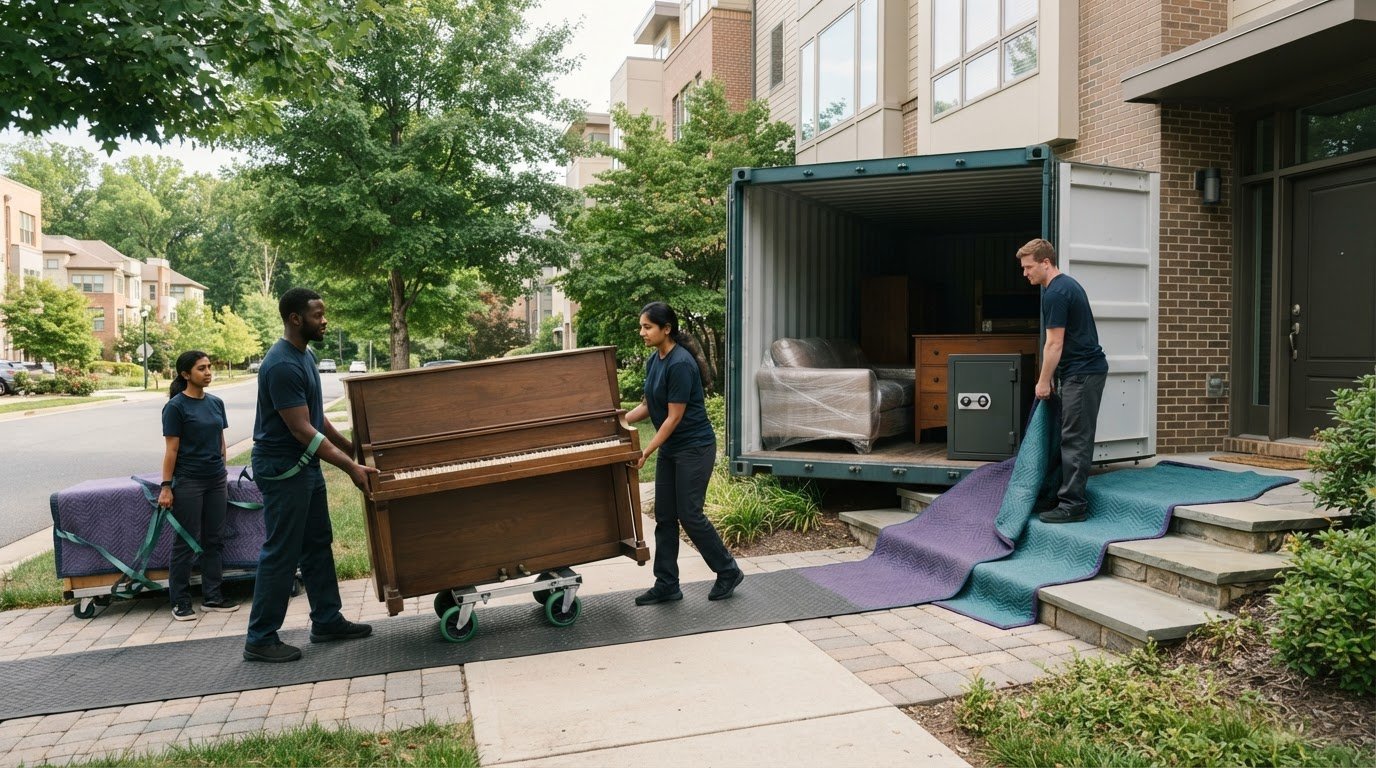
Heavy Furniture Moving handles pianos as part of its specialized heavy-item moving service for Clifton residents. Share the instrument and access details to describe the move clearly, then explore piano-moving help in Clifton.
Compare Clifton Piano-Moving Quotes by Scope, Not Just the Total
A total alone doesn’t show whether two estimates cover the same work. One might describe the piano and both locations clearly, while another leaves access details or the placement plan vague. To compare Clifton local piano movers cost fairly, line up the move details first. Different totals don’t automatically mean one quote is wrong. They may reflect different information or scopes.
What a clear piano-moving estimate should describe
Use the same checklist for each estimate. Record the instrument, pickup and delivery locations, access conditions at both ends, and the requested service scope. Note what each estimate explicitly includes, and keep that separate from anything you’re assuming. Consistent notes make it easier to see whether the estimates describe the same move.
| Comparison detail | What to record |
|---|---|
| Instrument | Piano type and any identifying details you know |
| Origin | Pickup address or location and the piano’s starting room |
| Destination | Delivery address or location and the intended placement area |
| Access notes | Stairs, landings, narrow turns, long carries, and entry conditions |
| Stated scope | Work the estimate describes, plus details left unstated |
Fill in each row for every estimate. If one description includes stairs at pickup but another only describes a ground-level entrance, the estimates aren’t based on the same access information. Likewise, “move piano” may leave questions about where it starts and where it should be placed. Missing details don’t prove an estimate is misleading, but they make a direct comparison harder.
How to spot an incomplete quote comparison
Look for differences in the route, access notes, and stated work. Check that each estimate refers to the same piano, the same origin and destination, and the same intended placement. If a phrase such as “standard move” doesn’t explain the work it covers, mark it as unclear rather than filling the gap with an assumption.
Before weighing the totals, resolve mismatches in your notes. Make sure both descriptions account for known stairs, tight turns, or long carries, and identify what each scope actually says. If an estimate leaves a detail open, treat it as an unanswered question, not proof that the price is unfair. A like-for-like comparison gives you a steadier basis for deciding.
Heavy Furniture Moving provides specialized piano handling for Clifton residents. Review Heavy Furniture Moving’s piano-moving service as you consider the details and scope of your move.
Prepare for a Clifton Piano-Moving Estimate: Details to Gather
A clear estimate starts with a clear description of the move. Gather details about the piano, its current location, the destination, and the path through both properties. Accurate information helps movers understand the work before moving day and gives you a consistent record if you’re comparing estimates.
Record the piano and destination details
Identify whether the instrument is an upright or grand, and note its make or model if you know it. Write down the pickup and delivery locations, including the room or floor at each end. Then trace the route from the piano’s current spot to its intended placement, noting stairs, narrow passages, tight turns, and other access limits.
Share access information clearly
Describe exterior steps, entryways, and the distance from a likely loading point to the entrance, if known. An address alone doesn’t explain access. Current photos can clarify a tight doorway, landing, or change in level. Keep questions about the requested service scope together so the estimate reflects the move details you’ve recorded.
Use this sequence to prepare your request:
- Identify the piano. Record its type and any make or model details you have.
- Write down both locations. Note the pickup and delivery addresses or locations, plus the piano’s room or floor at each end.
- Trace the indoor route. List stairs, landings, narrow passages, tight turns, and changes in level from the starting point to final placement.
- Describe exterior access. Note entry steps, doorway conditions, the approximate carry from a likely loading point, and any known access limitations. Avoid guessing about road, parking, or building rules.
- Clarify the requested work. Describe where the piano should be picked up and placed, and write down any questions about what the estimate covers.
- Add helpful photos. Share current images of access points or route sections that are hard to explain in words.
Keep the details consistent. If the piano is on an upper floor at pickup but will be placed on the main floor at delivery, say so directly. If you don’t know a measurement or model, mark it as unknown rather than estimating. This helps avoid confusion and gives movers a clearer picture of the Clifton move.
Quick checklist:
- Piano type and make or model, if known
- Pickup and delivery locations, rooms, and floors
- Stairs, turns, narrow entries, and exterior access
- Carry distance and final placement details
- Current photos and questions about service scope
With these details in hand, Clifton local piano movers cost can be discussed in relation to the actual job rather than a vague description. Request a Clifton piano-moving estimate with your piano and access details ready.
Plan Your Clifton Piano Move with Heavy Furniture Moving
A clear picture of the move helps put quote factors in context. Heavy Furniture Moving provides residential moving support and specialized handling for pianos and other heavy household items, including moves in Clifton. Share the piano type, its destination, and the route at both properties. These details help describe the work without relying on assumptions.
What to include when requesting help with a Clifton piano move
Start with the instrument and the two locations. Include the piano type, pickup and delivery addresses, and the room or floor at each end. Then describe the route through each property. Mention stairs, tight turns, narrow entryways, long carries, and the intended placement spot. Include your preferred moving date or timing if you have one.
Keep the description practical. For example, say that the piano is upstairs at pickup and needs to go into a ground-floor room at delivery. If a turn near an entryway looks especially narrow, point it out. Photos can help explain details that are difficult to put into words. You don’t need to guess at measurements or technical terms. Share what you know and mark anything you’re unsure about.
Before requesting help, gather these details:
- Piano: Upright or grand, with make or model if known.
- Locations: Pickup and delivery addresses, rooms, and floors.
- Access: Stairs, landings, tight turns, narrow entrances, and long carries.
- Placement: The room or area where the piano should end up.
- Timing: Your preferred moving date or timing.
A local moving team for heavy household items
Piano moving calls for attention to both the instrument and the route through the home. Heavy Furniture Moving’s piano service is part of its residential focus on heavy and difficult-to-move household items. For a Clifton move, sharing access conditions upfront helps describe the job and gives the estimate a useful starting point. It also keeps the request focused on the pickup, destination, and placement you have in mind.
Clifton local piano movers cost depends on the specific move details, so lead with those rather than a broad description. Include the piano type, pickup and delivery locations, stairs or tight turns, placement needs, and preferred timing. A straightforward request brings the important details together without promising a particular price or outcome.
Ready to plan your move? Request help with your piano move and share the details of your Clifton pickup, destination, and access conditions.
Take the Next Step Toward a Well-Planned Piano Move
Your piano move doesn’t have to begin with guesswork. Treat the estimate request as a planning checkpoint: use it to describe the instrument, route, and intended placement clearly. Getting organized can also help you plan around the piano’s arrival and prepare the space where it will go.
Approach Clifton local piano movers cost with practical expectations: a useful estimate reflects the move you need, not a generic scenario. You don’t need every detail figured out before getting started. Share what you know, describe any concerns, and plan one step at a time.
Heavy Furniture Moving supports Clifton residents with specialized piano handling as part of its residential moving work for heavy household items. Request help with your Clifton piano move and take the next step toward getting it underway.
Frequently Asked Questions
How much do local piano movers cost in Clifton?
There isn’t one fixed price that fits every Clifton piano move. The Clifton local piano movers cost depends on the instrument, locations, access conditions, and requested work. Heavy Furniture Moving provides specialized piano handling as part of its residential heavy-item moving services. Share the move details to get an estimate based on your particular job rather than relying on a broad online average that may describe a different situation.
What information do piano movers need to estimate a move?
Give a clear description of the instrument, pickup and delivery locations, and intended placement room. Include details that could affect the route, such as stairs, a narrow doorway, or a long distance from the entrance to the piano’s room. Your preferred move date can help frame the request, too. If a detail is uncertain, say so instead of guessing, so the estimate is based on accurate information.
Do piano movers charge more for stairs?
Stairs can affect the work involved and may affect the estimate, but they don’t automatically mean the same added charge for every move. A short set of exterior steps differs from a route with multiple stair sections and landings. Describe where the stairs are, whether they’re at pickup or delivery, and how they fit into the piano’s path. That gives the move a more accurate access description.
Does piano type affect a moving estimate?
Yes. An upright and a grand have different shapes, which can influence how movers plan the route and handle the instrument. Identify the type when you request an estimate, and include the make or model if you know it. If you’re not sure what kind of piano you have, a clear photo can help describe it. Don’t assume a particular model requires a specific service or preparation.
Should I send photos when requesting a piano-moving quote?
Photos can help explain details that are difficult to describe, especially a tight entrance, staircase, landing, or turn. Take clear, current images of relevant areas at both locations, with enough context to show how each space connects to the route. A photo adds useful context, but it doesn’t replace written details about the piano’s starting room, destination, or access limitations.
Can the quote change if the access details are different on moving day?
The scope may need to be reassessed if the actual route or access differs from what the estimate describes. For example, an unmentioned staircase or a blocked entrance could change the work involved. Share known constraints early, then flag any changes before the move if you can. Accurate details help align the estimate with the job, while the final scope depends on the conditions and requested work.
When should I request a quote for moving a piano in Clifton?
Request an estimate once you know the likely pickup and delivery locations and have a preferred moving date. That gives you time to collect useful details, review the requested scope, and plan around the piano’s destination. If your date or address changes, update the move information so the request stays relevant. Heavy Furniture Moving serves Clifton with residential support for pianos and other heavy household items.
Frequently Asked Questions
There isn’t one fixed price that fits every Clifton piano move. The Clifton local piano movers cost depends on the instrument, locations, access conditions, and requested work. Heavy Furniture Moving provides specialized piano handling as part of its residential heavy-item moving services. Share the move details to get an estimate based on your particular job rather than relying on a broad online average that may describe a different situation.
Give a clear description of the instrument, pickup and delivery locations, and intended placement room. Include details that could affect the route, such as stairs, a narrow doorway, or a long distance from the entrance to the piano’s room. Your preferred move date can help frame the request, too. If a detail is uncertain, say so instead of guessing, so the estimate is based on accurate information.
Stairs can affect the work involved and may affect the estimate, but they don’t automatically mean the same added charge for every move. A short set of exterior steps differs from a route with multiple stair sections and landings. Describe where the stairs are, whether they’re at pickup or delivery, and how they fit into the piano’s path. That gives the move a more accurate access description.
Yes. An upright and a grand have different shapes, which can influence how movers plan the route and handle the instrument. Identify the type when you request an estimate, and include the make or model if you know it. If you’re not sure what kind of piano you have, a clear photo can help describe it. Don’t assume a particular model requires a specific service or preparation.
Photos can help explain details that are difficult to describe, especially a tight entrance, staircase, landing, or turn. Take clear, current images of relevant areas at both locations, with enough context to show how each space connects to the route. A photo adds useful context, but it doesn’t replace written details about the piano’s starting room, destination, or access limitations.
The scope may need to be reassessed if the actual route or access differs from what the estimate describes. For example, an unmentioned staircase or a blocked entrance could change the work involved. Share known constraints early, then flag any changes before the move if you can. Accurate details help align the estimate with the job, while the final scope depends on the conditions and requested work.
Request an estimate once you know the likely pickup and delivery locations and have a preferred moving date. That gives you time to collect useful details, review the requested scope, and plan around the piano’s destination. If your date or address changes, update the move information so the request stays relevant. Heavy Furniture Moving serves Clifton with residential support for pianos and other heavy household items.