
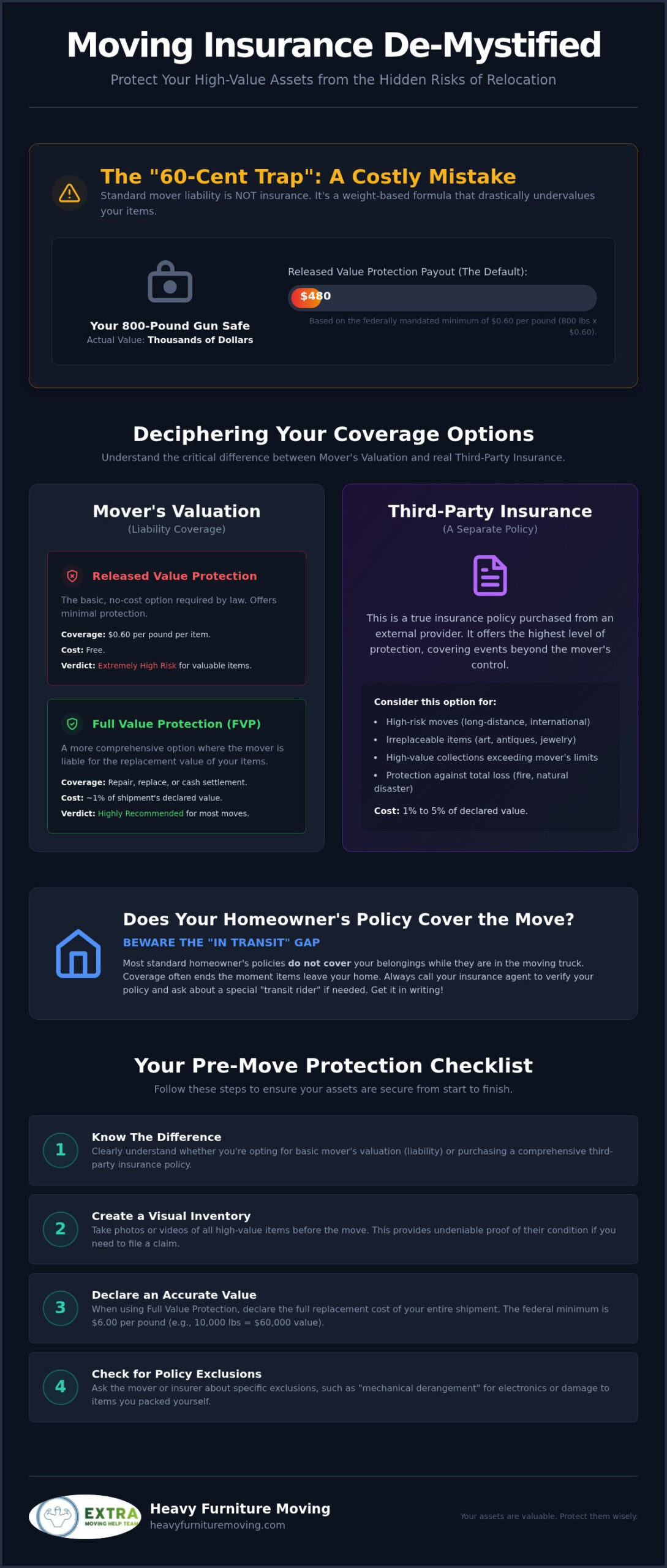
If your 800-pound gun safe slips off the ramp and shatters, do you know exactly how much your mover is legally required to pay you? For most people, the answer is a measly $480. That is the brutal reality of the 60-cent-per-pound rule. It is a financial trap for anyone moving heavy, high-value assets. You’ve spent years investing in quality furniture and specialized equipment. It is natural to feel anxious about those items surviving the trip. When it comes to moving insurance what you need to know is that standard liability protection rarely covers the true replacement cost of your gear.
We understand the sweat and care it takes to own these items. This guide breaks down the critical differences between moving valuation and actual insurance so you can protect your pianos, safes, and sofas with total confidence. You will get a clear checklist for filing claims and a breakdown of specific coverage options for 2026. You deserve peace of mind while we handle the heavy lifting. Let’s make sure your assets are protected from the moment they leave your floor until they are safely set in your new home.
Key Takeaways
- Avoid the “60-cent trap” by learning the critical difference between standard mover valuation and actual third-party insurance policies.
- Discover moving insurance what you need to know to protect high-value items like pianos and safes that exceed standard liability limits.
- Master the visual inventory process to ensure your claim is undeniable if an accident happens during transit.
- Identify specific policy exclusions like “mechanical derangement” that could leave your home gym or electronic equipment unprotected.
- Leverage local expertise to navigate the unique logistical and insurance challenges of moving heavy assets in Northern Virginia homes.
The Reality of Moving Insurance: Why Basic Liability Often Fails
Most homeowners assume their movers are fully insured for any accident. That is a dangerous mistake. Technically, what moving companies provide is not insurance at all; it is valuation. Valuation is simply the level of liability a mover is willing to accept for your belongings. Professional Relocation services are regulated by federal and state laws, which dictate the bare minimum a company must pay if something breaks. In Virginia, these rules differ slightly depending on whether you are moving across Fairfax or across state lines. Understanding these legal minimums is the first step in protecting your home.
The biggest risk you face is the 60-Cent Trap. Federal law requires interstate movers to offer Released Value Protection for free, but it only covers $0.60 per pound per item. Imagine your 100-pound 4K TV falls off a ramp. Under this rule, the mover only owes you $60. For high-value, heavy items like gun safes or designer armoires, this coverage is practically worthless. When researching moving insurance what you need to know is that weight does not equal value. Heavy furniture also carries a double risk. A dropped safe doesn’t just break itself; it can crush hardwood floors or punch holes in drywall. Standard valuation rarely accounts for the massive cost of home repairs.
Released Value vs. Full Value Protection
Released Value is the “free” option, but it offers almost no protection for modern electronics or antiques. Full Value Protection (FVP) is the industry standard for a reason. With FVP, if an item is lost or damaged while in the mover’s care, the company must either repair the item, replace it with a similar one, or offer a cash settlement for the current market value. It’s a proactive way to ensure your $5,000 piano isn’t treated like a $400 piece of scrap metal based on its weight alone. Always check the “Replacement” clause to see how your mover handles high-value inventory.
Does Your Homeowners Policy Cover the Move?
Don’t assume your current home insurance has your back. Most standard policies have an “In Transit” gap. This means your coverage often stops the moment your furniture crosses the front door. Call your agent before moving day. Ask if they cover “all-risk” or only “named perils” like fire or theft. Most policies won’t cover a dropped box or a scratched table. If your policy is limited, you might need a separate transit rider to bridge the gap while your life is loaded onto a truck. Get these answers in writing before the first box is packed.
Deciphering Your Coverage Options: Valuation vs. Third-Party Insurance
Pick your protection based on the actual value of your life’s work. Carrier liability is the standard path. Under federal law, the minimum for Full Value Protection is $6.00 per pound. If your total shipment weighs 10,000 pounds, your “Lump Sum” value is $60,000. You must declare this total worth before the first box is lifted. If your belongings are worth more, speak up. Part of moving insurance what you need to know is that you can always declare a higher value to match your actual replacement costs. This ensures you aren’t left short if a major loss occurs.
Deductibles work just like your car insurance. You can choose a zero-deductible plan for maximum coverage or a higher deductible to lower your upfront premium. If you have a tight budget, a $500 deductible might make sense. If you are moving a $20,000 grand piano, paying a bit more upfront for a zero-deductible plan is often the smarter move. It removes the stress of unexpected out-of-pocket costs during an already expensive transition.
When to Choose Third-Party Moving Insurance
Third-party insurance is a separate policy you buy from an outside provider like MovingInsurance.com. It is actual insurance, not just a liability limit. Consider this for:
- High-risk moves: Long-distance or international trips with more “touch points” where damage can occur.
- High-value collections: When your jewelry, art, or rare collectibles exceed the mover’s maximum liability.
- Total loss protection: Coverage for natural disasters, fires, or truck accidents that might fall outside a mover’s standard responsibility.
The Cost of Peace of Mind
Protecting your assets in 2026 comes with a predictable price tag. Full Value Protection typically costs around 1% of your shipment’s total estimated value. For a $60,000 shipment, expect to pay about $600. Third-party premiums are more varied, usually ranging from 1% to 5% of the declared value. Specialized items like safes or pianos can increase these rates because they require more labor and specialized rigging. When you need expert furniture moving services, these costs are a small price for total security. We prioritize safety above all else, but having the right paper trail ensures you are protected if the unthinkable happens.
Protecting High-Value Assets: Pianos, Safes, and Home Gyms
Heavy furniture requires more than just muscle; it requires a strategy for internal protection. If an item is worth more than $100 per pound, federal guidelines classify it as an “Item of Extraordinary Value.” Understanding moving insurance what you need to know starts with identifying these prized possessions. A 500-pound safe valued at $10,000 far exceeds the standard liability limits. If you don’t declare these items specifically, you might only receive a fraction of their worth after an accident. We treat these pieces as the centerpieces of your move, ensuring the paperwork matches the physical care we provide.
Safe and vault moving presents unique risks to your home’s structure. These items are concentrated weight. Moving a 1,000-pound safe across a hardwood floor without reinforcement can cause thousands in property damage. Standard valuation often ignores the specialized rigging and floor protection needed for these tasks. Similarly, piano moving isn’t just about protecting the wood finish. A piano has thousands of delicate internal parts. A warped soundboard or a snapped string can ruin the instrument’s soul. We focus on the internal mechanisms just as much as the exterior shine.
Exercise equipment moving adds another layer of complexity. Modern treadmills and smart gyms are essentially high-end computers wrapped in heavy steel. The risk often lies in the disassembly and reassembly process. If a cable is pinched or a screen is cracked during setup, you need to know your coverage includes mechanical issues, not just cosmetic scratches. Always verify that your policy covers “mechanical derangement” for any electronics-heavy fitness gear.
The High-Value Inventory Form
To secure Full Value Protection, you must fill out a High-Value Inventory Form. This is where you list jewelry, antiques, and high-end electronics that exceed the $100 per pound threshold. Be specific. List the make, model, and condition of every item. For rare furniture or family heirlooms, get a professional appraisal before moving day. This document is your strongest weapon if you ever need to file a claim. It removes the guesswork and ensures you are compensated for the true replacement cost, not a generic estimate.
Sofa Hoisting and Unique Liability
Sometimes, the stairs in a Fairfax townhouse are just too narrow for a designer sectional. In these cases, we utilize sofa hoisting to move items through windows or over balconies. This specialized technique requires heavy-duty rigging and a high level of physical coordination. Because hoisting involves moving items through the air, it often requires specific insurance riders. Heavy Furniture Moving manages these high-risk maneuvers with expert care, but we always encourage clients to double-check that their policy covers “external transit” risks. It is the best way to ensure your oversized furniture is protected from every angle.
The Moving Insurance Checklist: How to Secure Your Shipment
Take control of your move before the truck even arrives. A visual inventory is your best defense. Grab your phone and take high-resolution, time-stamped photos of every heavy item from multiple angles. Focus on the corners of your gun safe, the legs of your piano, and the surfaces of your exercise equipment. If there is a scratch later, you need proof it wasn’t there before. When it comes to moving insurance what you need to know is that clear documentation is the only language claims adjusters speak.
Read the fine print for phrases like “mechanical derangement.” This exclusion means if your treadmill’s internal computer stops working but there is no external dent, the mover might not be liable. Also look for “sets and pairs” clauses. If one chair in a matched set of four is destroyed, some policies only pay for that one chair. They won’t cover the loss of value for the entire set. Understanding these technical nuances helps you decide if you need a higher level of coverage for your specific assets.
The packing factor is another major hurdle for insurance claims. If you choose “Packed by Owner” (PBO), most movers will not cover internal damage. They cannot verify how well you cushioned that heirloom. If you want full protection for fragile or complex items, let the pros handle the packing and unpacking. Finally, verify the mover’s DOT number. A legitimate company will proudly display this license on their website and trucks. This proves they are legally authorized to offer valuation and follow federal safety standards.
How to File a Claim (And Actually Get Paid)
If something goes wrong, act fast. You have a nine-month federal window to file a claim for interstate moves, but local Virginia moves often require much tighter reporting. Don’t wait until you’ve fully unpacked every box. Document the damage immediately with fresh photos and keep the item in its damaged state for inspection. Gather your original receipts and get professional repair estimates. A claims adjuster will review this evidence to determine your payout. Clear proof makes their job easier and your payout faster.
Common Exclusions to Watch For
Be aware of what is left out of a standard agreement. Moving valuation usually ends the moment items enter a long-term storage facility. At that point, you need separate storage insurance to stay protected. Movers also won’t touch hazardous materials for safety reasons. Don’t pack chemicals, fuel, or ammunition; they are safety risks and are never insured. Finally, “Acts of God” like a sudden Northern Virginia derecho or flash flood are typically excluded. Your mover is responsible for their handling and equipment, not the unpredictable weather.
Moving with Confidence in Northern Virginia: The Veteran-Owned Difference
Navigating the tight hallways of a Fairfax townhome or the steep basement stairs of a Manassas Park split-level requires more than just muscle. It takes local expertise. We understand the architectural quirks of Northern Virginia homes because we live and work here every day. When you hire general labor, you risk a mover who doesn’t respect the physics of a 600-pound safe on a narrow landing. That is how accidents happen and claims begin. Part of moving insurance what you need to know is that your best insurance is actually prevention. Our team uses professional-grade dollies, custom ramps, and specialized hoisting gear to ensure your heavy assets never touch a doorframe or a hardwood floor.
As a Veteran-family owned business, we built our reputation on integrity and transparent service. We don’t hide behind corporate jargon or complex liability waivers. Instead, we offer a neighborly approach that prioritizes your peace of mind. We explain your coverage options in plain English before the first item is lifted. Our physical power is matched by our emotional intelligence. We know that a family piano or a heavy gun safe represents a significant investment and often carries deep sentimental value. We treat your property with the same discipline and care we would use for our own equipment.
Serving Fairfax, Manassas, and Beyond
Our commitment to the Northern Virginia community runs deep. Whether you are moving a home gym in Ashburn or need sofa hoisting for a designer sectional in a Woodbridge apartment, we understand the local logistics. We know which neighborhoods have difficult parking for large trucks and which buildings require specific insurance certificates for their elevators. This local knowledge allows us to plan every detail of your move, reducing the risk of delays or damage. If you want a mover who understands the specific transit risks of the I-66 corridor and the local regulations of Fairfax County, you are in the right place. Reach out to us for a transparent, fully insured quote that covers every pound of your shipment.
Ready for a Stress-Free Move?
Hiring experts who specialize in heavy items removes the physical and financial weight from your shoulders. You don’t have to worry about the “60-cent trap” or the logistics of a 1,000-pound vault when you have a capable protector on your side. We handle the heavy lifting, the specialized rigging, and the liability management so you can focus on settling into your new home. Experience the relief of working with a team that values hardworking dedication and tangible results. Get your free specialized moving quote today!
Take Control of Your Move Today
Your heavy assets represent years of hard work and investment. Don’t leave their safety to chance or a generic 60-cent-per-pound liability rule. By understanding the critical gap between basic valuation and full protection, you can move with total confidence. When it comes to moving insurance what you need to know is that preparation is your best defense. Create your visual inventory, list your extraordinary items, and verify your mover’s credentials before the first box is lifted.
As a Veteran-family owned and operated team, we take pride in being the capable protectors of your pianos, safes, and gym equipment. We specialize in navigating the tight spaces of Northern Virginia with expert sofa hoisting and specialized rigging gear. You deserve a moving experience that is defined by reliability and ease, not anxiety. Let us handle the heavy lifting and the technical logistics while you focus on your next chapter.
Get a Free Quote for Your Heavy Item Move and see the difference that local expertise makes for your peace of mind. We are ready to move your world with the care it deserves.
Frequently Asked Questions
Does my homeowners insurance cover my move in Virginia?
Standard homeowners policies rarely cover items once they leave your property. Your Virginia policy might cover theft from a truck, but it won’t pay for a dropped safe or a scratched piano. Call your insurance agent to ask about “in-transit” riders. Without this specific addition, you are likely unprotected the moment your furniture crosses the threshold of your new Fairfax home.
What is the difference between moving insurance and valuation?
Valuation is the level of liability a mover accepts, while insurance is a policy sold by a third party. Understanding moving insurance what you need to know means recognizing that valuation is regulated by federal law. Insurance offers broader coverage for accidents that aren’t the mover’s fault. Pick the one that matches the total replacement cost of your life’s work.
How much does full value protection cost for a heavy safe?
Most companies base the cost on the total value of your entire shipment. You can expect to pay roughly 1% of the declared value for Full Value Protection. If your total inventory, including the safe, is valued at $50,000, your protection cost would be about $500. This ensures your heavy vault is covered for its actual worth, not just its weight.
Can I buy moving insurance if I am moving myself with a rental truck?
You can definitely buy third-party transit insurance for a DIY move. Rental truck companies usually offer coverage for the vehicle and the driver, but your furniture is often left out. External providers sell policies that protect your goods while they are in the back of a rental. This is vital for heavy items that might shift or sustain damage during a self-move.
What happens if my movers drop a piano during a sofa hoisting service?
If you have Full Value Protection, the mover is responsible for the repair or replacement of the instrument. Specialized tasks like sofa hoisting require extreme precision and physical strength. If an accident occurs during this high-risk maneuver, the mover must settle the claim based on the piano’s market value. Make sure you have documented the piano’s condition with photos before the hoist begins.
Are there items that moving insurance will not cover?
Movers will not insure hazardous materials like ammunition, propane tanks, or cleaning chemicals. They also typically exclude “mechanical derangement” for electronics. This means if your treadmill’s computer fails without a dent on the frame, it might not be covered. Items you pack yourself are also rarely covered for internal damage because the mover didn’t oversee the packing process.
How long do I have to file a claim after my move is complete?
You have nine months to file a claim for an interstate move under federal law. For local moves within Virginia, the window is often much shorter. Check your specific contract for these deadlines. We recommend inspecting your heavy furniture and exercise equipment immediately upon delivery. Reporting damage the same day makes the claims process much smoother for everyone involved.
Is it worth getting third-party insurance for a local move in Fairfax?
Third-party insurance is worth it if your items are worth more than the mover’s maximum liability. For a local Fairfax move, the trip is short, but the risk of a dropped item remains the same. If you own high-value collections or specialized equipment, the extra premium provides total peace of mind. It ensures your assets are protected against every possible scenario, including truck fires or major accidents.