Window Hoisting for Large Furniture in Haymarket, VA: What to Expect
Could the safest route for an oversized sofa be through a window, not up the stairs? When interior doors, tight turns, or stairways block the way, window hoisting for large furniture Haymarket homeowners need may be a practical option. Start by assessing access, not by trying to lift the item.
It’s natural to worry about valuable furniture, your walls, and the exterior of your home. A careful plan accounts for the item, the opening, and the space outside before the move begins. Heavy Furniture Moving provides sofa hoisting in Haymarket, with specialized handling for bulky items that can’t take the usual route.
This article explains when hoisting may make sense, what details help the crew assess the job, and how to prepare the window and surrounding area. Knowing what to consider can help you arrange professional help and make an informed decision about moving your furniture.
Key Takeaways
- Consider window hoisting when tight stairs, narrow turns, or small doorways block the usual route.
- A sound plan for window hoisting for large furniture Haymarket homes depends on the item, the opening, and the path to its destination.
- Compare stairs, suitable disassembly, and exterior access before choosing how to move a bulky piece.
- Prepare by sharing item details, describing the access route, clearing the work area, and deciding where the furniture will go.
- Heavy Furniture Moving’s sofa-hoisting service can help with difficult furniture access in Haymarket.
When window hoisting for large furniture makes sense in Haymarket
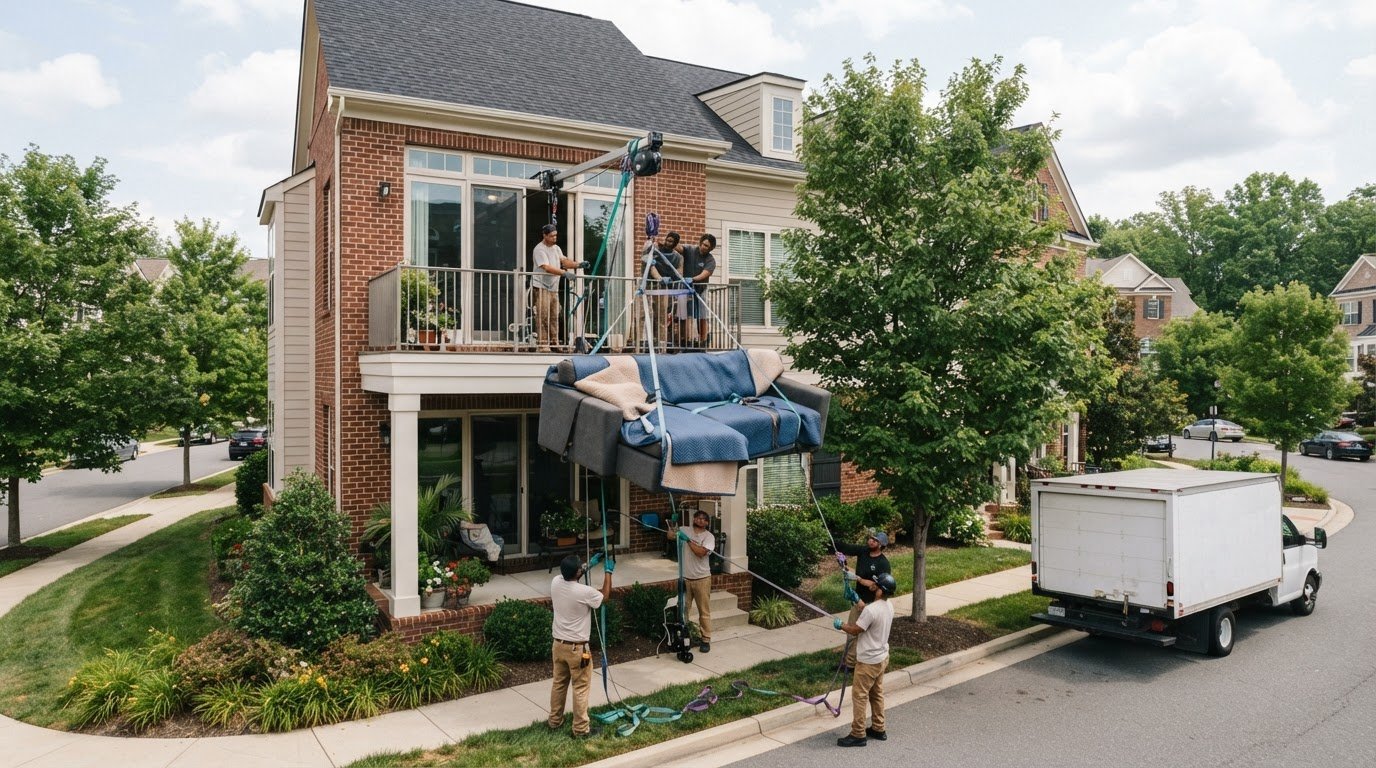
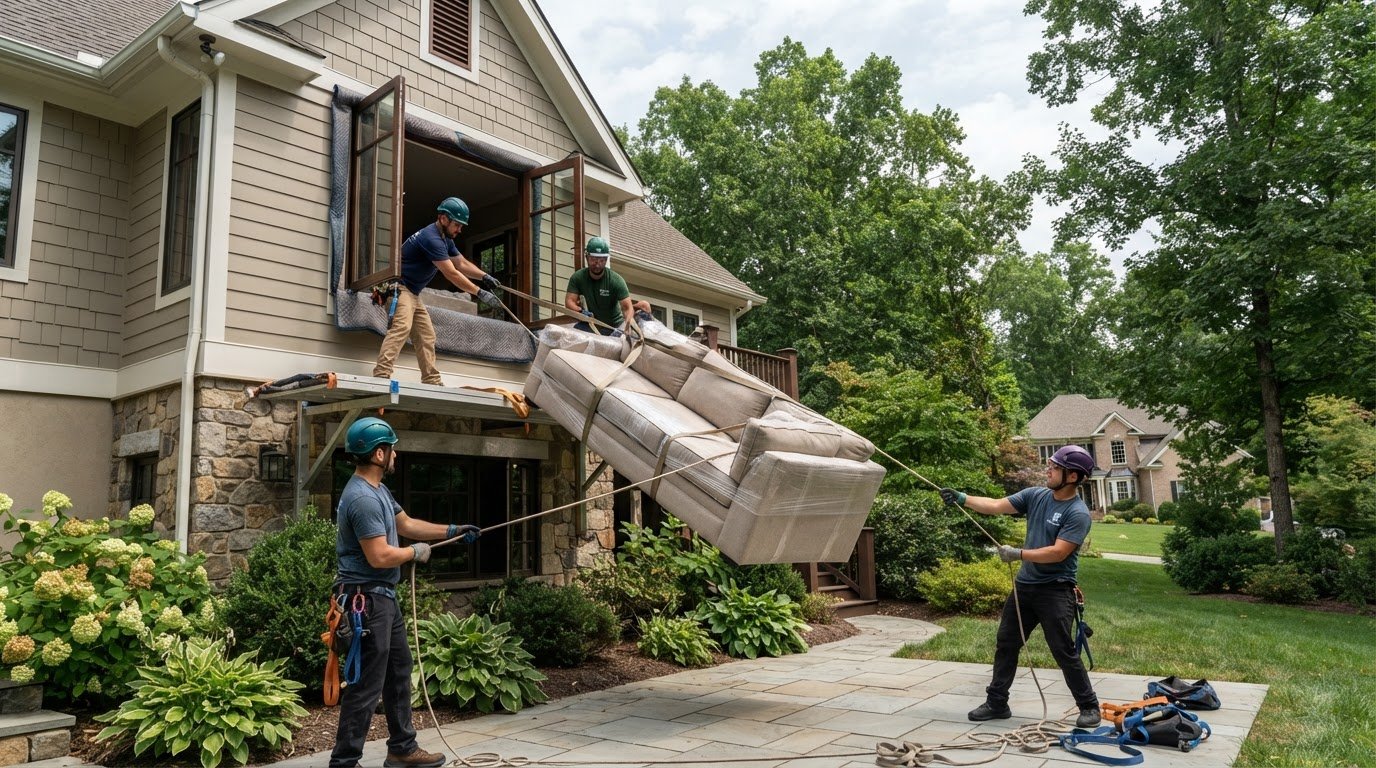
Window hoisting moves furniture through a suitable exterior opening when the usual indoor route is too restrictive. It can provide another way to bring in a bulky piece without forcing it around tight corners or through an opening it can’t fit. A hoist is a device used to lift or lower loads; the What is a Hoist? overview explains the general idea. The right approach depends on the furniture, the home, and the exterior access.
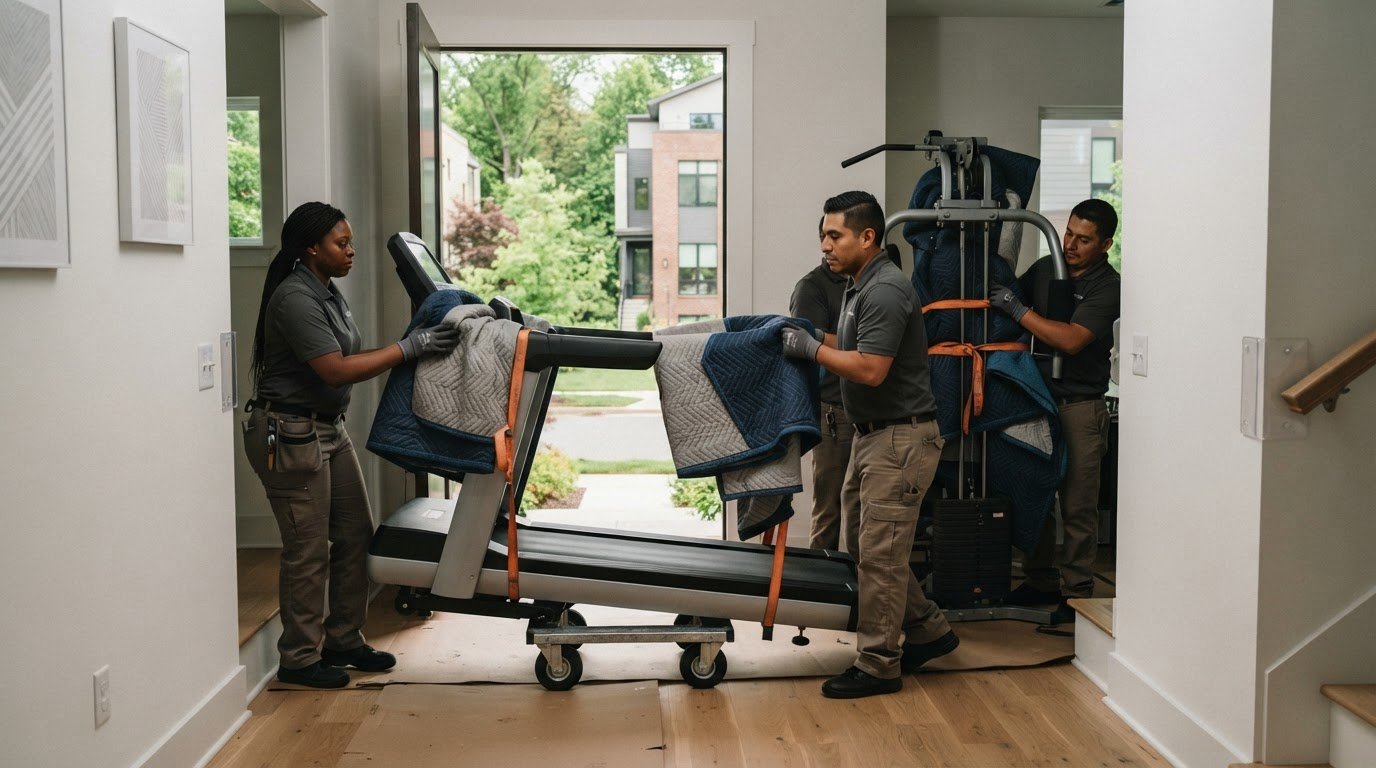
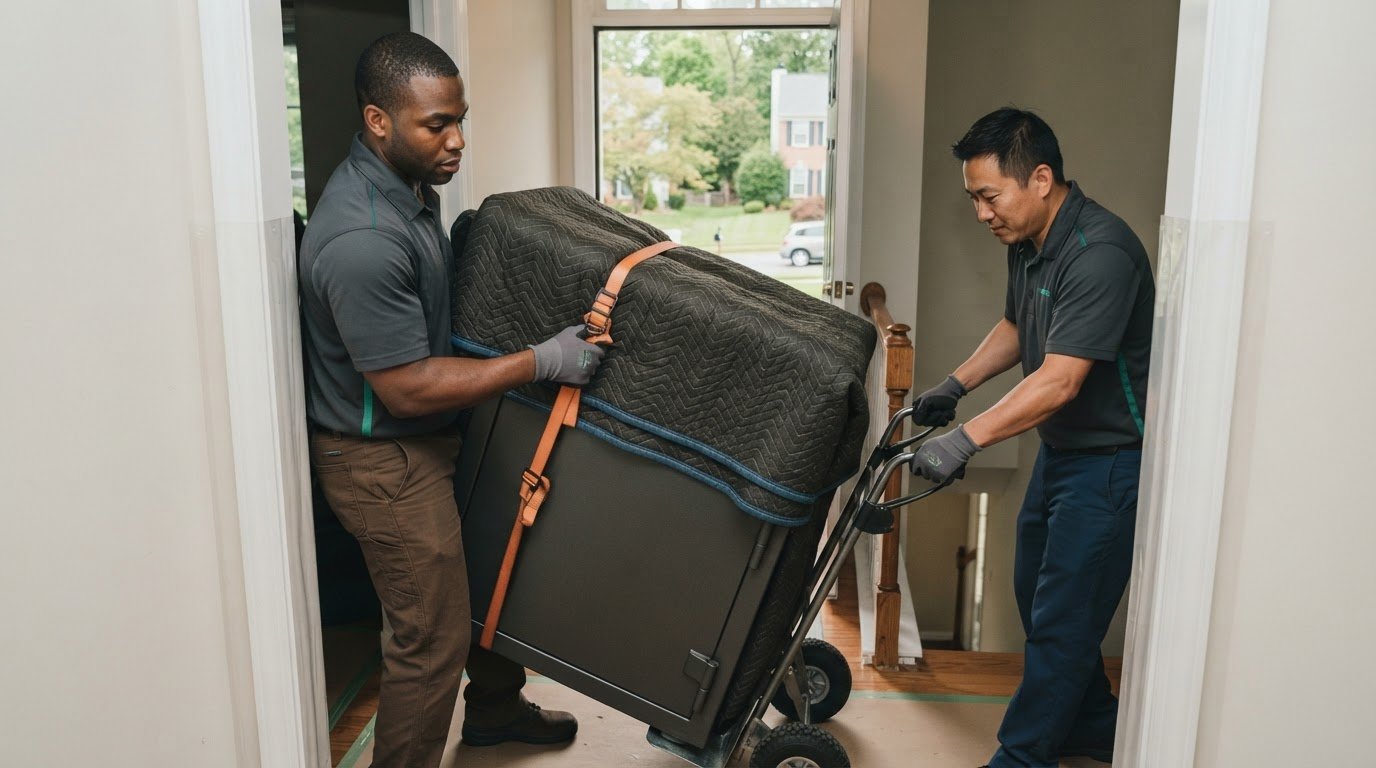
Haymarket homes have different layouts and access conditions. A sofa might fit through the front door but get stuck at a hallway turn. A narrow doorway, tight staircase, or limited elevator access can also make the interior route impractical. Hoisting is an option to assess, not an automatic solution for every oversized item.
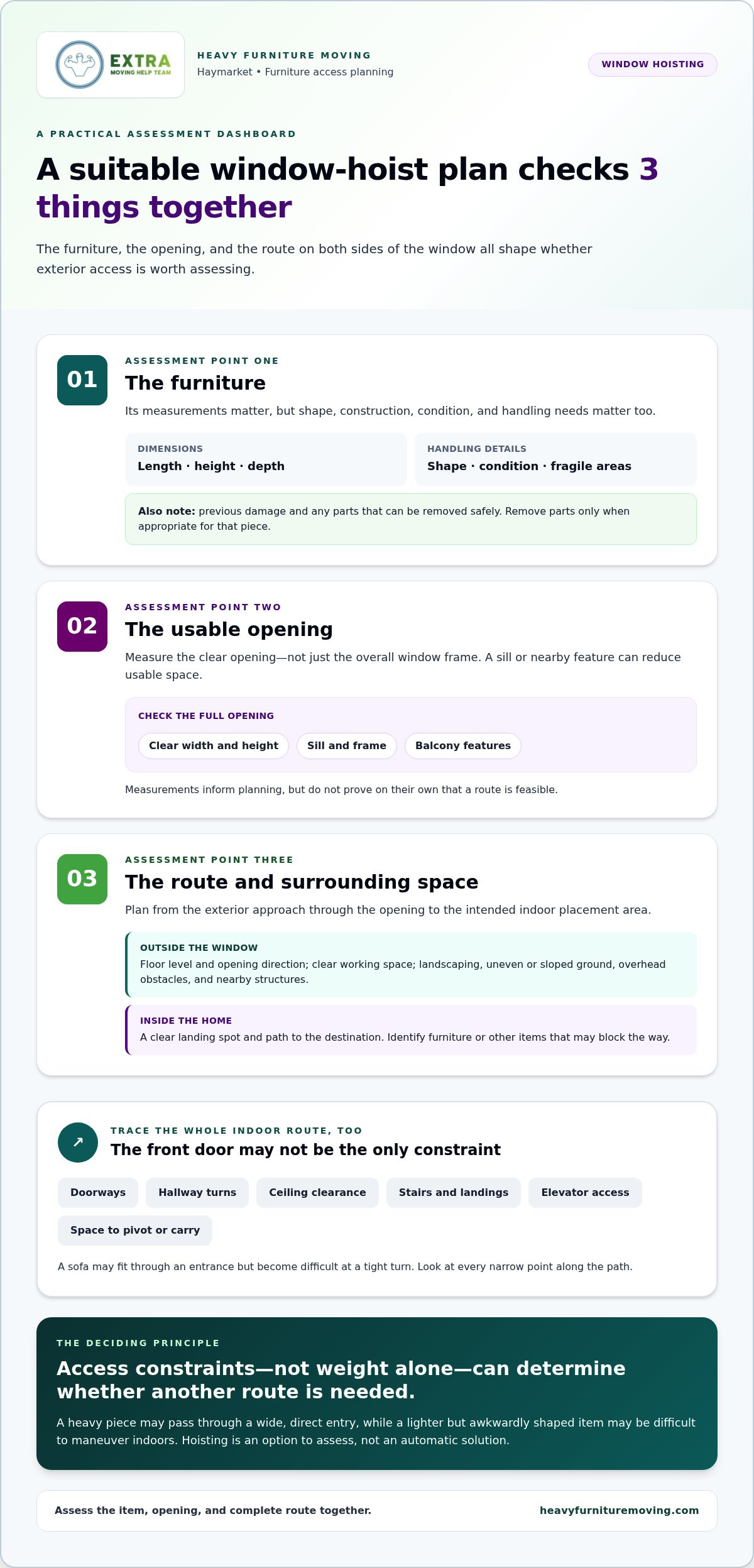
Access constraints, not weight alone, often determine whether furniture needs a different route. A heavy piece may pass through a wide, direct entry, while a lighter but awkwardly shaped item may be difficult to maneuver indoors.
Which access problems can make an exterior route worth considering?
Look at the full path from the entrance to the room. Door width matters, but so do hallway turns, ceiling clearance, stair width, landings, and space to pivot or carry the item. An elevator can have its own constraints, including the doorway and the room needed to position furniture.
Checking only the front door can miss the real obstacle. Measure or describe each narrow point, including turns where a long sofa may not be able to angle through. If the piece has to pass several tight spots, a suitable exterior opening may be worth assessing as an alternative.
Which large furniture items may need a different route?
Sofas are a familiar example, especially when their length or shape makes tight turns difficult. Other bulky household furniture can pose similar access challenges. Size alone doesn’t determine whether an item can be hoisted. Its shape, construction, condition, fragile surfaces, and removable parts all affect how it can be handled.
Share what you know about the item and its route so the proposed lift can be assessed. The opening must suit the furniture, and the exterior approach and indoor destination matter too. A piece that seems too large for the stairs may still be unsuitable for a window route if the opening or surrounding access presents a problem.
That’s why window hoisting for large furniture Haymarket residents are considering should begin with an access assessment, not assumptions based on a photo or the item’s weight. A professional review helps determine whether the exterior route is appropriate or another option may be more practical. Heavy Furniture Moving provides sofa hoisting in Haymarket for difficult furniture access, with planning focused on the item and the home’s route.
How a Haymarket window-hoisting plan accounts for the item and property
A workable plan starts with two questions: what does the furniture need, and what does the property allow? A sofa’s dimensions matter, but so do its shape, condition, and handling needs. A broad arm or fixed frame may affect how it passes through an opening. A delicate finish or worn section may call for extra care. Removable legs or other parts can change the item’s dimensions, but remove them only when appropriate for that piece.
The furniture and its route must be assessed together; measurements alone can’t show whether a lift is suitable. A window that looks wide enough on paper may have a sill, frame, or balcony edge that reduces the usable opening. The path from the opening to the intended placement area matters as well. A clear landing spot inside helps the crew plan how to receive the item and move it into the room.
What should be assessed before moving furniture through a window?
Record the furniture’s length, height, and depth, along with its general shape and condition. Note parts that can be removed safely, and mention fragile areas or previous damage. Measure the clear opening rather than relying on the window’s overall frame size. Include the sill, nearby balcony features, and the room layout beyond the opening. These details inform planning, but don’t prove a route is feasible on their own.
Describe the exterior access at your Haymarket home, too. Note the floor level, which way the opening faces, whether there’s a clear area outside, and where the furniture can be set down inside. Photos can help show the layout, but they don’t replace an assessment of the actual item, opening, and surrounding space.
How do home and site conditions shape the plan?
Conditions outside can matter as much as the window. Share details about landscaping, sloped or uneven ground, overhead obstacles, nearby structures, and anything that may limit access or working room. Inside, identify furniture or other items that could block the path from the window to the destination. Haymarket properties vary, so describe the actual conditions rather than assuming a familiar layout.
Weather and changing site conditions can also affect safe work planning. The crew needs to account for the space available and conditions at the property when assessing the approach. For general workplace safety information, OSHA safety resources offer useful context on safe work practices. The specific plan should be based on the job and site, not an assumption about equipment or lifting methods.
Share clear details about the item and property to make the assessment more useful and reduce uncertainty before the visit. If the furniture’s interior route is restricted, professional sofa-hoisting help in Haymarket can help plan the next step. Preparation lets the crew focus on the real constraints and handle the item with care.
Window hoisting versus stairs, disassembly, or another furniture route
No single route works best for every large piece. Compare the furniture’s construction and handling needs with the dimensions and conditions of each possible path. A clear interior route may be simplest. If the piece can be professionally disassembled without risking its structure or finish, that may help it fit. Exterior hoisting is another option when indoor access doesn’t work and the opening and outdoor space can accommodate the move.
Use this comparison as a starting point, not a final decision. In Haymarket, the right choice depends on the specific home and item, including tight turns, placement needs, and available exterior access.
| Route | Potential advantage | Limiting factor |
|---|---|---|
| Stairs or doorway | Uses the home’s existing interior path. | Turns, landings, or narrow passages may prevent maneuvering. |
| Professional disassembly | May reduce the size of a piece that can be safely taken apart. | Some furniture isn’t designed for disassembly, or parts may be fragile or difficult to reassemble. |
| Exterior hoisting | Offers an alternate route when indoor access is unsuitable. | The opening, exterior clearance, or space at the destination may rule it out. |
When might the interior route still be the better option?
If the furniture can travel through a sufficiently wide, clear path, moving it indoors may avoid the additional planning involved in an exterior route. Check the whole path, not just the doorway: a wide entrance won’t solve a tight hallway turn or small stair landing. The interior route may work for one item but not another, so base the decision on the furniture’s shape and the home’s layout.
When might window hoisting offer a practical alternative?
Window hoisting may be worth assessing when stairs, hallways, or doorways can’t accommodate a piece and an exterior opening offers another possible entry. The window needs enough usable clearance, and the area outside must allow the work to be planned safely. A balcony edge, nearby structure, or limited ground access can affect the route. Hoisting isn’t automatically safer, faster, or less disruptive; actual site conditions matter.
Consider disassembly carefully, too. Don’t assume a piece can be taken apart just because it has visible seams or parts that look removable. Its construction, condition, and the way its components fit together all matter. A professional can assess whether disassembly is appropriate or whether another route better suits the item.
For window hoisting for large furniture Haymarket homeowners should weigh all three options against the piece and the property, rather than choosing based on size alone. Heavy Furniture Moving provides sofa hoisting in Haymarket for difficult access situations, with the route shaped around the move’s specific needs.
How to prepare your Haymarket home for a furniture-hoisting visit
Preparation helps the crew understand the item, route, and space around your home before work begins. For window hoisting for large furniture Haymarket homeowners can make the visit more straightforward by sharing clear details and keeping the work area open. Use this checklist to get organized.
- Share details about the furniture. Provide the item type and approximate dimensions, and describe its condition. Mention delicate surfaces, loose or removable components, unusual shapes, or anything that may need special care.
- Describe the access. Identify the intended window or other exterior opening, the floor level, and the route from the opening to the planned placement area. Include the opening’s approximate dimensions, sill or balcony features, and outdoor access. Measurements help with planning, but don’t guarantee that a route will work.
- Clear the work area. Remove loose objects from the approach to the opening and the area where the furniture will be placed. Keep children and pets away from the work zone, and move unrelated furniture or belongings that could block access.
- Plan the placement. Decide where the item should go after it enters the home. Clear a path to that spot and tell the crew about obstacles along the way, such as nearby furniture, narrow passages, or a turn that may affect movement.
Ready to organize the details? Plan your Haymarket furniture move with professional help.
What details should you share when arranging the move?
Be specific without guessing. A sofa’s approximate length, depth, and height, its current condition, and any fragile parts give the crew useful context. Describe the opening you have in mind and what lies inside and outside it. Note the floor level, the path to the destination, exterior access, and any known access restrictions or scheduling requirements. If you’re unsure about a measurement, say so rather than treating an estimate as exact.
What can you clear or protect before the crew arrives?
Make the route accessible from the outside approach to the opening and from the interior landing area to the furniture’s destination. Put away small objects, clear walkways, and keep other people and pets outside the active work zone. Point out surfaces or nearby belongings you’re concerned about so they’re visible during planning. Leave lifting, rigging, and other technical handling decisions to the professional crew. Don’t set up equipment or move the furniture through the opening yourself.
These steps won’t determine the lifting plan, but they help the crew arrive with a clearer picture of the job. Share what you know, point out anything that could affect access, and leave room for the professionals to assess the setup and handle the work with care.
Arrange professional window hoisting for large furniture in Haymarket
Once you’ve identified the access problem, share clear details about the furniture and property. This gives the crew a useful starting point for planning the route and discussing what the move involves. For window hoisting for large furniture Haymarket homeowners can follow a straightforward decision path: explain what won’t fit, describe the item and access, then arrange professional help.
Before reaching out, gather the details that make your situation easier to understand:
- The furniture: Share the type of item, approximate dimensions, condition, shape, and any delicate or removable components.
- The opening: Describe the intended window or other exterior opening, its floor level, and any sill or balcony features that may affect access.
- The surroundings: Explain the exterior approach, nearby obstacles, and the interior path from the opening to the intended placement area.
- The challenge: Point out where the regular route becomes difficult, such as a tight turn or restricted stair access, and mention any known access or scheduling requirements.
What to expect when arranging specialized furniture help
Expect to discuss the furniture and property as one job. The item’s size and condition, the opening’s usable space, exterior access, and final placement all help shape the plan. Share what you know, including approximate measurements and any handling concerns. You don’t need to decide how the lift will be carried out. The professional assessment considers the specific route and conditions rather than assuming one setup will suit every home.
Clear information is useful, but it can’t establish that a particular route or lifting arrangement will work. The opening, access outside, and landing space inside need to make sense together. If a detail is uncertain, say so. That’s more helpful than relying on a guess and gives the crew a clearer picture of what needs attention.
How Heavy Furniture Moving can help with a difficult furniture route
Heavy Furniture Moving serves Haymarket and provides professional sofa hoisting as part of its specialized heavy-item moving services. If a sofa or other bulky furniture can’t take the usual interior route, the team can help assess the access challenge and plan around the item and property. You don’t have to solve a difficult lift alone. Sharing the details is a practical first step toward getting help with the move.
Keep the next step simple: identify the access issue, explain the furniture and site conditions, and arrange professional assistance. Get help with furniture hoisting in Haymarket.
Move forward with confidence
A challenging furniture move doesn’t have to become a last-minute scramble. Make a considered plan before the item is at the doorway. Rather than forcing a tight route or improvising a lift, put the difficult work in experienced hands and focus on the result: getting your furniture where it belongs with less stress.
If window hoisting for large furniture Haymarket is the option you’re considering, take the next step with the details you’ve gathered and a clear idea of your priorities. Heavy Furniture Moving serves Haymarket with specialized heavy-item handling, including sofa hoisting. Discussing the move is a practical way to turn an access challenge into a more organized plan.
Heavy Furniture Moving provides local moving help in Haymarket and nearby communities, including Fairfax, Woodbridge, Manassas, Manassas Park, Aldie, Ashburn, Mclean, Vienna, Reston, Centreville, Chantilly, Clifton, Dumfries, South Riding, Fairfax Station, and Gainesville. Get professional help with window hoisting in Haymarket. You don’t have to figure out a difficult furniture route alone. With professional support, you can move ahead feeling prepared.
Frequently Asked Questions
Can large furniture be hoisted through a window in Haymarket?
Yes, it may be possible if the furniture and the full route are suitable. A sofa’s shape, the opening’s usable space, and clear access outside all matter, as does the area where the item will land indoors. When arranging Heavy Furniture Moving’s sofa-hoisting service, share the item’s details and photos of the proposed opening and surrounding access, if you have them. That context helps the crew understand the Haymarket property.
Is window hoisting safe for large furniture?
It can be planned with safety in mind, but no method is right for every item or property. Professional movers should assess the furniture, opening, exterior space, and conditions at the home rather than treating a lift as routine. Don’t attempt a DIY hoist or stand in the active work area. Mention the floor level and nearby access constraints so the crew can consider the setting before the move.
What furniture can be hoisted through a window?
Large sofas and other bulky household furniture may be candidates, but suitability depends on the individual piece. A sofa with a rigid frame, for example, may present different handling needs than one with removable legs or cushions. Fragile finishes, loose components, and existing wear also matter. Describe the specific item rather than relying on its category or appearance alone, since the opening and exterior route must suit it too.
Do movers need to remove a window to hoist furniture?
Not necessarily. Whether a window provides a usable opening depends on its design, the clear space available, and the furniture’s dimensions. Screens, fixed panes, frames, and nearby balcony features can affect access. Don’t remove a window or alter its parts on your own; that may not be needed or appropriate. If you can, share photos and approximate measurements so the access can be considered before planning the move.
How should I prepare my home for window furniture hoisting?
Share the furniture’s approximate size, the planned opening, floor level, and details about outdoor access. Before the visit, move curtains or other loose window coverings out of the work area, clear belongings from the indoor path, and keep children and pets away. Mention anything that could affect access, such as limited outdoor space or a shared entrance. Leave equipment setup and technical handling decisions to the moving crew.
Can window hoisting prevent furniture damage?
No route can guarantee damage-free handling. Hoisting may avoid a difficult interior passage, but the furniture’s condition, finish, shape, and the property’s access still affect the work. Point out existing scratches, weak joints, delicate trim, or other concerns before moving day. Clear, specific information helps the crew account for the item’s condition as it plans. For furniture in Haymarket, discuss any special handling concerns as part of the hoisting arrangement.
Frequently Asked Questions
Look at the full path from the entrance to the room. Door width matters, but so do hallway turns, ceiling clearance, stair width, landings, and space to pivot or carry the item. An elevator can have its own constraints, including the doorway and the room needed to position furniture. Checking only the front door can miss the real obstacle. Measure or describe each narrow point, including turns where a long sofa may not be able to angle through. If the piece has to pass several tight spots, a suitable exterior opening may be worth assessing as an alternative.
Sofas are a familiar example, especially when their length or shape makes tight turns difficult. Other bulky household furniture can pose similar access challenges. Size alone doesn’t determine whether an item can be hoisted. Its shape, construction, condition, fragile surfaces, and removable parts all affect how it can be handled. Share what you know about the item and its route so the proposed lift can be assessed. The opening must suit the furniture, and the exterior approach and indoor destination matter too. A piece that seems too large for the stairs may still be unsuitable for a window route if the opening or surrounding access presents a problem. That’s why window hoisting for large furniture Haymarket residents are considering should begin with an access assessment, not assumptions based on a photo or the item’s weight. A professional review helps determine whether the exterior route is appropriate or another option may be more practical. Heavy Furniture Moving provides sofa hoisting in Haymarket for difficult furniture access, with planning focused on the item and the home’s route. A workable plan starts with two questions: what does the furniture need, and what does the property allow? A sofa’s dimensions matter, but so do its shape, condition, and handling needs. A broad arm or fixed frame may affect how it passes through an opening. A delicate finish or worn section may call for extra care. Removable legs or other parts can change the item’s dimensions, but remove them only when appropriate for that piece. The furniture and its route must be assessed together; measurements alone can’t show whether a lift is suitable. A window that looks wide enough on paper may have a sill, frame, or balcony edge that reduces the usable opening. The path from the opening to the intended placement area matters as well. A clear landing spot inside helps the crew plan how to receive the item and move it into the room.
Record the furniture’s length, height, and depth, along with its general shape and condition. Note parts that can be removed safely, and mention fragile areas or previous damage. Measure the clear opening rather than relying on the window’s overall frame size. Include the sill, nearby balcony features, and the room layout beyond the opening. These details inform planning, but don’t prove a route is feasible on their own. Describe the exterior access at your Haymarket home, too. Note the floor level, which way the opening faces, whether there’s a clear area outside, and where the furniture can be set down inside. Photos can help show the layout, but they don’t replace an assessment of the actual item, opening, and surrounding space.
Conditions outside can matter as much as the window. Share details about landscaping, sloped or uneven ground, overhead obstacles, nearby structures, and anything that may limit access or working room. Inside, identify furniture or other items that could block the path from the window to the destination. Haymarket properties vary, so describe the actual conditions rather than assuming a familiar layout. Weather and changing site conditions can also affect safe work planning. The crew needs to account for the space available and conditions at the property when assessing the approach. For general workplace safety information, OSHA safety resources offer useful context on safe work practices. The specific plan should be based on the job and site, not an assumption about equipment or lifting methods. Share clear details about the item and property to make the assessment more useful and reduce uncertainty before the visit. If the furniture’s interior route is restricted, professional sofa-hoisting help in Haymarket can help plan the next step. Preparation lets the crew focus on the real constraints and handle the item with care. No single route works best for every large piece. Compare the furniture’s construction and handling needs with the dimensions and conditions of each possible path. A clear interior route may be simplest. If the piece can be professionally disassembled without risking its structure or finish, that may help it fit. Exterior hoisting is another option when indoor access doesn’t work and the opening and outdoor space can accommodate the move. Use this comparison as a starting point, not a final decision. In Haymarket, the right choice depends on the specific home and item, including tight turns, placement needs, and available exterior access.
If the furniture can travel through a sufficiently wide, clear path, moving it indoors may avoid the additional planning involved in an exterior route. Check the whole path, not just the doorway: a wide entrance won’t solve a tight hallway turn or small stair landing. The interior route may work for one item but not another, so base the decision on the furniture’s shape and the home’s layout.
Window hoisting may be worth assessing when stairs, hallways, or doorways can’t accommodate a piece and an exterior opening offers another possible entry. The window needs enough usable clearance, and the area outside must allow the work to be planned safely. A balcony edge, nearby structure, or limited ground access can affect the route. Hoisting isn’t automatically safer, faster, or less disruptive; actual site conditions matter. Consider disassembly carefully, too. Don’t assume a piece can be taken apart just because it has visible seams or parts that look removable. Its construction, condition, and the way its components fit together all matter. A professional can assess whether disassembly is appropriate or whether another route better suits the item. For window hoisting for large furniture Haymarket homeowners should weigh all three options against the piece and the property, rather than choosing based on size alone. Heavy Furniture Moving provides sofa hoisting in Haymarket for difficult access situations, with the route shaped around the move’s specific needs. Preparation helps the crew understand the item, route, and space around your home before work begins. For window hoisting for large furniture Haymarket homeowners can make the visit more straightforward by sharing clear details and keeping the work area open. Use this checklist to get organized. Ready to organize the details? Plan your Haymarket furniture move with professional help.
Be specific without guessing. A sofa’s approximate length, depth, and height, its current condition, and any fragile parts give the crew useful context. Describe the opening you have in mind and what lies inside and outside it. Note the floor level, the path to the destination, exterior access, and any known access restrictions or scheduling requirements. If you’re unsure about a measurement, say so rather than treating an estimate as exact.
Make the route accessible from the outside approach to the opening and from the interior landing area to the furniture’s destination. Put away small objects, clear walkways, and keep other people and pets outside the active work zone. Point out surfaces or nearby belongings you’re concerned about so they’re visible during planning. Leave lifting, rigging, and other technical handling decisions to the professional crew. Don’t set up equipment or move the furniture through the opening yourself. These steps won’t determine the lifting plan, but they help the crew arrive with a clearer picture of the job. Share what you know, point out anything that could affect access, and leave room for the professionals to assess the setup and handle the work with care. Once you’ve identified the access problem, share clear details about the furniture and property. This gives the crew a useful starting point for planning the route and discussing what the move involves. For window hoisting for large furniture Haymarket homeowners can follow a straightforward decision path: explain what won’t fit, describe the item and access, then arrange professional help. Before reaching out, gather the details that make your situation easier to understand:
Yes, it may be possible if the furniture and the full route are suitable. A sofa’s shape, the opening’s usable space, and clear access outside all matter, as does the area where the item will land indoors. When arranging Heavy Furniture Moving’s sofa-hoisting service, share the item’s details and photos of the proposed opening and surrounding access, if you have them. That context helps the crew understand the Haymarket property.
It can be planned with safety in mind, but no method is right for every item or property. Professional movers should assess the furniture, opening, exterior space, and conditions at the home rather than treating a lift as routine. Don’t attempt a DIY hoist or stand in the active work area. Mention the floor level and nearby access constraints so the crew can consider the setting before the move.
Large sofas and other bulky household furniture may be candidates, but suitability depends on the individual piece. A sofa with a rigid frame, for example, may present different handling needs than one with removable legs or cushions. Fragile finishes, loose components, and existing wear also matter. Describe the specific item rather than relying on its category or appearance alone, since the opening and exterior route must suit it too.
Not necessarily. Whether a window provides a usable opening depends on its design, the clear space available, and the furniture’s dimensions. Screens, fixed panes, frames, and nearby balcony features can affect access. Don’t remove a window or alter its parts on your own; that may not be needed or appropriate. If you can, share photos and approximate measurements so the access can be considered before planning the move.
Share the furniture’s approximate size, the planned opening, floor level, and details about outdoor access. Before the visit, move curtains or other loose window coverings out of the work area, clear belongings from the indoor path, and keep children and pets away. Mention anything that could affect access, such as limited outdoor space or a shared entrance. Leave equipment setup and technical handling decisions to the moving crew.
No route can guarantee damage-free handling. Hoisting may avoid a difficult interior passage, but the furniture’s condition, finish, shape, and the property’s access still affect the work. Point out existing scratches, weak joints, delicate trim, or other concerns before moving day. Clear, specific information helps the crew account for the item’s condition as it plans. For furniture in Haymarket, discuss any special handling concerns as part of the hoisting arrangement.