Navigating Tight Stairwells with Furniture in Fairfax Station
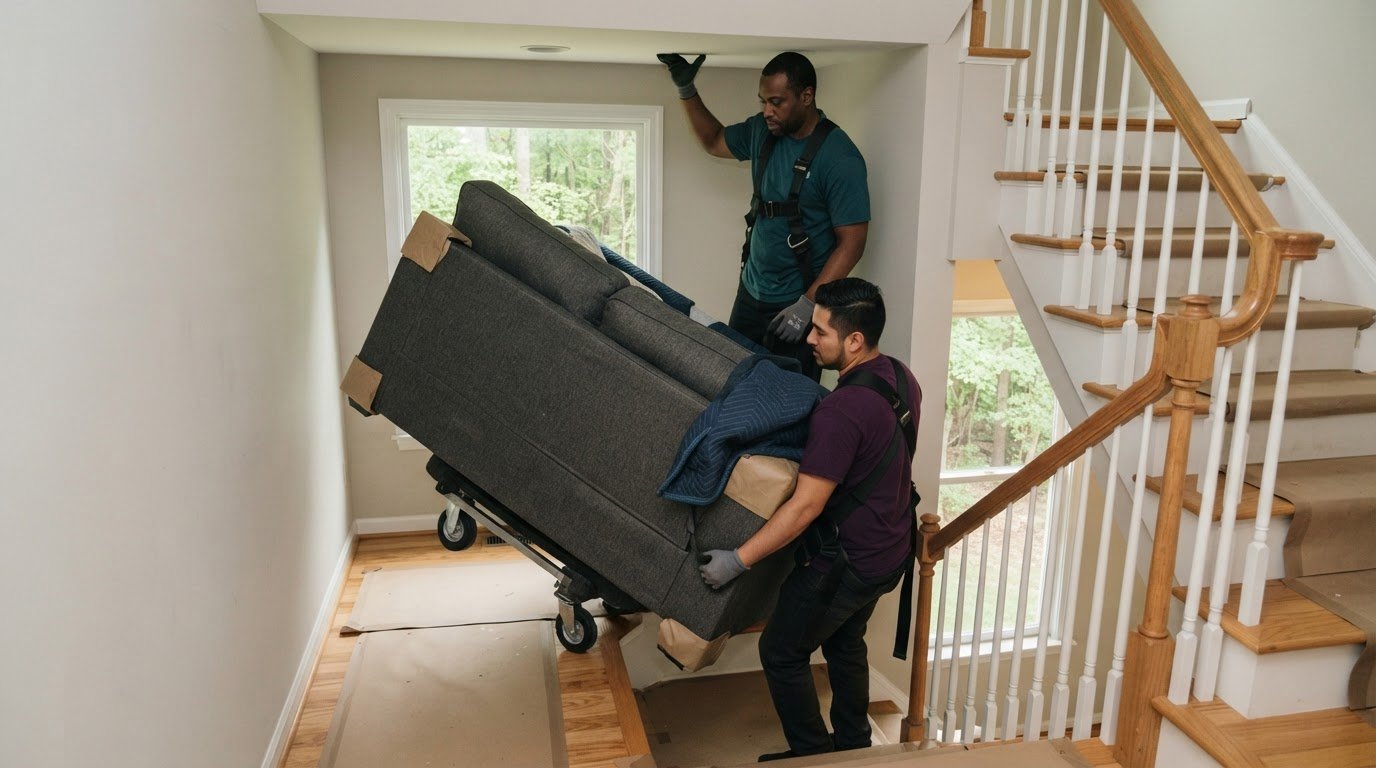
What if the stairwell turn, not the doorway, is what stops your sofa from moving upstairs? Navigating tight stairwells with furniture Fairfax Station starts with checking the entire route before anyone lifts. A piece may fit through the entrance but still run into a narrow landing, low ceiling, or sharp turn. Guessing can put walls, handrails, flooring, furniture, and the people carrying it at risk.
It makes sense to feel cautious. Heavy furniture is difficult to control on stairs, especially when there’s little room to adjust your grip or change direction. A careful assessment can help you decide whether to carry the item as-is, take it apart, or stop before forcing it through.
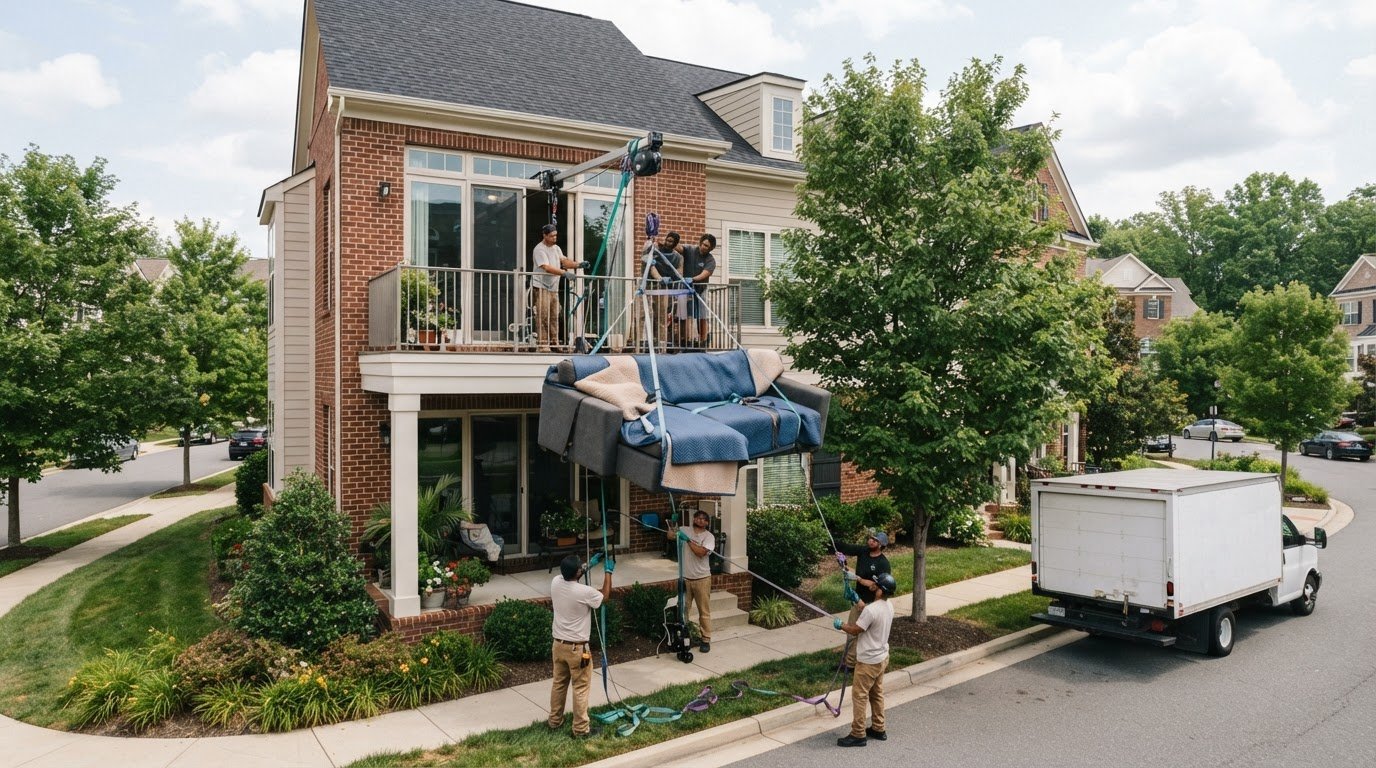
This guide explains what to measure on the furniture and along the stair route, how to assess a restrictive landing, and which safety signs mean it’s time to change plans. If the stair geometry makes carrying too risky, Heavy Furniture Moving provides help with bulky pieces in Fairfax Station. Sofa hoisting may provide another route when it suits the item and property.
Key Takeaways
- Check the furniture and the entire stair route before lifting, including narrow turns, low headroom, and landings.
- Measure the item at its widest and tallest points, including handles, legs, and other projections.
- Compare carrying, disassembly, and alternate routes, and stop if the fit or safe handling is uncertain.
- Clear trip hazards and protect vulnerable surfaces before moving furniture through the stairwell.
- Use these checks for navigating tight stairwells with furniture Fairfax Station, and recognize when experienced help or sofa hoisting may be the safer choice.
Why tight stairwells make furniture moves difficult in Fairfax Station
A bulky piece at the foot of a narrow staircase can make a simple move feel risky. You may be picturing scraped walls, a damaged handrail, or someone losing balance while trying to hold the furniture in place. For navigating tight stairwells with furniture Fairfax Station homeowners need to consider the whole route, not just whether the item fits through the front door.
A stairwell can look wide enough at the bottom and still become difficult at a turn or landing. A sofa might clear the straight section when tilted, then run short of room to rotate. Stair width alone doesn’t tell you whether the full piece can travel safely from one level to another. You also need to consider headroom, the angle of each turn, and the space available to hold and adjust the item.
Stairwell clearance is the usable space along the full route, including its width, height, landings, turns, and any obstacles that limit movement.
What makes a stairwell a tight fit?
Narrow passages leave less room to grip and reposition furniture. Low ceilings can block a tall item when it’s tilted, while a sharp turn may require more room than the landing provides. Protruding handrails, light fixtures, door frames, and trim can narrow the path further. A landing isn’t automatically a useful turning space if its shape or surrounding walls restrict movement.
The furniture’s shape matters, too. A long sofa, a deep armchair, or a cabinet with fixed legs may be hard to angle around a corner, even if its narrowest side seems to fit. Stair layouts vary from one Fairfax Station home to another, so assess the specific item and staircase rather than relying on a general estimate.
Why forcing a piece through can create bigger problems
Rushing makes a difficult carry harder to control. A heavy item can shift unexpectedly, strain the people holding it, or leave them with no safe space to reset their grip. Basic principles of ergonomics emphasize fitting the task to people’s abilities and the conditions around them. On stairs, that means paying attention to balance, posture, grip, and room to move.
If furniture scrapes against a wall, wedges between surfaces, or needs force to get past a turn, stop. Pushing harder can damage upholstery, wood, paint, flooring, or the handrail, and can make the item harder to control. Pause and reconsider the angle or route before trying again. A tight stairwell doesn’t automatically rule out the move, but the approach may need to change instead of relying on strength alone.
How to assess furniture and stairwell clearance before moving
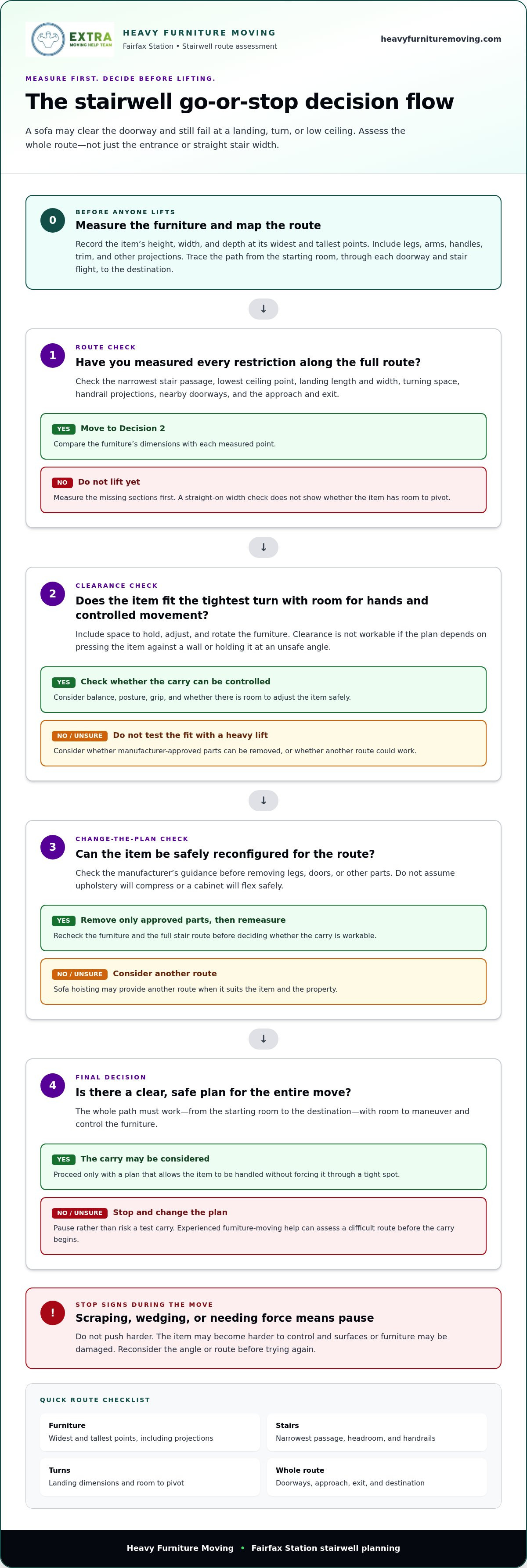
Before lifting, turn the move into a measuring and route-planning task. A tape measure, notes, and clear photos can reveal problem spots while the furniture is still on level ground. For navigating tight stairwells with furniture Fairfax Station, compare the item with the entire path, not just one doorway or the stairs’ overall width.
- Measure the item. Record its height, width, and depth at the widest and tallest points. Include feet, handles, arms, trim, and other projections that won’t move out of the way.
- Map the route. Trace the path from the room where the furniture starts, through each doorway and stair flight, to its destination.
- Find the tightest points. Measure stair width, ceiling clearance, landing dimensions, turn space, and handrail projections. Check the approach to the first stair and the exit at the top.
- Consider exit options. Note whether the item can be safely turned, whether manufacturer-approved parts can be removed, or whether another route could work.
Measure the furniture and its removable parts
Measure from the outermost edges, not just the main frame. A sofa’s arms or legs may add width; a cabinet’s handles can catch on a wall or door frame. Check the manufacturer’s guidance before removing legs, doors, or other parts. Don’t assume upholstery will compress or a cabinet will flex safely to squeeze through a gap. Write down the measurements so you can compare them with the route.
Map the stair route from entry to destination
Measure each restriction where it occurs. Include the narrowest stair passage, landing length and width, lowest ceiling point, and any handrail that extends into the path. Check doorways and nearby walls at the bottom and top, too. Sketch the route and mark where the furniture must rotate. The narrowest turn can decide whether the whole route works. A straight-on width check won’t show whether the item has room to pivot.
Use measurements to make a go-or-stop decision
Compare the furniture’s dimensions with each measured opening, while allowing space for hands and controlled movement. A measurement that only works if the item is pressed against a wall or held at an unsafe angle isn’t workable clearance. If the turn is hard to assess, pause rather than test it with a heavy lift. Photos of the stairs, landings, and item, paired with your notes, can help prepare for moving help in Fairfax Station.
If the route remains uncertain, experienced furniture-moving help can be a practical next step before the carry begins.
Compare safe options for furniture in a Fairfax Station stairwell
Once you’ve assessed the route, compare the moving options instead of assuming the strongest people can muscle the item through. Strength can’t create room at a tight turn or make an awkward load easier to control. The right choice depends on the furniture’s construction, measured clearance, and whether the people handling it can move it without scraping, twisting, or losing control.
| Option | May suit | Limitations and risk signals |
|---|---|---|
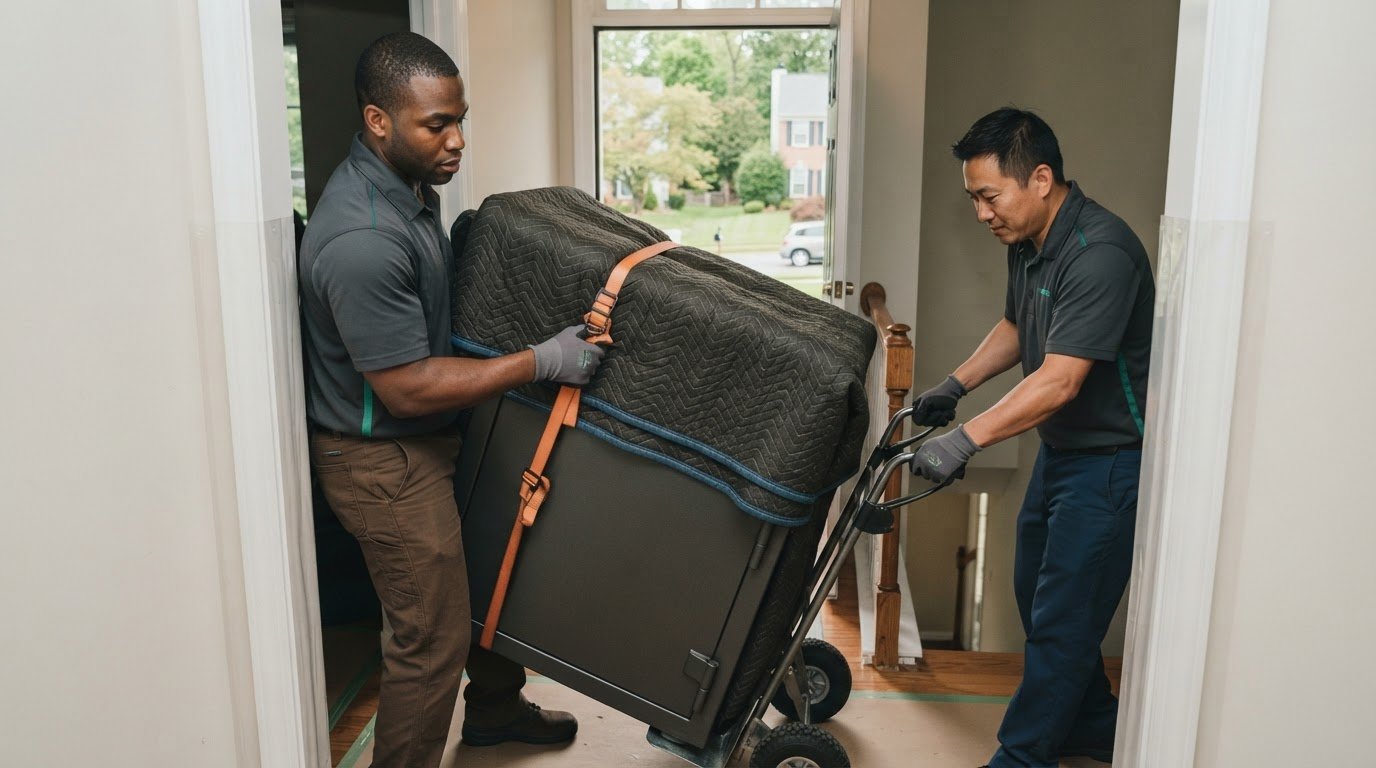
| Professional stair carrying | The measured route allows room to move and turn the item under control. | Weight, shape, and footing still matter. Stop if the item shifts, catches, or can’t be controlled through a turn. |
| Appropriate disassembly | Manufacturer-approved parts can be removed to reduce the item’s size. | Not every piece can be taken apart safely. Forcing components or losing track of hardware can cause damage or complicate reassembly. |
| Alternate route, including sofa hoisting | A different doorway or suitable exterior route avoids a restrictive stair turn. | The route must suit the item and property. Hoisting isn’t appropriate for every piece or home, so assess it as an alternative, not a shortcut. |
When carrying through the stairs may be practical
Stair carrying may work when measured clearance allows the item to move and turn without being wedged or forced. The people carrying it also need clear communication and a shared understanding of the path. Dimensions alone don’t settle the decision: a heavy cabinet or long sofa may be difficult to control even if it appears to fit. Choose this option only when the item can be handled steadily.
When disassembly or another route deserves consideration
Check the manufacturer’s guidance before removing legs, doors, or other parts, and keep loose hardware together. If the stair turn remains restrictive, consider whether a different doorway or route offers a safer path. Sofa hoisting can be an alternative when stairs won’t work and the item and property are suitable. Heavy Furniture Moving provides specialized handling for bulky household pieces, including sofa hoisting when standard entry routes don’t work.
Recognize the signs that a DIY attempt should stop
Stop if clearance is inadequate, footing feels unstable, grips are slipping, or the item can’t be controlled. Don’t twist a load through an awkward turn, wedge it against a fixed obstruction, or force it past a handrail. A pause is safer than pushing on to finish quickly. For navigating tight stairwells with furniture Fairfax Station, base the decision on control and safety, not on how close the furniture seems to getting upstairs.
Prepare the stairwell and furniture for a safer move
A clear route helps everyone focus on moving the furniture, not dodging obstacles. Before moving day, set aside time to prepare the stairs, landings, and item. Keep children, pets, and anyone not helping out of the work area so the path stays open and the moving team can communicate without distractions.
- Remove shoes, loose rugs, decorations, and other trip hazards from stairs and landings.
- Check that the route is well lit, and make sure doors can remain open without blocking the passage.
- Identify fragile finishes, narrow corners, and surfaces that may need protection.
- Empty furniture and secure doors or drawers that could swing or slide during handling.
- Set aside small parts in a labeled container if manufacturer-approved disassembly is part of the plan.
Clear and inspect the route
Walk the full path from the furniture’s starting point to its destination. Move loose items out of the way, then check that each stair and landing is clear. Look for dim spots, doors that swing into the passage, and corners where walls or trim could be vulnerable. A clear route reduces distractions, but it doesn’t make an unsuitable turn safe. Keep the way open for controlled movement.
Prepare the item without creating new risks
Remove loose contents before moving a cabinet, dresser, or other storage furniture. Secure any doors or drawers that could shift, but don’t use a method that damages the finish or blocks a safe grip. Padding can help protect vulnerable surfaces, provided it stays in place and doesn’t make handles or stable contact points harder to hold. Keep approved removable parts and their hardware together.
Don’t improvise a ramp or attempt a solo stair carry to save time. A setup that changes balance or footing can make a heavy item harder to control. If padding slips, a door moves, or the furniture’s shape becomes difficult to manage, pause and reassess before continuing.
Know when to pause and bring in help
Stop if the route feels uncertain, footing is unstable, grips aren’t secure, or people handling the item can’t coordinate clearly. Preparation can reduce clutter and protect surfaces, but it can’t solve every clearance problem. If navigating tight stairwells with furniture Fairfax Station leaves you unsure about controlling a heavy or bulky piece, experienced moving help is a practical option.
For support with a challenging stair move, get professional furniture-moving help from Heavy Furniture Moving, serving Fairfax Station and surrounding Northern Virginia communities.
Get professional help navigating tight stairwells with furniture in Fairfax Station
A heavy item, a sharp stair turn, or an unclear fit can make a DIY move risky. Get experienced help if the furniture is bulky, difficult to grip, or too awkward to control on stairs. The same goes for a route where the landing leaves little room to reposition the piece. Pausing before the lift helps you avoid turning an uncertain carry into a rushed one.
Heavy Furniture Moving provides residential moving help in Fairfax Station and surrounding Northern Virginia communities, with specialized handling for heavy and bulky household items. If a sofa cannot travel through the standard entry route, sofa hoisting may offer an alternate path when it suits the item and property. The best approach depends on the furniture, access, and route.
What to share when arranging a Fairfax Station furniture move
Give the moving team a clear picture of the job before moving day. Share the item type, approximate dimensions, and whether its parts can be removed according to the manufacturer’s guidance. Mention the destination floor and any detail that could affect handling, such as a narrow landing, a sharp turn, a low ceiling, or a fragile wall finish.
Photos can show details that measurements alone may not: the shape of a landing, how a hallway meets the stairs, or the space around the destination doorway. Capture stair turns, landings, entry points, and the room where the furniture needs to go. Include access restrictions along the route, such as doors that limit movement or surfaces that need extra care. Clear details make it easier to discuss a practical plan.
How specialized moving help can simplify a difficult route
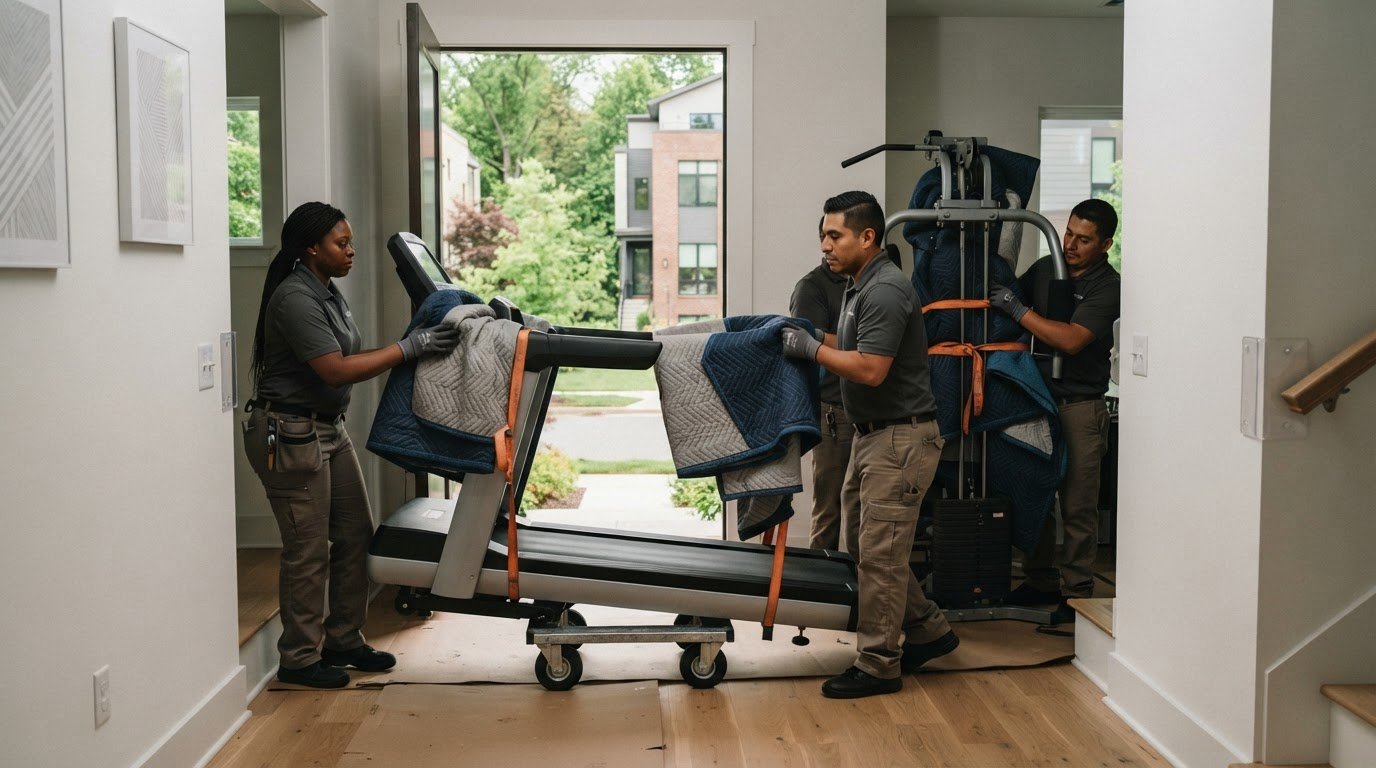
Experienced furniture movers can help manage heavy or awkward household pieces when carrying them through a narrow stairwell feels uncertain. That’s useful for items that are hard to grip, bulky enough to restrict visibility, or challenging to turn in a confined space. Heavy Furniture Moving specializes in handling demanding residential moves involving heavy and bulky household items.
If measurements suggest a sofa won’t clear the stairs or entryway, don’t assume force is the answer. Sofa hoisting may provide another route when standard access doesn’t work and the property and item are suitable. It’s an alternative to consider, not a fit for every home.
Take the next step without guessing
Assess the route, prepare the furniture and work area, then choose an approach you can control safely. If the clearance or carry still feels uncertain, don’t solve the problem by trial and error. For navigating tight stairwells with furniture Fairfax Station residents can use experienced local moving help for heavy and bulky pieces.
Get professional furniture-moving help in Fairfax Station and take the uncertainty out of planning a difficult stair move.
Make your next move with confidence
A challenging staircase doesn’t have to leave you guessing on moving day. Turn your measurements and route notes into a clear decision before lifting begins. If the path still feels uncertain, pause and get support rather than letting time pressure decide for you. Planning ahead helps you protect your home and make the next step more manageable.
For navigating tight stairwells with furniture Fairfax Station, Heavy Furniture Moving provides help with bulky household items and can use sofa hoisting as an alternate route when appropriate. The company is veteran-family owned and operated, with specialized handling for heavy furniture. Share what you’re moving and what makes the route difficult.
Discuss your Fairfax Station furniture move and take the uncertainty out of your next step. With a thoughtful plan and the right help, you can move forward with greater confidence.
Frequently Asked Questions
Can I remove a stair handrail or door to make furniture fit?
You may be able to remove a door if it’s designed to come off safely, but don’t remove a handrail just to gain space without considering how it affects stair safety. A door can also be heavier or less manageable than expected once detached. Check how it’s secured and where it can be placed out of the way. If removing a fixed feature seems necessary, pause and get experienced help rather than risking damage or an unsafe stairway.
Is a furniture slider safe to use on stairs?
Don’t assume a furniture slider is safe on stairs. Sliders intended for flat floors can reduce friction, making a heavy item harder to stop or control on an incline. Even if a product appears to fit beneath furniture, that doesn’t mean it’s designed for stair use. Check its instructions, and don’t improvise with household items. If the furniture can’t be carried safely without relying on a slider, choose another plan.
What should I do if furniture gets stuck halfway through a stairwell?
Stop moving and don’t yank, twist, or push harder. If the item is stable and everyone can keep clear, pause and reassess how it’s caught without changing anyone’s footing or grip. Keep other people away from the stairs. If it’s slipping, blocking the route, or too heavy to control, don’t try to free it alone. Get experienced help before attempting another move.
Should I take furniture apart before moving it upstairs?
Only take furniture apart if the manufacturer allows it and you can identify how the parts reconnect. For example, removing approved table legs may make a piece easier to handle, while dismantling a cabinet’s fixed frame could weaken it. Keep screws and small parts together, and protect finished edges during handling. If you’re unsure whether a component is removable, leave it in place and consider another moving approach.
Can a heavy couch be carried over a staircase banister?
Don’t carry a couch over a banister. The railing isn’t a safe support for the furniture or the people handling it, and a couch can shift suddenly as it clears the stairs. That creates a serious fall and damage risk. If the stair route won’t work, stop and consider a different access route. For navigating tight stairwells with furniture Fairfax Station residents can also use experienced moving help or sofa hoisting when appropriate.
Can professional movers help with one piece of furniture in Fairfax Station?
Yes. Heavy Furniture Moving provides residential moving help for individual heavy or bulky household items, including furniture that’s difficult to manage through a stairwell. Share what the piece is, where it needs to go, and any access details that could affect the move. The company serves Fairfax Station and nearby communities including Fairfax, Woodbridge, Manassas, Manassas Park, Aldie, Ashburn, Mclean, Vienna, Reston, Centreville, Chantilly, Clifton, Dumfries, South Riding, Haymarket, and Gainesville.
Frequently Asked Questions
Narrow passages leave less room to grip and reposition furniture. Low ceilings can block a tall item when it’s tilted, while a sharp turn may require more room than the landing provides. Protruding handrails, light fixtures, door frames, and trim can narrow the path further. A landing isn’t automatically a useful turning space if its shape or surrounding walls restrict movement. The furniture’s shape matters, too. A long sofa, a deep armchair, or a cabinet with fixed legs may be hard to angle around a corner, even if its narrowest side seems to fit. Stair layouts vary from one Fairfax Station home to another, so assess the specific item and staircase rather than relying on a general estimate.
You may be able to remove a door if it’s designed to come off safely, but don’t remove a handrail just to gain space without considering how it affects stair safety. A door can also be heavier or less manageable than expected once detached. Check how it’s secured and where it can be placed out of the way. If removing a fixed feature seems necessary, pause and get experienced help rather than risking damage or an unsafe stairway.
Don’t assume a furniture slider is safe on stairs. Sliders intended for flat floors can reduce friction, making a heavy item harder to stop or control on an incline. Even if a product appears to fit beneath furniture, that doesn’t mean it’s designed for stair use. Check its instructions, and don’t improvise with household items. If the furniture can’t be carried safely without relying on a slider, choose another plan.
Stop moving and don’t yank, twist, or push harder. If the item is stable and everyone can keep clear, pause and reassess how it’s caught without changing anyone’s footing or grip. Keep other people away from the stairs. If it’s slipping, blocking the route, or too heavy to control, don’t try to free it alone. Get experienced help before attempting another move.
Only take furniture apart if the manufacturer allows it and you can identify how the parts reconnect. For example, removing approved table legs may make a piece easier to handle, while dismantling a cabinet’s fixed frame could weaken it. Keep screws and small parts together, and protect finished edges during handling. If you’re unsure whether a component is removable, leave it in place and consider another moving approach.
Don’t carry a couch over a banister. The railing isn’t a safe support for the furniture or the people handling it, and a couch can shift suddenly as it clears the stairs. That creates a serious fall and damage risk. If the stair route won’t work, stop and consider a different access route. For navigating tight stairwells with furniture Fairfax Station residents can also use experienced moving help or sofa hoisting when appropriate.
Yes. Heavy Furniture Moving provides residential moving help for individual heavy or bulky household items, including furniture that’s difficult to manage through a stairwell. Share what the piece is, where it needs to go, and any access details that could affect the move. The company serves Fairfax Station and nearby communities including Fairfax, Woodbridge, Manassas, Manassas Park, Aldie, Ashburn, Mclean, Vienna, Reston, Centreville, Chantilly, Clifton, Dumfries, South Riding, Haymarket, and Gainesville.